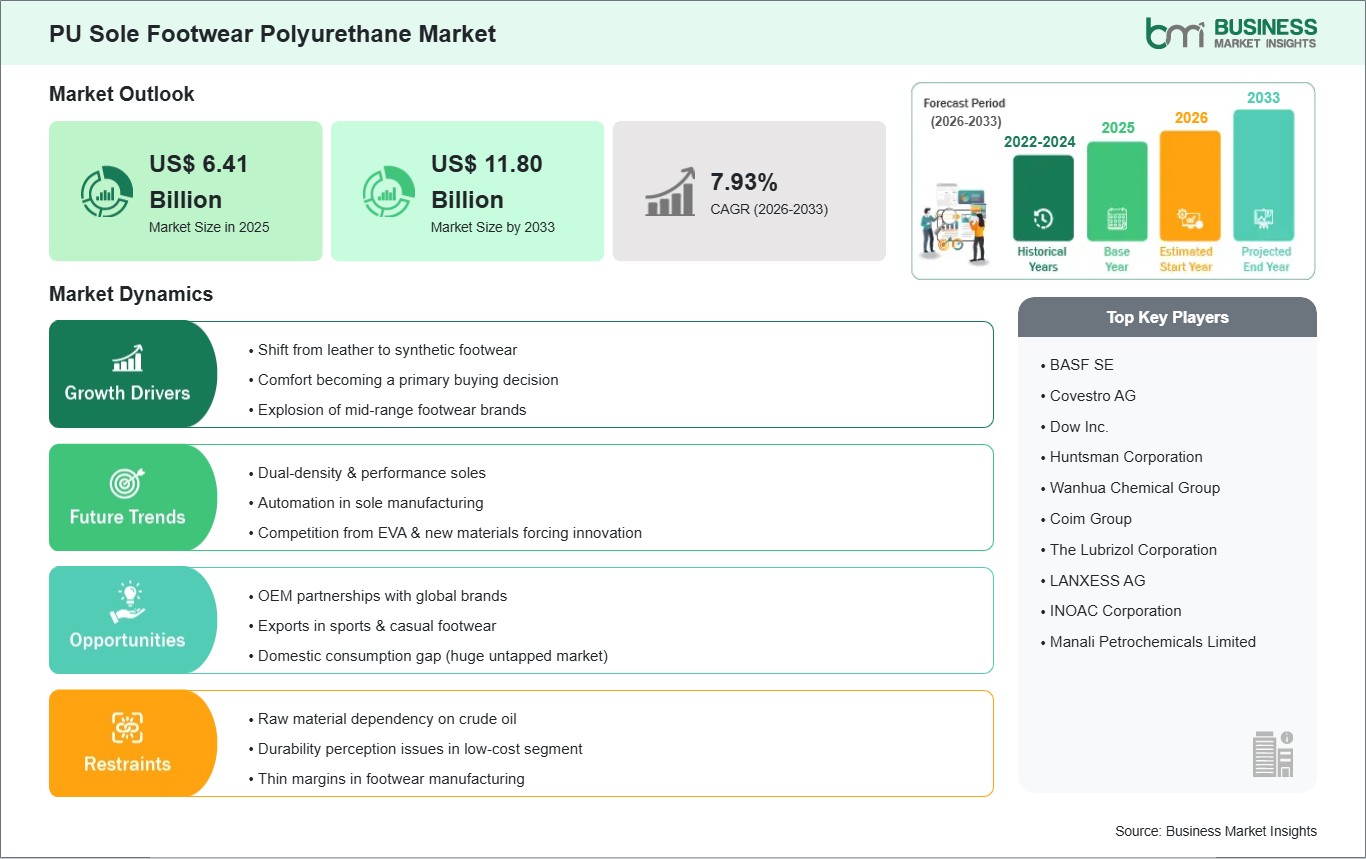
The PU Sole Footwear Polyurethane Market size is expected to reach US$ 11.8 billion by 2033 from US$ 6.41 billion in 2025. The market is estimated to record a CAGR of 7.93% from 2026 to 2033.
The global PU (polyurethane) sole footwear market is witnessing strong momentum as manufacturers and consumers increasingly prioritize comfort, durability, and lightweight performance in footwear design. Polyurethane soles are widely favored for their superior cushioning, flexibility, abrasion resistance, and long service life compared to traditional rubber or PVC alternatives. This makes them highly suitable across diverse footwear categories, including sports shoes, casual wear, formal footwear, and industrial safety boots. The market is being driven by changing consumer lifestyles, rising health awareness, and growing demand for ergonomically designed footwear that supports prolonged usage.
Additionally, the expansion of e-commerce and global fashion trends is accelerating product innovation and customization, encouraging footwear brands to adopt PU soles for enhanced product differentiation. Another key growth factor is the increasing demand for safety footwear in industrial sectors such as construction, manufacturing, and oil & gas, where PU soles provide slip resistance and shock absorption. However, the market faces certain restraints, including fluctuating raw material prices linked to petrochemical derivatives and environmental concerns related to the recyclability of polyurethane materials.
Furthermore, competition from alternative materials such as EVA and thermoplastic rubber can limit adoption in cost-sensitive segments. Despite these challenges, advancements in bio-based polyurethane, improved processing technologies, and the shift toward sustainable footwear manufacturing are expected to strengthen the long-term outlook of the global PU sole footwear polyurethane market.

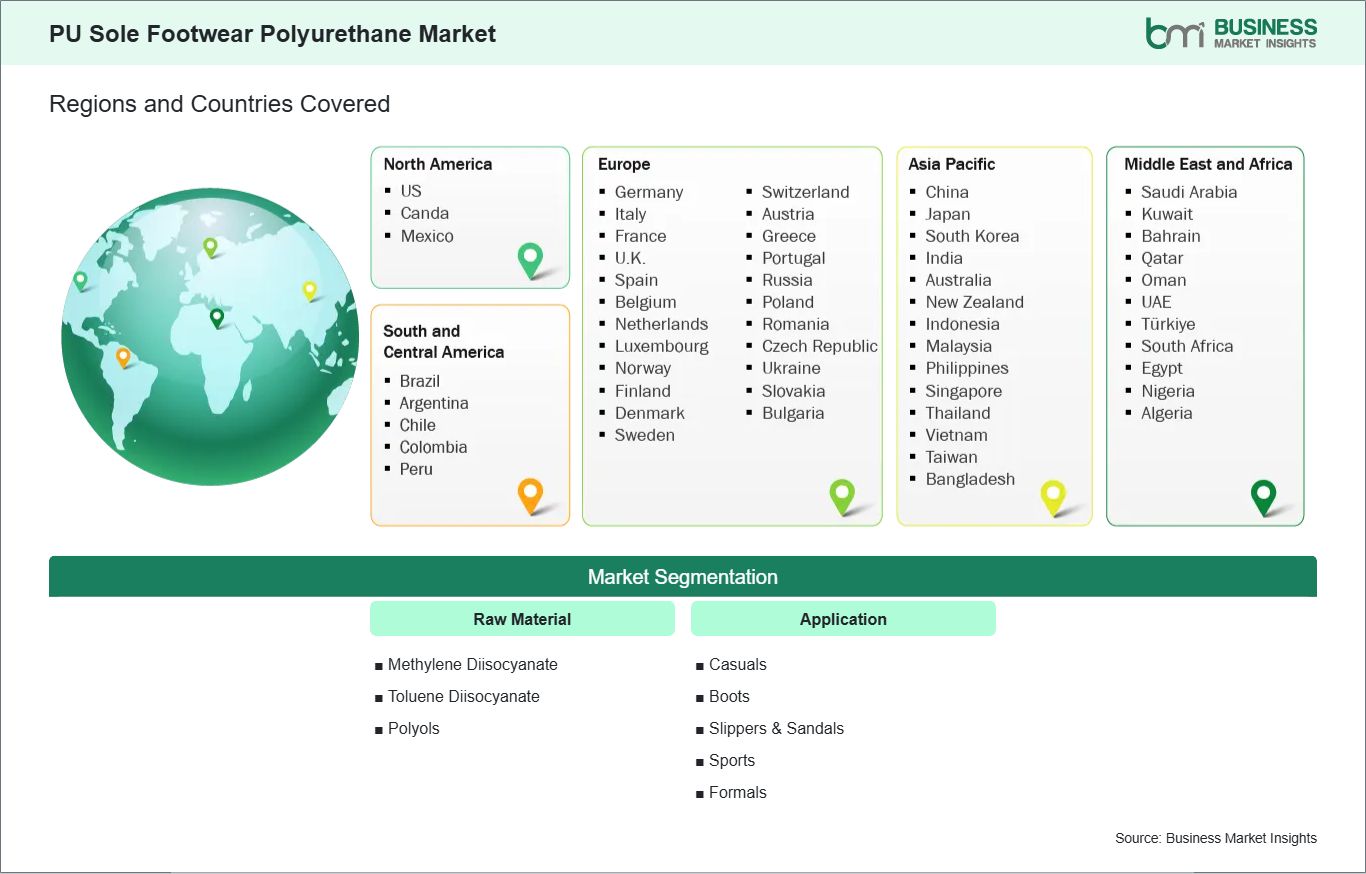
Key segments that contributed to the derivation of the PU sole footwear polyurethane market analysis are raw material and application
In terms of Western European consumers and manufacturing focus, there is a clear shift away from traditional leather products and toward synthetic materials in the region. This is particularly true in markets such as Germany, the Netherlands, and the UK, where sustainability is a major focus. In terms of soles, there is a clear shift toward PU soles made of polyurethane, as they offer a more sustainable option than traditional soles made of leather and rubber. As such, urban consumers in cities such as Berlin and Amsterdam are turning toward products such as sneakers and casual wear with PU soles, as they offer a lighter and more shock-absorbing option for consumers with active lifestyles and who require the functionality of such a sole for daily commuting.
Footwear manufacturers across Western Europe are responding to this shift by expanding their synthetic lines and reducing reliance on leather components. Italian and Spanish footwear clusters, long known for their leather craftsmanship, are now investing in advanced PU materials that offer customization of hardness, flexibility, and abrasion resistance. This has allowed brands in Milan and Madrid to develop hybrid designs that appeal to both fashion-conscious and performance-driven consumers, bridging the gap between traditional style and modern functionality. Market insiders estimate that synthetic (including PU) sole footwear production in Western Europe has grown by about 7 - 8% annually over the past three years, reflecting this structural change in material preferences.
Consumer awareness of animal welfare, coupled with tighter environmental regulations in Western European countries, has further accelerated the move away from leather. PU soles are often marketed as part of broader sustainability strategies, with companies highlighting the recyclability and lower water consumption during production compared with leather tanning. Retailers in Scandinavia and Switzerland report that synthetic‑sole models now comprise over 55% of total footwear sales in the mid‑price segment, indicating that Western European buyers are readily embracing non‑leather options. As a result, the PU footwear market is expected to continue expanding as leather alternatives become mainstream across both urban and suburban consumer bases.
The sports and casual footwear market in Western Europe, particularly in Italy, Portugal, and the UK, is becoming increasingly export-oriented, in which PU sole technologies are a significant contributor to international competitiveness. Portuguese footwear producers have utilized advanced PU injection and compression molding technologies to develop lightweight and high-performance soles that satisfy comfort and durability demands. These exports have met a very good market in North America and East Asia, where there is a strong market for European-designed casual and sports footwear. Industry sources indicate that Portuguese PU sole footwear exports are increasing annually over the last few seasons, particularly due to expanding market outlets and trade agreements that facilitate easier market access.
However, the country remains a significant exporter of designer and premium casual footwear with PU soles. Brands based in Milan remain prominent in major international fashion events, and the range of PU-based casual footwear is particularly in demand in the Middle East and Asian countries. In the case of French manufacturers, they are exploring export opportunities in North Africa and South America, where the market for casual and athleisure footwear is expanding rapidly. This is because the flexibility of the materials enables the manufacturers to offer different products according to the demands of the region.
The sports footwear exports from Western Europe are further boosted by the partnership between regional producers and global sports brands. Through the engineering expertise of German producers in PU sole technology, it has been possible to introduce innovations in sports footwear, including multi-density soles that offer improved energy return, thus meeting the demands of sportsmen and sports enthusiasts worldwide. Export data from German clusters indicate a rise in PU sole integrated sports footwear exports to Southeast Asia and Latin America, where a growing middle-class population is increasingly adopting a healthy lifestyle. As trade facilitation improves and Western European producers develop their global distribution network, the PU sole's role in boosting sports footwear exports is likely to gain momentum, thus positioning Western Europe as a notable exporter in the global market for footwear materials.

The global PU sole footwear polyurethane market is experiencing steady growth, with market size and share analysis reflecting evolving treatment preferences and competitive dynamics among key players. The report evaluates important subsegments categorized within raw material and application highlighting their respective contributions to overall market performance.
By raw material, the toluene diisocyanate subsegment dominated the market in 2025 because it offers better elasticity, abrasion resistance, and comfort compared to MDI and other alternatives. Footwear manufacturers prefer TDI-based PU for mass-market and casual shoes, where comfort and flexibility are key selling points. MDI is more suited for rigid applications, so TDI dominates in PU soles.
By application, the casual subsegment dominated the market in 2025 because casual shoes have high global demand, are produced in large quantities, and rely on PU soles for lightweight, durable, and comfortable wear.
| Report Attribute | Details |
|---|---|
| Market size in 2025 | US$ 6.41 Billion |
| Market Size by 2033 | US$ 11.80 Billion |
| Global CAGR (2026 - 2033) | 7.93% |
| Historical Data | 2022-2024 |
| Forecast period | 2026-2033 |
| Segments Covered | By Raw Material
|
|
Regions and Countries Covered
| |
| North America | US, Canada, Mexico |
| Europe | Belgium, Austria, Finland, Denmark, Greece, Poland, Romania, Russia, Ukraine, Czech Republic, Slovakia, Bulgaria, Italy, Luxembourg, Germany, Switzerland, France, Netherlands, Norway, Portugal, Spain, Sweden, United Kingdom |
| Asia-Pacific | Australia, China, India, Japan, South Korea, Indonesia, Malaysia, Philippines, Singapore, Thailand, Vietnam, Bangladesh, New Zealand, Taiwan |
| South and Central America | Brazil, Argentina, Peru, Chile, Colombia |
| Middle East and Africa | Bahrain, Kuwait, Oman, Qatar, Saudi Arabia, United Arab Emirates, Turkiye, South Africa, Egypt, Algeria, Nigeria |
| Market leaders and key company profiles |
|
The "PU Sole Footwear Polyurethane Market Size and Forecast (2022 - 2033)" report provides a detailed analysis of the market covering below areas:
The geographical scope of the PU sole footwear polyurethane market report is divided into: North America, Asia Pacific, Europe, Middle East & Africa, and South & Central America. North America held the largest share in 2025.
North America dominates the global PU sole footwear polyurethane market, driven by strong consumer demand for high-performance, comfortable, and durable footwear across both lifestyle and occupational segments. The United States plays a central role, with a well-established footwear industry that emphasizes innovation, branding, and product quality. Consumers in the region increasingly prefer footwear that combines style with functionality, leading to higher adoption of PU soles known for their lightweight structure and long-term comfort.
The growing fitness culture and demand for athleisure products are also contributing to the widespread use of polyurethane soles in sports and casual footwear. In addition to consumer-driven demand, North America has a significant requirement for industrial safety footwear, particularly in sectors such as construction, logistics, and manufacturing. PU soles are preferred in these applications due to their durability, chemical resistance, and shock-absorbing properties, which enhance worker safety and productivity. The region also benefits from advanced manufacturing capabilities and ongoing R&D efforts focused on improving material performance and sustainability.
However, challenges such as rising production costs, environmental concerns related to synthetic materials, and competition from alternative sole technologies persist. Despite this, North America continues to lead the market by setting trends in design innovation, performance standards, and the adoption of next-generation polyurethane materials in footwear applications.

The PU sole footwear polyurethane market is evaluated by gathering qualitative and quantitative data post primary and secondary research, which includes important corporate publications, association data, and databases. A few of the key developments in the PU sole footwear polyurethane market are:
The PU Sole Footwear Polyurethane Market is valued at US$ 6.41 Billion in 2025, it is projected to reach US$ 11.80 Billion by 2033.
As per our report PU Sole Footwear Polyurethane Market, the market size is valued at US$ 6.41 Billion in 2025, projecting it to reach US$ 11.80 Billion by 2033. This translates to a CAGR of approximately 7.93% during the forecast period.
The PU Sole Footwear Polyurethane Market report typically cover these key segments-
The historic period, base year, and forecast period can vary slightly depending on the specific market research report. However, for the PU Sole Footwear Polyurethane Market report:
The PU Sole Footwear Polyurethane Market is populated by several key players, each contributing to its growth and innovation. Some of the major players include:
The PU Sole Footwear Polyurethane Market report is valuable for diverse stakeholders, including:
Essentially, anyone involved in or considering involvement in the PU Sole Footwear Polyurethane Market value chain can benefit from the information contained in a comprehensive market report.
Please tell us your area of interest
(Market Segments/ Regions and Countries/ Companies)