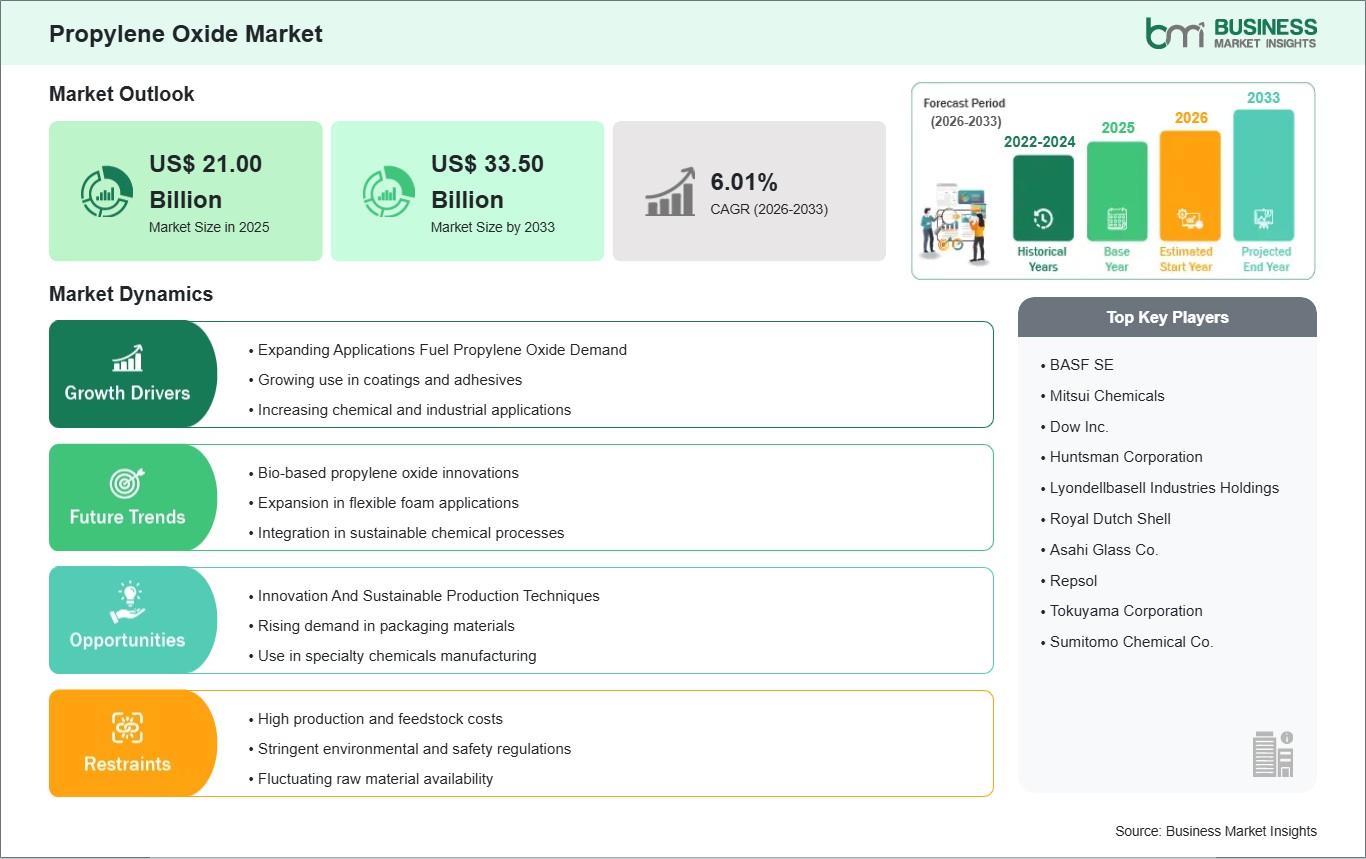
The Propylene Oxide Market size is expected to reach US$ 33.5 billion by 2033 from US$ 21. billion in 2025. The market is estimated to record a CAGR of 6.01% from 2026 to 2033.
The propylene oxide market is expanding as demand for key downstream derivatives strengthens across multiple industrial sectors. Propylene oxide (PO) is a crucial intermediate in the manufacture of polyether polyols, propylene glycols, and glycol ethers, which feed into applications such as flexible and rigid polyurethane foams, coatings, adhesives, sealants, elastomers (CASE), and automotive components. Growth in construction, automotive, and durable goods sectors is driving robust uptake of PU foams and specialty chemicals derived from PO, supported by rising global infrastructure investment and consumer spending on discretionary goods.
The shift toward lightweight, high‑performance polymers in automotive and transport industries aimed at improving fuel efficiency and reducing emissions has become a significant demand driver for PO‑based polyols. In parallel, expanding personal care and pharmaceutical formulation markets bolster the requirement for propylene glycol derivatives, reinforcing the value chain for propylene oxide. Competitive dynamics in the market feature integrated petrochemical producers alongside specialized intermediates manufacturers that leverage economies of scale, feedstock integration, and logistics optimization to secure cost advantages. Feedstock volatility, particularly in propylene and crude oil pricing, significantly influences production margins and pricing strategies, compelling manufacturers to adopt hedging contracts and vertical integration to mitigate risk. Environmental and safety regulations also impact operational costs and process technologies, with firms investing in process intensification and energy‑efficient reactor systems to reduce emissions and utility usage.
Furthermore, innovation in catalyst systems and process design is enhancing conversion efficiency and product selectivity, strengthening competitive positioning. Although alternative chemistries and bio‑based feedstock exploration present long‑term disruption potential, the entrenched role of PO in established industrial applications provides a resilient market foundation, with expectations for steady growth aligned with broader industrial expansion and polymer demand trends.

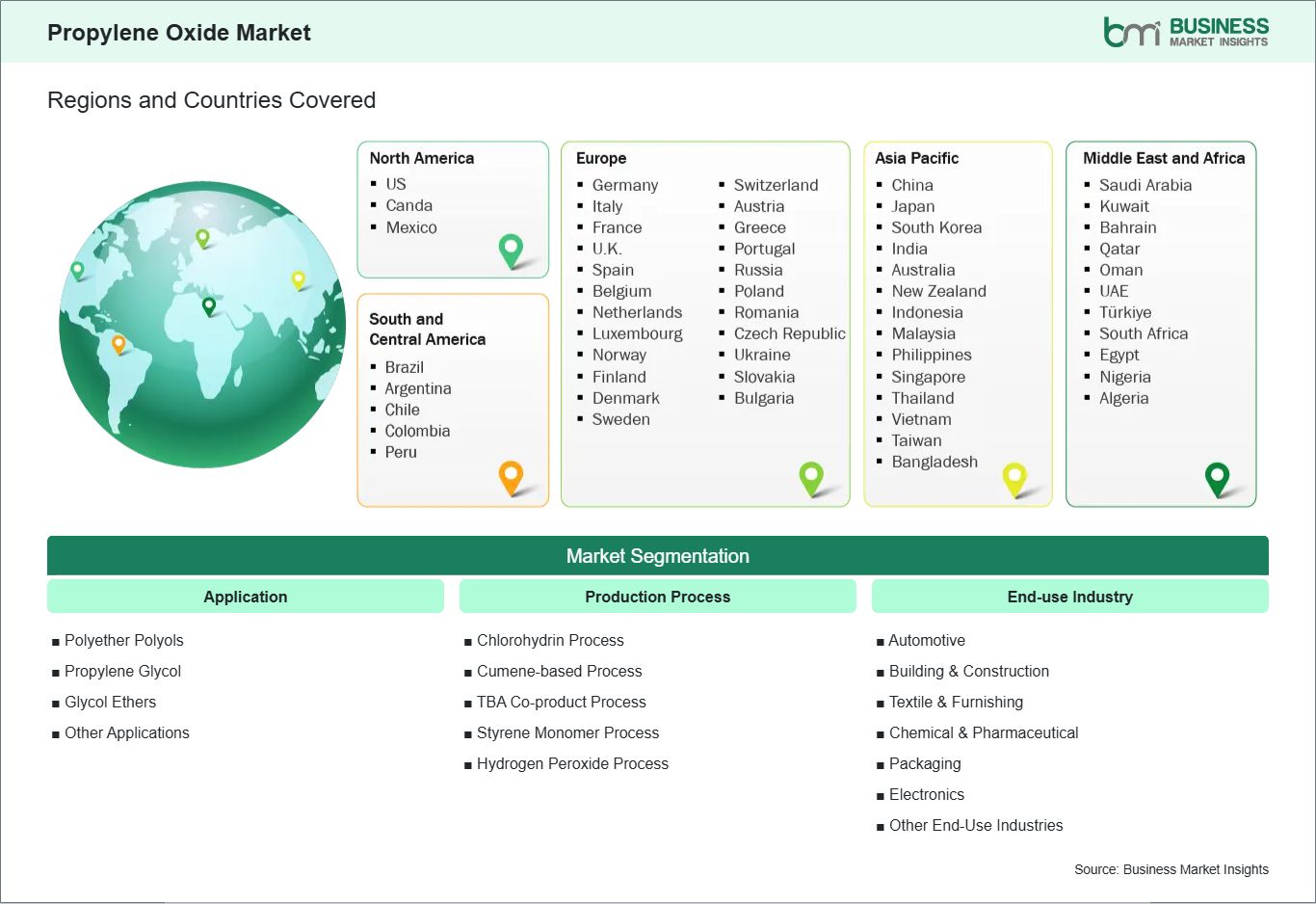
Key segments that contributed to the derivation of the propylene oxide market analysis are application, production process, and end‑use industry.
By Application, the propylene oxide market is segmented into polyether polyols, propylene glycol, glycol ethers, and other applications. The polyether polyols segment dominated the market in 2025.
Based on Production Process, the propylene oxide market is classified into chlorohydrin process, cumene‑based process, TBA co‑product process, styrene monomer process, and hydrogen peroxide process. The chlorohydrin process segment dominated the market in 2025.
On the Basis of End‑use Industry, the propylene oxide market is segmented into automotive, building & construction, textile & furnishing, chemical & pharmaceutical, packaging, electronics, and other end‑use industries. The automotive segment dominated the market in 2025.
The global propylene oxide market is witnessing consistent growth, mainly because of its widespread uses. Propylene oxide is an intermediate chemical used in the production of polyurethane, glycols, and other specialty chemicals. The chemical is versatile in its uses, chemically stable, and highly reactive. Therefore, it is used in several chemical reactions. The efficiency of propylene oxide in chemical reactions is what makes it an essential chemical in modern manufacturing processes.
Propylene oxide is used in the production of polyurethane. It is used in producing polyether polyols, which are used in flexible foams, adhesives, sealants, elastomers, etc. Such products are used in furniture, automobile interiors, and insulations. Therefore, propylene oxide is used in producing materials that have high demand in today’s world. It is also used in producing propylene glycol, which is used in pharmaceuticals, cosmetics, food, beverages, etc. Therefore, propylene oxide is used in producing materials that have high demand in today’s world.
Industrial activities also take advantage of propylene oxide’s reactivity and capacity as an intermediate for other chemicals. The efficiency of propylene oxide also reduces production time and cost in industrial applications. With industries increasingly utilizing new materials and technology, propylene oxide is also in demand as an intermediate. The material’s versatility and importance in generating other valuable chemicals will always be in demand. With its applications in construction and other industries, propylene oxide is an important chemical in industrial growth.
Innovation and sustainability are two important aspects that affect the propylene oxide industry. Companies in the industry are working towards developing better production technologies that minimize negative effects on the environment. The innovations in the production of propylene oxide have been in the development of energy-efficient production technologies, waste reduction technologies, and the adoption of green feedstocks. The adoption of sustainable production technologies helps companies comply with regulations and produce high-quality products for various industrial applications.
Propylene oxide specialty derivatives are widely used in the production of advanced industrial materials. The materials produced with these derivatives are used in the production of advanced materials such as high-performance coatings, adhesives, and elastomers. The materials produced with these derivatives are flexible and can be used in various industrial applications. The flexibility of the materials produced with these derivatives helps companies customize the materials to meet the needs of various applications.
The growth of end-use industries, such as automotive, construction, packaging, and electronics, fuels the demand for propylene oxide and its derivatives. Organizations are focusing on R&D to produce a safe and sustainable manufacturing process and increase the scope of high-end products. The combination of versatility, chemical efficiency, and sustainability makes propylene oxide a vital intermediate for today's industry. The continuous drive for innovation and sustainable manufacturing processes will help sustain a high rate of global demand for this compound in a number of industries.
The propylene oxide market demonstrates steady growth, with size and share analysis highlighting evolving trends and competitive dynamics among key players. The report examines subsegments categorized within application, production process, and end‑use industry, offering insights into their contribution to overall market performance.
By Application, the polyether polyols subsegment dominated the market in 2025, driven by its extensive use in flexible and rigid polyurethane foams.
Based on Production Process, the chlorohydrin process subsegment dominated the market in 2025, owing to its established industrial adoption and cost efficiency.
On the Basis of End‑use Industry, the automotive subsegment dominated the market in 2025, propelled by the growing demand for lightweight and high-performance materials in vehicle manufacturing.
| Report Attribute | Details |
|---|---|
| Market size in 2025 | US$ 21.00 Billion |
| Market Size by 2033 | US$ 33.50 Billion |
| Global CAGR (2026 - 2033) | 6.01% |
| Historical Data | 2022-2024 |
| Forecast period | 2026-2033 |
| Segments Covered | By Application
|
|
Regions and Countries Covered
| |
| North America | US, Canada, Mexico |
| Europe | Belgium, Austria, Finland, Denmark, Greece, Poland, Romania, Russia, Ukraine, Czech Republic, Slovakia, Bulgaria, Italy, Luxembourg, Germany, Switzerland, France, Netherlands, Norway, Portugal, Spain, Sweden, United Kingdom |
| Asia-Pacific | Australia, China, India, Japan, South Korea, Indonesia, Malaysia, Philippines, Singapore, Thailand, Vietnam, Bangladesh, New Zealand, Taiwan |
| South and Central America | Brazil, Argentina, Peru, Chile, Colombia |
| Middle East and Africa | Bahrain, Kuwait, Oman, Qatar, Saudi Arabia, United Arab Emirates, Turkiye, South Africa, Egypt, Algeria, Nigeria |
| Market leaders and key company profiles |
|
The "Propylene Oxide Market Size and Forecast (2022 - 2033)" report provides a detailed analysis of the market covering below areas:
The geographical scope of the Propylene Oxide Market report is divided into North America, Asia Pacific, Europe, Middle East & Africa, and South & Central America. North America held the largest share in 2025.
Regional‑level dynamics in the propylene oxide market reflect varied industrial priorities, regulatory environments, and end‑use demand drivers. In North America, the market holds a strong position, supported by mature petrochemical infrastructure, integrated feedstock availability, and significant production capacities. The United States and Canada benefit from established downstream industries such as automotive, construction, and chemicals manufacturing, driving consistent PO consumption. Technological investments and robust logistics networks further reinforce the region’s competitive edge.
Europe exhibits steady demand, led by Germany, France, and Italy, where stringent environmental standards and emissions regulations influence production technologies and product portfolios. The CASE (coatings, adhesives, sealants, elastomers) and automotive sectors are key contributors to regional PO demand, while sustainability mandates drive investments in eco‑efficient processing and lower‑emission chemistries.
The Asia Pacific region represents the fastest‑growing market, with China, India, South Korea, and Japan leading expansion. Rapid industrialization, urbanization, and increasing consumer spending drive demand for polyurethane foams, automotive components, and performance chemicals derived from PO. Local investments in capacity expansion and the growth of downstream industries reinforce long‑term regional momentum.
In the Middle East & Africa, demand is emerging from petrochemical diversification strategies and infrastructure development, although growth is moderated by varying levels of industrialization across countries. Saudi Arabia, UAE, and South Africa are focal markets, with strategic investments in chemical complexes and export‑oriented production enhancing regional relevance.
South & Central America, particularly Brazil and Mexico, displays moderate growth driven by construction, automotive, and industrial chemicals, with currency volatility and regulatory adjustments influencing procurement strategies. These regional dynamics illustrate a mix of mature, high‑demand markets and rapidly developing regions that collectively shape the global propylene oxide landscape.

The Propylene Oxide Market is evaluated by gathering qualitative and quantitative data post primary and secondary research, which includes important corporate publications, association data, and databases. A few of the key developments in the propylene oxide market are:
The Propylene Oxide Market is valued at US$ 21.00 Billion in 2025, it is projected to reach US$ 33.50 Billion by 2033.
As per our report Propylene Oxide Market, the market size is valued at US$ 21.00 Billion in 2025, projecting it to reach US$ 33.50 Billion by 2033. This translates to a CAGR of approximately 6.01% during the forecast period.
The Propylene Oxide Market report typically cover these key segments-
The historic period, base year, and forecast period can vary slightly depending on the specific market research report. However, for the Propylene Oxide Market report:
The Propylene Oxide Market is populated by several key players, each contributing to its growth and innovation. Some of the major players include:
The Propylene Oxide Market report is valuable for diverse stakeholders, including:
Essentially, anyone involved in or considering involvement in the Propylene Oxide Market value chain can benefit from the information contained in a comprehensive market report.
Please tell us your area of interest
(Market Segments/ Regions and Countries/ Companies)