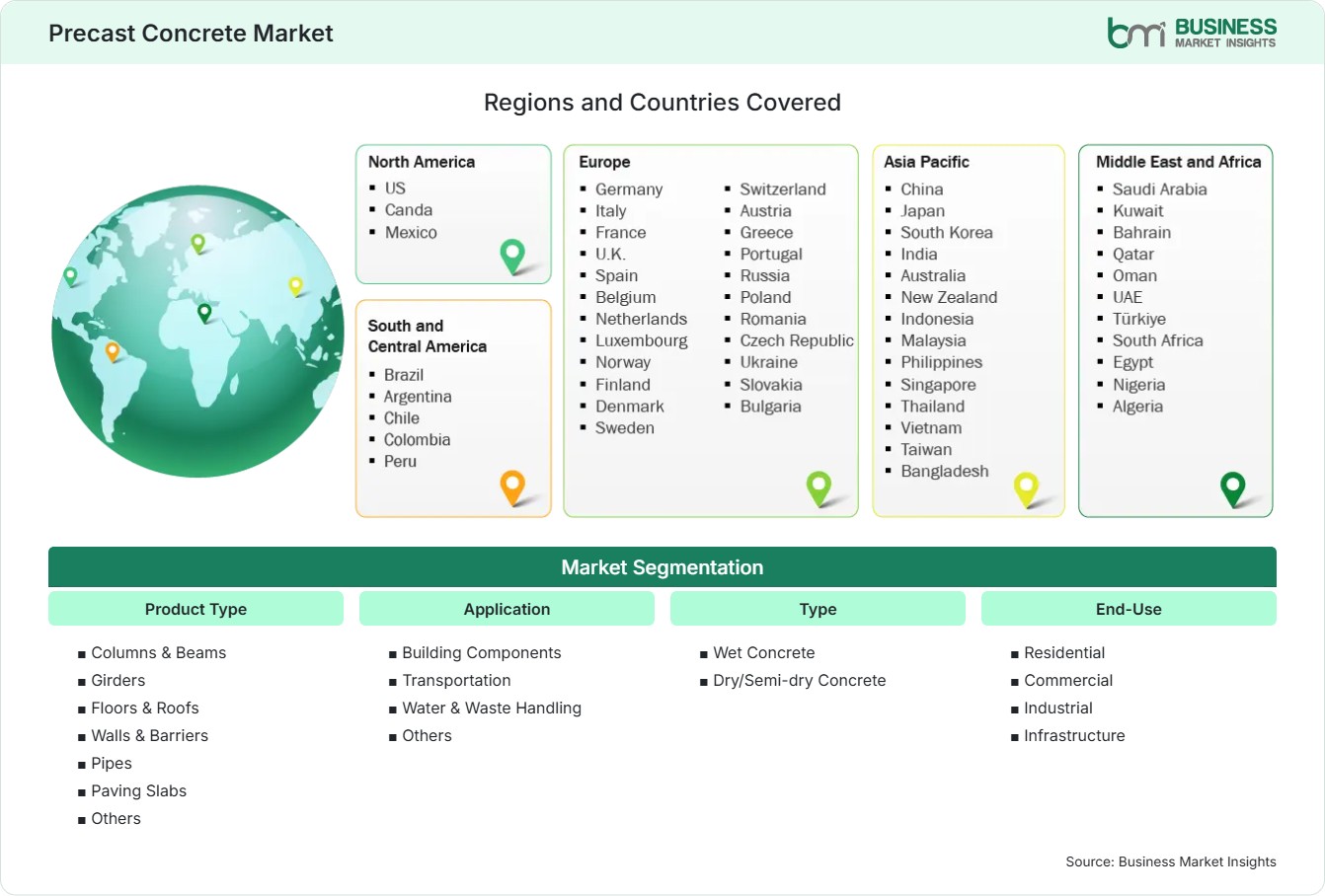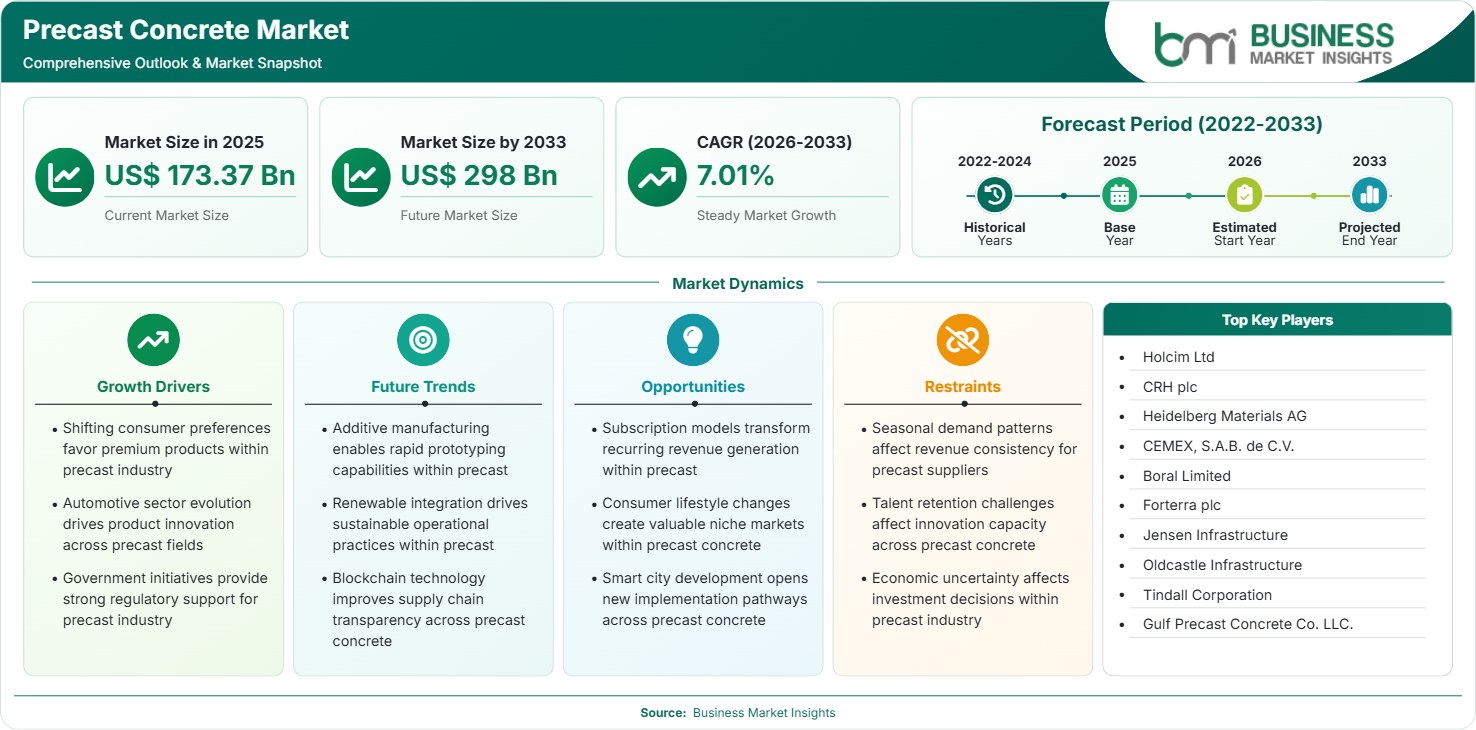
Precast Concrete Market Regional Highlights
North America Precast Concrete Market
North America represented 24%–27% of global demand in 2025 and is expected to grow at 6.2%–6.8% through 2033. The region benefits from infrastructure rehabilitation, logistics development, data-center investments, and strong public spending. Precast Concrete Market share remains supported by demand for bridges, utility infrastructure, and commercial projects. Increasing labor shortages are encouraging factory-manufactured components, improving schedule certainty and project quality.
- Transportation modernization programs support demand for bridge girders, retaining walls, tunnel segments, and highway barriers.
- Data-center development generates significant consumption of structural systems and utility-support components.
- Labor productivity concerns continue encouraging offsite manufacturing adoption.
- Sustainability requirements support investment in recycled materials and lower-carbon production technologies.
US Precast Concrete Market
The United States accounts for 78%–82% of North American demand and is expected to expand at 6.4%–7.0% CAGR. Federal infrastructure spending, manufacturing reshoring investments, and increasing warehouse construction support market development. Large-scale transportation projects and utility modernization initiatives remain major consumption drivers.
- Bridge rehabilitation projects continue creating steady demand for engineered structural products.
- Industrial construction growth supports higher utilization of modular building systems.
- Water infrastructure upgrades increase demand for pipes, manholes, and precast utility products.
- Renewable energy developments contribute to specialized structural component requirements.
Europe Precast Concrete Market
Europe accounts for 22% to 25% of the market and is projected to see a 5.8% to 6.4% CAGR in the coming years. Sustainability policies, energy-efficient construction standards, and modernization of transport infrastructure ensure growth in market demand. Germany dominates the market, whereas Eastern European countries are expanding faster due to infrastructure investment and industrial growth.
- Green-building targets encourage resource-efficient construction methods.
- Germany leads regional consumption through commercial and infrastructure development.
- Poland and Romania exhibit stronger growth trajectories supported by transportation investments.
- Prefabricated housing initiatives support structural element demand.
- Carbon-reduction policies influence manufacturing innovation.
Asia Pacific Precast Concrete Market
Asia Pacific holds the largest Precast Concrete Market share, estimated at 39%–42% in 2025, and is forecast to grow at 8.0%–8.6% CAGR. China remains the dominant consumer while India represents the fastest-growing major market. Urbanization, industrialization, rail expansion, and housing construction continue supporting regional demand.
- China leads consumption across residential and infrastructure sectors.
- India records the fastest regional expansion due to smart-city and housing programs.
- Southeast Asian nations increasingly adopt prefabricated construction techniques.
- Metro rail and airport projects stimulate demand for engineered components.
- Industrial park development contributes additional growth opportunities.
Rest of World Precast Concrete Market
Rest of World accounts for 11%–14% share and is projected to expand at 7.2%–7.8% CAGR. Gulf countries benefit from mega-project development and urban infrastructure investments. South and Central American growth remains tied to transportation networks and public infrastructure modernization.
- Saudi Arabia leads Middle Eastern demand through large-scale infrastructure programs.
- UAE supports adoption through commercial construction and logistics growth.
- Brazil remains the largest South American market.
- Chile demonstrates attractive growth linked to infrastructure investments.
- Water and utility projects continue supporting regional demand.