Market Summary
Executive Summary and Global Market Analysis
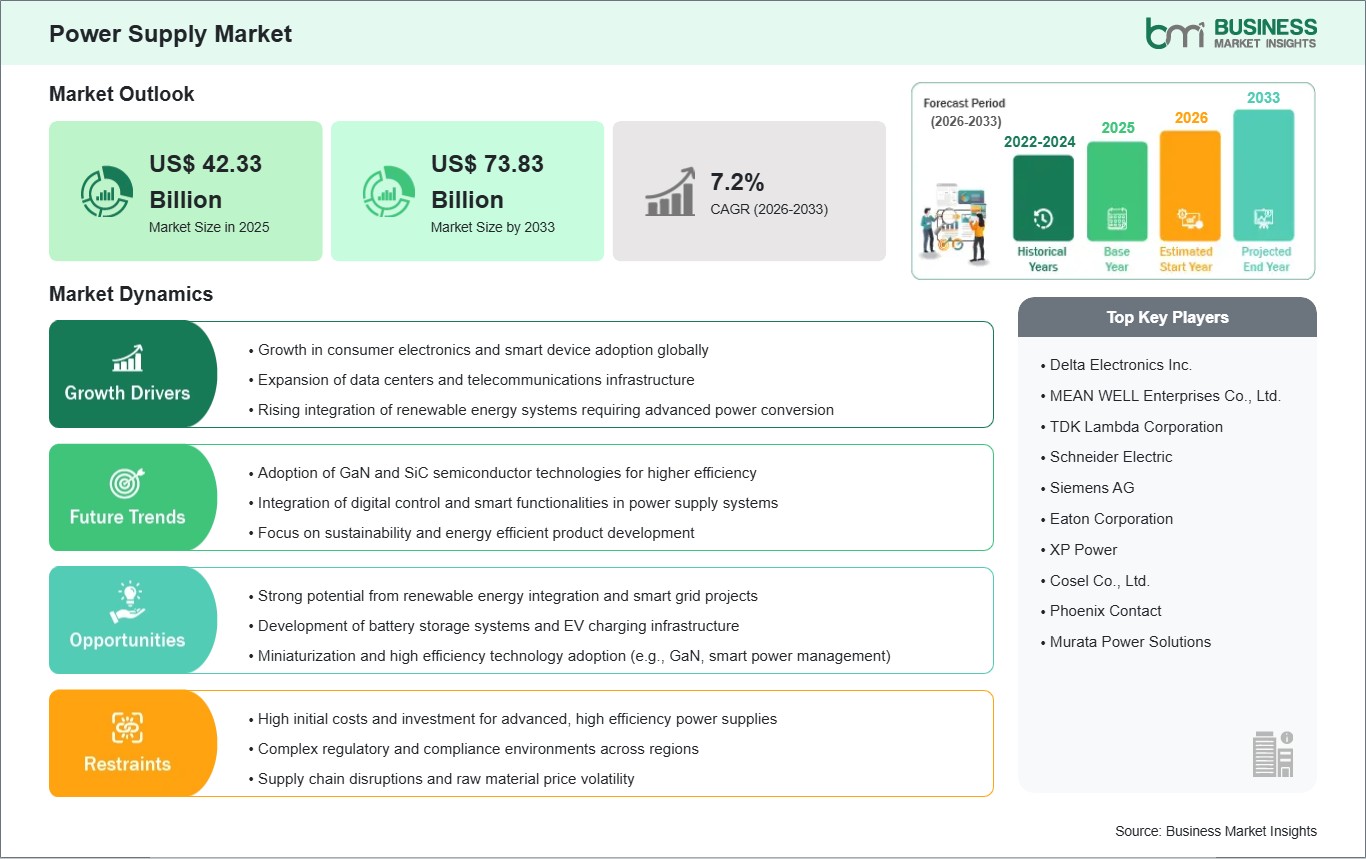
Power supply systems refer to the essential electrical components designed to convert and regulate primary energy into the specific voltage and current required by various electronic devices and industrial machinery. These systems, ranging from AC-DC and DC-DC converters to uninterruptible power supplies (UPS), are fundamental to the operational integrity of the telecommunications, aerospace, manufacturing, and data center sectors. Market expansion is being propelled by the rapid transition toward industrial automation and the Internet of Things (IoT), which necessitates reliable and stable energy delivery for intelligent control systems. Furthermore, the global surge in electric vehicle adoption and the expansion of hyperscale data center infrastructure are driving a substantial requirement for high-density, high-efficiency power conversion technologies.
However, several factors may restrain market progression. The high capital intensity associated with the initial deployment of advanced, digitally configurable power solutions remains a barrier for many small and medium-sized enterprises. The industry also faces technical challenges regarding the rising requirement for sophisticated thermal management and electromagnetic interference mitigation as devices become more compact and power-dense. Additionally, volatility in the global supply chain for critical semiconductors, such as silicon carbide (SiC) and gallium nitride (GaN), can impact manufacturing costs and product availability. Stringent regional regulatory frameworks and the increasing complexity of safety certifications further increase the total cost of ownership and engineering timelines for manufacturers.
Despite these hurdles, the market outlook remains favorable. Opportunities are emerging through the adoption of wide-bandgap semiconductors, which enable the development of ultra-compact units with significantly reduced energy losses and improved reliability. The expansion of smart grid initiatives and the integration of renewable energy sources are gaining traction, creating demand for sophisticated power conditioning and bidirectional conversion systems. Furthermore, the growth of Industry 4.0 aligns with institutional mandates for energy-efficient manufacturing and predictive maintenance through integrated digital monitoring. Collectively, these innovations position the power supply industry for sustained long-term development and central importance in the global evolution toward a more electrified and digitally-driven economy.
Segment Analysis
Power Supply Market Segmentation
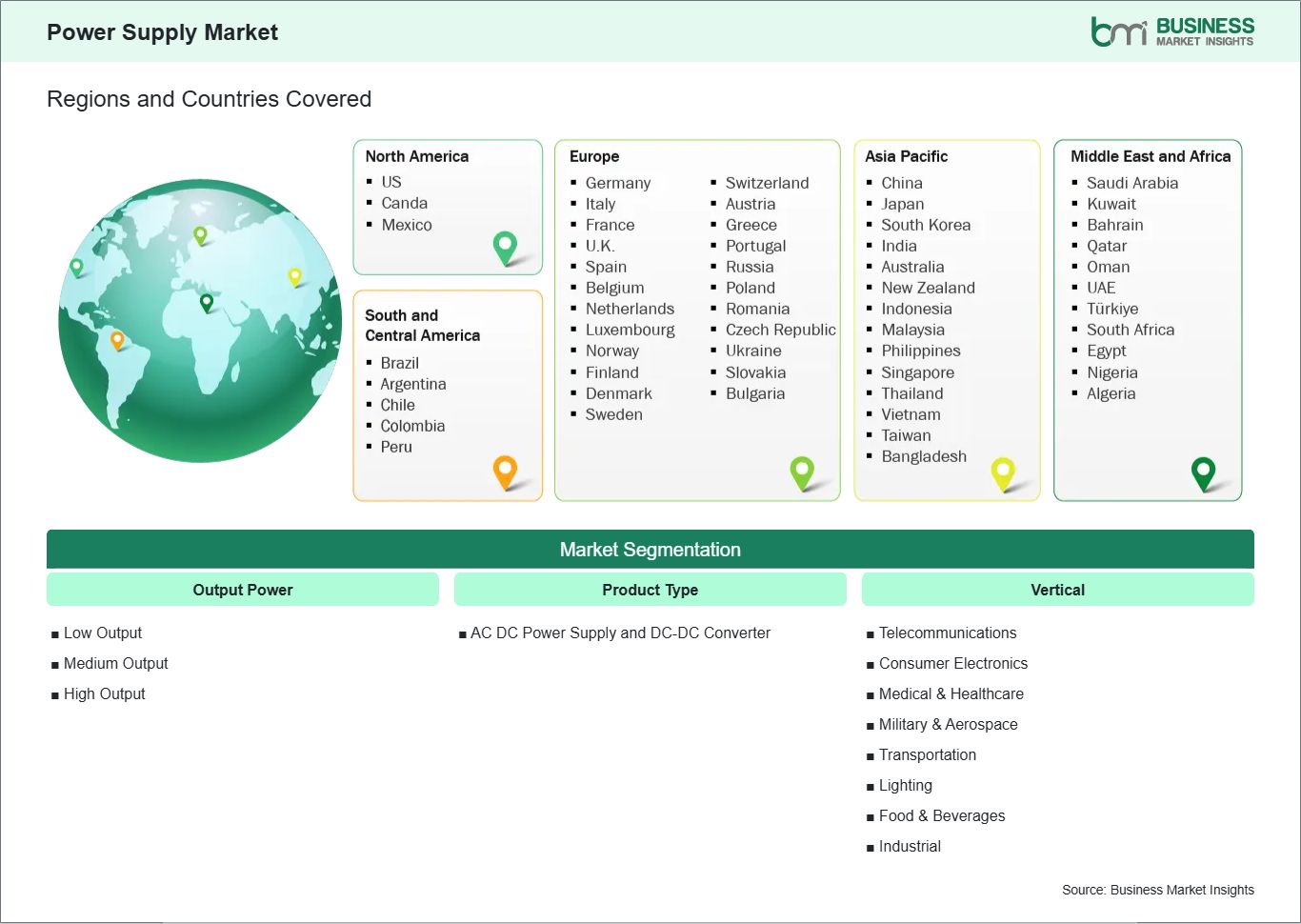
Key segments that contributed to the derivation of the Power Supply market analysis are output power, product type, and vertical.
- By Output Power, the market is segmented into Low Output, Medium Output, and High Output.
- By Product Type, the market is divided into AC‑DC Power Supply and DC-DC Converter.
- By Vertical, the market is categorized into Telecommunications, Consumer Electronics, Medical & Healthcare, Military & Aerospace, Transportation, Lighting, Food & Beverages, and Industrial.
Market Forces
Power Supply Market Drivers and Opportunities
Rising Demand for Reliable Energy and Industrial Automation
The power supply market is being driven by the growing need for reliable and efficient energy solutions across industries such as manufacturing, healthcare, IT, and telecommunications. With the rapid expansion of industrial automation, smart factories, and digital infrastructure, stable power delivery has become critical to ensure uninterrupted operations. The increasing adoption of advanced technologies such as robotics, IoT, and AI is further amplifying demand for high-performance power supplies that can support complex systems. In healthcare, medical devices and diagnostic equipment require precision power management, while in IT and telecom, data centers depend on robust power supplies to maintain uptime and scalability. Rising global energy consumption, coupled with stricter regulatory standards for efficiency and safety, is reinforcing the adoption of modern power supply units. Collectively, industrial modernization, digital transformation, and the need for reliable energy are propelling sustained growth in the global power supply market, positioning it as a cornerstone of technological and economic development.
Rising Integration of Renewable Energy and Smart Power Solutions
Opportunities in the power supply market are expanding through the integration of renewable energy sources, smart technologies, and eco-friendly innovations. As governments and enterprises prioritize sustainability, power supplies designed to integrate with solar, wind, and other renewable systems are gaining traction. Smart power solutions equipped with IoT connectivity, AI-driven analytics, and cloud platforms enable real-time monitoring, predictive maintenance, and adaptive load management, enhancing efficiency and reducing downtime. Portable and modular power supplies are also creating new pathways for adoption in sectors such as electric vehicles, consumer electronics, and off-grid applications. The growing emphasis on green energy and carbon reduction is encouraging vendors to develop eco-friendly designs with recyclable materials and higher energy efficiency ratings. Additionally, the rising demand for compact, high-capacity, and digitally enabled power supplies in emerging industries such as 5G infrastructure and smart cities is opening lucrative opportunities. The convergence of renewable integration, smart functionality, and sustainability underscores a transformative growth trajectory for the global power supply market.
Size and Share Analysis
Power Supply Market Size and Share Analysis
The Power Supply market demonstrates steady growth, with size and share analysis revealing evolving trends and competitive positioning among key players. The report examines subsegments categorized within output power, product type, and vertical, offering insights into their contribution to overall market performance.
Based on Output Power, the low output subsegment holds a strong presence in the market. These supplies are indispensable for consumer electronics and small devices, ensuring efficient energy delivery with compact designs. The Medium output subsegment is essential for industrial equipment and medical devices, balancing reliability with higher capacity needs. The high output subsegment anchors demand in heavy industries, aerospace, and transportation, where robust performance and uninterrupted energy flow are critical.
Report Coverage
Power Supply Market Report Coverage and Deliverables
The "Power Supply Market Size and Forecast (2022 - 2033)" report provides a detailed analysis of the market covering below areas:
- Market size and forecast at global, regional, and country levels for all market segments covered under the scope
- Market trends, as well as drivers, restraints, and opportunities
- Market analysis covering key trends, global and regional framework, major players, and recent developments
- Market concentration, heat map analysis, prominent players, and recent developments
- Detailed company profiles, including SWOT analysis
Geographic Insights
Power Supply Market Geographic Insights
The geographical scope of the Power Supply market report is divided into five regions: North America, Asia Pacific, Europe, Middle East & Africa, and South & Central America.
North America maintains a preeminent position within the global industry, a standing solidified by the aggressive expansion of hyperscale data centers and the rapid transition toward an electrified economy. The regional landscape is characterized by high-stakes investments in digital infrastructure, particularly in the United States, where the surge in Artificial Intelligence (AI) workloads has necessitated a fundamental redesign of power delivery architectures. This market leadership is further supported by significant federal initiatives aimed at enhancing grid resilience and reshoring semiconductor manufacturing, creating a robust domestic supply chain for high-performance power conversion technologies.
Technological progression in the United States and Canada is largely driven by a decisive shift toward Wide Bandgap (WBG) Semiconductors, specifically Gallium Nitride (GaN) and Silicon Carbide (SiC). These materials enable power supply units (PSUs) to achieve unprecedented levels of efficiency and power density, which are critical for supporting the escalating energy demands of AI-centric server racks. Furthermore, the region is witnessing an increasing utilization of Digitally Configurable and Modular Power Solutions, allowing for real-time optimization of energy flow and predictive maintenance in mission-critical environments. This focus on Intelligent Power enables North American enterprises to comply with stringent energy efficiency standards while simultaneously reducing the thermal footprint and operational costs of large-scale industrial and computing facilities.
Industry Activity
Recent Developments
The Power Supply market is evaluated by gathering qualitative and quantitative data post primary and secondary research, which includes important corporate publications, association data, and databases. A few of the key developments in the Power Supply market are:
- In December 2025, ABB completed the acquisition of the power electronics business of Gamesa Electric from Siemens Gamesa to strengthen its renewable power conversion capabilities. The acquired portfolio includes wind converters, solar inverters, and battery energy storage system technologies. This acquisition enhances ABB`s position in the growing renewable energy and power supply infrastructure market.
- In October 2025, onsemi completed the acquisition of Vcore Power Technologies and associated IP rights from Aura Semiconductor. The acquisition strengthens onsemi`s power management portfolio and supports advanced power delivery solutions for AI data centers. This development enhances the company`s capability to address the complete power supply chain from grid to core infrastructure.
Trust & Transparency
Research Methodology
The market analysis combines proprietary research with secondary data from government agencies, company disclosures, regulatory filings, industry databases and expert interviews. Market estimates are validated through data triangulation, cross-market benchmarking and analyst
review.
View Full Research Methodology
Key Sources Referred:
World Bank & Global Trade IndicatorsWorld Trade Organization (WTO)(International Monetary Fund )IMFInternational Trade Administration (ITA)Company websiteCompany annual reportsCompany investor presentations