Market Summary
Executive Summary and Global Market Analysis
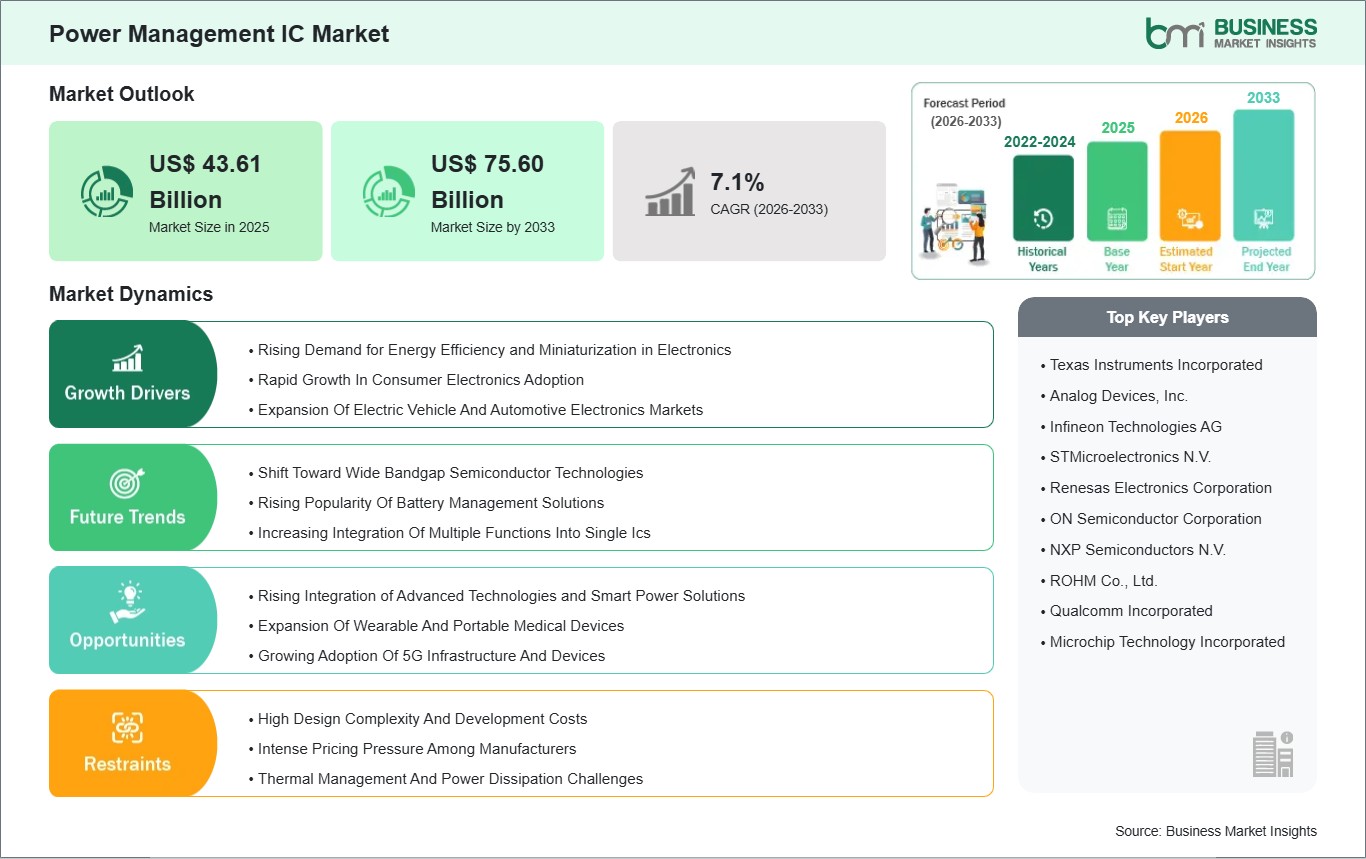
Power management integrated circuits (PMICs) refer to specialized semiconductor devices engineered to regulate and distribute electrical power within a host system. By integrating multiple functions, such as voltage scaling, battery charging, and power sequencing, onto a single chip, PMICs optimize energy efficiency and minimize the physical footprint of electronic assemblies. This technology is fundamental to the operational integrity of smartphones, electric vehicle powertrains, and high-performance data centers. Market expansion is being propelled by the rapid proliferation of battery-powered Internet of Things devices and by the rising demand for sophisticated energy management in artificial intelligence infrastructure, where precise power delivery is essential for sustaining peak computational loads.
However, several factors may restrain market progression. The high technical complexity of integrating advanced features into increasingly compact silicon footprints poses significant thermal management challenges, as excessive heat density can compromise device reliability. The industry also faces volatility in the global semiconductor supply chain, characterized by fluctuating raw material prices and geopolitical trade barriers that impact production costs. Additionally, the requirement for PMICs to withstand harsh environments, particularly in automotive and industrial applications involving extreme temperatures, necessitates lengthy and capital-intensive certification cycles. These hurdles, alongside the persistent shortage of specialized semiconductor design talent, increase operational expenditures and require strategic focus on high-yield manufacturing processes.
Despite these hurdles, the market outlook remains favorable. Opportunities are emerging through the adoption of wide-bandgap materials, such as gallium nitride and silicon carbide, which enable superior switching speeds and higher power density compared to traditional silicon. The expansion of the electric vehicle and renewable energy sectors is gaining traction, driven by global mandates for electrification. Furthermore, the growth of Industry 4.0 aligns with institutional goals for smart manufacturing, facilitating the development of intelligent PMICs equipped with real-time telemetry for predictive diagnostics. Collectively, these innovations position the industry for sustained long-term development and central importance in the transition toward energy-efficient electronics.
Segment Analysis
Power Management IC Market Segmentation
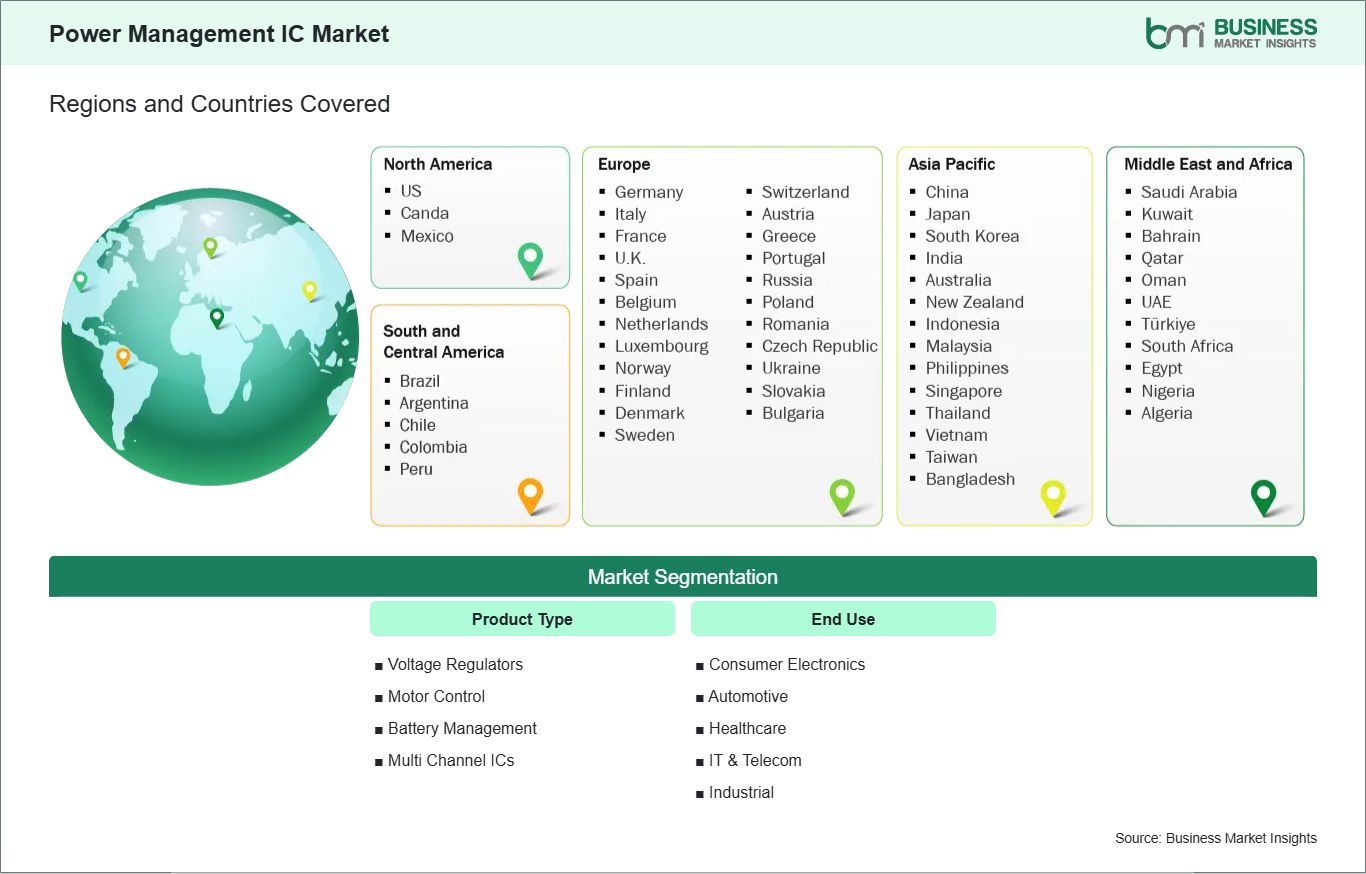
Key segments that contributed to the derivation of the Power Management IC market analysis are product type and end use.
- By Product Type, the market is segmented into Voltage Regulators, Motor Control, Battery Management, and Multi‑Channel ICs.
- By End Use, the market is divided into Consumer Electronics, Automotive, Healthcare, IT & Telecom, and Industrial.
Market Forces
Power Management IC Market Drivers and Opportunities
Rising Demand for Energy Efficiency and Miniaturization in Electronics
The power management IC (PMIC) market is being driven by the increasing demand for energy efficiency, compact design, and reliable power regulation in modern electronic devices. With the proliferation of smartphones, tablets, laptops, and wearables, PMICs have become essential for managing battery life, reducing power consumption, and ensuring stable performance. The rapid growth of IoT devices, smart home systems, and connected infrastructure is further amplifying demand, as these applications require efficient power distribution in compact form factors. Automotive electronics, particularly in electric vehicles and advanced driver assistance systems, are also fueling adoption, as PMICs enable optimized energy usage and battery management. Rising emphasis on miniaturization and multifunctional integration is pushing manufacturers to design PMICs that combine voltage regulation, battery charging, and system monitoring in a single chip. Collectively, consumer electronics growth, automotive electrification, and IoT expansion are propelling sustained growth in the global PMIC market, positioning it as a cornerstone of modern electronics design.
Rising Integration of Advanced Technologies and Smart Power Solutions
Opportunities in the power management IC market are expanding through the integration of advanced technologies such as AI‑enabled power optimization, GaN/SiC semiconductors, and smart energy solutions. Modern PMICs are being designed to support fast charging, adaptive voltage scaling, and dynamic power allocation, aligning with consumer expectations for efficiency and convenience. The adoption of GaN and SiC materials is creating new pathways for innovation, enabling higher energy density, faster switching speeds, and improved thermal performance, particularly in automotive and industrial applications. Smart PMICs with IoT connectivity are also gaining traction, offering real‑time monitoring, predictive analytics, and adaptive load management for devices ranging from smartphones to electric vehicles. Beyond technological innovation, the rising demand for renewable energy integration and sustainable electronics is encouraging vendors to develop eco‑friendly, energy‑efficient PMICs. Vendors who focus on multifunctional, compact, and digitally enabled solutions tailored for diverse applications are well‑positioned to capture growth. The convergence of advanced materials, smart functionality, and sustainability underscores a transformative trajectory for the global power management IC market.
Size and Share Analysis
Power Management IC Market Size and Share Analysis
Based on Product Type, the Voltage Regulators subsegment holds the primary market presence. These ICs are indispensable for stabilizing power supply across devices, ensuring consistent performance and protecting sensitive components. The Motor Control subsegment is essential for automotive and industrial applications, enabling efficient operation of motors with precision and reliability. The Battery Management subsegment anchors demand in consumer electronics and electric vehicles, providing critical monitoring, charging, and safety functions. The Multi‑Channel ICs subsegment is strategically deployed in complex systems, offering integrated solutions that manage multiple power rails simultaneously, enhancing efficiency and reducing design complexity.
Report Coverage
Power Management IC Market Report Coverage and Deliverables
The "Power Management IC Market Size and Forecast (2022 - 2033)" report provides a detailed analysis of the market covering below areas:
- Market size and forecast at global, regional, and country levels for all market segments covered under the scope
- Market trends, as well as drivers, restraints, and opportunities
- Market analysis covering key trends, global and regional framework, major players, and recent developments
- Market concentration, heat map analysis, prominent players, and recent developments
- Detailed company profiles, including SWOT analysis
Geographic Insights
Power Management IC Market Geographic Insights
The geographical scope of the Power Management IC market report is divided into five regions: North America, Asia Pacific, Europe, Middle East & Africa, and South & Central America.
North America maintains a preeminent position within the global industry, a standing established by the region's advanced semiconductor design capabilities and the aggressive expansion of high-performance computing infrastructure. The regional landscape is characterized by a high density of leading integrated circuit (IC) architects and a robust ecosystem of research and development facilities, particularly in the United States. This leadership is further supported by significant institutional investments through the CHIPS and Science Act, which prioritizes the domestic fabrication of foundational technologies and the development of next-generation power management integrated circuits (PMICs) to reduce reliance on international supply chains.
Technological progression in the United States and Canada is largely driven by a decisive shift toward Wide Bandgap (WBG) Semiconductor Integration and High-Efficiency Multi-Channel PMICs. These advanced components utilize Gallium Nitride (GaN) and Silicon Carbide (SiC) to achieve superior thermal management and power density, which are essential for supporting the escalating energy demands of Generative AI data centers and hyperscale cloud environments. Furthermore, the region is witnessing an increasing utilization of Intelligent Battery Management ICs (BMICs), as enterprises seek to optimize the performance and safety of large-scale energy storage systems and electric vehicle (EV) powertrains. This focus on Energy-Aware Design allows North American manufacturers to comply with stringent federal efficiency standards while simultaneously extending the operational life of portable and industrial electronics.
Industry Activity
Recent Developments
The Power Management IC market is evaluated by gathering qualitative and quantitative data post primary and secondary research, which includes important corporate publications, association data, and databases. A few of the key developments in the Power Management IC market are:
- In November 2025, ABLIC Inc., a subsidiary of MinebeaMitsumi Inc., launched the S-19560B Series power management IC designed for automotive camera modules. The PMIC integrates two step-down DC-DC converters and one LDO regulator in a compact HSNT-8 package, enabling one of the industry`s smallest mounting areas for automotive camera power systems. The solution supports ADAS and autonomous driving applications while improving thermal efficiency and reducing PCB space requirements.
- In April 2025, Asahi Kasei Microdevices launched the AP4413 series ultra-low current power management ICs designed for energy harvesting battery charging systems. The PMIC consumes only 52 nA and supports efficient charging for rechargeable batteries used in IoT sensors, Bluetooth trackers, and remote controls. The solution enables autonomous power management using ambient energy sources such as light and heat, supporting the growing adoption of battery-efficient IoT devices.
Trust & Transparency
Research Methodology
The market analysis combines proprietary research with secondary data from government agencies, company disclosures, regulatory filings, industry databases and expert interviews. Market estimates are validated through data triangulation, cross-market benchmarking and analyst
review.
View Full Research Methodology
Key Sources Referred:
World Bank & Global Trade IndicatorsWorld Trade Organization (WTO)(International Monetary Fund )IMFInternational Trade Administration (ITA)Company websiteCompany annual reportsCompany investor presentations