Market Summary
Executive Summary and Global Market Analysis
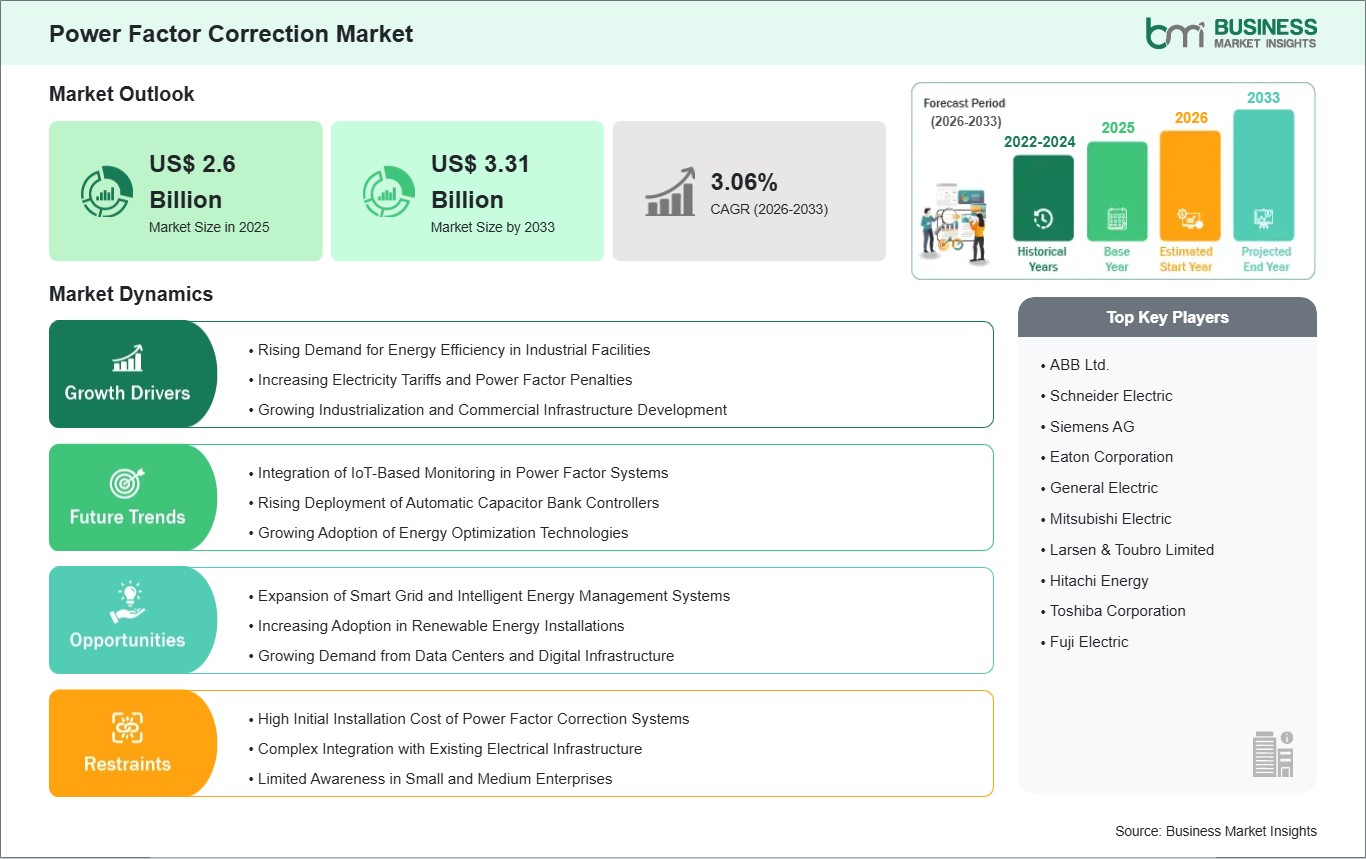
The power factor correction market is witnessing steady growth due to the increasing need for energy efficiency and power quality improvement across industrial and commercial sectors. Power factor correction systems are designed to optimize electrical performance by reducing reactive power, improving voltage stability, and minimizing energy losses in electrical distribution networks. These systems are widely used in industrial plants, commercial buildings, and power generation facilities where maintaining a balanced power factor is essential for efficient electricity consumption. As electricity demand continues to rise globally, the importance of efficient energy management solutions has become increasingly significant.
More and more industries and commercial buildings are implementing power factor correction technologies as a way to lower their electricity expenses and to get away from being charged for low power factor by their electricity suppliers. Besides that, the rise of smart grids and sophisticated energy management systems is another factor that is boosting power factor correction market growth. With the help of power factor correction equipment, electrical systems become more reliable and stable, which allows modern facilities to run in an efficient manner. Since governments and energy bodies are still advocating energy efficiency programs, the need for modern power factor correction technologies is likely to increase a lot in the next years.
Segment Analysis
Power Factor Correction Market Segmentation
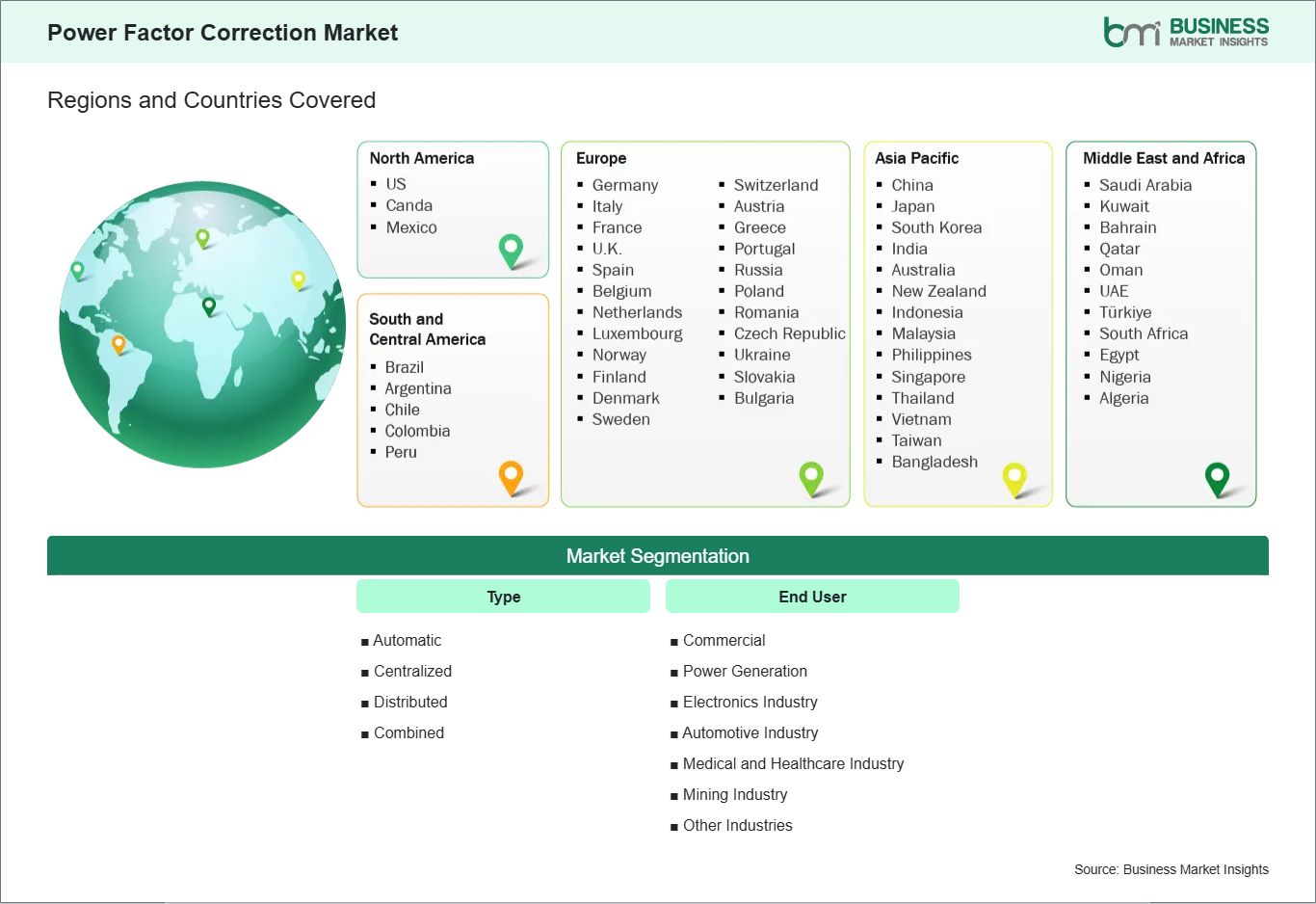
Key segments that contributed to the derivation of the Power Factor Correction market analysis are type and end user.
- By type, the power factor correction market is segmented into Automatic, Centralized, Distributed, and Combined. The Automatic segment dominated the market in 2025.
- By end user, the power factor correction market is segmented into Commercial, Power Generation, Electronics Industry, Automotive Industry, Medical and Healthcare Industry, Mining Industry, and Other Industries. The Commercial segment dominated the market in 2025.
Market Forces
Power Factor Correction Market Drivers and Opportunities
Rising Demand for Energy Efficiency in Industrial Facilities
A growing emphasis on energy efficiency across industrial operations is one of the major factors driving growth in the power factor correction market. Industrial plants use a significant amount of electrically driven equipment, including motors, pumps, compressors, and automated production systems that generate large amounts of reactive power within an electrical network. This reactive power decreases overall system efficiency while increasing electricity usage. As industries continue to increase their production activity, there has been an increased focus on how to manage electrical efficiency as part of their operations. Power factor correction solutions assist industrial companies in optimizing their electrical systems' performance by decreasing reactive power usage and stabilizing their voltage supply. Power factor correction systems improve the efficiency of electrical distribution systems by making sure that the energy supplied from utility companies is being utilized effectively by industrial machines. An improved power factor will decrease the overall amount of energy lost in transmission lines and transformers. This means that industrial companies can greatly decrease the costs of electrical power while having a constant supply of power for their production facilities. Additionally, many electricity utilities impose financial penalties on industrial consumers operating with poor power factor levels. To avoid these penalties and maintain regulatory compliance, industries are increasingly adopting advanced power factor correction solutions. These systems enable facilities to maintain optimal power factor levels, improve operational efficiency, and ensure reliable electrical system performance across large manufacturing environments.
Expansion of Smart Grid and Intelligent Energy Management Systems
The expansion of the smart grid infrastructure is creating significant opportunities in the power factor correction market. The modern grid infrastructure is becoming more complex with the increase in the demand for electricity, the use of distributed energy, and the integration of renewable energy sources into the grid. The modern grid, therefore, makes use of advanced monitoring and control systems in order to optimize the distribution of electricity.
Power factor correction systems are important in the maintenance of the stability of the power quality in the modern grid, referred to as the smart grid. The systems are important in the reduction of the flow of reactive power, the stability of the voltage, and the minimization of the loss of energy in the process of electricity transmission and distribution. The modern grid makes use of advanced electrical management systems in order to ensure the efficient delivery of power in the grid.
Additionally, the growing integration of renewable energy sources such as solar and wind power is creating additional demand for power quality management solutions. Renewable energy generation can introduce fluctuations in electrical systems, making power factor management more important. As investments in smart grids and digital energy infrastructure continue to rise globally, demand for advanced power factor correction systems is expected to increase significantly.
Size and Share Analysis
Power Factor Correction Market Size and Share Analysis
The global Power Factor Correction market is experiencing steady growth, with market size and share analysis reflecting evolving treatment preferences and competitive dynamics among key players. The report evaluates important subsegments categorized within type and end user, highlighting their respective contributions to overall market performance.
By type, the Automatic subsegment dominated the market in 2025 due to its ability to continuously monitor electrical loads and automatically adjust capacitor banks, improving energy efficiency, minimizing power losses, and helping industries and commercial facilities avoid utility penalties associated with poor power factor.
By end user, the Commercial subsegment dominated the market in 2025 due to high electricity consumption in commercial infrastructures such as office buildings, shopping malls, hospitals, and data centers where maintaining optimal power factor helps reduce energy costs and improve electrical system efficiency.
Report Coverage
Power Factor Correction Market Report Coverage and Deliverables
The "Power Factor Correction Market Size and Forecast (2022 - 2033)" report provides a detailed analysis of the market covering below areas:
- Power Factor Correction market size and forecast at the regional and country levels for segments covered under the scope
- Power Factor Correction market trends, as well as drivers, restraints, and opportunities
- Power Factor Correction market analysis covering key trends, regional framework, major players, regulations, and recent developments
- Industry landscape and competition analysis covering market concentration, heat map analysis, prominent players, and recent developments for the Power Factor Correction market
- Detailed company profiles, including SWOT analysis
Geographic Insights
Power Factor Correction Market Geographic Insights
The geographical scope of the Power Factor Correction market report is divided into: North America, Asia Pacific, Europe, Middle East & Africa, and South & Central America. North America held the largest share in 2025.
North America dominated the power factor correction market in 2025 due to the strong presence of advanced electrical infrastructure and high adoption of energy efficiency technologies. Industrial facilities, commercial buildings, and large data centers across the region require efficient power management systems to maintain stable electricity distribution and reduce operational energy costs. The United States and Canada have implemented strict energy efficiency regulations that encourage industries to adopt technologies that improve electrical system performance and reduce energy losses. These regulatory policies are increasing the adoption of power factor correction systems across manufacturing plants, commercial infrastructure, and utility networks.
Additionally, the region has a strong presence of leading electrical equipment manufacturers and energy technology companies that are actively developing advanced power management solutions. These companies are investing in innovative technologies that enhance electrical monitoring, automation, and power quality management. The growing expansion of smart grid infrastructure and increasing investments in renewable energy systems are also contributing to market growth in North America. As industries continue focusing on efficient energy usage and stable power distribution, the region is expected to maintain its dominant position in the global power factor correction market.
Industry Activity
Recent Developments
The Power Factor Correction market is evaluated by gathering qualitative and quantitative data post primary and secondary research, which includes important corporate publications, association data, and databases. A few of the key developments in the Power Factor Correction market are:
- In July 2024, Hillcrest Energy Technologies announced the launch of a testing and demonstration program for its Zero Voltage Switching (ZVS) technology prototype designed for power factor correction applications, aiming to improve grid stability, reduce electromagnetic interference, and achieve efficiencies above 99%.
- In March 2025, Infineon Technologies announced the release of the E-version of its XDP™ hybrid flyback digital controller IC family, featuring improved integrated PFC functionality to enable ultra-high-power-density AC-DC power supplies for chargers, adapters, and industrial power systems.
- In May 2025, Texas Instruments announced new power-management innovations showcased at PCIM 2025, including advanced controller solutions and reference designs that enable engineers to develop high-efficiency AC-DC power systems with integrated power factor correction for applications such as electric-vehicle charging and energy systems.
Trust & Transparency
Research Methodology
The market analysis combines proprietary research with secondary data from government agencies, company disclosures, regulatory filings, industry databases and expert interviews. Market estimates are validated through data triangulation, cross-market benchmarking and analyst
review.
View Full Research Methodology
Key Sources Referred:
IEEE Power & Energy SocietyIEC (International Electrotechnical Commission)NEMA (National Electrical Manufacturers Association)EPE Association (European Power Electronics and Drives Association)IEEMA (Indian Electrical & Electronics Manufacturers’ Association)Association of Power Producers (APP)Company WebsitesCompany Annual ReportsCompany Investor Presentations