Market Summary
Executive Summary and Global Market Analysis
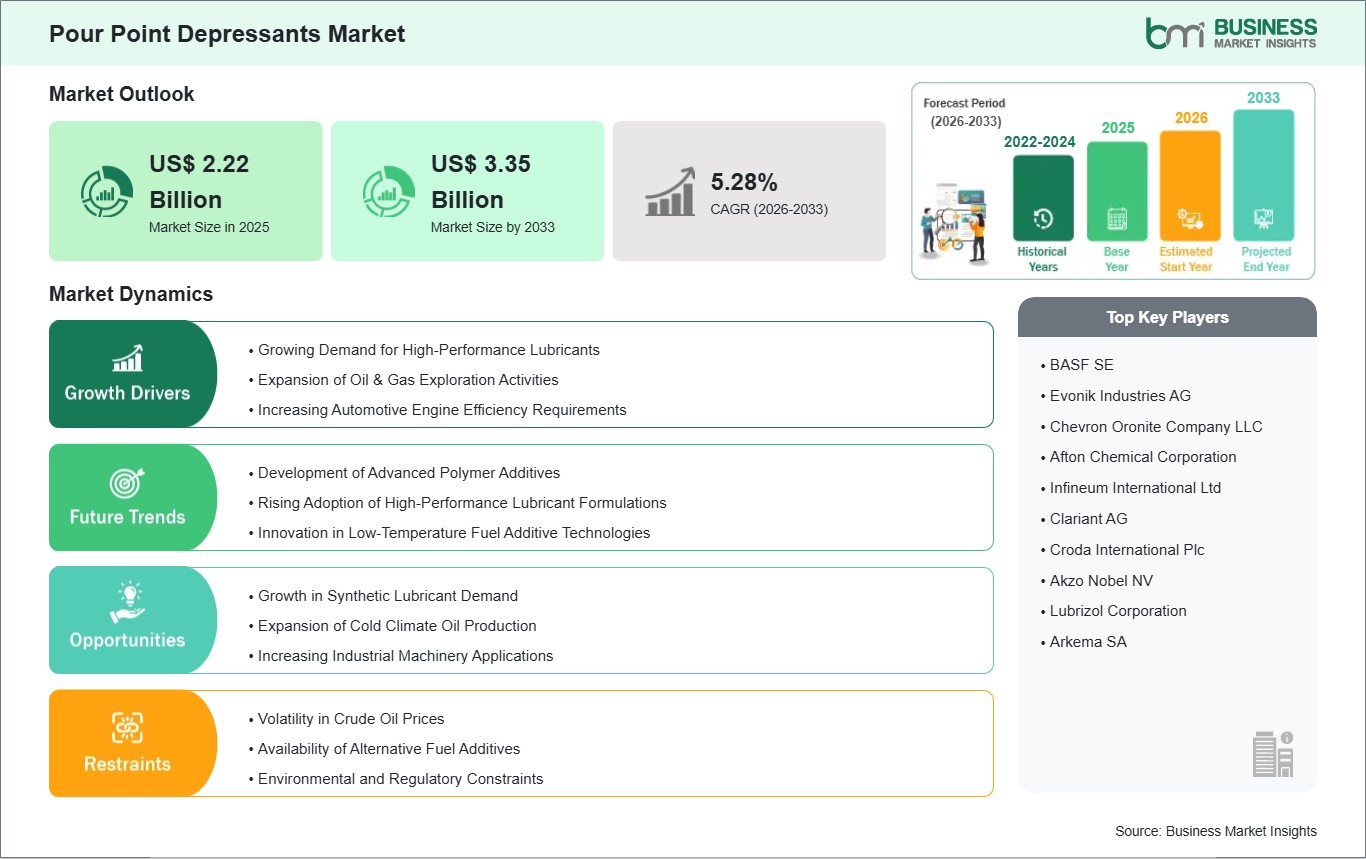
The Pour Point Depressants Market is witnessing continuous expansion due to the rising demand for cutting-edge lubricant additives that enhance the low-temperature flow characteristics of fuels and oils. Pour point depressants are a class of chemical additives that help in preventing the formation of wax crystals in petroleum products, thereby allowing the fluids to move freely even in cold environments. Their contribution to the smooth running of engines, pipelines, and industrial machinery by preserving their efficiency in the presence of low temperatures is invaluable.
The growing requirement for top-notch lubricants, the development of oil and gas exploration activities, and the increase in automotive production are the most significant factors that are keeping the market on its growth path. The continuous improvements in polymer-based additive formulations are adding to the efficiency and performance of pour point depressants.
What is more, synthetic lubricants and specialized fuel additives are being extensively used which in turn, is offering a whole lot of new opportunities for market growth. With equipment reliability and performance being top priorities for industries even in the harshest climates, pour point depressants will stand out as vital ingredients of the latest fuel and lubricant formulations for years to come.
Segment Analysis
Pour Point Depressants Market Segmentation
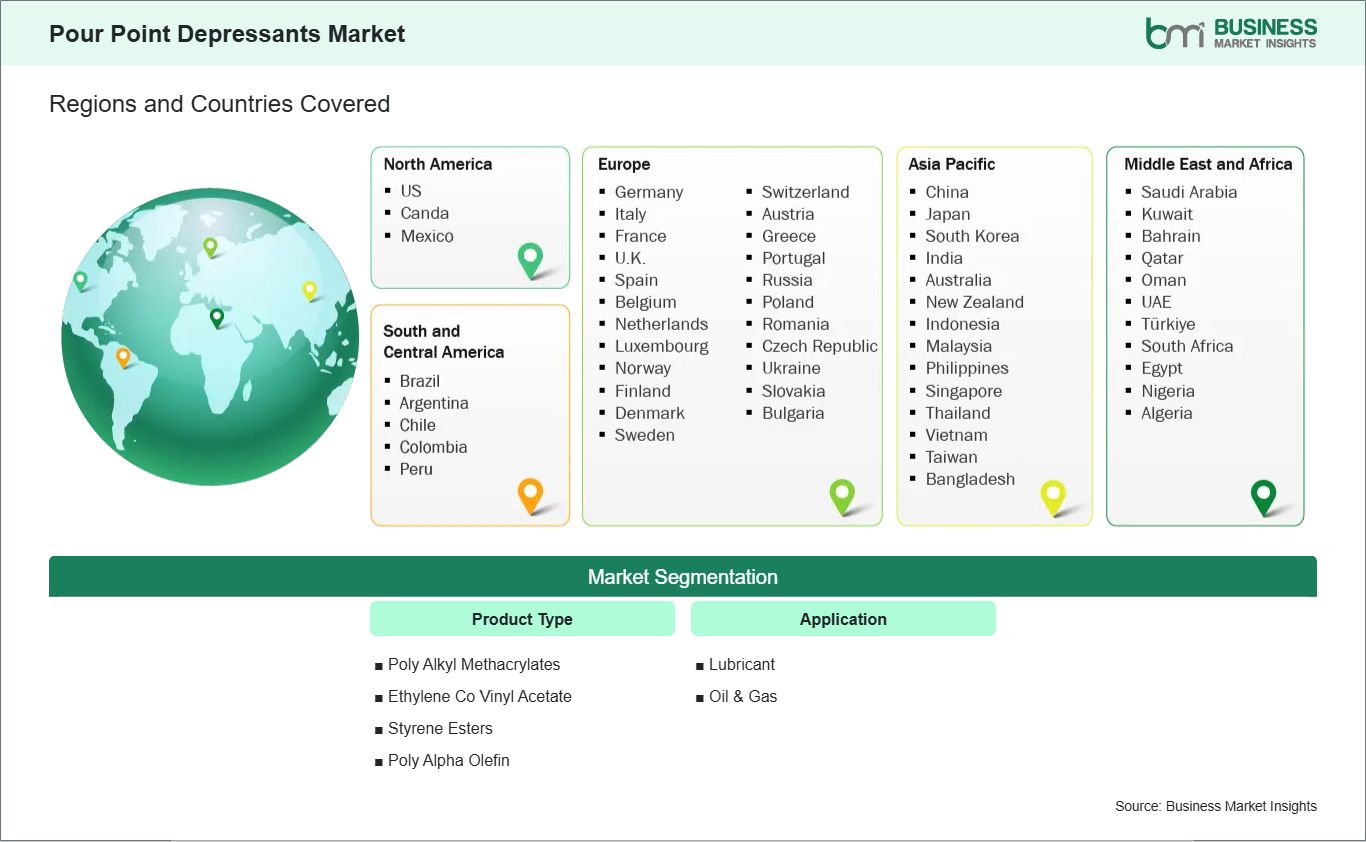
Key segments that contributed to the derivation of the Pour Point Depressants market analysis are product type and application.
- By product type, the Pour Point Depressants Market is segmented into poly alkyl methacrylates, ethylene co vinyl acetate, styrene esters, and poly alpha olefin. The poly alkyl methacrylates segment dominated in 2025.
- By application, the Pour Point Depressants Market is segmented into lubricant and oil & gas. The lubricant segment dominated in 2025.
Market Forces
Pour Point Depressants Market Drivers and Opportunities
Growing Demand for High-Performance Lubricants
One of the main factors contributing to the growth of the Pour Point Depressants Market is the rising need for advanced lubricants with superior performance. Today, both engines and industrial equipment need lubricants that can deliver top performance even at harsh climatic conditions. Pour point depressants help lubricants to stay liquid at freezing temperatures by inhibiting the formation of wax crystals which block the flow of oil. Automotive companies are always updating their engines not only to be more efficient but also to be more durable. This in turn demands highly sophisticated lubricant formulas that can stand up to very tough conditions.
One of the functions of pour point depressants is to help lubricants keep their viscosity and fluidity at a stable level even in very cold conditions. Thus, they go on to improve the engine's ability to start up as well as lessen the mechanical wear when the vehicle is operated at low temperatures. This, among many other benefits, has led to their use in automotive engine oils, transmission fluids, and industrial lubricants. Besides automotive uses, industries such as manufacturing, mining, and power generation also depend greatly on high-performance lubricants to keep their equipment running smoothly even in very difficult environments. The increasing need for dependable lubrication across these sectors is indeed one of the main reasons why pour point depressant additives are becoming more and more common in the latest lubricant formulations.
Growth in Synthetic Lubricant Demand
The growing demand for synthetic lubricants presents a significant opportunity for the Pour Point Depressants Market. Synthetic lubricants are increasingly preferred over conventional mineral oils because they offer superior thermal stability, extended service life, and improved performance under extreme operating conditions. These characteristics make them highly suitable for modern automotive engines and industrial machinery. Pour point depressants play a vital role in synthetic lubricant formulations by enhancing their low-temperature flow characteristics.
Even though synthetic base oils generally exhibit better cold-flow properties than mineral oils, additives such as pour point depressants are still required to optimize performance in extremely cold environments and ensure reliable equipment operation. As industries focus on improving equipment efficiency and reducing maintenance costs, the adoption of synthetic lubricants is increasing globally. Automotive manufacturers, aviation companies, and industrial operators are investing in advanced lubricant technologies that support longer operating intervals and improved machinery performance. This shift toward high-performance lubrication solutions creates substantial growth opportunities for pour point depressant manufacturers.
Size and Share Analysis
Pour Point Depressants Market Size and Share Analysis
The global Pour Point Depressants market is experiencing steady growth, with market size and share analysis reflecting evolving treatment preferences and competitive dynamics among key players. The report evaluates important subsegments categorized within product type and application, highlighting their respective contributions to overall market performance.
By product type, the poly alkyl methacrylates subsegment dominated in 2025 due to superior effectiveness in controlling wax crystal formation, improving low-temperature flow properties, and maintaining lubricant and fuel fluidity across automotive, industrial, and energy sector applications.
By application, the lubricant subsegment dominated in 2025 due to extensive use in automotive engine oils, industrial lubricants, and hydraulic fluids where maintaining low-temperature flow characteristics is essential for equipment performance and reliability.
Report Coverage
Pour Point Depressants Market Report Coverage and Deliverables
The "Pour Point Depressants Market Size and Forecast (2022 - 2033)" report provides a detailed analysis of the market covering below areas:
- Pour Point Depressants market size and forecast at the regional and country levels for segments covered under the scope
- Pour Point Depressants market trends, as well as drivers, restraints, and opportunities
- Pour Point Depressants market analysis covering key trends, regional framework, major players, regulations, and recent developments
- Industry landscape and competition analysis covering market concentration, heat map analysis, prominent players, and recent developments for the Pour Point Depressants market
- Detailed company profiles, including SWOT analysis
Geographic Insights
Pour Point Depressants Market Geographic Insights
The geographical scope of the Pour Point Depressants market report is divided into: North America, Asia Pacific, Europe, Middle East & Africa, and South & Central America. North America held the largest share in 2025.
North America dominates the Pour Point Depressants Market due to the region’s strong oil and gas industry, high automotive production, and significant demand for advanced lubricant formulations. The United States plays a major role in market growth with extensive exploration activities, pipeline transportation networks, and industrial operations requiring reliable fuel and lubricant performance in varying climate conditions. The region also experiences cold winter temperatures in many areas, which increases the need for additives that improve low-temperature fuel and lubricant performance. Major lubricant manufacturers and chemical companies in North America are continuously developing advanced additive technologies to improve engine efficiency and meet regulatory standards.
Additionally, the presence of a well-established automotive and industrial machinery sector further supports the demand for pour point depressants across the region.
Industry Activity
Recent Developments
The Pour Point Depressants market is evaluated by gathering qualitative and quantitative data post primary and secondary research, which includes important corporate publications, association data, and databases. A few of the key developments in the Pour Point Depressants market are:
- In January 2024, BASF SE announced that it signed a license agreement with The Lubrizol Corporation for the production and distribution of selected industrial lubricant products, enabling Lubrizol to market BASF-licensed products under its CPI Fluid Engineering brand.
- In December 2023, The Lubrizol Corporation announced multiple innovations across its additives portfolio, including new environmentally acceptable lubricant additive technologies aimed at improving sustainability and performance in transportation and industrial fluids.
- In 2024, The Lubrizol Corporation announced the introduction of new additive solutions designed to meet ILSAC GF-7 engine oil performance standards, helping lubricant manufacturers develop higher-efficiency and lower-emission formulations.
Trust & Transparency
Research Methodology
The market analysis combines proprietary research with secondary data from government agencies, company disclosures, regulatory filings, industry databases and expert interviews. Market estimates are validated through data triangulation, cross-market benchmarking and analyst
review.
View Full Research Methodology
Key Sources Referred:
American Petroleum Institute (API) ASTM International (American Society for Testing and Materials) Society of Tribologists and Lubrication Engineers (STLE) European Chemical Industry Council (Cefic) Indian Chemical Council (ICC) Company Websites Company Annual Reports Company Investor Presentations