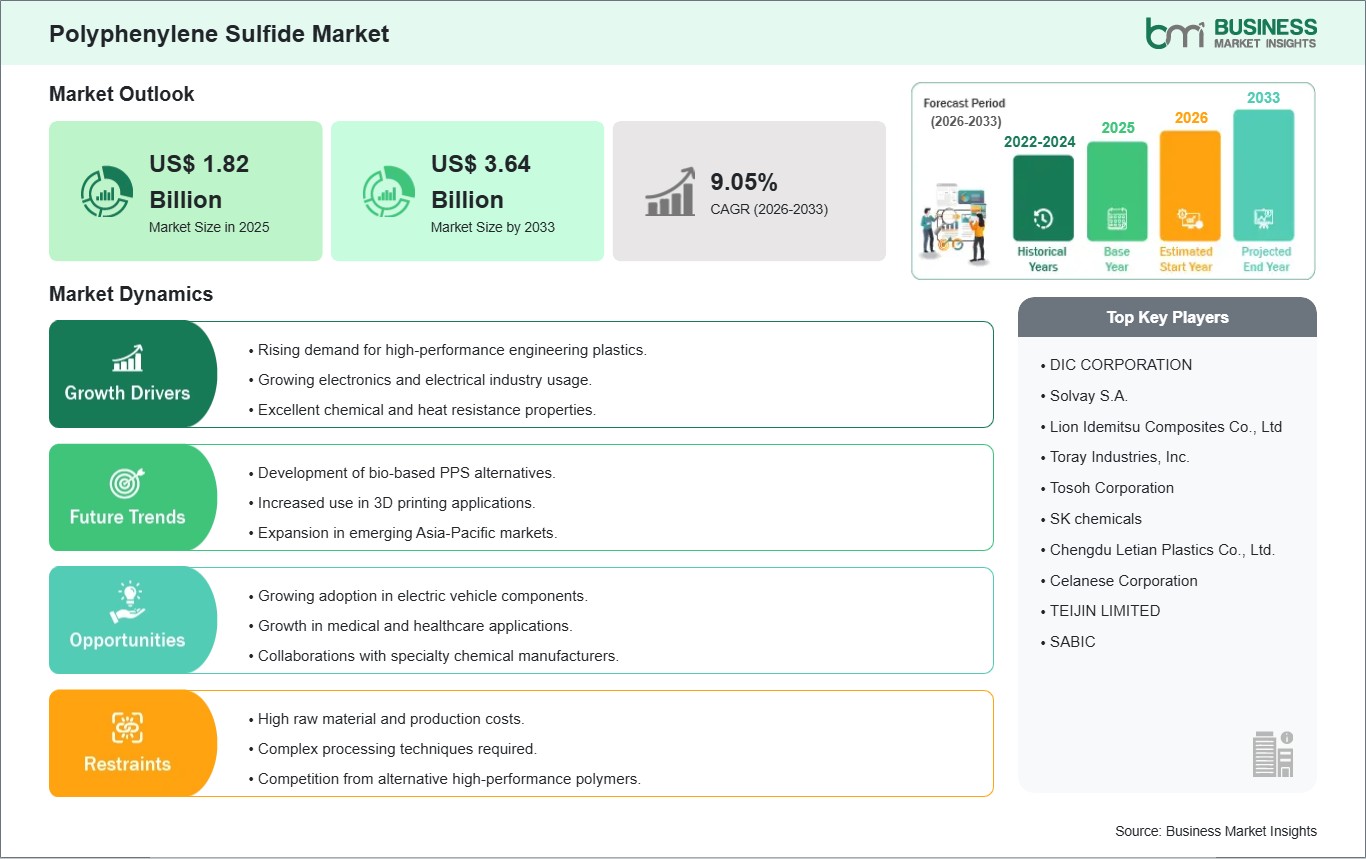
The Polyphenylene Sulfide Market size is expected to reach US$ 3.64 billion by 2033 from US$ 1.82 billion in 2025. The market is estimated to record a CAGR of 9.05% from 2026 to 2033.
The polyphenylene sulfide market is seen to have a strong track record with its high thermal, chemical, and mechanical properties, making it a preferred material for use as an engineering thermoplastic. The trend to replace metallic components with lighter materials, such as those made of polymers, is seen to be increasing in the manufacturing sector, especially for the automotive industry. The use of PPS compounds is seen to be increasing in the electrical and electronics industry because of its excellent properties, especially for use at high temperatures.
The emergence of electric mobility is also seen to have increased the use of PPS for battery and connector applications, especially for its use in extreme conditions. From the supply side, the focus is on compounding innovations, including glass fibers and minerals, to match the performance requirements of the product. Strategic partnerships are also being formed in the value chain to improve product customization and reduce lead times. Raw material volatility, along with high processing costs, are the key challenges faced in the industry, affecting the pricing mechanism as well.
Sustainability is gradually becoming a driving force in the market, focusing on recyclability and the environment during the manufacturing process. Intensity in the market is differentiated through technology rather than pricing, as the end-user requires high-performance consistency in the product. The PPS market is moving towards specialized, high-value applications, focusing on innovation and end-user diversification as the main drivers of growth.

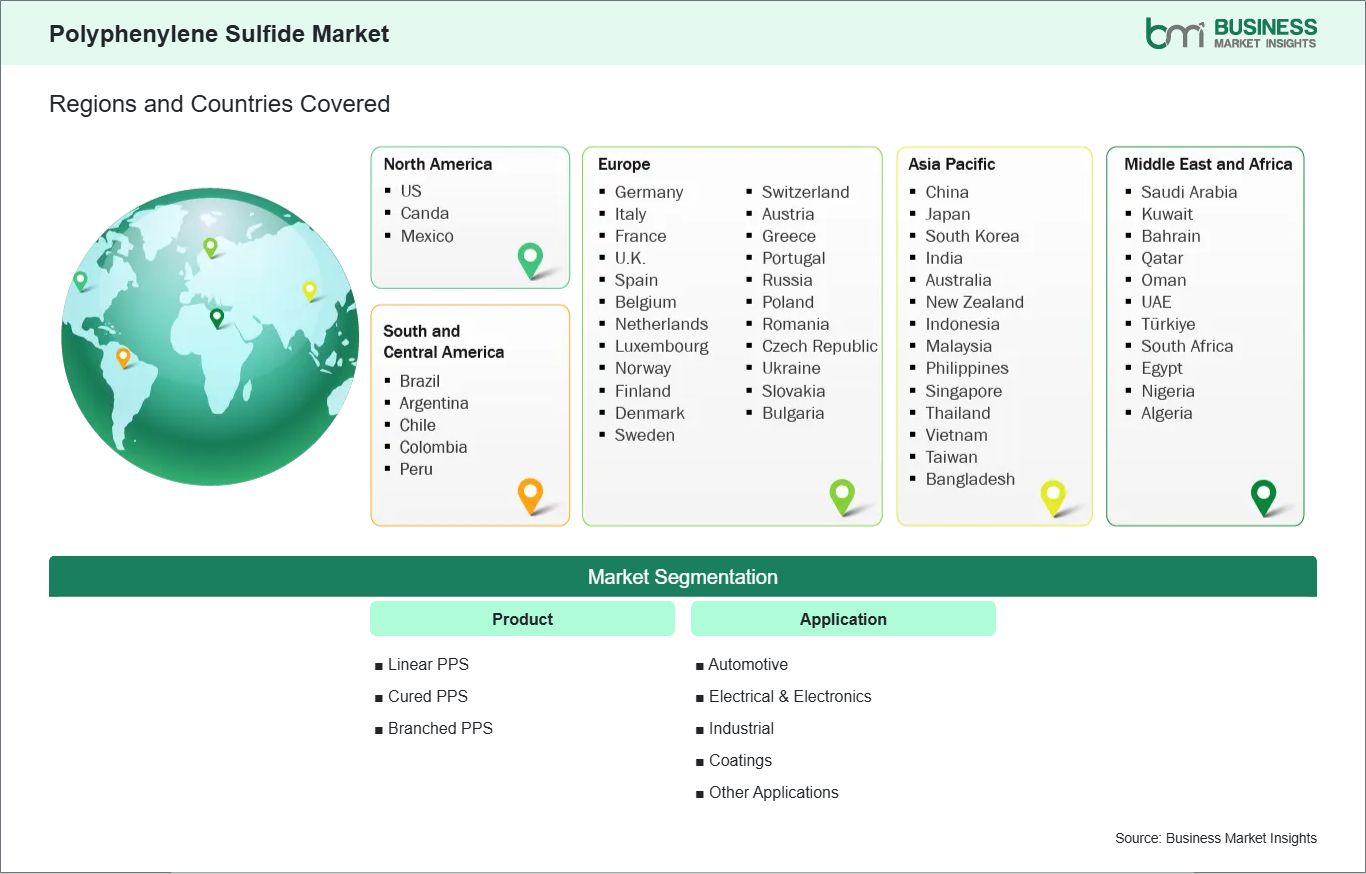
Key segments that contributed to the derivation of the polyphenylene sulfide market analysis are product and application.
The polyphenylene sulfide (PPS) market is highly influenced by the increasing demand for high-performance engineering plastics in different industrial sectors. PPS is a high-performance, specialty thermoplastic that is known for its excellent thermal stability, chemical resistance, and mechanical properties. It is used to meet extreme performance requirements and is often preferred for applications where regular plastics are not able to meet performance demands. The growing use of PPS is observed in different industrial sectors, including the automotive, electronic, aerospace, and industrial machinery sectors, to meet the demands for high-performance requirements. In the automotive industry, PPS is used for fuel system components, under-the-hood components, and electrical connectors, where high-temperature and corrosive chemicals are often experienced. Similarly, in the electronic industry, PPS is used for switches, connectors, and insulators, where its excellent dimensional stability and electrical insulation properties are required.
The demand is also driven by global trends that focus on miniaturization, lightweight construction, and power-saving capabilities. As electronic components get smaller and smarter, and car manufacturers want to make lighter, fuel-efficient cars, materials such as PPS have a lot to offer. Additionally, industries are increasingly required to meet strict regulations that pertain to safety, performance, and environmental concerns. PPS is a material that helps manufacturers meet these requirements, as it is a material that is known for its reliability and durability, and its resistance to chemicals and thermal degradation.
In addition to this, technological advancements in the processing of polymers have also led to an increase in the application of PPS. This is due to the molding and composite materials that have been developed to enable PPS to be used in more complex applications, thus increasing efficiency and cost-effectiveness. Therefore, with the superior properties of PPS, coupled with its versatility and compliance with regulations, the increasing need for high-performance engineering plastics is an important factor in the PPS market.
The polyphenylene sulfide market offers significant opportunities with the increasing use of electric vehicles globally. Electric vehicle manufacturers are increasingly looking for materials that offer high thermal stability, electric insulation, and resistance to chemicals. PPS is one such material that meets these criteria. PPS is used due to its high temperature resistance and ability to withstand harsh environmental conditions. PPS also offers the advantage of being lightweight, thus increasing the efficiency and driving range of electric vehicles. These are important factors to be considered while designing electric vehicles. With the electric vehicle market growing at an increasing rate globally, the PPS market is also expected to grow at an increasing rate.
Government initiatives and incentives are also boosting the electric vehicle market. Many governments are investing heavily in electric vehicle infrastructure in countries across North America, Asia, and Europe. These are increasing the chances of using PPS materials. Battery safety is an important factor that PPS is expected to address. PPS is used to insulate battery housings, connectors, and shields. This will increase the lifespan of electric vehicles.
In addition, as EVs are becoming more technologically advanced, the complexity of the electrical and electronic components is rising. PPS is suitable for the manufacturing of parts which need precision, stability, and durability, particularly under electrical and thermal stress conditions. Hence, the regulatory support, technological demand, and the inherent benefits of the PPS make it an integral component in the EV revolution. As a result, the manufacturers and suppliers in the PPS market are in a position to tap the huge potential in the EV industry, which is rising in the coming years.

The polyphenylene sulfide (PPS) market demonstrates steady growth, with size and share analysis highlighting evolving trends and competitive dynamics among key players. The report examines subsegments categorized within product and application, offering insights into their contribution to overall market performance.
By Product, the linear PPS subsegment dominated the market in 2025, driven by its superior thermal stability, chemical resistance, and wide applicability across high-performance industries.
Based on Application, the automotive subsegment dominated the market in 2025, owing to increasing demand for lightweight, heat-resistant materials in modern vehicle components.
| Report Attribute | Details |
|---|---|
| Market size in 2025 | US$ 1.82 Billion |
| Market Size by 2033 | US$ 3.64 Billion |
| Global CAGR (2026 - 2033) | 9.05% |
| Historical Data | 2022-2024 |
| Forecast period | 2026-2033 |
| Segments Covered | By Product
|
|
Regions and Countries Covered
| |
| North America | US, Canada, Mexico |
| Europe | Belgium, Austria, Finland, Denmark, Greece, Poland, Romania, Russia, Ukraine, Czech Republic, Slovakia, Bulgaria, Italy, Luxembourg, Germany, Switzerland, France, Netherlands, Norway, Portugal, Spain, Sweden, United Kingdom |
| Asia-Pacific | Australia, China, India, Japan, South Korea, Indonesia, Malaysia, Philippines, Singapore, Thailand, Vietnam, Bangladesh, New Zealand, Taiwan |
| South and Central America | Brazil, Argentina, Peru, Chile, Colombia |
| Middle East and Africa | Bahrain, Kuwait, Oman, Qatar, Saudi Arabia, United Arab Emirates, Turkiye, South Africa, Egypt, Algeria, Nigeria |
| Market leaders and key company profiles |
|
The "Polyphenylene Sulfide Market Size and Forecast (2022 - 2033)" report provides a detailed analysis of the market covering below areas:
The geographical scope of the Polyphenylene Sulfide Market report is divided into North America, Asia Pacific, Europe, Middle East & Africa, and South & Central America. North America held the largest share in 2025.
The polyphenylene sulfide (PPS) market in North America maintains a dominant position, driven by advanced industrial infrastructure, high adoption in aerospace, automotive, and electronics, and strong innovation capabilities. The region benefits from a mature manufacturing ecosystem, robust R&D networks, and stringent performance standards that favor high-quality PPS applications. Increasing investments in electric vehicles and renewable energy infrastructure are boosting demand for PPS in battery components, connectors, and insulation systems, where thermal and chemical stability are critical.
Additionally, North American players are actively focusing on reshoring supply chains and enhancing local compounding capabilities, which strengthens market control and reduces dependency on imports. Regulatory standards around safety and product reliability further incentivize the use of high-performance thermoplastics like PPS, solidifying the region’s leadership in advanced applications.
In the Asia Pacific, PPS demand is expanding rapidly due to the region’s strong industrialization, electronics manufacturing, and automotive production. The adoption is largely driven by the need for high-performance polymers in miniaturized electronic components, connectors, and precision engineering applications.
Asia Pacific also exhibits aggressive capacity expansion, driven by local production initiatives and growing collaboration with global suppliers. Cost competitiveness and economies of scale play a key role, as manufacturers strive to meet both regional and international demand. The market in this region is increasingly focused on innovation in composite formulations, enhancing mechanical and thermal properties to meet evolving industry requirements.
Europe presents a market environment shaped by high regulatory standards and sustainability mandates. Demand for PPS is influenced by stringent environmental directives and the automotive shift toward electrification. European manufacturers emphasize compliance, long-term durability, and performance under extreme conditions, making PPS a critical material in high-value applications such as electric vehicle components and industrial machinery. Technological partnerships and customization capabilities are key growth drivers, allowing suppliers to differentiate through quality and precision.
In the Middle East & Africa, PPS adoption is emerging gradually, supported by infrastructure development, industrial diversification, and energy sector projects. Growth is slower due to limited local processing infrastructure, but high-performance industrial applications and oil & gas projects are increasing demand for PPS in corrosion-resistant components and high-temperature systems. In South & Central America, PPS penetration remains moderate, driven by growing automotive and electronics sectors. Market expansion is limited by processing capabilities and awareness, but targeted industrial projects and regional manufacturing initiatives are gradually increasing adoption for specialized applications requiring thermal and chemical resistance.

The Polyphenylene Sulfide Market is evaluated by gathering qualitative and quantitative data post primary and secondary research, which includes important corporate publications, association data, and databases. A few of the key developments in the polyphenylene sulfide market are:
The Polyphenylene Sulfide Market is valued at US$ 1.82 Billion in 2025, it is projected to reach US$ 3.64 Billion by 2033.
As per our report Polyphenylene Sulfide Market, the market size is valued at US$ 1.82 Billion in 2025, projecting it to reach US$ 3.64 Billion by 2033. This translates to a CAGR of approximately 9.05% during the forecast period.
The Polyphenylene Sulfide Market report typically cover these key segments-
The historic period, base year, and forecast period can vary slightly depending on the specific market research report. However, for the Polyphenylene Sulfide Market report:
The Polyphenylene Sulfide Market is populated by several key players, each contributing to its growth and innovation. Some of the major players include:
The Polyphenylene Sulfide Market report is valuable for diverse stakeholders, including:
Essentially, anyone involved in or considering involvement in the Polyphenylene Sulfide Market value chain can benefit from the information contained in a comprehensive market report.
Please tell us your area of interest
(Market Segments/ Regions and Countries/ Companies)