Market Summary
Executive Summary and Global Market Analysis
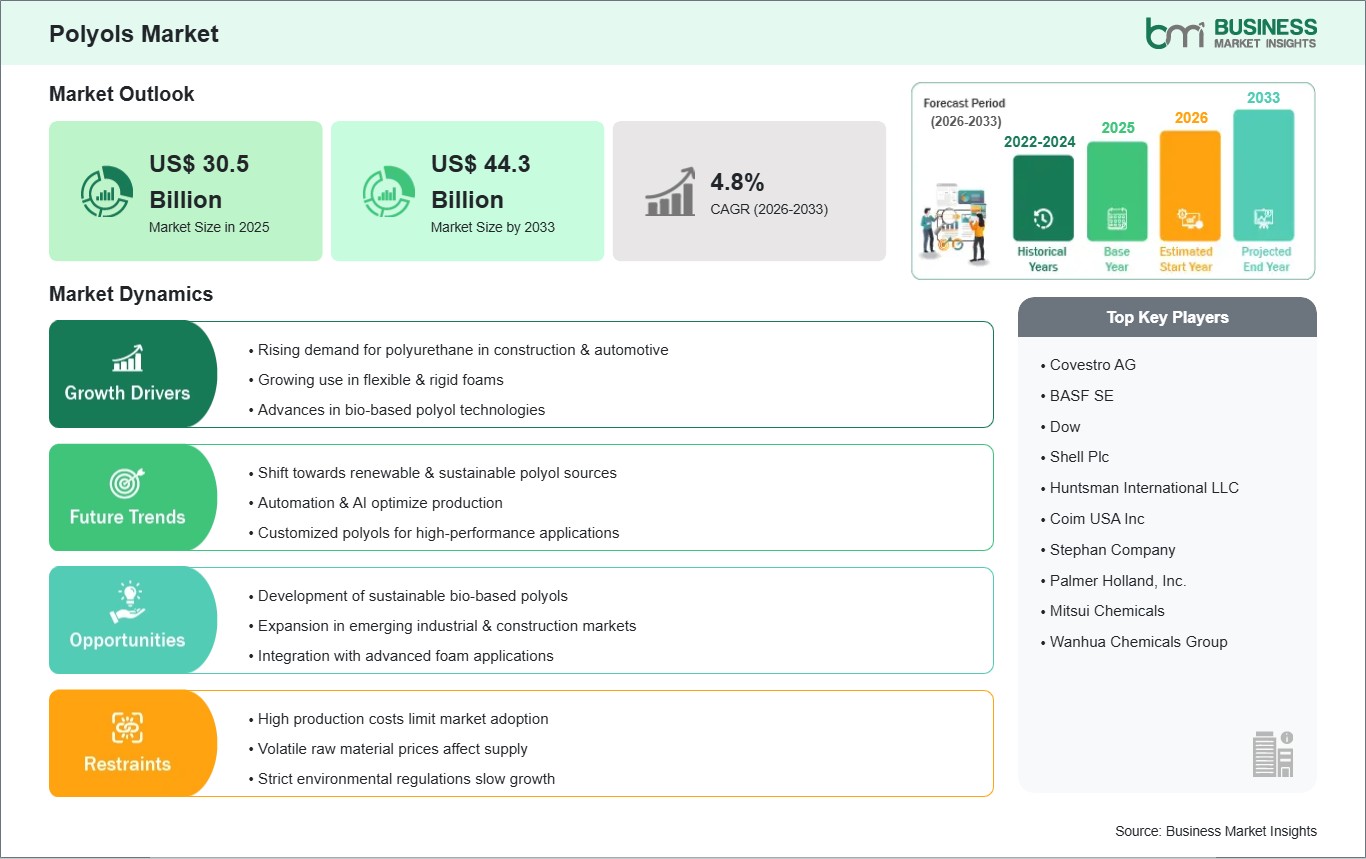
Polyols are multi-functional alcohols containing two or more hydroxyl groups per molecule. In the chemical industry, they serve as a critical co-reactant with isocyanates to produce polyurethanes (PU). They are broadly categorized into polyether polyols, valued for their flexibility and hydrolytic stability, and polyester polyols, preferred for their high mechanical strength and chemical resistance. Polyols are essential chemicals for polymer and foam industries, encompassing polyether, polyester, and increasingly, bio-based and CO--derived variants. These materials provide key benefits, such as adjustable densities for flexible cushioning, excellent thermal insulation for rigid foams, and durable performance in coatings, adhesives, sealants, and elastomers (CASE). Market growth is fueled by increased demand for energy-efficient building insulation, expansion in the global furniture and bedding sectors, and the automotive industry's focus on lightweighting for electric vehicles (EVs). The adoption of bio-polyols from vegetable oils and captured carbon is also aligning the market with global net-zero goals.
However, several challenges can restrain market growth: extreme price volatility of petroleum-based feedstocks, such as propylene oxide and ethylene oxide, creates significant margin pressure. Stringent environmental regulations concerning volatile organic compound (VOC) emissions and the lifecycle impact of traditional PU foams pose constant compliance hurdles. Furthermore, the industry faces constraints due to regional supply chain disruptions and the technical complexity of scaling bio-based "drop-in" replacements that maintain the exact performance specifications of fossil-derived polyols. Despite these hurdles, the market holds immense opportunities in the universal mandate for a circular economy, the accelerating deployment of recycled polyols from post-consumer waste, and the rising use of polyols as low-calorie sweeteners and excipients in the food and pharmaceutical sectors. The transition toward AI-optimized polymerization processes and next-generation catalyst systems is expected to create significant opportunities for market growth.
Segment Analysis
Polyols Market Segmentation
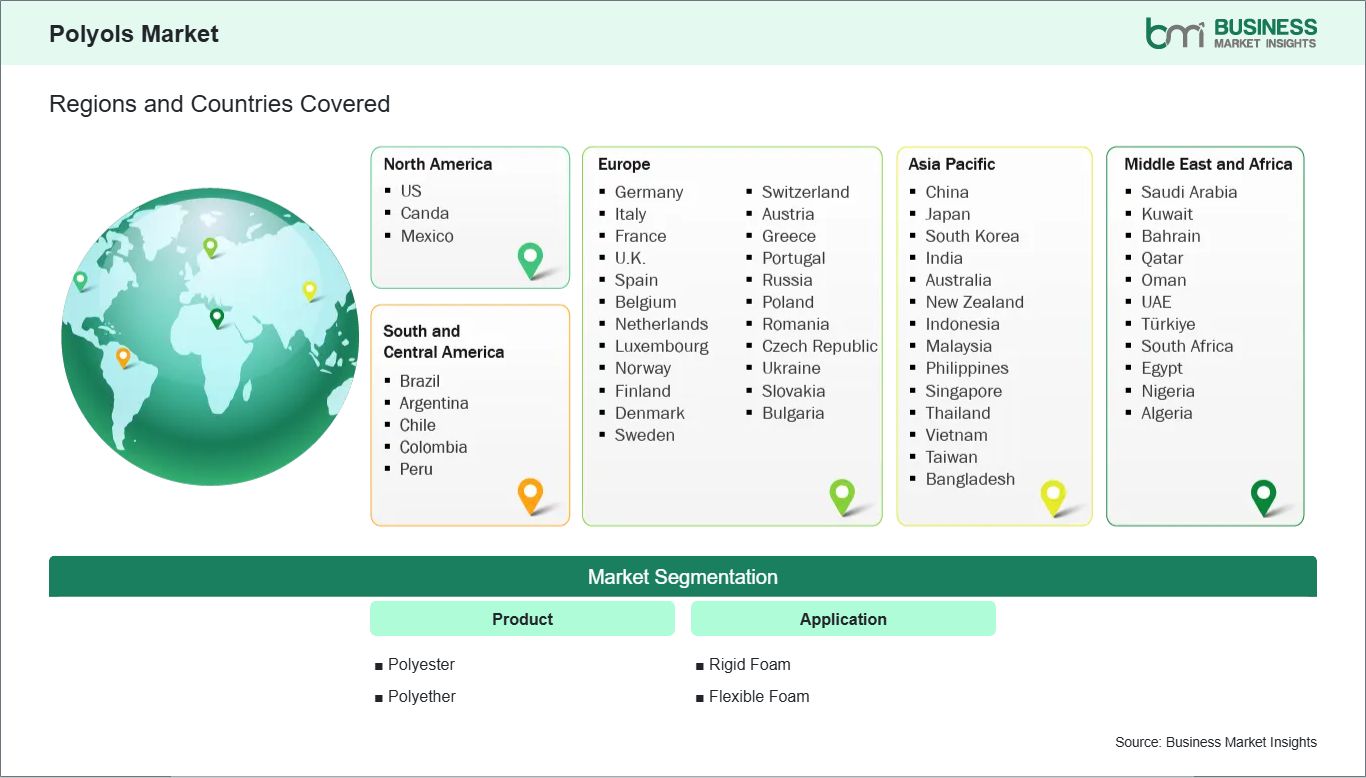
Key segments that contributed to the derivation of the Polyols market analysis are product and application.
- By Product, the market is bifurcated into Polyester and Polyether.
- By Application, the market is segmented into Rigid Foam and Flexible Foam.
Market Forces
Polyols Market Drivers and Opportunities
Growing Demand for Energy Efficiency and Automotive Light-Weighting
In the construction industry, the push for energy-efficient buildings has made rigid PU foams essential for high-quality thermal insulation. These materials help maintain indoor temperatures and drastically reduce energy consumption for heating and cooling, aligning with stringent green building codes like the EU’s Energy Performance of Buildings Directive. Simultaneously, the automotive industry is driving polyol demand as manufacturers strive for "light-weighting" to improve fuel efficiency and extend the range of electric vehicles (EVs). Flexible PU foams derived from polyols are extensively used in seating, headrests, and interior trims to provide superior comfort while minimizing vehicle weight. As urbanization accelerates in emerging economies, the burgeoning furniture and bedding industries act as significant catalysts, utilizing polyols to meet the growing consumer preference for ergonomic and durable cushioning solutions.
Increasing Need for Bio-Polyols and Chemical Recycling
With intensifying regulatory pressure to reduce dependency on petrochemicals, there is a massive market opening for polyols derived from renewable feedstocks such as soybean, castor oil, and carbon dioxide capture. These "green polyols" offer a lower carbon footprint and appeal to eco-conscious brands in the footwear and consumer goods sectors. Furthermore, the development of chemical recycling technologies, specifically polyol-to-polyol recycling, allows for the recovery of high-quality raw materials from post-consumer polyurethane waste. This circular approach not only addresses plastic waste concerns but also provides a stabilized, cost-effective supply chain. Manufacturers who innovate in high-resiliency and specialized "CASE" (Coatings, Adhesives, Sealants, and Elastomers) applications, tailored for extreme environments in the aerospace and electronics industries, are positioned to capture high-margin segments in a market that increasingly values both performance and environmental stewardship.
Size and Share Analysis
Polyols Market Size and Share Analysis
The Polyols market demonstrates steady growth, with size and share analysis revealing evolving trends and competitive positioning among key players. The report further examines subsegments categorized within product and application, offering insights into their contribution to overall market performance.
For instance, the Polyether subsegment holds a significant share in the market. Polyether is particularly utilized in Flexible Foam applications. Known for their excellent resilience, hydrolysis resistance, and low-temperature flexibility, polyether polyols are the primary material used for comfort-driven products such as mattresses, upholstered furniture, and automotive seating. As consumer demand for ergonomic bedding and premium interior comfort rises globally, this segment benefits from established large-scale production processes that maintain cost-efficiency and consistent material quality.
Report Coverage
Polyols Market Report Coverage and Deliverables
The "Polyols Market Size and Forecast (2022–2033)" report provides a detailed analysis of the market covering below areas:
- Polyols market size and forecast at global, regional, and country levels for all the key market segments covered under the scope
- Polyols market trends, as well as market dynamics such as drivers, restraints, and key opportunities
- Polyols market analysis covering key market trends, global and regional framework, major players, regulations, and recent market developments
- Industry landscape and competition analysis covering market concentration, heat map analysis, prominent players, and recent developments for the Polyols market
- Detailed company profiles, including SWOT analysis
Geographic Insights
Polyols Market Geographic Insights
The geographical scope of the Polyols market report is divided into five regions: North America, Asia Pacific, Europe, Middle East & Africa, and South & Central America.
The Asia-Pacific Polyols Market is segmented into China, Japan, South Korea, India, Australia, New Zealand, Indonesia, Malaysia, the Philippines, Singapore, Thailand, Vietnam, Taiwan, Bangladesh, and the Rest of Asia. The market is primarily driven by the region's dominant construction and automotive sectors. Growth is further bolstered by the rapid expansion of the furniture and bedding industry, where polyols are essential for high-performance cushions and mattresses. The shift toward a circular economy, marked by the introduction of bio-circular polyether polyols and 100% bio-based variants to meet evolving environmental standards in Japan and India, ensures that Asia-Pacific remains the primary hub for polyol innovation and sustainable manufacturing.
Industry Activity
Recent Developments
The Polyols market is evaluated by gathering qualitative and quantitative data post primary and secondary research, which includes important corporate publications, association data, and databases. A few of the key developments in the Polyols market are:
- In December 2024, Dow announced that VORANOL™ WK5750, a cutting-edge polyether polyol, is set to be produced at its Freeport polyol plant, marking its continued commitment to high application performance. With its unique design and ability to produce soft and hypersoft foams, VORANOL™ WK5750 aims to transform the comfort experience in products such as mattresses and furniture. Its ability to serve as a powerful cell opener further extends its utility to viscoelastic and high-resiliency foam applications, offering unprecedented softness and resilience.
- In May 2025, Covestro secured ISCC PLUS certification for its South Charleston, West Virginia site, which produces base polyether and polymer polyols used in automotive seating, mattresses, and furniture. The certification expands Covestro’s capacity to supply bio-attributed and recycled-content polyols, strengthening its sustainable materials portfolio in North America.
Trust & Transparency
Research Methodology
The market analysis combines proprietary research with secondary data from government agencies, company disclosures, regulatory filings, industry databases and expert interviews. Market estimates are validated through data triangulation, cross-market benchmarking and analyst
review.
View Full Research Methodology
Key Sources Referred:
World Bank – Global Trade Indicators
World Trade Organization (WTO)
International Monetary Fund (IMF)
International Trade Administration (ITA)
Company Websites
Company Annual Reports
Company Investor Presentations