
Polyolefin Market Outlook: Size, Share, Trends, Growth Analysis, Competitive Landscape & Forecast, 2026-2033

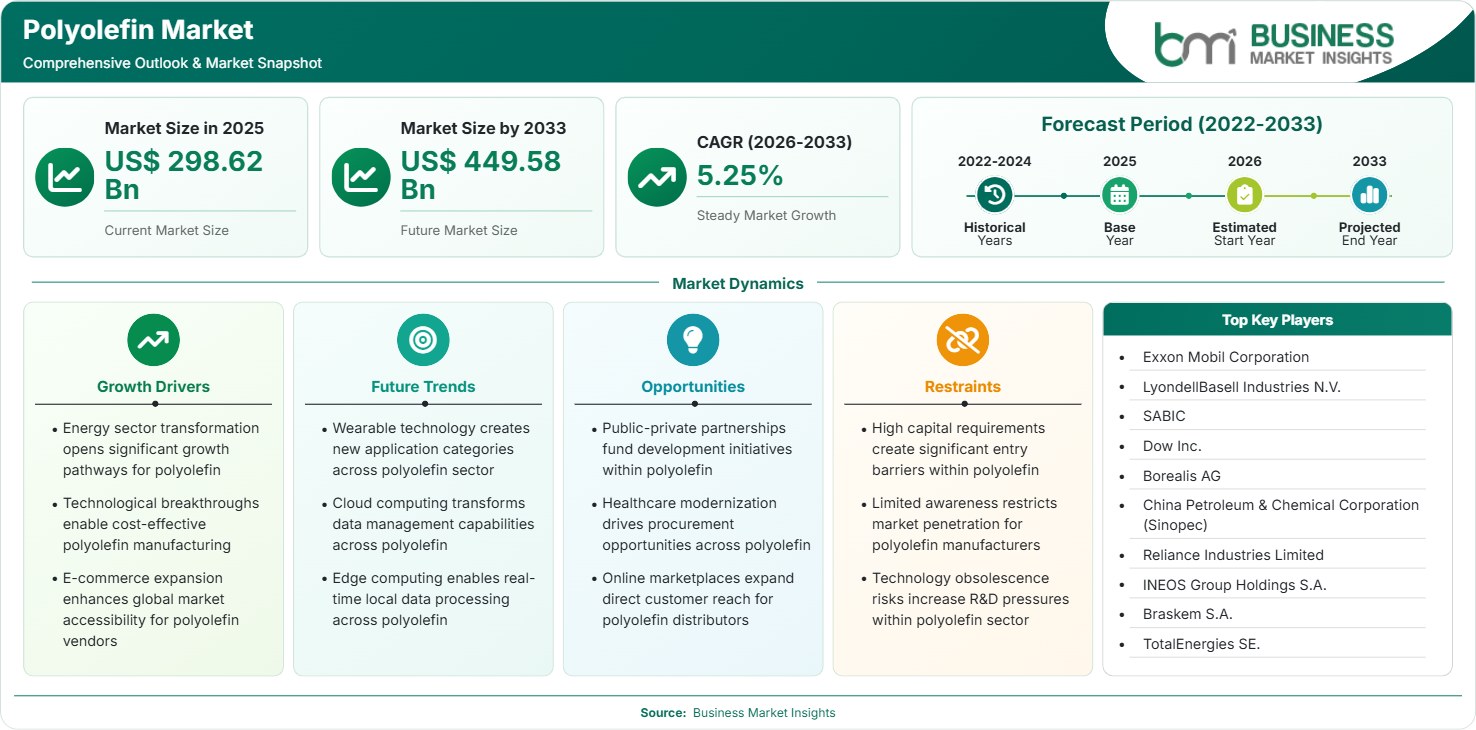
The Polyolefin Market size was valued at US$ 298.62 Billion in 2025 and is projected to reach US$ 449.58 Billion by 2033, growing at a CAGR of 5.25% during 2026–2033. Growth is supported by rising packaging demand, lightweight automotive materials adoption, infrastructure investments, circular economy initiatives, advanced polymer processing technologies, and expanding applications across healthcare, electronics, and consumer goods industries.

Report Coverage
  • Type: Polyethylene , Polypropylene , Others
  • Application: Injection Molding, Film & Sheets, Blow Molding, Profile Extrusion, Others
  • End-Use Industry: Packaging, Construction, Automotive, Electronics & Electricals, Pharmaceuticals, Others
US$ 298.62 Bn Market size in 2025
US$ 449.58 Bn Market Size by 2033
5.25% CAGR, 2026 - 2033
2026-2033 Forecast Period

AI Overview

Polyolefin Market Summary

  • North America Region: North America holds a 24%–27% share in 2025 and is projected to grow at a CAGR of 4.8%–5.3% during 2026–2033. Demand is supported by packaging innovation, shale-based feedstock advantages, healthcare applications, automotive lightweighting, recycling investments, industrial production growth, advanced manufacturing ecosystems, and sustainability programs. U.S. demand represents 78%–82% of regional consumption and is forecast to grow at a CAGR of 4.9%–5.4%.
  • Fastest Growing Region: Asia Pacific accounts for a 45%–48% share in 2025 and is expected to expand at a CAGR of 6.3%–6.9% through 2033. Urbanization, industrial expansion, flexible packaging demand, automotive manufacturing investments, and infrastructure spending continue supporting consumption growth.
  • Leading Segment: Polyethylene (PE) represents a 52%–56% share in 2025 and is expected to grow at a CAGR of 5.0%–5.5%. Dominance is sustained by extensive usage in films, packaging, containers, pipes, and consumer goods.
  • High Growth Segment: Film & Sheets account for 28%–32% share in 2025 and are anticipated to grow at a CAGR of 6.0%–6.6%. E-commerce packaging, food preservation requirements, and flexible packaging innovations support expansion.
  • Key Market Opportunity: Increasing investments in advanced recycling, bio-based feedstocks, and circular polymer technologies create opportunities for producers to enhance sustainability credentials, regulatory compliance, and long-term profitability.
  • Major Market Players: Exxon Mobil Corporation, LyondellBasell Industries N.V., SABIC, Dow Inc., Borealis AG, China Petroleum & Chemical Corporation (Sinopec), Reliance Industries Limited, INEOS Group Holdings S.A., Braskem S.A., and TotalEnergies SE.
Strategic Insights

Polyolefin Market: Strategic Insights

Polyolefin Market Strategic Framework
FREE PDF
Request your free sample
Request free sample
Stakeholder View

Key Takeaways

  • Integrated producers with feedstock access maintain stronger margin resilience during commodity price fluctuations.
  • Packaging remains the most influential value chain segment, creating long-term volume opportunities for converters and resin manufacturers.
  • Investment in recyclable and circular-grade polymers is becoming a critical competitive differentiator.
  • Asia Pacific offers the strongest growth outlook due to manufacturing expansion and rising consumer demand.
  • Strategic partnerships in recycling infrastructure are increasing across North America and Europe.
  • Specialty polyolefin grades for healthcare and electronics applications generate higher value realization than conventional commodity products.
Geographic Outlook

Polyolefin Market Regional Highlights

North America Polyolefin Market

North America accounts for 24%–27% of global demand in 2025 and is projected to expand at a CAGR of 4.8%–5.3% through 2033. Regional competitiveness is supported by shale gas feedstock availability, advanced manufacturing capabilities, and strong packaging consumption. Polyolefin Market share remains substantial across healthcare, consumer goods, and industrial applications. Producers continue investing in recycling technologies and premium polymer grades.

  • Packaging demand remains the primary growth catalyst across the United States and Canada.
  • Shale-derived feedstocks provide cost advantages for regional resin producers.
  • Circular economy initiatives support investments in recycled-content polymers.
  • Healthcare packaging and medical-grade applications continue expanding.
  • Industrial reshoring trends support downstream processing investments.

US Polyolefin Market

The United States holds a 78%-82% share of the North American market and is projected to experience a 4.9%-5.4% CAGR. The US has a well-developed petrochemical industry, export facilities, and packaging applications that facilitate market expansion across multiple industrial sectors.

  • E-commerce growth sustains demand for flexible packaging materials.
  • Recycling capacity investments continue increasing nationwide.
  • Automotive lightweighting supports polymer substitution strategies.
  • Industrial manufacturing growth strengthens resin consumption.

Europe Polyolefin Market

Europe has a 20%–23% market share in 2025 and a CAGR growth of 4.5%–5.0%. Germany has the highest demand, whereas fast growth is observed in Eastern Europe. Sustainability and circular economy regulations drive purchasing decisions across industries.

  • Germany leads regional consumption across packaging and industrial sectors.
  • Poland exhibits stronger growth owing to manufacturing investment.
  • Recycled-content mandates influence product development activity.
  • Automotive sector innovation stimulates demand for lightweight materials.
  • Energy efficiency objectives support material modernization programs.

Asia Pacific Polyolefin Market

The Asia Pacific region holds a 45%-48% share in 2025 and is projected to have a 6.3%-6.9% CAGR. The Chinese market is driving demand for thermoplastic elastomers, while the Indian market is growing rapidly due to industrialization and infrastructure growth. Regional manufacturing strength supports extensive polymer consumption.

  • China remains the largest consumer and producer globally.
  • India benefits from packaging and infrastructure investments.
  • Electronics manufacturing supports engineering polymer demand.
  • Urbanization accelerates construction applications.
  • Export-oriented industries strengthen resin utilization.

Rest of World Polyolefin Market

Rest of World contributes 8%–11% of global demand and is expected to expand at a CAGR of 5.3%–5.9%. The Middle East benefits from feedstock availability while Latin America sees growth from packaging and consumer goods industries.

  • Saudi Arabia and UAE benefit from integrated petrochemical complexes.
  • Brazil remains the leading Latin American consumer.
  • Infrastructure projects support pipe and construction applications.
  • Population growth increases packaged goods consumption.
  • Industrial diversification strengthens polymer demand.
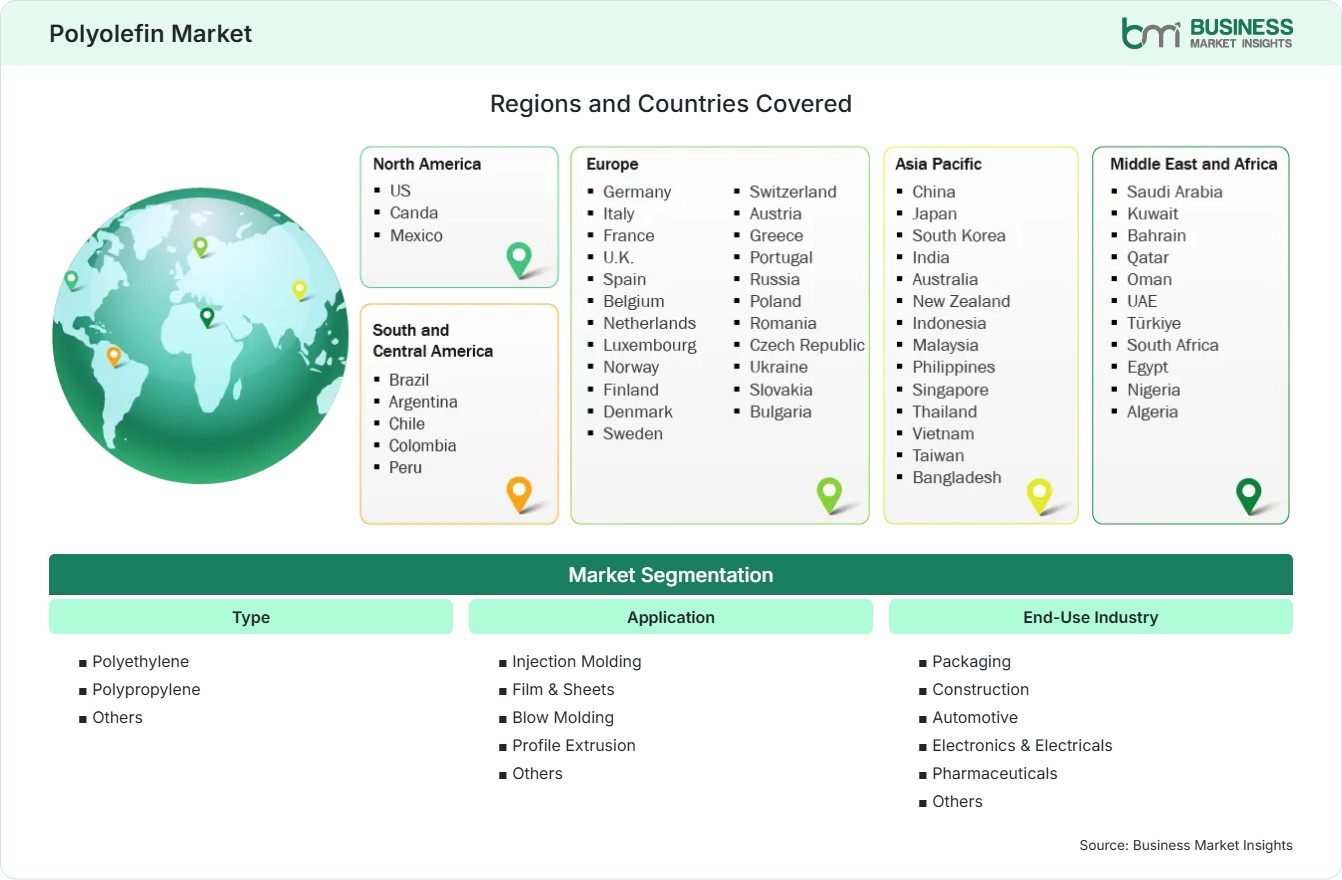
Global Market Geography
FREE PDF
Request your free sample
Request free sample
Segment Analysis

Polyolefin Market Segmentation

Type

This segment accounts for 48%–52% of overall market activity and is forecast to grow at a CAGR of 5.0%–5.7%. Polyolefin Market scope continues expanding through innovation in resin grades, processing efficiency improvements, and increasing adoption across packaging and industrial applications.

  • Polyethylene (PE): Widely used across films, containers, packaging products, and piping systems due to versatility, cost efficiency, and processing flexibility.
  • Polypropylene (PP): Strong demand from automotive, packaging, consumer goods, and healthcare sectors supports continued adoption globally.

Application

Application Categories are expected to account for 30%-34% in 2025 and have a growth potential of 5.4%-6.0%. Polyolefin Market trends point towards increased use of lightweight materials, advanced films, and durable molded products.

  • Injection Molding: Supports manufacturing of automotive components, consumer goods, industrial equipment, and medical products requiring dimensional stability.
  • Film & Sheets: Driven by food packaging, retail packaging, industrial wraps, and e-commerce logistics requirements.
  • Blow Molding: Commonly used for containers, bottles, tanks, and packaging solutions across industries.
  • Profile Extrusion: Supports pipe manufacturing, construction products, and engineered plastic profiles.

End-Use Industry

This market segment provides a 40%-45% contribution and is forecast to grow at 5.3%-5.9%. Polyolefin Market share is largely driven by the packaging industry, but diversification into healthcare and electronics improves resilience.

  • Packaging: Largest consumption category owing to flexible and rigid packaging requirements globally.
  • Construction: Growth driven by pipes, insulation products, geomembranes, and infrastructure development.
  • Automotive: Lightweighting efforts encourage polymer substitution for metal components.
  • Electronics & Electricals: Expanding demand for insulation materials and protective housings supports consumption.
  • Pharmaceuticals: Medical packaging and healthcare applications continue generating stable demand.
Market Forces

Polyolefin Market Dynamics

Key Market Drivers

Expansion of Global Packaging Demand

Food safety demands, the expansion of e-commerce, consumer goods usage, and the development of logistics will continue to drive demand for polyolefin-based packaging materials. Flexible packaging is highly significant for its cost-effectiveness in transportation, longevity, and product differentiation. A growing urban population in developing countries is another driving force for increased consumption of packaged products. Manufacturers are focusing on innovative film technology and recycling options for their packaging materials.

Automotive Lightweighting Initiatives

Vehicle manufacturers use lightweight polymers to enhance fuel economy and support their electrification plans. Polyolefin plastics exhibit a good strength-to-weight ratio, design flexibility, corrosion resistance, and cost-effectiveness. The increasing production of electric vehicles boosts demand for polymer-based interior and exterior parts. Advanced forms of polypropylene and polyethylene have become substitutes for conventional materials in multiple applications.

Growth in Infrastructure and Construction Activity

Infrastructure development projects need materials that are not only durable but also corrosion-resistant and economical. Polyolefin is commonly used in pipelines, insulation systems, cables, and construction membranes. There are significant opportunities driven by urban and infrastructure development in Asia, the Middle East, and Africa, which continue to create substantial demand.

Key Market Opportunities

Advanced Recycling Technologies

Advances in mechanical and chemical recycling processes create many possibilities for resin companies. Polyolefin Market Forecasts now include the recycled content requirement in response to regulatory and brand-owner efforts to achieve a circular economy. This investment in the infrastructure for sorting, processing, and recovering feedstocks improves the prospects for sustainable polymers.

Bio-Based Feedstock Development

The move towards lower carbon emissions and sustainable material production is fueling efforts to explore bio-based pathways for ethylene and propylene production processes within the petrochemicals sector. There is growing exploration of using renewable sources, such as biomass and agri-waste, as feedstocks that can substitute for fossil-based feedstocks. This will not only help companies reduce carbon emissions but also enable them to meet their sustainability goals amid changing environmental laws. Investing in bio-based feedstock technology can improve companies’ market position by enabling them to capture premium pricing and mitigate long-term regulatory and carbon-related risks.

High-Performance Specialty Grades

Specialty grades with high-performance properties are increasingly used in medicine, electronics, automotive, and other industrial applications requiring high-performance materials. Specialty grades have been formulated to exhibit superior properties, including mechanical strength, heat and chemical resistance, electrical properties, and improved processability, enabling their use in harsh operating conditions. Specialty grades differ from standard commodity materials in terms of profitability and product differentiation. Their ability to meet stringent industry requirements is expanding application opportunities and driving value-added growth across multiple end-use sectors.

Market Restraints and Challenges

Feedstock Price Volatility and Margin Instability

Factor: Fluctuations in crude oil and natural gas markets continue to have a direct influence on petrochemical feedstock costs, significantly affecting resin production economics and pricing dynamics across the plastics value chain. Changes in energy and raw material prices can rapidly alter manufacturing cost structures, making it difficult for industry participants to accurately forecast expenses and manage procurement strategies. Impact: This volatility creates considerable uncertainty for both producers and converters, complicating budgeting, pricing, and long-term business planning efforts. Unpredictable raw material costs can compress profit margins, particularly when cost increases cannot be fully passed on to customers promptly. The resulting financial uncertainty may also discourage capacity expansion projects and delay investment decisions, as companies remain cautious about committing capital amid unstable market conditions.

Environmental Regulations and Compliance Costs

Factor: Growing regulatory scrutiny surrounding plastic waste management, recycling targets, emissions reduction, and sustainability performance is compelling manufacturers to invest in advanced technologies, circular economy initiatives, and environmentally compliant production processes. Regulatory frameworks are becoming increasingly comprehensive, requiring greater monitoring, reporting, and resource allocation throughout the value chain. Impact: The need to comply with evolving environmental standards is driving higher operational expenditures through increased compliance costs, technology upgrades, and sustainability-related investments. Companies that are unable to adapt efficiently may face competitive disadvantages, while the additional financial burden can affect profitability and resource allocation. At the same time, the pressure to meet environmental expectations is accelerating industry-wide transformation toward more sustainable production and recycling practices.

Company Analysis

Competitive Landscape

Polyolefin Market analysis indicates intense competition among integrated petrochemical producers focused on capacity expansion, sustainability, and specialty product development.

Company Name

Overview

Products and Services relevant to this market

Exxon Mobil Corporation

Integrated energy and petrochemical leader with significant global polymer production capacity.

Polyethylene, polypropylene, specialty polymers, packaging materials, industrial resins.

LyondellBasell Industries N.V.

Major global producer focused on advanced polymer technologies and recycling initiatives.

Polyolefins, compound materials, recycled polymers, specialty resin solutions.

SABIC

Leading petrochemical company with extensive international manufacturing presence.

Polyethylene, polypropylene, engineering plastics, packaging and automotive materials.

Dow Inc.

Global materials science company serving diversified industrial sectors.

Packaging resins, polyethylene grades, performance plastics, sustainability solutions.

Borealis AG

Innovation-driven polyolefin producer focused on circular economy technologies.

Polyolefins, recyclable materials, infrastructure polymers, advanced packaging solutions.

China Petroleum & Chemical Corporation (Sinopec)

Major integrated petrochemical manufacturer and supplier.

Polyethylene, polypropylene, industrial polymers, packaging-grade materials.

Reliance Industries Limited

Large producer serving domestic and export polymer markets.

Polyolefins, packaging materials, industrial resins, specialty grades.

INEOS Group Holdings S.A.

International chemicals company with extensive polymer manufacturing operations.

Polyethylene, polypropylene, industrial polymer solutions, feedstock integration.

Braskem S.A.

Leading producer recognized for bio-based polymer development.

Polyethylene, renewable polymers, packaging and consumer product materials.

TotalEnergies SE

Diversified energy and petrochemical enterprise with global reach.

Polyolefins, specialty polymers, sustainable resin solutions, industrial applications.

Trust & Transparency

Research Methodology

The market analysis combines proprietary research with secondary data from government agencies, company disclosures, regulatory filings, industry databases and expert interviews. Market estimates are validated through data triangulation, cross-market benchmarking and analyst review.

View Full Research Methodology

Questions Answered

Frequently Asked Questions

What information does a Polyolefin Market Report typically provide?

A Market Report commonly evaluates market size, competitive positioning, technology developments, demand drivers, regional dynamics, sustainability trends, segment performance, and future opportunities.

How does automotive manufacturing influence demand?

Vehicle manufacturers use lightweight polymers to reduce weight, improve efficiency, support electrification, and enhance design flexibility across multiple vehicle components.

Why is sustainability becoming important in this industry?

Brand owners, regulators, and consumers increasingly demand recyclable and lower-carbon materials, encouraging investments in circular economy technologies and recycled-content solutions.

What is the largest product type within the industry?

Polyethylene remains the dominant product category because of its versatility and extensive use in packaging, films, containers, pipes, and consumer goods.

Which region leads global polyolefin consumption?

Asia Pacific leads global consumption due to its manufacturing dominance, infrastructure development activities, packaging demand, and expanding consumer markets.

Access the Full Polyolefin Market Report

Get segment-level forecasts, regional estimates, competitive benchmarking, company profiles and downloadable Excel datasets.

Access the full Polyolefin Market Report
350 pages PDF & Excel | 2026-08-31