Market Summary
Executive Summary and Global Market Analysis
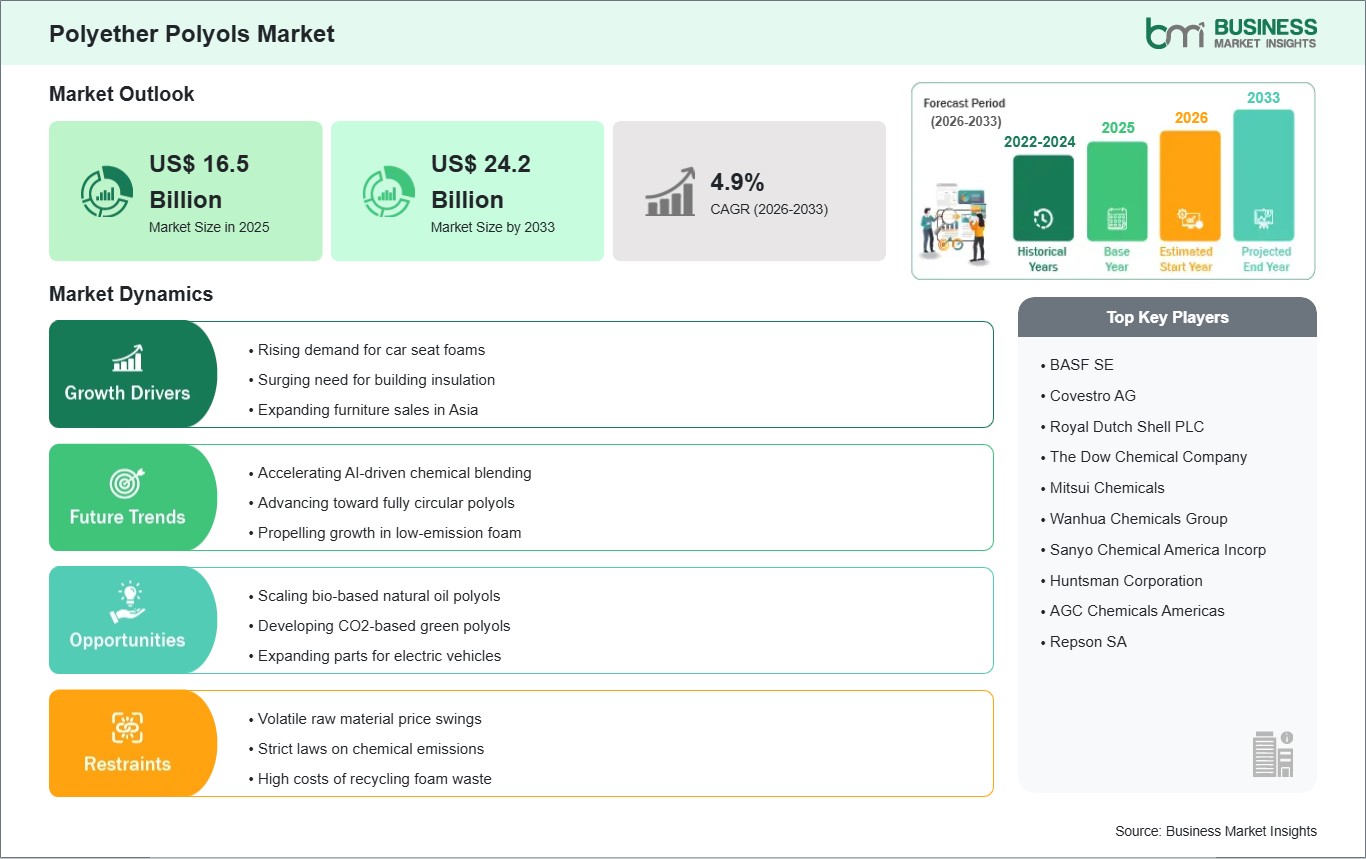
Polyether polyols are essential chemical building blocks primarily used in the production of polyurethanes, serving as a foundational material for a wide variety of industrial and consumer applications. They are critical for the manufacturing of flexible and rigid foams, coatings, adhesives, and sealants. Known for their excellent hydrolytic stability, low glass transition temperatures, and high resilience, polyether polyols are indispensable to industries such as automotive, building and construction, furniture, and electronics. The increasing demand for lightweight automotive components, energy-efficient building insulation, and comfortable home furnishings is fueling the market. Additionally, innovations in manufacturing technologies and the growing shift toward circular economy principles are enhancing the versatility of these polyols.
However, several challenges can restrain market growth, such as the volatility of raw material prices, specifically propylene oxide and ethylene oxide, which are highly sensitive to crude oil price fluctuations. Stringent environmental regulations regarding the emission of volatile organic compounds (VOCs) and the environmental impact of petroleum-based production also pose hurdles. Despite these challenges, the market holds significant opportunities driven by the rising demand for bio-based and sustainable polyols derived from renewable resources like castor or soybean oil. The expansion of the electric vehicle (EV) sector and the rapid urbanization in emerging economies are also expected to open new avenues for market expansion.
Segment Analysis
Polyether Polyols Market Segmentation
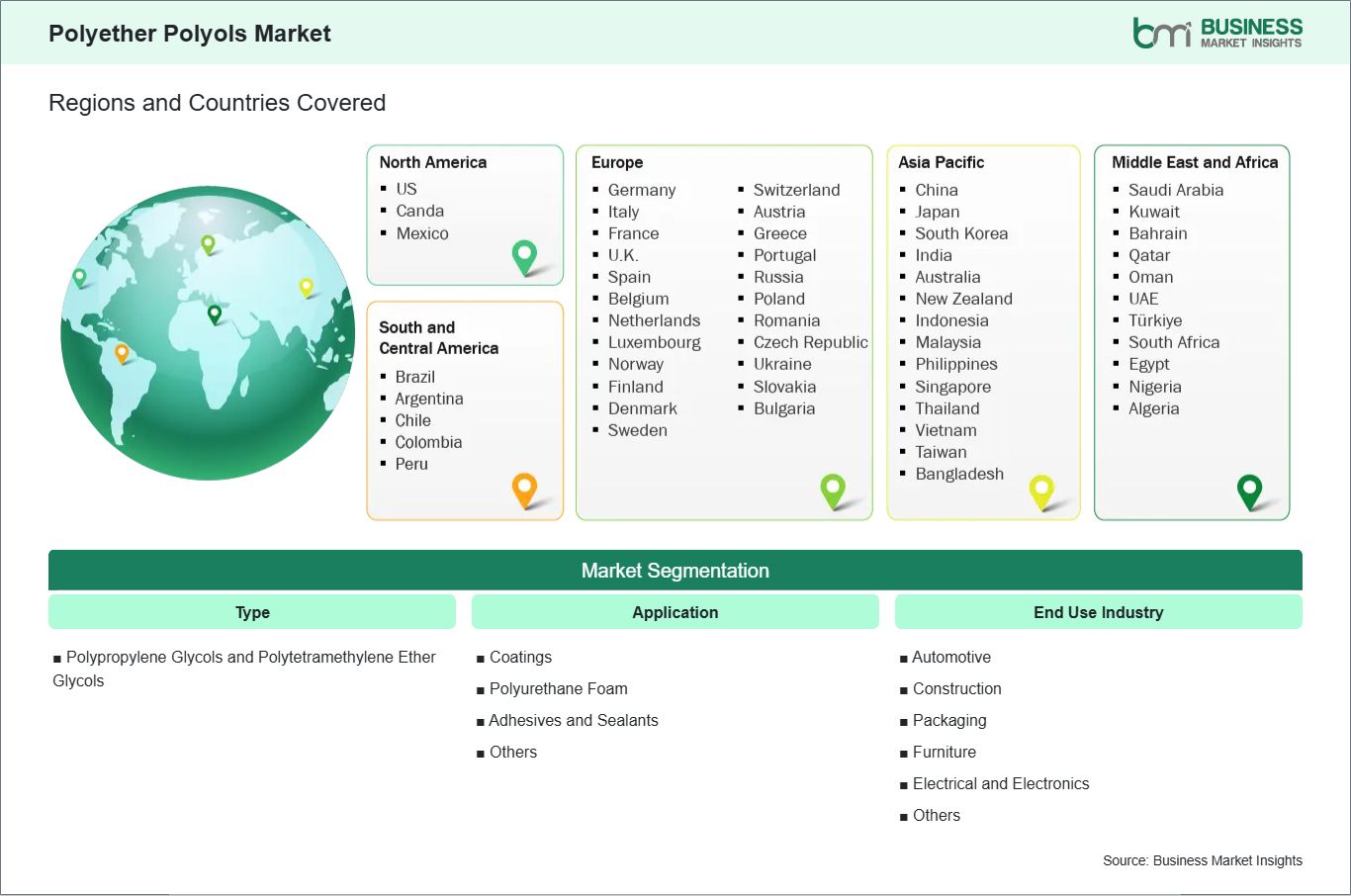
Key segments that contributed to the derivation of the Polyether Polyols market analysis are type, application, and end use industry.
- By Type, the market is segmented into Polypropylene Glycols (PPG) and Polytetramethylene Ether Glycols (PTMEG)
- By Application, the market is segmented into Coatings, Polyurethane Foam, Adhesives and Sealants, and Others.
- By End Use Industry, the market is segmented into Automotive, Construction, Packaging, Furniture, Electrical and Electronics, and Others.
Market Forces
Polyether Polyols Market Drivers and Opportunities
Growing Demand for Energy-Efficient Building Insulation
The rapid expansion of the global construction sector, combined with a heightened focus on energy conservation, has emerged as a pivotal factor positively driving the polyether polyols market. Rigid polyurethane foams, which are produced using polyether polyols, are increasingly utilized as high-performance insulation materials for walls, roofs, and flooring in both residential and commercial buildings. These foams offer superior thermal resistance (R-values) compared to traditional insulation materials, effectively reducing energy consumption for heating and cooling.
For instance, the building and construction segment continues to be a primary driver for polyols, with demand rising as governments worldwide implement stricter building energy codes. The growth is associated with the increasing adoption of "green building" standards and the need for sustainable infrastructure in rapidly urbanizing regions such as Asia Pacific and the Middle East. This robust construction activity directly supports the growth of the polyether polyols market, as the need for durable, energy-efficient insulation solutions continues to increase to meet climate goals and reduce operational costs for building owners worldwide.
Shift Toward Sustainable and Bio-Based Polyols
The current trend of transitioning towards Green Chemistry and Sustainability has emerged as a significant opportunity for the polyether polyols market. With the increasing stringency of environmental regulations, coupled with the rising demand for environmentally friendly products, companies have begun looking for bio-based alternatives for polyols, which are currently obtained from petrochemicals. Bio-based polyol polyethers, primarily produced through the use of renewable resources such as soybean oil, castor oil, or recycled materials, have a substantially reduced carbon footprint but retain similar characteristics necessary for making quality polyurethane materials.
In recent years, government policies such as the Green Deal initiative in the European Union have promoted the development of chemical building blocks using renewable resources. The high-end usage of the product in the automobile and furniture industries has acted as the primary initiator of this trend, where top automobile brands have begun using biogas in their vehicle seating in order to satisfy their company’s sustainability goals. Often, this brings about the applicability of novel polyol compounds with the ability to sustain the circular economy paradigm. Due to the adaptation of demand-driven production operations by the industry, the demand for sustainable biopolymers is set to increase steadily.
Size and Share Analysis
Polyether Polyols Market Size and Share Analysis
The polyether polyols market demonstrates steady growth, with size and share analysis revealing evolving trends and competitive positioning among key players. The report further examines subsegments categorized within type, application, and end use industry, offering insights into their contribution to overall market performance.
For instance, Polypropylene Glycols (PPG) are typically used for the production of flexible polyurethane foams found in cushions, mattresses, and automotive seating, representing a substantial volume segment due to their versatility and cost-effectiveness. Polytetramethylene Ether Glycols (PTMEG) are valued for their high-performance properties in elastomers and high-end coatings. Polyurethane Foam remains the leading application segment, serving the critical insulation needs of the construction industry and comfort needs of the furniture sector. The Automotive industry utilizes these materials not only for comfort but also for lightweighting strategies essential for improving the efficiency of internal combustion engines and extending the battery range of electric vehicles.
Report Coverage
Polyether Polyols Market Report Coverage and Deliverables
The "Polyether Polyols Market Size and Forecast (2022 - 2033)" report provides a detailed analysis of the market covering below areas:
- Polyether Polyols market size and forecast at global, regional, and country levels for all the key market segments covered under the scope
- Polyether Polyols market trends, as well as market dynamics such as drivers, restraints, and key opportunities
- Polyether Polyols market analysis covering key market trends, global and regional framework, major players, regulations, and recent market developments
- Industry landscape and competition analysis covering market concentration, heat map analysis, prominent players, and recent developments for the Polyether Polyols market
- Detailed company profiles, including SWOT analysis
Geographic Insights
Polyether Polyols Market Geographic Insights
The geographical scope of the Polyether Polyols market report is divided into five regions: North America, Asia Pacific, Europe, Middle East & Africa, and South & Central America.
The Asia-Pacific Polyether Polyols market is segmented into China, Japan, South Korea, India, Australia, New Zealand, Indonesia, Malaysia, the Philippines, Singapore, Thailand, Vietnam, Taiwan, Bangladesh, and the Rest of Asia. The Asia-Pacific market is experiencing robust growth, driven by the rapid expansion of the automotive and construction sectors in economies like China and India.
China remains a global powerhouse in polyol production, while India is witnessing a significant surge in demand, fueled by its burgeoning middle class and increasing consumption of upholstered furniture and mattresses. The region is also seeing increased investment in advanced chemical facilities and a shift toward domestic production of high-performance polyol grades to support local manufacturing hubs.
Industry Activity
Recent Developments
The Polyether Polyols market is evaluated by gathering qualitative and quantitative data post primary and secondary research, which includes important corporate publications, association data, and databases. A few of the key developments in the market are:
- In September 2025, Dow in partnership with Gruppo Fioriopens in a new tab, announced the latest advancements in a jointly-developed, novel process that enables recovery of polyurethane waste from end-of-life vehicles without disassembly. This innovation combines Dow’s expertise in materials science and Gruppo Fiori’s established automotive recycling ecosystem to create a new pathway for end-of-life vehicle materials.
- In December 2024, Dow announced that VORANOL™ WK5750, a cutting-edge polyether polyol, is set to be produced at its Freeport polyol plant, marking its continued commitment to high application performance.
Trust & Transparency
Research Methodology
The market analysis combines proprietary research with secondary data from government agencies, company disclosures, regulatory filings, industry databases and expert interviews. Market estimates are validated through data triangulation, cross-market benchmarking and analyst
review.
View Full Research Methodology
Key Sources Referred:
World Bank - Global Trade IndicatorsWorld Trade Organization (WTO)International Monetary Fund (IMF)International Trade Administration (ITA)Company WebsitesCompany Annual ReportsCompany Investor Presentations