Market Summary
Executive Summary and Global Market Analysis
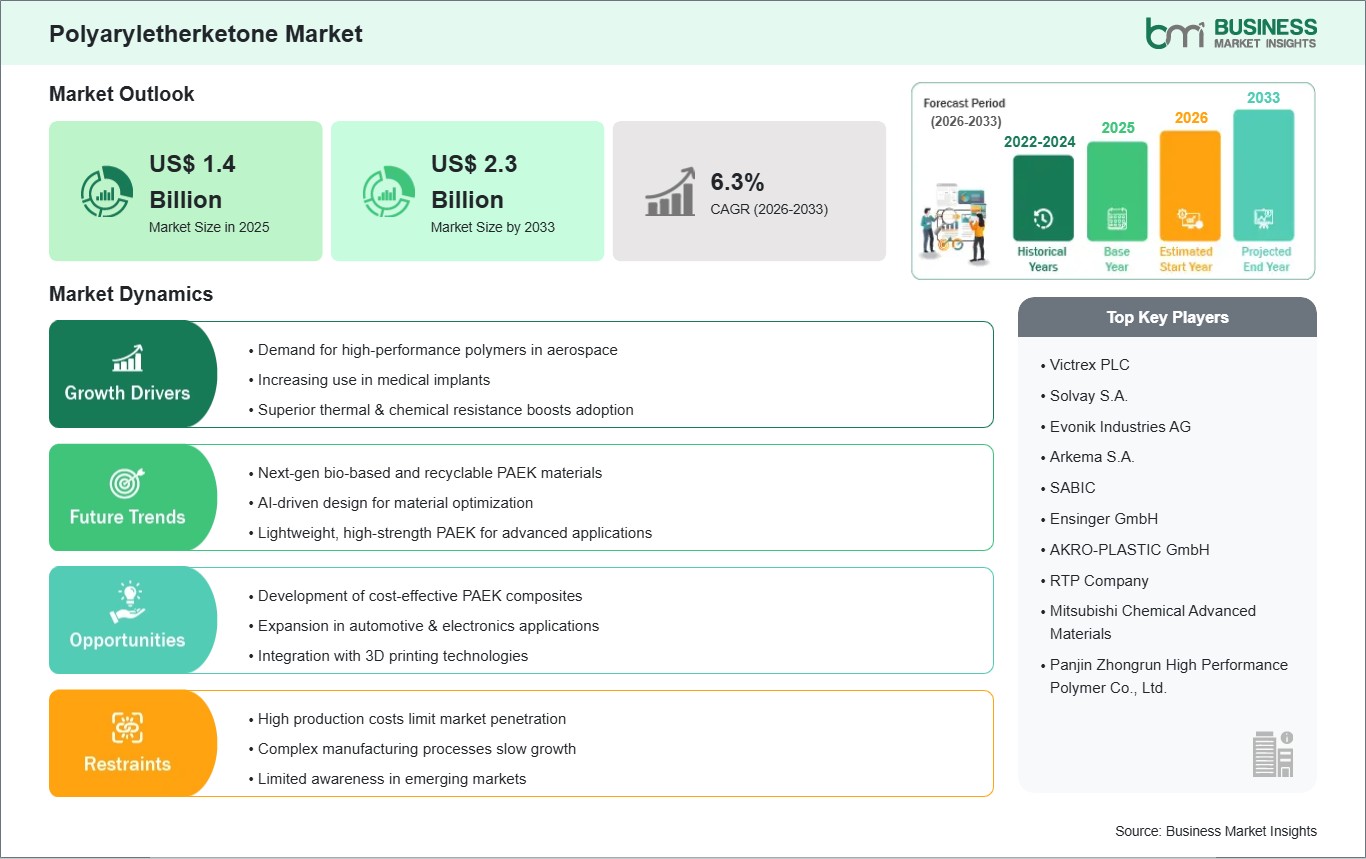
The Polyaryletherketone (PAEK) Market provides the critical high-performance polymer infrastructure for extreme engineering environments, encompassing PEEK, PEKK, and PEK in various forms such as granules, powders, and films. These materials offer the distinct advantage of being "metal replacements," providing a high strength-to-weight ratio, inherent flame retardancy, and superior resistance to aggressive chemicals and ionizing radiation. Market growth is propelled by the aerospace industry’s demand for lightweight structural components, the rapid electrification of the automotive sector (EVs), and the increasing use of biocompatible PEEK in medical and dental implants. Furthermore, the shift toward additive manufacturing (3D printing) is fundamentally expanding the market, as PAEK filaments and powders enable the production of complex, topology-optimized parts that were previously unmanufacturable.
However, several challenges can restrain market growth: exceptionally high material costs compared to standard engineering plastics like polyamides (nylon) limit PAEK to "mission-critical" applications where performance justifies the premium. Complex processing requirements, including high melting temperatures (often 340°C) and specialized equipment to manage crystallization, pose constant operational hurdles for manufacturers. Additionally, the industry faces constraints due to the availability of lower-cost high-performance substitutes like Polyetherimide (PEI) and the technical difficulty of achieving void-free bonds in large-scale composite structures. Despite these hurdles, the market holds immense opportunities in the universal mandate for fuel efficiency and decarbonization, the accelerating deployment of next-generation semiconductor manufacturing equipment, and the rising adoption of radiolucent spinal cages and orthopedic fixation devices. The transition toward low-melt PAEK grades for energy-efficient processing and the integration of recycled (PCR) PAEK into circular supply chains are expected to create significant opportunities for market growth.
Segment Analysis
Polyaryletherketone Market Segmentation
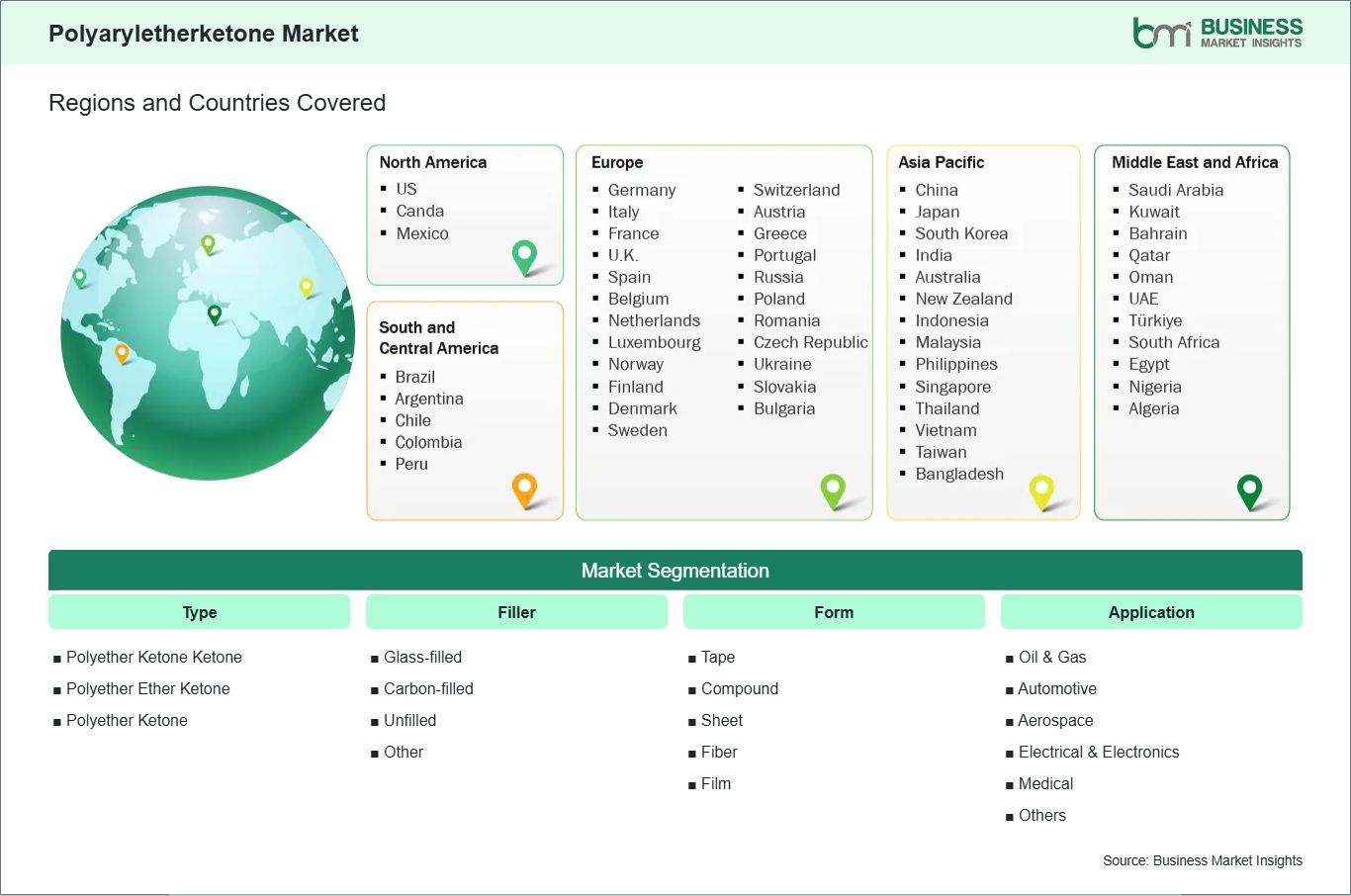
Key segments that contributed to the derivation of the Polyaryletherketone market analysis are type, filler, form, and application.
- By Type, the market is segmented into Polyether Ketone Ketone, Polyether Ether Ketone, and Polyether Ketone.
- By Filler, the market is segmented into Glass-filled, Carbon-filled, Unfilled, and Other.
- By Form, the market is segmented into Tape, Compound, Sheet, Fiber, and Film.
- By Application, the market is segmented into Oil & Gas, Automotive, Aerospace, Electrical & Electronics, Medical, and Others.
Market Forces
Polyaryletherketone Market Drivers and Opportunities
Growing Need for Metal Replacement and Extreme Environment Performance
As manufacturers strive for superior fuel efficiency and increased payload capacity, PAEK, including variants like PEEK and PEKK, has become indispensable due to its exceptional strength-to-weight ratio, which can reduce component weight by up to 60% compared to aluminum or steel. These polymers are uniquely capable of maintaining structural integrity and mechanical properties at continuous operating temperatures exceeding 250°C. Furthermore, PAEK's near-universal chemical resistance and low outgassing properties make it the "material of last resort" for critical applications, such as aircraft engine components, high-voltage cable insulation, and downhole tools in the oil and gas sector. The rise of the electric vehicle (EV) market also acts as a significant catalyst; PAEK is increasingly utilized in battery housings and motor components where traditional plastics fail under extreme thermal and electrical stress, ensuring both safety and longevity in next-generation mobility.
Surge in Additive Manufacturing and Biocompatible Innovation
Unlike traditional injection molding, 3D printing with PAEK filaments and powders allows for the cost-effective production of complex, topology-optimized geometries and patient-specific medical implants. This is particularly transformative in the orthopedic and dental sectors, where PAEK’s "bone-like" elastic modulus reduces stress shielding, a common failure in titanium implants, and promotes better long-term patient outcomes. Another major growth frontier is the development of "low-melt" PAEK grades and carbon-filled composites designed for high-volume automated production. These innovations lower the energy barriers for processing, opening doors to broader industrial use. Additionally, the transition toward a circular economy presents an opportunity for manufacturers to market PAEK as a sustainable alternative to thermosets; because it is a thermoplastic, it can be reprocessed and recycled without significant loss of properties, aligning with global mandates for sustainable manufacturing and resource recovery.
Size and Share Analysis
Polyaryletherketone Market Size and Share Analysis
The Polyaryletherketone market demonstrates steady growth, with size and share analysis revealing evolving trends and competitive positioning among key players. The report further examines subsegments categorized within type, filler, form, and application, offering insights into their contribution to overall market performance.
For instance, the Polyether Ether Ketone (PEEK) subsegment remains a cornerstone of the market, particularly when utilized in its unfilled form. This material is highly valued in the Medical sector for spinal implants and orthopedic devices due to its biocompatibility and radiolucency, which allows for clearer X-ray imaging compared to metal alternatives. Manufacturers are increasingly producing this polymer in Fiber and Filament to support the rise of 3D printing in healthcare, enabling the creation of patient-specific implants and complex surgical instruments that can withstand repeated sterilization.
Report Coverage
Polyaryletherketone Market Report Coverage and Deliverables
The Polyaryletherketone Market Size and Forecast (2022–2033) report provides a detailed analysis of the market covering below areas:
- Polyaryletherketone market size and forecast at global, regional, and country levels for all the key market segments covered under the scope
- Polyaryletherketone market trends, as well as market dynamics such as drivers, restraints, and key opportunities
- Polyaryletherketone market analysis covering key market trends, global and regional framework, major players, regulations, and recent market developments
- Industry landscape and competition analysis covering market concentration, heat map analysis, prominent players, and recent developments for the Polyaryletherketone market
- Detailed company profiles, including SWOT analysis
Geographic Insights
Polyaryletherketone Market Geographic Insights
The geographical scope of the Polyaryletherketone market report is divided into five regions: North America, Asia Pacific, Europe, Middle East & Africa, and South & Central America.
The Asia-Pacific Polyaryletherketone Market is segmented into China, Japan, South Korea, India, Australia, New Zealand, Indonesia, Malaysia, the Philippines, Singapore, Thailand, Vietnam, Taiwan, Bangladesh, and the Rest of Asia. The market is primarily driven by the region's burgeoning Electric Vehicle (EV) and semiconductor manufacturing sectors. China dominates regional volume, recently lifting domestic PEEK production capacity to meet high demand in electronics, while India is emerging as a critical growth hub due to rising investments in orthopedic and trauma implants.
Growth is further bolstered by the rapid adoption of PAEK-based additive manufacturing (3D printing) for flight-critical aerospace components and patient-specific medical implants. The shift toward replacing traditional metals with high-performance thermoplastics to achieve lightweighting in automotive powertrains solidifies Asia-Pacific as the primary global driver for PAEK innovation and supply chain expansion.
Industry Activity
Recent Developments
The Polyaryletherketone market is evaluated by gathering qualitative and quantitative data post primary and secondary research, which includes important corporate publications, association data, and databases. A few of the key developments in the Polyaryletherketone market are:
- In October 2025, Teijin Carbon, in collaboration with A&P Technology, announced a joint innovation in advanced composite materials. IMS65 PAEK Bimax® biaxial fabric is a rate-enabling solution using Teijin Carbon’s Tenax™ TPUD IMS65 PAEK product, a thermoplastic unidirectional (UD) tape. It is designed to meet growing demand for scalable, high-speed production of composites in aerospace, space, defense, and other evolving markets. Teijin’s Tenax™ TPUD IMS65 PAEK – a high-quality UD tape based on polyaryletherketone (PAEK) resin, is slit into narrow widths and braided by A&P Technology into a 65” wide +/-45° fabric. The +/-45° braid architecture has minimal crimp, offering a high translation of tape properties while providing excellent drapability for complex geometries.
- In October 2024, Victrex, a global leader in high-performance polymer solutions, announced the full commercial availability of LMPAEK Granules and Powders to all industries for the first time. The materials offer high-temperature performance, fire resistance, lightweighting benefits, and processability for applications including composite manufacturing and additive manufacturing.
Trust & Transparency
Research Methodology
The market analysis combines proprietary research with secondary data from government agencies, company disclosures, regulatory filings, industry databases and expert interviews. Market estimates are validated through data triangulation, cross-market benchmarking and analyst
review.
View Full Research Methodology
Key Sources Referred:
World Bank – Global Trade IndicatorsWorld Trade Organization (WTO)International Monetary Fund (IMF)International Trade Administration (ITA)Company WebsitesCompany Annual ReportsCompany Investor Presentations