Market Summary
Executive Summary and Global Market Analysis
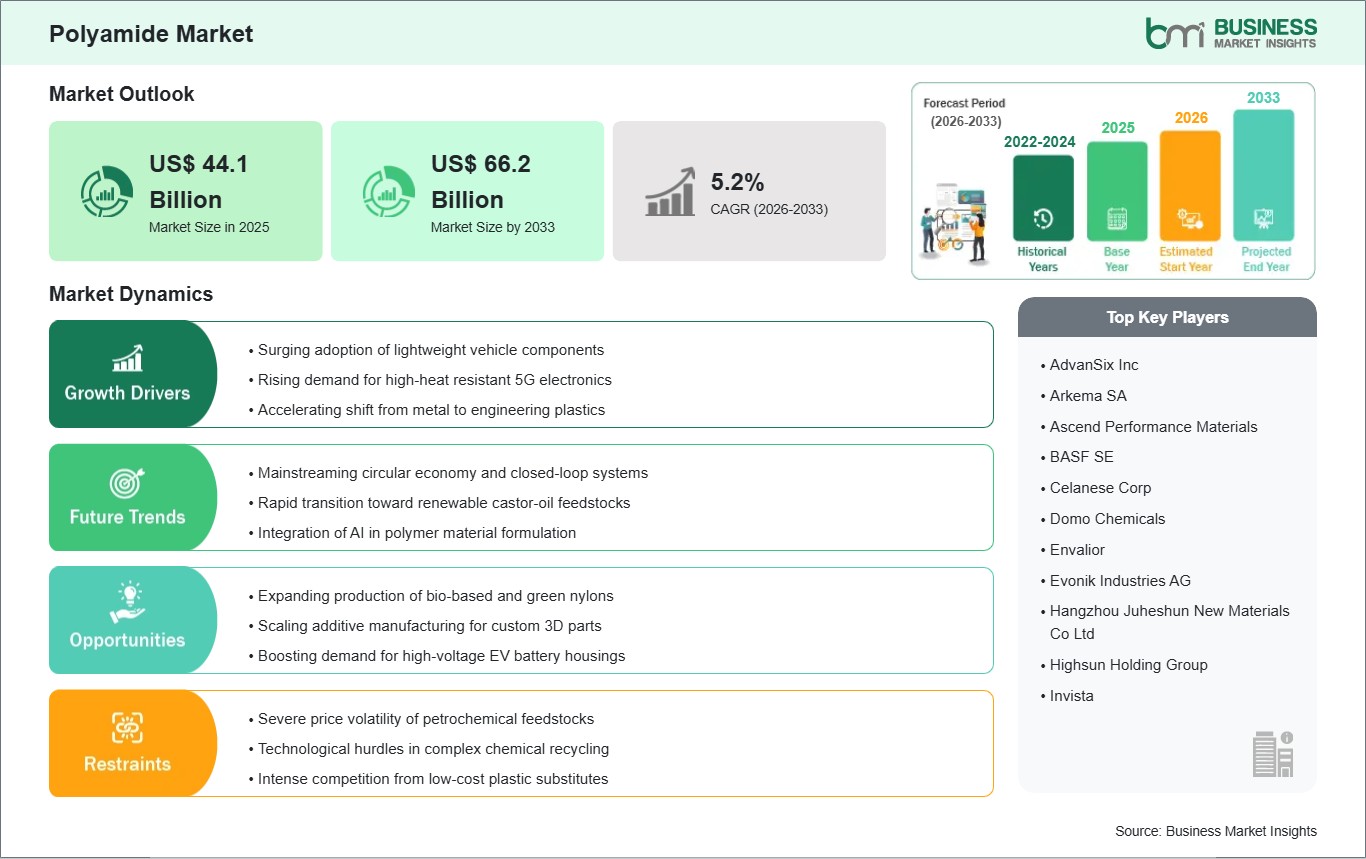
The Polyamide (PA) Market is significant due to its high-performance engineering thermoplastic and fiber, valued for its superior balance of mechanical, thermal, and chemical properties. PA is essential for core sectors: Automotive, Electrical & Electronics, Textiles, and Packaging. Polyamides offer advantages, including an excellent strength-to-weight ratio (crucial for lightweighting), high thermal and chemical resistance, and durability, which allows them to replace metal components. The market is fueled by the massive push for vehicle lightweighting, particularly with the global rise of Electric Vehicles (EVs), robust demand for durable engineering plastics in electronics and consumer goods, and continuous innovation in bio-based and specialized PA grades (like PPA and PA12).
However, several challenges restrain market growth: significant price volatility of petrochemical feedstocks (e.g., caprolactam, adipic acid) directly impacts production costs. Moisture sensitivity of standard PA grades (like PA6 and PA66) can lead to dimensional instability, limiting certain applications. Furthermore, the industry faces constraints due to intense competition from alternative polymers (e.g., PBT, PEEK, Polyurethane) and the complexity of recycling certain high-performance grades. Despite these hurdles, opportunities arise driven by the accelerating adoption of bio-polyamides (PA11) to meet sustainability targets, the increasing use of PA in 5G infrastructure and high-temperature electronics, and substantial market dominance and growth in the Asia-Pacific region due to expanding manufacturing and automotive production. The expansion into additive manufacturing (3D printing) applications is expected to open powerful new avenues for market expansion.
Segment Analysis
Polyamide Market Segmentation
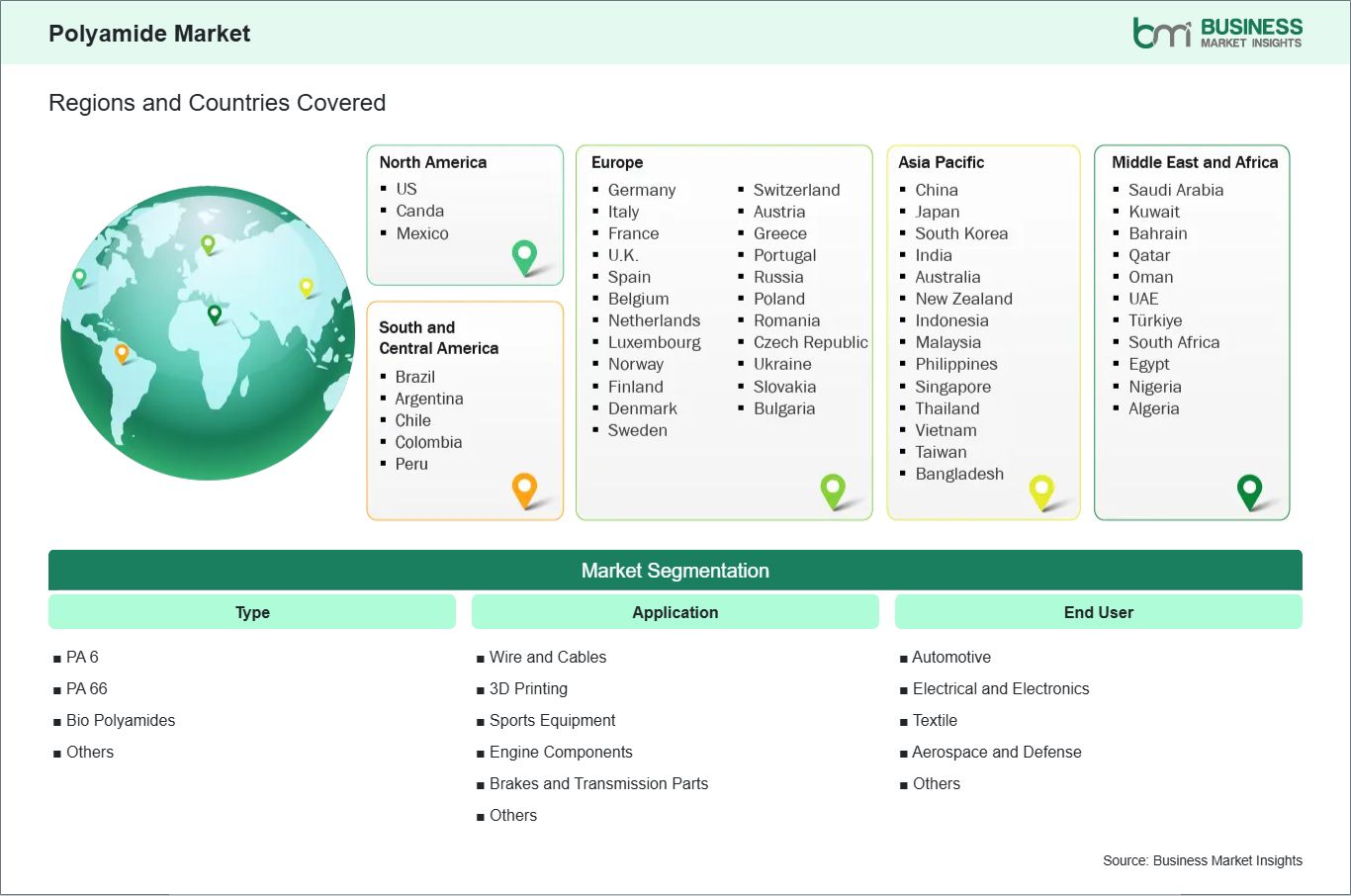
Key segments that contributed to the derivation of the Polyamide Market analysis are type, application, and end user.
- By Type, the market is segmented into PA 6, PA 66, Bio Polyamides, and Others.
- By Application, the market is segmented into Wire and Cables, 3D Printing, Sports Equipment, Engine Components, Brakes and Transmission Parts, and Others.
- By End User, the market is segmented into Automotive, Electrical and Electronics, Textile, Aerospace and Defense, and Others.
Market Forces
Polyamide Market Drivers and Opportunities
Growing Demand for Lightweight Materials for Automotives
The principal driver for the Polyamide (PA or Nylon) market is the critical demand for lightweight, high-performance materials from the automotive sector, intensely accelerated by the global shift toward electric vehicles (EVs) and e-mobility. Polyamides are ideal for replacing heavier metal parts in vehicles due to their superior strength-to-weight ratio, high mechanical strength, and excellent thermal/chemical resistance.
In conventional and electric vehicles, PA reduces overall mass, which improves fuel efficiency in combustion engines and extends the battery range in EVs. Crucially, the growth of e-mobility mandates the use of specialized polyamides for battery housings, high-voltage connectors, cooling ducts, and other components requiring exceptional electrical insulation, flame retardancy, and thermal stability in harsh, high-heat environments. This necessity for weight reduction and high-performance material integration makes the automotive industry the largest consumer and primary growth engine for advanced polyamides.
Surging Investments in Bio-Based and Recycled Polyamide Grades
A significant and high-value opportunity lies in the accelerating research and investment in bio-based and recycled polyamide grades and the expansion into high-performance, specialized engineering plastics segments. Consumers and manufacturers are increasingly prioritizing sustainability, driving the demand for polyamides derived from renewable sources like castor oil (e.g., PA 11, PA 10.10) or recycled content.
These bio-based and circular materials often offer comparable, or even superior, properties while aligning with corporate environmental, social, and governance (ESG) goals, commanding premium pricing. Furthermore, the market is capitalizing on the demand for advanced engineering polyamides (e.g., PA 66, PA 4.6, and high-temperature polyamides like PPA) in demanding applications. This includes miniaturized electronics, 5G infrastructure components, and high-performance parts for industrial machinery, where properties such as exceptional dimensional stability and wear resistance are paramount.
Size and Share Analysis
Polyamide Market Size and Share Analysis
The Polyamide Market demonstrates steady growth, with size and share analysis revealing evolving trends and competitive positioning among key players. The report further examines subsegments categorized within type, application, and end user, offering insights into their contribution to overall market performance.
For instance, PA 66 is widely adopted for Engine Components, brakes, and Transmission Parts. This subsegment is driven by its superior heat resistance, mechanical strength, and stiffness required for under-the-hood and structural applications.
PA 6 is commonly utilized in the Textile industry for fibers in apparel and carpet manufacturing, as well as in Wire and Cables for protective jacketing. Its versatility, good abrasion resistance, and cost-effectiveness drive high-volume demand across multiple sectors.
Report Coverage
Polyamide Market Report Coverage and Deliverables
The "Polyamide Market Size and Forecast (2022 - 2033)" report provides a detailed analysis of the market covering below areas:
- Polyamide Market size and forecast at global, regional, and country levels for all the key market segments covered under the scope
- Polyamide Market trends, as well as market dynamics such as drivers, restraints, and key opportunities
- Polyamide Market analysis covering key market trends, global and regional framework, major players, regulations, and recent market developments
- Industry landscape and competition analysis covering market concentration, heat map analysis, prominent players, and recent developments for the Polyamide Market
- Detailed company profiles, including SWOT analysis
Geographic Insights
Polyamide Market Geographic Insights
The geographical scope of the Polyamide Market report is divided into five regions: North America, Asia Pacific, Europe, the Middle East & Africa, and South & Central America.
The Asia-Pacific Polyamide Market is segmented into China, Japan, South Korea, India, Australia, New Zealand, Indonesia, Malaysia, the Philippines, Singapore, Thailand, Vietnam, Taiwan, Bangladesh, and the Rest of Asia. The Asia-Pacific market is driven by the massive presence of the automotive manufacturing hub and soaring demand from the electrical & electronics sector.
Growth is further supported by the expanding construction industry and the high-volume production of films and coatings used in packaging. The increasing adoption of bio-based polyamides and the region's strong position in textile and apparel production solidify Asia-Pacific's role as the primary global engine for polyamide market growth.
Industry Activity
Recent Developments
The Polyamide Market is evaluated by gathering qualitative and quantitative data post-primary and secondary research, which includes important corporate publications, association data, and databases. A few of the key developments in the Polyamide Market are:
- In July 2025, Arkema announced the construction of a new Rilsan® Clear transparent polyamide unit on its Singapore platform. The new capacity represents an investment of around US$ 20 million and is expected to be operational in the first quarter of 2026.
- In November 2025, Evonik announced the successful trial production of the second polyamides reactor at its Shanghai site. The achievement paves the way to doubling Evonik’s long-chain polyamides production capacity in Asia and strengthening the company’s market-leading role in high-performance polyamides.
Trust & Transparency
Research Methodology
The market analysis combines proprietary research with secondary data from government agencies, company disclosures, regulatory filings, industry databases and expert interviews. Market estimates are validated through data triangulation, cross-market benchmarking and analyst
review.
View Full Research Methodology
Key Sources Referred:
World Bank - Global Trade IndicatorsWorld Trade Organization (WTO)International Monetary Fund (IMF)International Trade Administration (ITA)Company WebsitesCompany Annual ReportsCompany Investor Presentations