
Point of Sale Market Outlook: Size, Share, Trends, Growth Analysis, Competitive Landscape & Forecast, 2026-2033

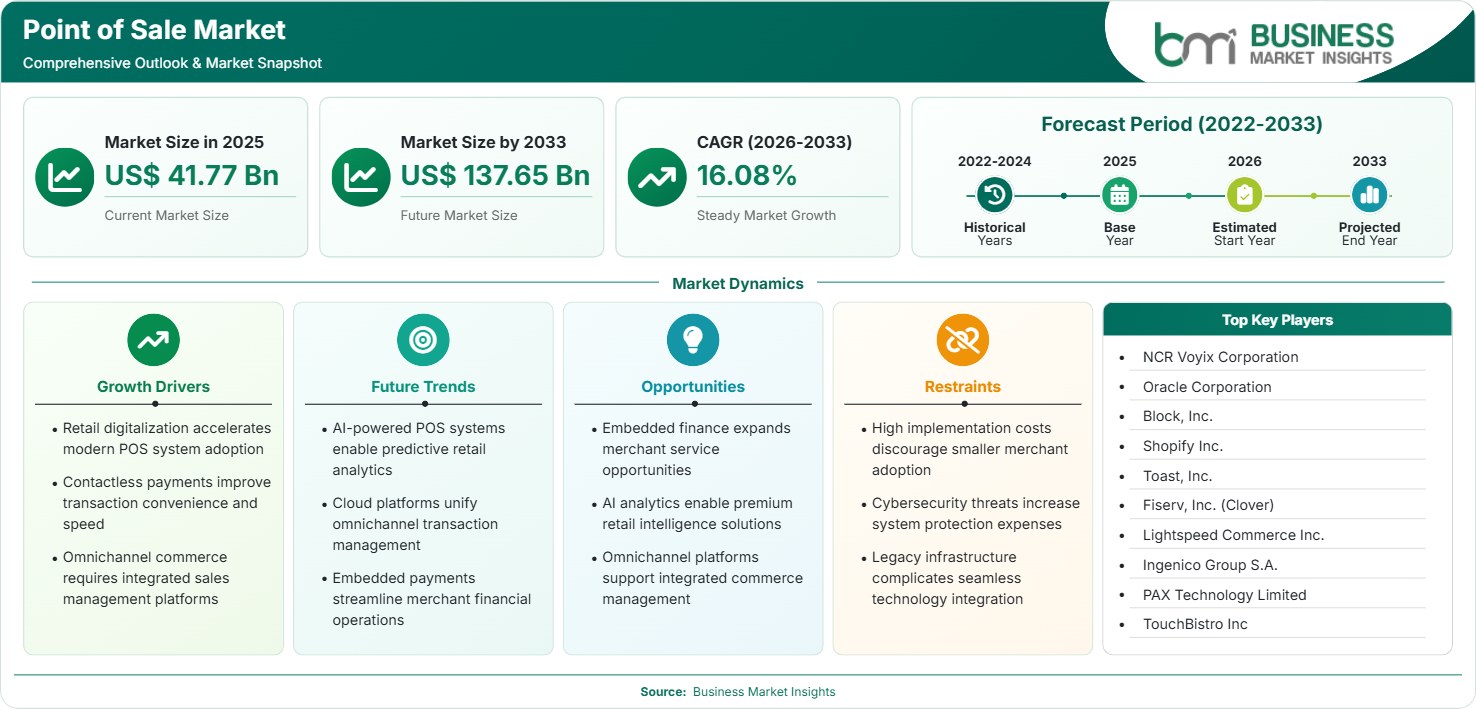
The Point of Sale Market size was valued at US$ 41.77 Billion in 2025 and is projected to reach US$ 137.65 Billion by 2033, growing at a CAGR of 16.08% during 2026–2033. Rising digital payment adoption, omnichannel retail expansion, cloud-native commerce platforms, AI-driven analytics, and growing SME digitization continue to create substantial opportunities across retail, restaurant, and entertainment ecosystems.

Report Coverage
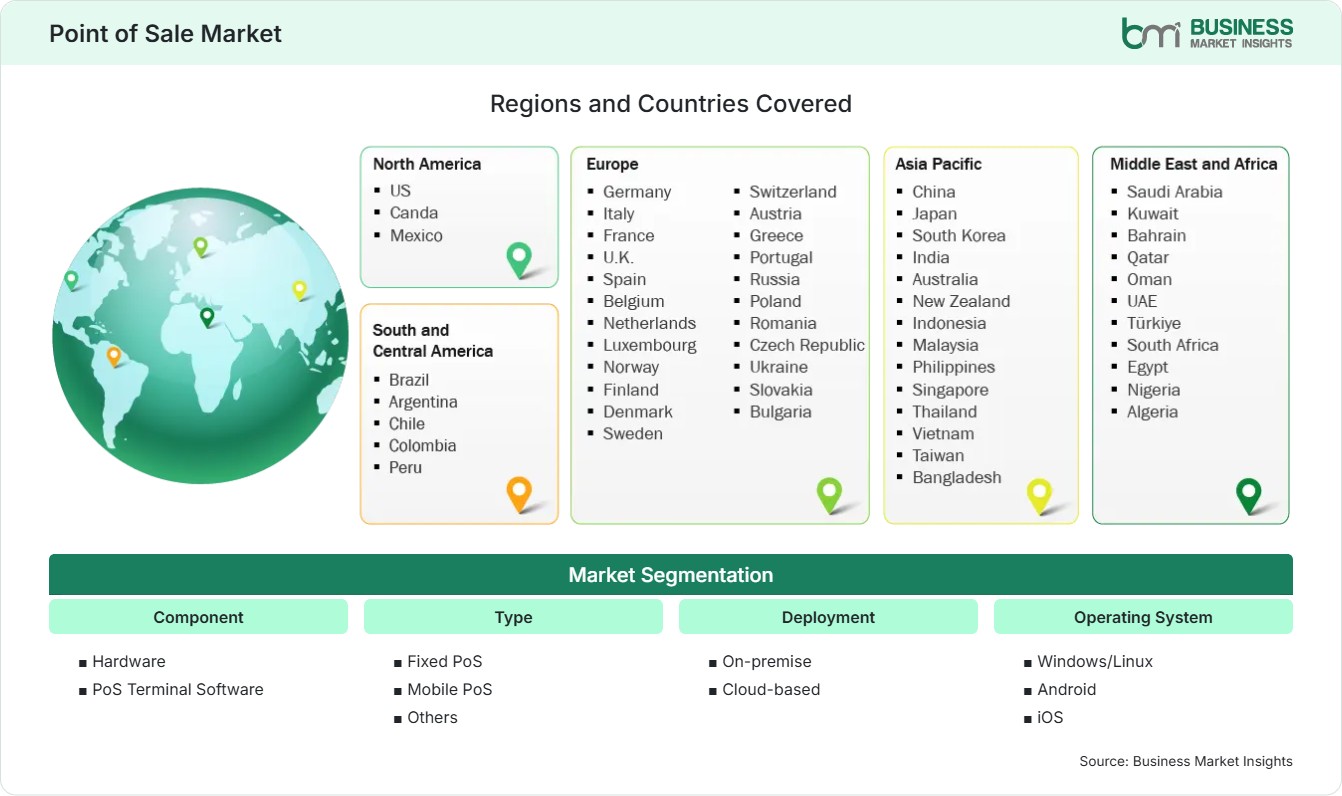
  • Component: Hardware, PoS Terminal Software
  • Type: Fixed PoS, Mobile PoS, Others
  • Deployment: On-premise, Cloud-based
  • Operating System: Windows/Linux, Android, iOS
  • End-user: Restaurants, Retail, Entertainment, Others
US$ 41.77 Bn Market size in 2025
US$ 137.65 Bn Market Size by 2033
16.08% CAGR, 2026 - 2033
2026-2033 Forecast Period

AI Overview

Point of Sale Market Summary

  • North America Region: North America holds a market share of 34%–37% in 2025, growing with a CAGR of 14.5%–15.5%. Adoption of cloud commerce platforms, contactless transactions, integrated payment ecosystems, retail modernization, restaurant automation, and analytics-driven customer engagement continues accelerating technology investments across enterprises. US market benefits from advanced payment infrastructure and omnichannel commerce adoption, expanding at 14.8%–15.8% CAGR.
  • Fastest Growing Region: Asia Pacific holds a market share of 25%–28% in 2025, growing with a CAGR of 18.5%–19.5%. Rapid merchant digitization, QR-based payments, mobile commerce expansion, government-backed cashless initiatives, retail investments, and rising SME technology spending sustain robust deployment momentum across developing economies.
  • Leading Segment: Hardware holds a market share of 53%–56% in 2025, growing with a CAGR of 14.5%–15.5%. Terminal replacement cycles, NFC-enabled payment acceptance, upgraded security standards, self-service installations, and enterprise retail modernization projects continue supporting segment dominance across large transaction environments.
  • High Growth Segment: Cloud-based deployment holds a market share of 44%–47% in 2025, growing with a CAGR of 19.5%–20.5%. Subscription-based software adoption, centralized management, scalability requirements, remote administration, analytics integration, and multi-location retail operations are expanding demand for cloud-native transaction platforms globally.
  • Key Market Opportunity: Embedded payments, AI-enabled sales intelligence, unified commerce architecture, and digital merchant onboarding are enabling vendors to create recurring revenue models while improving customer retention and transaction visibility.
  • Major Market Players: NCR Voyix Corporation, Oracle Corporation, Block, Inc., Shopify Inc., Toast, Inc., Fiserv, Inc. (Clover), Lightspeed Commerce Inc., Ingenico Group S.A., PAX Technology Limited, and TouchBistro Inc.
Strategic Insights

Point of Sale Market: Strategic Insights

Point of Sale Market Strategic Framework
FREE PDF
Request your free sample
Request free sample
Stakeholder View

Key Takeaways

  • Hardware manufacturers, software developers, payment processors, cloud providers, and companies that provide merchant services are becoming more integrated into a single commerce value chain.
  • The best near-term chances for expansion are offered by mobile-first merchant platforms and cloud-based deployments, especially when it comes to small and medium-sized businesses.
  • Analytics enabled by AI, along with predictive inventory management and automated customer engagement, are increasingly becoming key factors in gaining a competitive edge.
  • India, Indonesia, Vietnam, and Brazil offer great potential for investment due to the digital payment opportunities and the expanding retail infrastructure.
  • More strategic acquisitions are concentrating on payment orchestration, restaurant technology, and merchant software ecosystems to secure steady revenue streams.
  • Financial services that are embedded, such as lending and loyalty programs, are extending how the platform can be monetized beyond simply processing transactions.
Geographic Outlook

Point of Sale Market Regional Highlights

North America Point of Sale Market

North America accounted for 34%–37% Point of Sale Market share in 2025 and is projected to expand at a CAGR of 14.5%–15.5% through 2033. The presence of robust digital payment systems, extensive use of contactless payments, advanced retail networks, and high software investments helps in creating regional dominance. The enterprise retailers focus more on commerce platforms that integrate the online and offline channels. The restaurant chains keep on making investments in the area of self-ordering, kiosk systems, and customer analytics.

  • Stores are now using AI-powered checkout analytics to improve their conversion rates, get better visibility into their inventory, and enhance customer retention in both physical and online sales.
  • Enterprise merchants are still replacing their old terminals with cloud-connected systems that support omnichannel payments, digital receipts, and centralized operational management.
  • The greater the involvement of fintech companies, the more accessible integrated payment processing, loyalty tools, and embedded financial services become for merchants.
  • Hospitality companies are now putting more money into tableside ordering, self-service kiosks, and customer personalization technologies.

US Point of Sale Market

The US represented approximately 76%–80% share within North America during 2025 and is advancing at 14.8%–15.8% CAGR. High payment card adoption, sophisticated software ecosystem, and restaurant digitalization provide a foundation for steady demand. Merchants use cloud architecture, a self-checkout solution, and a customer data platform to improve their operations. Constant innovations by payment companies and technology suppliers contribute to further growth of the market.

  • Large retailers keep updating their checkout systems to support shared inventory and sales processes.
  • Restaurant chains increasingly integrate loyalty programs directly within transaction workflows.
  • The greater the adoption of subscription-based software, the more recurring spending on technology increases.
  • Acceptance among consumers is still growing for digital wallets and other forms of payment.

Europe Point of Sale Market

Europe held 27%–30% share in 2025 and is expected to grow at 15.0%–16.0% CAGR. Regulatory emphasis on electronic payments, fiscal compliance, and transaction transparency supports adoption. Germany and the United Kingdom remain leading revenue contributors, while Poland and Spain demonstrate stronger growth trajectories approaching 16.5%–17.5% CAGR. Retail automation investments and hospitality digitalization initiatives continue to encourage platform modernization. Cloud migration and integrated payment ecosystems remain central purchasing priorities.

  • The requirements imposed by electronic invoicing initiatives prompt merchants to upgrade their technology.
  • The need for multiple currencies and the ability to operate through various channels is caused by cross-border commerce.
  • The need for software integration rises with retail modernization programs.
  • Hospitality business operators place a priority on customer experience technologies and on accepting flexible payments.

Asia Pacific Point of Sale Market

Asia Pacific captured 25%–28% Point of Sale Market share in 2025 and records the highest CAGR of 18.5%–19.5%. Rapid urbanization, mobile-based commerce, QR payment adoption, and expanding SME digitization support regional acceleration. China, Japan, and India lead deployment volumes, while India and Southeast Asian economies register the fastest expansion. Government initiatives promoting digital transactions and financial inclusion continue to strengthen merchant technology investments across modern retail and service sectors.

  • The use of QR codes to enable payment systems speeds up the process of onboarding merchants in emerging economies.
  • The greater the expansion of organized retail chains, the greater the demand for integrated store management technologies.
  • The increasing number of people using smartphones supports mobile transaction environments.
  • Government cashless programs help set up payment systems.
  • Business models that are based on the cloud appeal to small enterprises looking for inexpensive solutions.

Rest of World Point of Sale Market

Rest of World accounted for 10%–13% Point of Sale Market share in 2025 and is projected to grow at 16.0%–17.0% CAGR. South and Central America benefit from expanding electronic payment adoption and retail modernization. The Middle East and Africa are increasingly investing in digital commerce infrastructure, tourism-related spending, and merchant acquisition programs. Brazil and Saudi Arabia remain key contributors, while the UAE and South Africa show notable technology adoption momentum supported by fintech ecosystem development.

  • The aims of financial inclusion programs are to increase the adoption of digital payments among small merchants.
  • Retail transformation initiatives promote a shift towards integrated transaction platforms.
  • The growth in tourism leads to increased investment in technology aimed at the hospitality sector.
  • The formation of partnerships between fintech companies speeds up the deployment of solutions that are based on mobile and cloud technology.
Global Market Geography
FREE PDF
Request your free sample
Request free sample
Segment Analysis

Point of Sale Market Segmentation

Component

Component adoption reflects the balance between transaction hardware and functional software ecosystems. Hardware commanded 53%–56% share in 2025 with 14.5%–15.5% CAGR, supported by terminal refresh cycles. The Point of Sale Market scope continues expanding as merchants seek integrated commerce architectures combining payment acceptance, analytics, inventory, and customer engagement capabilities.

  • Hardware: Terminals, scanners, receipt printers, kiosks, and payment devices remain essential transaction infrastructure supporting speed, compliance, and customer convenience across multiple end-use environments.
  • PoS Terminal Software: Cloud connectivity, analytics integration, inventory management, and customer relationship tools drive software differentiation and recurring subscription revenues.

Type

Deployment preferences increasingly vary according to business scale and mobility requirements. Fixed installations continue serving high-volume retail environments, while mobile formats gain traction among restaurants, pop-up stores, and service providers. The shift toward flexible merchant operations supports healthy expansion across platform categories.

  • Fixed PoS: Provides stability, advanced peripheral integration, and robust transaction processing capabilities suitable for supermarkets, department stores, and large retail chains.
  • Mobile PoS: Supports mobility, line-busting, tableside ordering, and flexible payment acceptance, improving customer experience and operational efficiency.

Deployment

Cloud-oriented architectures are reshaping vendor strategies and merchant purchasing decisions. Cloud-based solutions hold 44%–47% share and register 19.5%–20.5% CAGR, significantly exceeding traditional deployments. Centralized updates, scalability, lower maintenance costs, and remote visibility support widespread migration activities.

  • On-premise: Preferred by organizations requiring direct infrastructure control, customized workflows, and specific compliance frameworks.
  • Cloud-based: Delivers real-time visibility, subscription pricing, rapid deployment, and simplified management across distributed retail networks.

Operating System

Operating system choices influence software compatibility, hardware flexibility, and ecosystem integration. Merchants increasingly prioritize open architectures and mobile-friendly environments. Vendor differentiation increasingly centers on user experience and third-party connectivity.

  • Windows/Linux: Widely adopted across enterprise retailers requiring extensive peripheral compatibility and established operational frameworks.
  • Android: Rapidly expanding due to affordability, flexibility, mobile functionality, and growing application ecosystems.
  • iOS: Favored by premium merchants prioritizing user experience, security, and seamless device integration.

End-user

End-user demand patterns reflect changing consumer expectations and digital commerce integration. Retail remains the largest adopter, while hospitality-oriented environments increasingly deploy advanced customer engagement solutions. Point of Sale Market trends indicate broader adoption across experiential and service-based sectors.

  • Restaurants: Demand tableside ordering, kitchen integration, loyalty management, and customer personalization capabilities.
  • Retail: Requires inventory synchronization, omnichannel fulfillment, promotions management, and advanced transaction analytics.
  • Entertainment: Utilizes rapid payment acceptance, ticketing integration, and high-volume transaction management technologies.
Market Forces

Point of Sale Market Dynamics

Key Market Drivers

Expansion of Digital and Contactless Payment Ecosystems

Global migration toward electronic payments remains a primary growth catalyst. The European Central Bank reported continued expansion of contactless card transactions during recent reporting periods, reflecting consumer preference for frictionless payment experiences. Merchant demand for NFC-enabled terminals, digital wallet compatibility, and real-time authorization capabilities continues to increase. Retailers and restaurants increasingly invest in advanced transaction technologies to reduce checkout times and improve customer satisfaction. This driver directly supports Point of Sale Market growth across developed and emerging economies as cashless commerce becomes more prevalent and merchant acceptance infrastructure expands accordingly.

Rapid Adoption of Cloud-Based Commerce Platforms

Businesses are now favoring cloud architectures since these make software upgrades easier, allow for centralized management, and lower infrastructure costs. Retailers who have multiple locations and restaurant operators depend on real-time analytics and the synchronization of their inventory in order to enhance their performance. Cloud technologies also enable shorter deployment cycles and integration with loyalty, accounting, and customer engagement applications. When merchants place a priority on having operational visibility and scalability, those vendors who provide subscription-based solutions gain a competitive edge. The shift from separate transaction systems to connected commerce environments is causing implementation efforts to accelerate among both small businesses and large multinational organizations.

Growth of Omnichannel Retail and Unified Commerce

Retailers are now linking together e-commerce, mobile commerce, and their physical stores using unified transaction platforms. Customers want the same pricing, full visibility of inventory, and a consistent payment experience no matter which channel they use. In response, businesses need technologies that can coordinate fulfillment, returns, promotions, and customer data. Sophisticated transaction platforms achieve these aims while also producing useful operational intelligence. As online and offline commerce models become more integrated, the areas merchants invest in increasingly focus on systems that provide integrated customer journeys, streamlined operations, and greater profitability through real-time decision support.

Key Market Opportunities

Embedded Finance and Value-Added Merchant Services

Transaction platforms increasingly serve as distribution channels for lending, loyalty management, insurance offerings, and working capital solutions. Vendors capable of embedding financial services within merchant workflows can significantly expand recurring revenue opportunities. Small business customers especially value simplified access to financing and operational tools. These capabilities strengthen customer retention and platform stickiness while creating differentiated market positioning. Point of Sale Market Forecasts increasingly reflect growing monetization opportunities beyond transaction processing, particularly as software platforms evolve into broader business management ecosystems.

Emerging Market Merchant Digitization

In many parts of Asia, Africa, and Latin America, merchants are still not well served by sophisticated transaction technologies. The expansion of smartphone use, better connectivity, and favorable government policies have created good conditions for wider adoption. Because affordable cloud solutions and mobile acceptance devices are available, small businesses find it easier to get started. Businesses that aim to meet local payment preferences and comply with regional regulations can take advantage of considerable growth opportunities. The ongoing formalization of commercial activity also improves the long-term prospects for the rollout of these solutions in emerging economies.

AI-Powered Analytics and Personalization Solutions

By using artificial intelligence, transaction platforms can generate operational insights, suggest inventory actions, and tailor customer engagement. There is a growing demand from merchants for tools that can turn transaction data into practical business intelligence. AI-driven forecasting leads to better resource allocation, and predictive analytics helps optimize revenue. Since competitive pressures are rising, there is likely to be a greater willingness among businesses to invest in intelligent commerce technologies. Those vendors that incorporate AI capabilities directly into merchants' workflows will gain considerable competitive differentiation.

Market Restraints and Challenges

Cybersecurity Risks and Data Privacy Requirements

The greater the digitization of transactions, the larger the exposure to cyber threats, payment fraud, and risks involving sensitive customer data. As a result, merchants have to bear higher compliance costs, make greater infrastructure investments, and deal with increased operational complexity. It is necessary for organizations to maintain payment security standards, monitor threats, and implement sophisticated protection measures. Smaller businesses often struggle to overcome limitations in cybersecurity resources, leading them to delay upgrading their technology. When breaches occur, the vendor's reputation also suffers. These problems lead to higher implementation costs and may slow purchasing decisions, especially among cost-conscious organizations concerned about regulatory compliance and long-term risk management.

Integration Complexity Across Legacy Business Systems

Many organizations have fragmented technology environments, consisting of legacy software, outdated payment systems, and various operational applications. As a result, integration projects end up being expensive, require a lot of resources, and take up a great deal of time; compatibility problems can disrupt business processes and lead to longer deployment times. The need for custom configurations also increases implementation risk. When large companies seek to modernize their transaction ecosystems, they often encounter significant migration challenges. All of this can delay the return on investment and cause organizations to hesitate to consider extensive platform transformation programs, even when there are clear operational advantages.

Company Analysis

Competitive Landscape

Point of Sale Market analysis highlights competition among software providers, payment processors, hospitality technology specialists, and integrated commerce platform vendors.

Company Name

Overview

Products and Services relevant to this market

NCR Voyix Corporation

Global commerce technology leader serving retail and restaurant enterprises with large-scale transaction infrastructure.

POS software, self-checkout systems, payment processing integration, retail and restaurant commerce platforms.

Oracle Corporation

Enterprise software provider with strong hospitality and retail transaction management capabilities.

Oracle MICROS POS, cloud restaurant management, retail applications, analytics solutions.

Block, Inc.

Fintech company providing commerce and payment acceptance solutions for merchants.

Square POS, payment processing, merchant tools, invoicing and business management software.

Shopify Inc.

Omnichannel commerce platform supporting online and physical retail operations.

Shopify POS, inventory management, customer engagement and commerce software.

Toast, Inc.

Restaurant-focused technology provider serving independent and chain operators.

Restaurant POS, payroll integration, ordering, analytics, and management solutions.

Fiserv, Inc. (Clover)

Major payments company with extensive small business merchant network.

Clover POS devices, payment acceptance, analytics, and merchant services.

Lightspeed Commerce Inc.

Commerce platform provider targeting retailers and hospitality businesses.

Cloud POS, inventory tools, payments, and customer management applications.

Ingenico Group S.A.

Global payment technology specialist with broad terminal portfolio.

Smart terminals, payment acceptance infrastructure, security solutions.

PAX Technology Limited

Payment technology manufacturer serving merchants worldwide.

Android-based terminals, smart payment devices, software integration tools.

TouchBistro Inc.

Hospitality-focused platform specializing in restaurant operations.

Restaurant POS, tableside ordering, reservations, and reporting tools.

Trust & Transparency

Research Methodology

The market analysis combines proprietary research with secondary data from government agencies, company disclosures, regulatory filings, industry databases and expert interviews. Market estimates are validated through data triangulation, cross-market benchmarking and analyst review.

View Full Research Methodology

Questions Answered

Frequently Asked Questions

Which end-user industry remains the largest adopter?

Retail remains the dominant adopter because it requires inventory synchronization, omnichannel commerce execution, customer engagement capabilities, and high-volume transaction processing.

How does the Point of Sale Market Report help stakeholders?

The Point of Sale Market Report supports strategic planning by evaluating competitive positioning, technology trends, deployment strategies, growth opportunities, and regional demand patterns.

Why are cloud-based solutions gaining popularity?

Cloud deployments reduce maintenance costs, simplify software upgrades, enable centralized management, and provide better visibility across multiple business locations.

Which region offers the strongest long-term expansion potential?

Asia Pacific presents the strongest growth outlook due to digital payment adoption, SME digitization, government support for cashless commerce, and expanding organized retail networks.

What is driving adoption of advanced transaction platforms?

Growing demand for contactless payments, omnichannel retail integration, cloud deployment, and AI-enabled analytics is encouraging merchants to modernize payment and business management infrastructure.

Access the Full Point of Sale Market Report

Get segment-level forecasts, regional estimates, competitive benchmarking, company profiles and downloadable Excel datasets.

Access the full Point of Sale Market Report
350 pages PDF & Excel | 2026-09-16
Similar Research

Related Market Reports