Market Summary
Executive Summary and Global Market Analysis
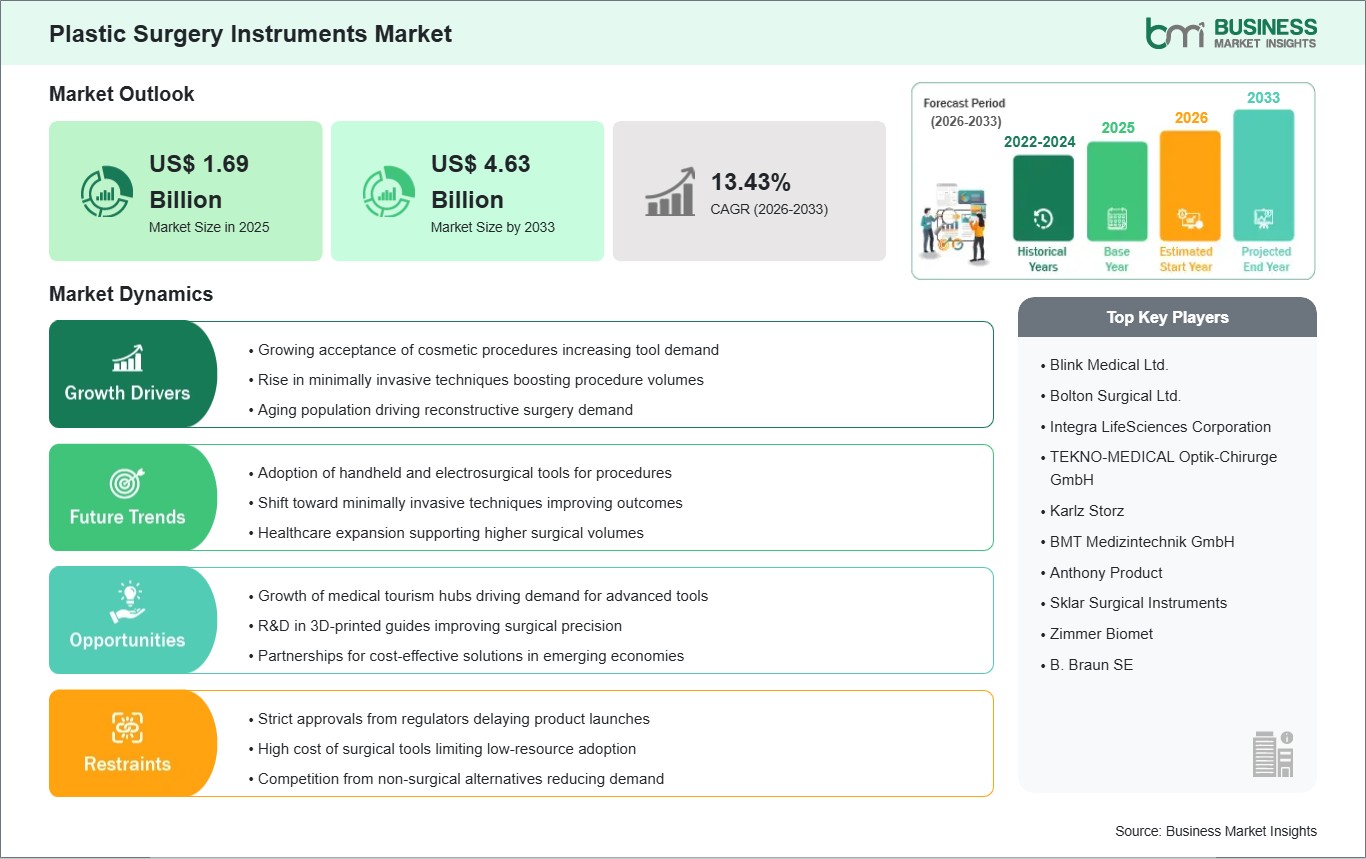
Plastic surgery instruments are specialized, handheld, and energy-based tools designed for precise manipulation of skin, soft tissue, and bone. They are essential for both reconstructive surgeries after trauma or oncology and elective cosmetic procedures. Market growth is driven by the global normalization of aesthetic procedures influenced by social media, the rapid adoption of minimally invasive techniques that reduce patient recovery time, and increased demand from an aging population. Additionally, the shift toward Ambulatory Surgical Centers, which focus on high-volume outpatient procedures, is increasing demand for specialized, often single-use or durable instrument sets.
However, several challenges may limit market growth. High capital costs for advanced energy-based systems often restrict adoption in smaller private clinics. Stringent regulatory requirements, including the transition to new Medical Device Regulations in Europe, increase compliance costs and delay the introduction of innovative micro-tools. The industry also faces competition from non-surgical alternatives, such as injectables and laser therapies, which can reduce demand for traditional surgical procedures requiring specialized instruments.
Despite these challenges, the market offers significant opportunities. Growth in medical tourism hubs in Asia and Latin America and the adoption of 3D-printed, patient-specific surgical guides are expanding the market. The rise of robotic-assisted plastic surgery and the development of gender-specific ergonomic handles are also expected to drive long-term growth.
Segment Analysis
Plastic Surgery Instruments Market Segmentation
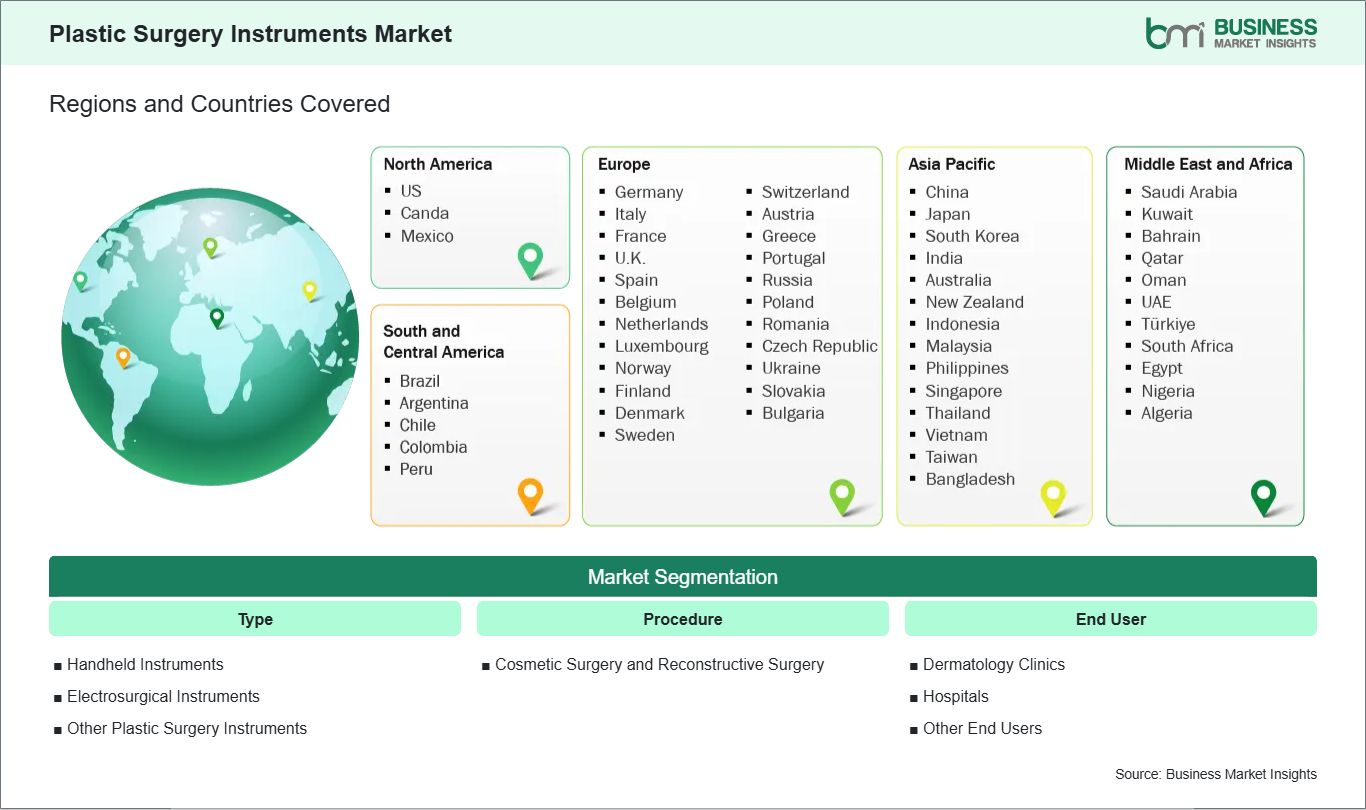
Key segments that contributed to the derivation of the Plastic Surgery Instruments market analysis are type, procedure, and end user.
- By Type, the market is segmented into Handheld Instruments, Electrosurgical Instruments, and Other Plastic Surgery Instruments.
- By Procedure, the market is divided into Cosmetic Surgery and Reconstructive Surgery.
- By End User, the market is categorized into Dermatology Clinics, Hospitals, and Other End Users.
Market Forces
Plastic Surgery Instruments Market Drivers and Opportunities
Aesthetic Normalization and the Surge in Minimally Invasive Reconstruction
The primary driver of the Plastic Surgery Instruments Market is the global increase in both cosmetic and reconstructive procedure volumes. The growing influence of social media and the prevalence of selfie culture serve as dominant catalysts, reducing the social stigma associated with aesthetic procedures and promoting prejuvenation trends among younger populations. This trend is further supported by the adoption of minimally invasive and electrosurgical techniques. As surgeons increasingly favor smaller incisions, the demand for bipolar and monopolar electrosurgical systems, which provide greater precision and reduced operative times, is surpassing that for traditional handheld instruments.
Additionally, the aging global population is a significant factor, as older adults more frequently seek reconstructive surgeries for age-related tissue degeneration and skin cancer repairs. The rise in body contouring procedures following substantial weight loss has also generated a new patient cohort requiring complex surgical interventions. Collectively, these factors, normalization of aesthetic procedures, advancements in surgical technology, and demographic changes, are driving sustained growth in the global plastic surgery supply chain.
AI-Integrated Robotics and 3D-Printed Custom Toolsets
A significant opportunity exists in the integration of plastic surgery instruments with robotic-assisted systems and AI-driven navigation. Next-generation robotic platforms are under development for super-microsurgery, allowing surgeons to perform complex lymphatic and nerve repairs with a level of stability and precision beyond human capability. Additionally, the advancement of 3D-printed, patient-specific surgical guides and instruments represents a major growth area. Utilizing preoperative imaging to produce custom templates for facial reconstruction enables manufacturers to enhance anatomical accuracy and achieve improved aesthetic symmetry.
The expansion of single-use, ergonomic handheld instruments presents a lucrative opportunity for ambulatory surgical centers (ASCs), which prioritize disposable tools to reduce costs and minimize infection risks associated with traditional sterilization. In addition to hardware innovations, the emergence of augmented reality (AR) overlay systems introduces a new frontier, integrating instruments with headsets that project the patient's internal vascular anatomy onto the skin surface during surgery. Manufacturers emphasizing titanium-alloy lightweight designs and pioneering regenerative aesthetic add-ons, such as fat-transfer cannulas, are well positioned to lead the plastic surgery instruments market.
Size and Share Analysis
Plastic Surgery Instruments Market Size and Share Analysis
The Plastic Surgery Instruments market demonstrates steady growth, with size and share analysis revealing evolving trends and competitive positioning among key players. The report further examines subsegments categorized within type, procedure, and end user, offering insights into their contribution to overall market performance.
Based on procedure, the Cosmetic Surgery and Reconstructive Surgery subsegment holds a significant share of the market, with increasingly interconnected drivers. Cosmetic Surgery remains essential, driven by the widespread acceptance of procedures such as rhinoplasty and breast augmentation. A key trend is the growth of the Reconstructive Surgery subsegment, particularly in Oncology-Related Repair and Congenital Correction, which are experiencing increased demand. In these fields, plastic surgery instruments are critical for Functional Aesthetics, as specialized microsurgical kits facilitate the complex vascular and nerve suturing necessary for successful tissue flap transfers and limb salvage.
Report Coverage
Plastic Surgery Instruments Market Report Coverage and Deliverables
The "Plastic Surgery Instruments Market Size and Forecast (2022–2033)" report provides a detailed analysis of the market covering below areas:
- Plastic Surgery Instruments market size and forecast at global, regional, and country levels for all the key market segments covered under the scope
- Plastic Surgery Instruments market trends, as well as market dynamics such as drivers, restraints, and key opportunities
- Plastic Surgery Instruments market analysis covering key market trends, global and regional framework, major players, regulations, and recent market developments
- Industry landscape and competition analysis covering market concentration, heat map analysis, prominent players, and recent developments for the Plastic Surgery Instruments market
- Detailed company profiles, including SWOT analysis
Geographic Insights
Plastic Surgery Instruments Market Geographic Insights
The geographical scope of the Plastic Surgery Instruments market report is divided into five regions: North America, Asia Pacific, Europe, Middle East & Africa, and South & Central America.
North America remains the leading region in the global market, supported by the highest volume of surgical aesthetic procedures and a significant concentration of board-certified surgeons employing advanced handheld and electrosurgical instruments. Europe sustains strong demand for reconstructive and aesthetic instruments, especially in Germany and France, where there is a marked preference for high-quality stainless steel and titanium micro-instruments. The Asia Pacific region is identified as the fastest-growing market, driven by expanding medical tourism in South Korea and Thailand and increasing disposable incomes in China and India.
The Asia-Pacific plastic surgery instruments market is segmented into China, Japan, South Korea, India, Australia, and the rest of Asia Pacific. South Korea continues to serve as a global center for facial and bone contouring, resulting in elevated demand for specialized rasps, osteotomes, and chisels. In China, market expansion is attributed to the increasing prevalence of minimally invasive 'lunch-time' procedures that require specialized needles and cannulas. India is experiencing growth in reconstructive surgeries following trauma and congenital repairs, while Australia demonstrates consistent growth in breast augmentation and body contouring instrumentation.
Industry Activity
Recent Developments
The Plastic Surgery Instruments market is evaluated by gathering qualitative and quantitative data post primary and secondary research, which includes important corporate publications, association data, and databases. A few of the key developments in the Plastic Surgery Instruments market are:
- In July 2025, ZEISS Medical Technology launched the PENTERO® 800 S surgical microscope in China, approved by the NMPA. Designed for neuro, spine, ENT, and plastic/reconstructive surgery, the device features 4K 3D visualization, enhanced magnification, and ergonomic design, strengthening high-end surgical capabilities in the Chinese market.
- In January 2025, MicroAire Surgical Instruments acquired NEOSYAD, integrating its AdiMate® device and Adipure® single-use kit into MicroAire`s portfolio. The technology, approved under EU MDR, combines infiltration, liposuction, and adipose tissue preparation in a single system, reducing operating times and ensuring high-quality fat for lipofilling procedures. This acquisition strengthens MicroAire`s leadership in the global plastic and reconstructive surgery instruments market.
Trust & Transparency
Research Methodology
The market analysis combines proprietary research with secondary data from government agencies, company disclosures, regulatory filings, industry databases and expert interviews. Market estimates are validated through data triangulation, cross-market benchmarking and analyst
review.
View Full Research Methodology
Key Sources Referred:
World Bank – Global Trade IndicatorsWorld Trade Organization (WTO)(International Monetary Fund )IMFInternational Trade Administration (ITA)Company websiteCompany annual reportsCompany investor presentations