Market Summary
Executive Summary and Global Market Analysis
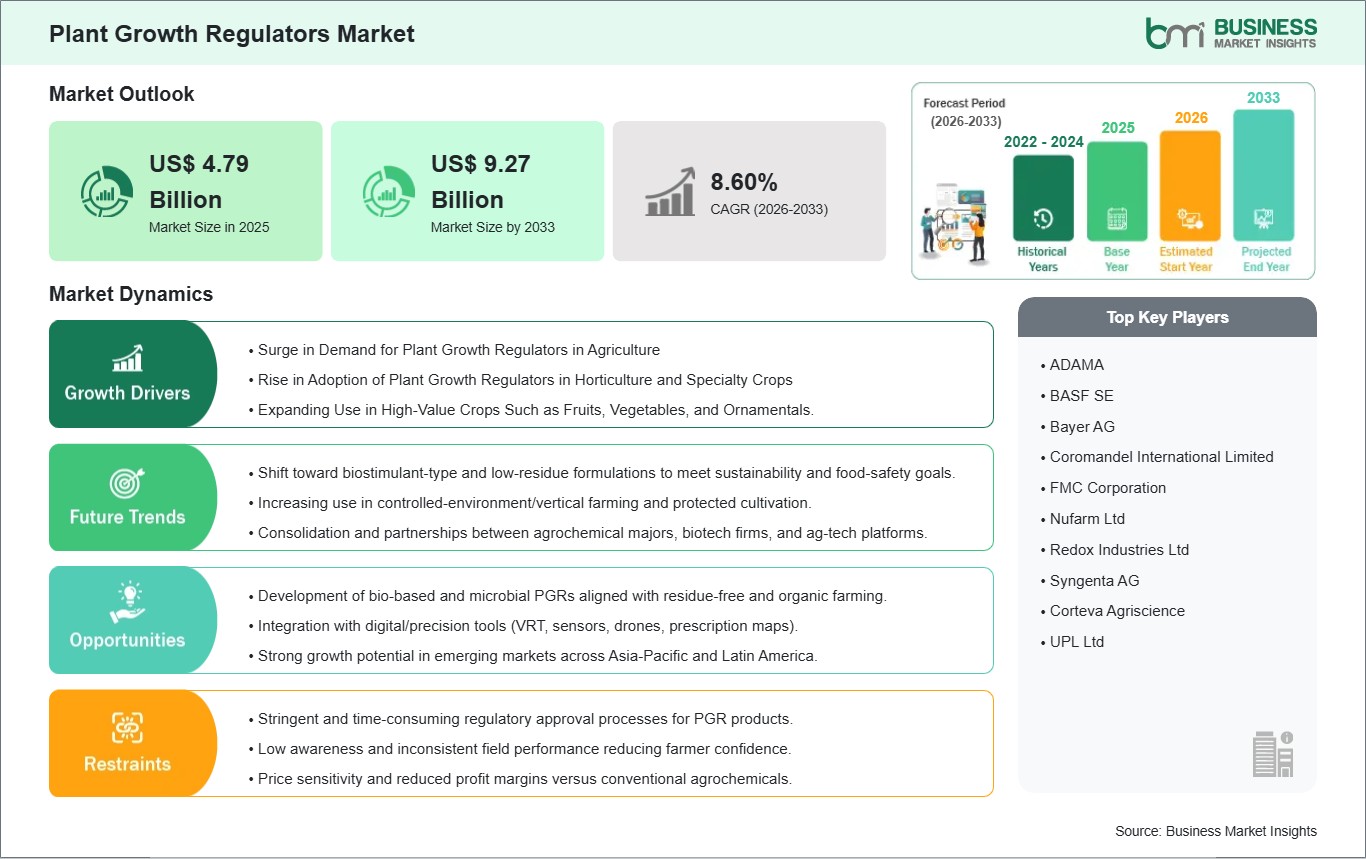
Plant growth regulators are an important part of the current agricultural and crop management that provide the desired effects on plant growth and yield increase by modulating hormonal levels. They play a crucial role in such industries as farming, horticulture, floriculture, and controlled environment agriculture. The benefits of plant growth regulators include increased root development, higher resistance to stress, and controlled flowering and fruit production. The increasing significance of precision farming across the globe, the growth of high-value crop production, and the expanding need to enhance crop productivity are driving the market. Moreover, improved technologies of formulation and streamlined application procedures, and combined crop solutions serve the upscaling of adoption and effectiveness.
Nevertheless, the market growth can be hampered by a number of obstacles, such as excessive product prices, insufficient awareness among smallholder farmers, and inconsistency of performance results. The industry is also complex due to regulatory compliance provisions and the differences in usage practices among different regions. The market is still faced with good opportunities despite these limitations due to the growing use of specialty crops, increasing use of covered cultivation in developing economies, and the growing adoption of plant growth regulators in stress management programs. Innovation will further be sponsored by supportive government policies, research investments, as well as sustainable intensification strategies, and this is predicted to create new market development and long-term growth channels in the world.
Segment Analysis
Plant Growth Regulators Market Segmentation
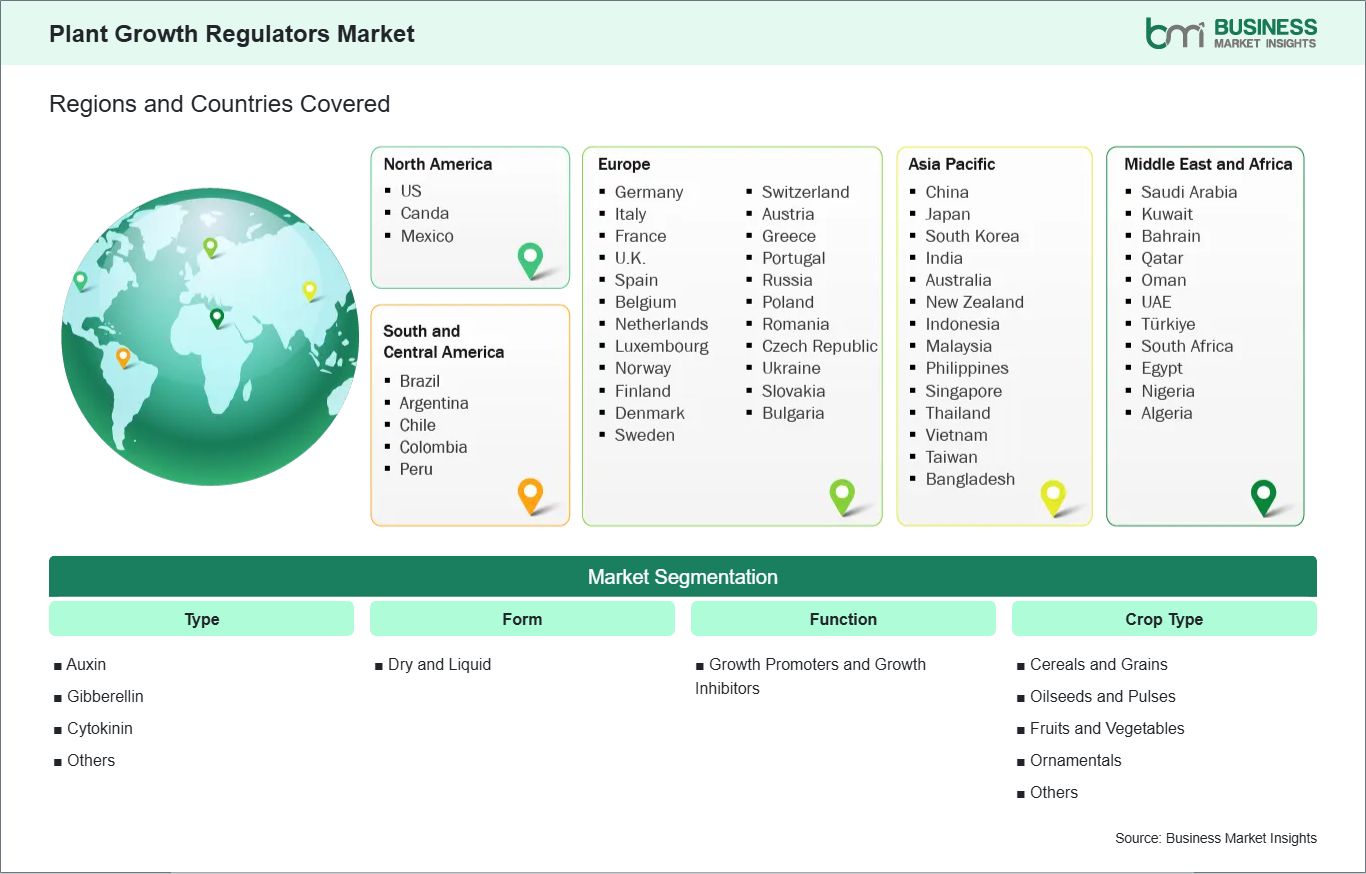
Key segments that contributed to the derivation of the Plant Growth Regulators market analysis are type, form, function, and crop type.
- By type, the plant growth regulators market is segmented into auxin, gibberellin, cytokinin, and others. The cytokinin segment dominated the market in 2025.
- By form, the market is bifurcated into dry and liquid. The dry segment held the largest share of the market in 2025.
- By function, the market is bifurcated into growth promoters and growth inhibitors. The growth promoters segment held the largest share of the market in 2025.
- By Crop Type, the market is segmented into cereals and grains, oilseeds and pulses, fruits and vegetables, ornamentals, and others. The cereals and grains are further segmented into corn, wheat, rice, and others. The oilseeds and pulses are further segmented into soya bean, cotton seeds, sunflower, and others. The fruits and vegetables segment held the largest share of the market in 2025.
Market Forces
Plant Growth Regulators Market Drivers and Opportunities
Surge in Demand for Plant Growth Regulators in Agriculture
Agriculture is one of the most important fields of use of plant growth regulators. Agricultural use of plant growth regulators has been on the rise in recent years. The use of plant growth regulators on crops may improve various processes of plant growth and development. Crop performance can be described as the capacity of plants to develop effectively with supporting high productivity and quality. Plant growth regulators are able to impact physiological functions such as cell division, elongation, and nutrient uptake, which can be better observed in large-scale and intensive crop systems. They also play the role of enhancing the uniformity of crops and yield, and quality.
One of the greatest issues in the global agricultural sector is crop and productivity pressures. Crops that are experiencing environmental stress are sprayed with plant growth regulators to enhance growth and tolerance. Regional organizations and extension programs that facilitate the use of plant growth regulators are found in North America. This can be seen in the case of the university-based agricultural extension services, which provide instruction to the growers on the correct usage and advantages of plant growth regulators. The associations of the industries also strive to encourage responsible use and development of crop regulation technologies. Additionally, as efforts are being made to improve the production of sustainable crops and the utilization of resources, the need to produce plant growth regulators in agriculture is still increasing due to awareness campaigns. Thus, the agricultural inputs market of plant growth regulators is increasing owing to the increased demand for advanced inputs.
Rise in Adoption of Plant Growth Regulators in Horticulture and Specialty Crops
Plant growth regulators are manufactured through various chemical and biological formulations that affect hormonal functions in plants, hence promoting growth control, flowering, and fruit maturation. These regulators prove helpful in the enhancement of crop appearance, shelf life, and market value, and they offer a two-fold benefit as they increase productivity and reduce crop losses.
The aim of enhancing crop productivity and satisfaction of the increasing food demand has been a boost to farmers of various regions in adopting sophisticated crop management products, and plant growth regulators are in line with the same. They can also be used in horticulture and specialty crops in order to minimize the variation in yield as a result of controlled growth and development. Moreover, the growth regulators of plants enhance the optimum use of resources, and that is why they are appropriate in intensive farming systems. There are a number of government policies and agricultural initiatives that promote the use of modern inputs to enhance farm output and sustainability. The rising efficiency and cost-effectiveness of plant growth regulators, which have been enhanced by the development of formulation and delivery technologies, have further enhanced their usage in various farming parts.
Report Coverage
Plant Growth Regulators Market Report Coverage and Deliverables
The Plant Growth Regulators Market Size and Forecast (2022-2033) report provides a detailed analysis of the market covering below areas:
- Plant growth regulators market size and forecast at global, regional, and country levels for all the key market segments covered under the scope
- Plant growth regulators market trends, as well as market dynamics such as drivers, restraints, and key opportunities
- Plant growth regulators market analysis covering key market trends, global and regional framework, major players, regulations, and recent market developments
- Industry landscape and competition analysis covering market concentration, heat map analysis, prominent players, and recent developments for the plant growth regulators market
- Detailed company profiles, including SWOT analysis
Geographic Insights
Plant Growth Regulators Market Geographic Insights
The geographical scope of the Plant Growth Regulators market report is divided into five regions: North America, Asia Pacific, Europe, Middle East & Africa, and South & Central America. The Plant Growth Regulators market in the Asia Pacific is expected to grow significantly during the forecast period.
The Asia-Pacific Plant Growth Regulators market is segmented into China, Japan, South Korea, India, Australia, New Zealand, Indonesia, Malaysia, the Philippines, Singapore, Thailand, Vietnam, Taiwan, Bangladesh, and the Rest of Asia. Asia Pacific is an expanding agricultural sector that is being boosted by the growing demand for quality and safe produce, as farmers are finding another way of farming other than using chemicals. India and China are some of the top producers of fruits, vegetables, as well as other horticultural products. Governments are also encouraging sustainable farming by facilitating policies and programs.
The Union Cabinet introduced the Agriculture Infrastructure Fund (AIF) in India to bolster the agricultural infrastructure and its sector. The program will promote sustainable projects and take steps that would promote agricultural productivity. In the same manner, the Government of Japan declared an economic stimulus plan to enhance agriculture, horticulture, and export operations. The increasing use of modern crop management technologies and positive agricultural policies is creating a demand to find plant growth regulators to increase crop growth, yield, and overall productivity.
Industry Activity
Recent Developments
The Plant Growth Regulators market is evaluated by gathering qualitative and quantitative data post-primary and secondary research, which includes important corporate publications, association data, and databases. A few of the key developments in the plant growth regulators market are:
- In Sept 2025, Performance Nutrition expanded its Prudent plant-health product lineup with three new offerings: Prudent Turf, Prudent Turf Plus, and Prudent Green. These products utilize the company's urea phosphite technology to enhance rapid foliar uptake, support natural plant defense, and improve turf resilience to environmental stress. The urea phosphite platform is designed for efficient phosphite delivery in a low-salt formulation, ensuring foliar entry and compatibility in tank mixes while reducing scale and residue.
- In March 2023, Adama enhanced its crop protection offerings by introducing two new plant growth regulators (PGRs), rinexapac-ethyl and chlormequat. These active ingredients are approved for various spring and winter arable crops, with rinexapac-ethyl suitable for spring and winter barley, durum wheat, grassland (seed crop), oats, rye, triticale, and spring and winter wheat, while chlormequat is designated for winter barley, oats, and spring and winter wheat.
Trust & Transparency
Research Methodology
The market analysis combines proprietary research with secondary data from government agencies, company disclosures, regulatory filings, industry databases and expert interviews. Market estimates are validated through data triangulation, cross-market benchmarking and analyst
review.
View Full Research Methodology
Key Sources Referred:
National Pest Management Association
Food and Agriculture Organization
United States Department of Agriculture
World Bank – Global Trade Indicators
World Trade Organization (WTO)
International Trade Administration (ITA)
Company website
Company annual reports
Company investor presentations