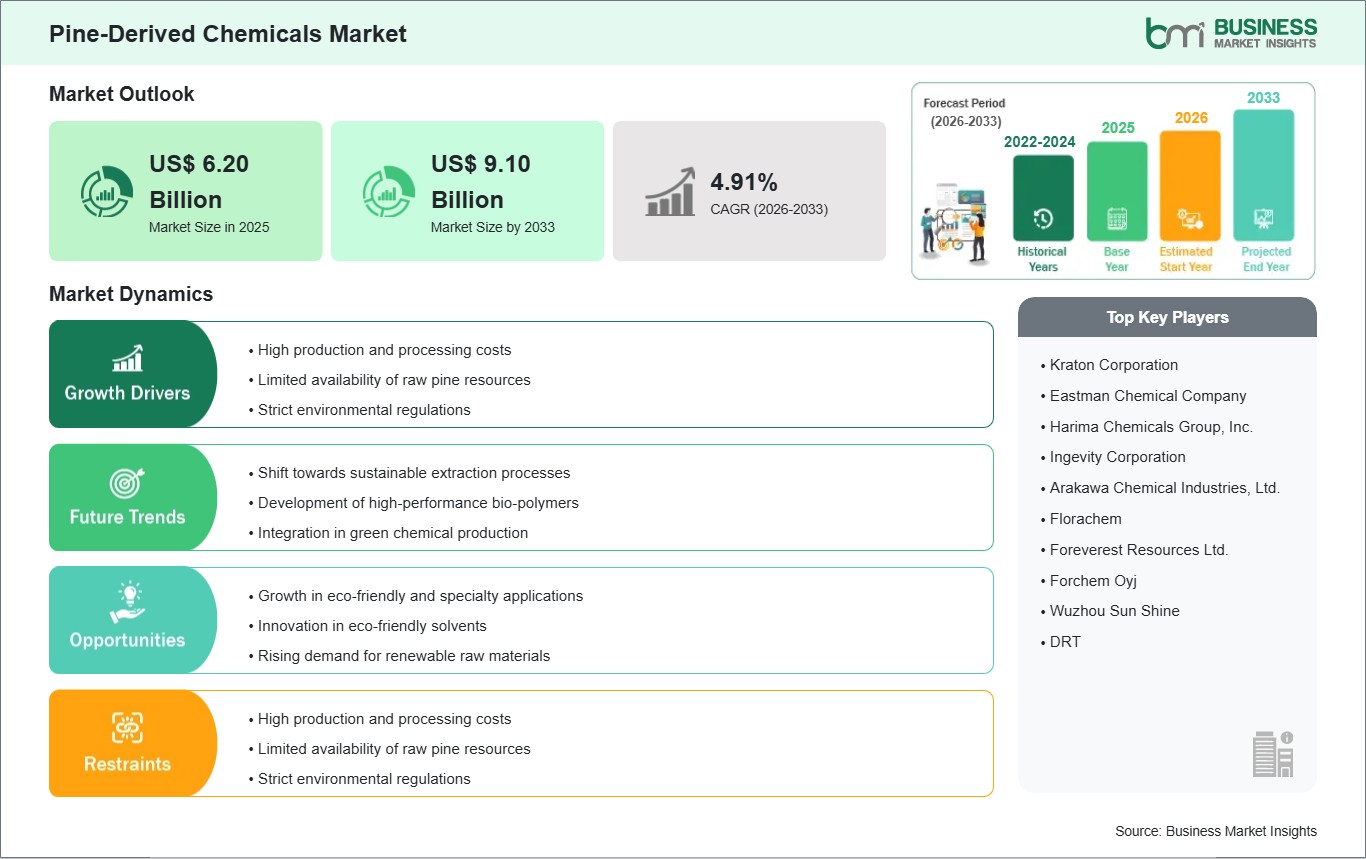
The Pine-Derived Chemicals Market size is expected to reach US$ 9.1 billion by 2033 from US$ 6.2 billion in 2025. The market is estimated to record a CAGR of 4.91% from 2026 to 2033.
The pine-derived chemicals market is gaining traction due to the rising need for bio-based, renewable, and sustainable chemical products in different end-use markets. These chemicals are produced from pine trees using techniques like pulping and distillation. The main pine-derived chemicals include tall oil fatty acids (TOFA), pine resin, turpentine oil, and sterols. These chemicals are used in a variety of applications like adhesives, coatings, inks, rubber compounds, personal care products, and biofuels. They possess properties like tackiness and chemical stability. One of the notable pine-derived chemicals market trends is the increasing adoption of green chemistry and the substitution of petroleum-based chemicals with bio-based chemicals. This trend is favoring pine-derived chemicals due to their bio-based nature and reduced carbon footprint. This trend is more evident in markets like adhesives and coatings, where sustainability and green labels have become important parameters for purchasing decisions. Technological advancements in extraction and refining processes are enhancing yield efficiency and product quality. Innovations in fractionation and chemical modification are enabling the development of high-purity derivatives tailored for specific industrial applications.
Additionally, the integration of pine chemicals into advanced formulations—such as bio-based resins and specialty additives—is expanding their applicability in high-performance sectors. The competitive landscape is characterized by a mix of global chemical companies and regionally integrated forestry-based producers. Vertical integration, from raw material sourcing to chemical processing, provides a competitive advantage by ensuring supply stability and cost control. Strategic partnerships with end-use industries, along with investments in sustainable forestry practices, are further strengthening market positioning. The pine-derived chemicals market is defined by the convergence of sustainability, resource efficiency, and application versatility. Companies that can deliver high-quality, renewable, and performance-driven chemical solutions are well-positioned to capitalize on growing demand across industrial and consumer-facing sectors.

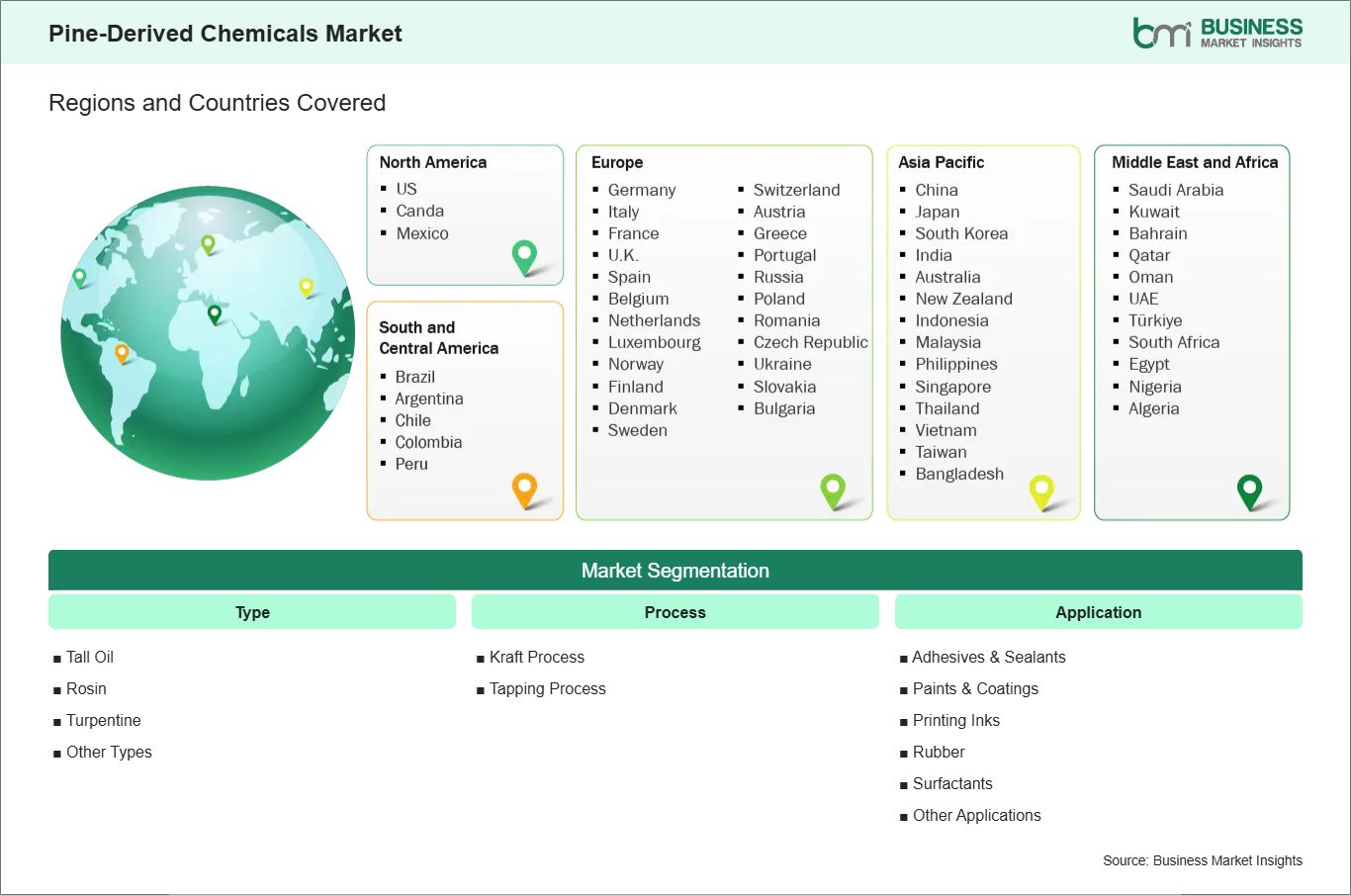
Key segments that contributed to the derivation of the pine-derived chemicals market analysis are type, process, and application.
The demand for pine-derived chemicals is growing steadily as more and more industries are turning towards the use of more sustainable and renewable resources for their raw materials. As the chemicals are derived from the pine tree, the use of pine-derived chemicals can be a more eco-friendly alternative to the conventional petroleum-based chemicals, which is a major reason for the increasing popularity of the chemicals in the industry.
The major reason for the increasing popularity of the pine-derived chemicals is the fact that the chemicals, which include rosin, turpentine, and tall oil, can be used for a wide range of applications as the chemicals offer binding, solvent, and tackifying properties, which can be very helpful for the industry, as the chemicals can deliver the results in a consistent manner. Also, the chemicals can help improve the quality of the final product, which can be very helpful for the industry, as the quality of the final product is a major factor in the industry.
Continuous innovation is further driving demand in this market. Companies are investing in refining processes and chemical modification techniques to enhance the purity, stability, and functionality of pine-derived products. These advancements allow manufacturers to meet specific performance requirements while maintaining the benefits of a renewable source. As industries continue to prioritize sustainability without compromising efficiency, pine-derived chemicals are becoming an essential component of modern chemical production and supply chains.
The increased focus on sustainability is providing a powerful platform for pine-derived chemicals used in eco-friendly products. This is due to the biodegradability and renewability of these chemicals. Various industries are increasingly using these chemicals in the formulation of products used as adhesives, coatings, and personal care products. The focus on these products has increased, especially as the need to be eco-friendly has become a crucial factor.
Specialty applications are also providing new opportunities for pine-derived chemicals. This is due to the formulation of these chemicals to meet specific functional needs. This has become crucial as manufacturers are developing these chemicals to meet specific needs. This has become important, especially when considering the needs of various industries. This has become crucial, especially when considering the needs of various industries. This has become crucial, especially when considering the needs of various industries.
Current research and development activities are aimed at exploring new opportunities and increasing efficiency. New processing technologies are making it possible to create higher-value derivatives that are more consistent and possess better performance characteristics. As interest in sustainable and high-performance materials continues to increase, pine-derived chemicals are likely to become increasingly important in many different industries. The balance of positive environmental attributes and high-performance characteristics is anticipated to continue to fuel growth in this market.
The pine-derived chemicals market demonstrates steady growth, with size and share analysis highlighting evolving trends and competitive dynamics among key players. The report examines subsegments categorized within type, process, and application, offering insights into their contribution to overall market performance.
By Type, the tall oil subsegment dominated the market in 2025, driven by its extensive use in adhesives, sealants, and coatings due to its strong binding properties and biodegradability.
Based on Process, the kraft process subsegment dominated the market in 2025, supported by its widespread use in extracting valuable chemicals during pulp manufacturing.
On the Basis of Application, the adhesives & sealants subsegment dominated the market in 2025, driven by rising demand for bio-based and sustainable materials in construction and packaging industries.
| Report Attribute | Details |
|---|---|
| Market size in 2025 | US$ 6.20 Billion |
| Market Size by 2033 | US$ 9.10 Billion |
| Global CAGR (2026 - 2033) | 4.91% |
| Historical Data | 2022-2024 |
| Forecast period | 2026-2033 |
| Segments Covered | By Type
|
|
Regions and Countries Covered
| |
| North America | US, Canada, Mexico |
| Europe | Belgium, Austria, Finland, Denmark, Greece, Poland, Romania, Russia, Ukraine, Czech Republic, Slovakia, Bulgaria, Italy, Luxembourg, Germany, Switzerland, France, Netherlands, Norway, Portugal, Spain, Sweden, United Kingdom |
| Asia-Pacific | Australia, China, India, Japan, South Korea, Indonesia, Malaysia, Philippines, Singapore, Thailand, Vietnam, Bangladesh, New Zealand, Taiwan |
| South and Central America | Brazil, Argentina, Peru, Chile, Colombia |
| Middle East and Africa | Bahrain, Kuwait, Oman, Qatar, Saudi Arabia, United Arab Emirates, Turkiye, South Africa, Egypt, Algeria, Nigeria |
| Market leaders and key company profiles |
|
The "Pine-Derived Chemicals Market Size and Forecast (2022 - 2033)" report provides a detailed analysis of the market covering below areas:
The geographical scope of the Pine-Derived Chemicals Market report is divided into North America, Asia Pacific, Europe, Middle East & Africa, and South & Central America. North America held the largest share in 2025.
Regional-level dynamics in the pine-derived chemicals market reveal distinct demand patterns shaped by forestry resources, industrial development, and sustainability initiatives.
North America is the dominant market, driven by abundant forestry resources, a well-established pulp and paper industry, and advanced chemical processing capabilities. The United States and Canada lead in the production and consumption of tall oil derivatives, rosin, and turpentine. Strong emphasis on sustainable sourcing and bio-based product innovation supports the widespread adoption of pine-derived chemicals across adhesives, coatings, and specialty chemical applications.
Europe represents a mature and sustainability-driven market, with countries such as Sweden, Finland, and Germany emphasizing renewable raw materials and circular economy practices. The region’s strong forestry sector and stringent environmental regulations promote the use of bio-based chemicals, particularly in coatings, inks, and personal care products. Technological innovation and high-quality standards further support market growth.
Asia Pacific is experiencing steady growth, led by China, India, and Japan, driven by increasing industrialization and demand for bio-based chemicals in adhesives, rubber, and construction applications. While the region relies partly on imports, local production capacities are expanding to meet rising demand. Cost competitiveness and growing environmental awareness are influencing adoption patterns.
Middle East & Africa is an emerging market where industrial diversification and infrastructure development are creating demand for specialty chemicals, including pine derivatives. Adoption is primarily driven by coatings, adhesives, and rubber applications, though limited local raw material availability influences supply dynamics.
South & Central America shows moderate growth, particularly in Brazil and Chile, supported by strong forestry resources and expanding chemical processing industries. The region benefits from access to raw materials and increasing demand for bio-based solutions in industrial and consumer applications, though market growth is influenced by economic variability and export-oriented production strategies.

The Pine-Derived Chemicals Market is evaluated by gathering qualitative and quantitative data post primary and secondary research, which includes important corporate publications, association data, and databases. A few of the key developments in the pine-derived chemicals market are:
The Pine-Derived Chemicals Market is valued at US$ 6.20 Billion in 2025, it is projected to reach US$ 9.10 Billion by 2033.
As per our report Pine-Derived Chemicals Market, the market size is valued at US$ 6.20 Billion in 2025, projecting it to reach US$ 9.10 Billion by 2033. This translates to a CAGR of approximately 4.91% during the forecast period.
The Pine-Derived Chemicals Market report typically cover these key segments-
The historic period, base year, and forecast period can vary slightly depending on the specific market research report. However, for the Pine-Derived Chemicals Market report:
The Pine-Derived Chemicals Market is populated by several key players, each contributing to its growth and innovation. Some of the major players include:
The Pine-Derived Chemicals Market report is valuable for diverse stakeholders, including:
Essentially, anyone involved in or considering involvement in the Pine-Derived Chemicals Market value chain can benefit from the information contained in a comprehensive market report.
Please tell us your area of interest
(Market Segments/ Regions and Countries/ Companies)