Market Summary
Executive Summary and Global Market Analysis
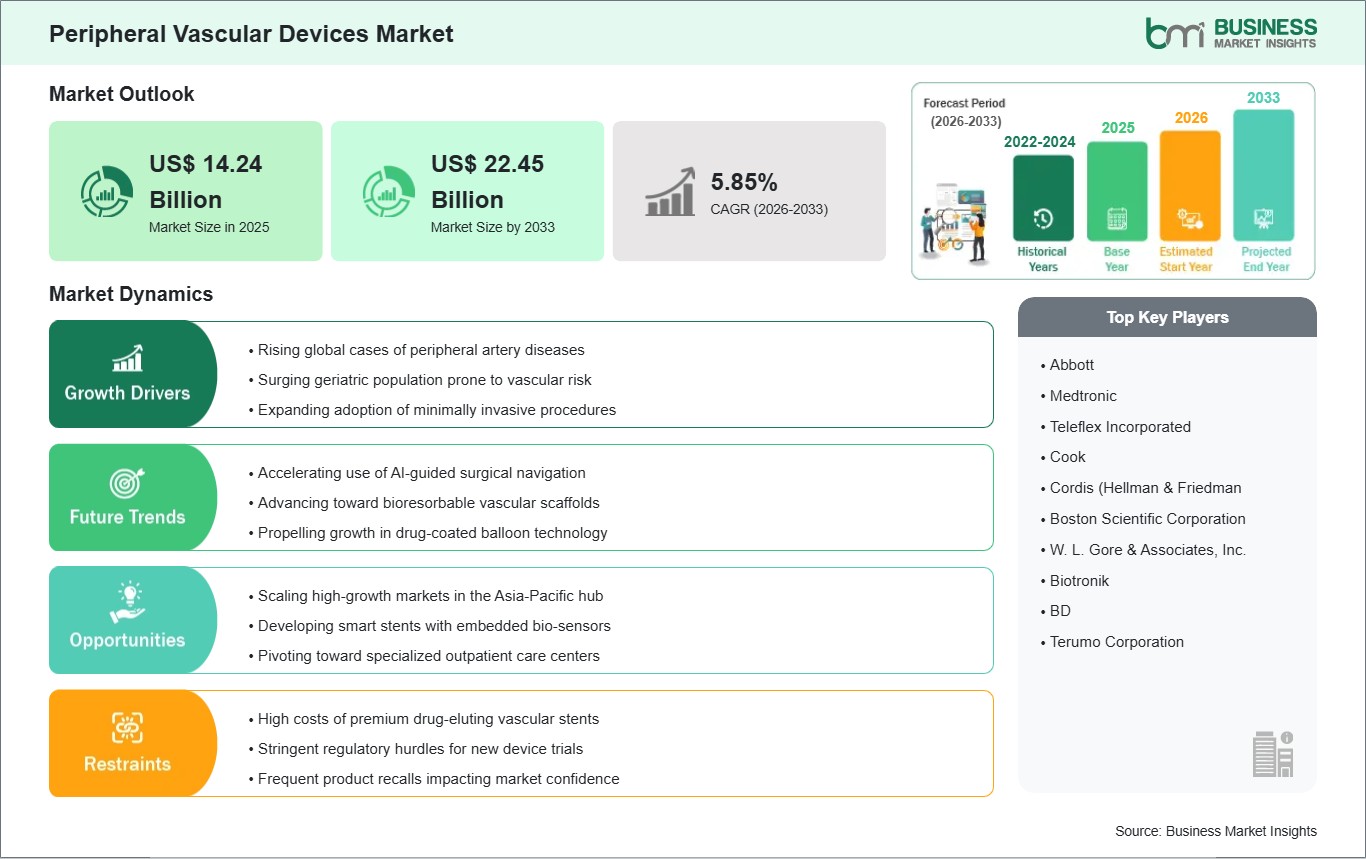
Peripheral Vascular Devices are crucial for diagnosing and treating diseases outside the heart, primarily Peripheral Arterial Disease (PAD). These devices are essential across core settings: hospitals, ambulatory surgical centers, and clinics. Devices offer advantages, including enabling minimally invasive procedures, reduced patient recovery times, and improved long-term vascular outcomes. The market is fueled by the rising global prevalence of PAD, affecting over 200 million individuals, the growing geriatric population, and the increasing incidence of diabetes and obesity. Technological innovation in devices, drug-eluting balloons (DCBs) and bioresorbable scaffolds drives market expansion.
However, several challenges restrain market growth, such as stringent regulatory approval and the high cost of clinical trials, which delay new products. Product recalls and failures in specific devices introduce safety concerns. Moreover, the industry is further constrained by the shortage of trained specialists to perform various sophisticated endovascular procedures. Despite these hurdles, opportunities arise with the shift toward outpatient settings, reducing hospital costs, while supportive reimbursement for the interventions and significant market growth in the Asia-Pacific region, with its increasing rates of diabetes, also present opportunities.
Segment Analysis
Peripheral Vascular Devices Market Segmentation
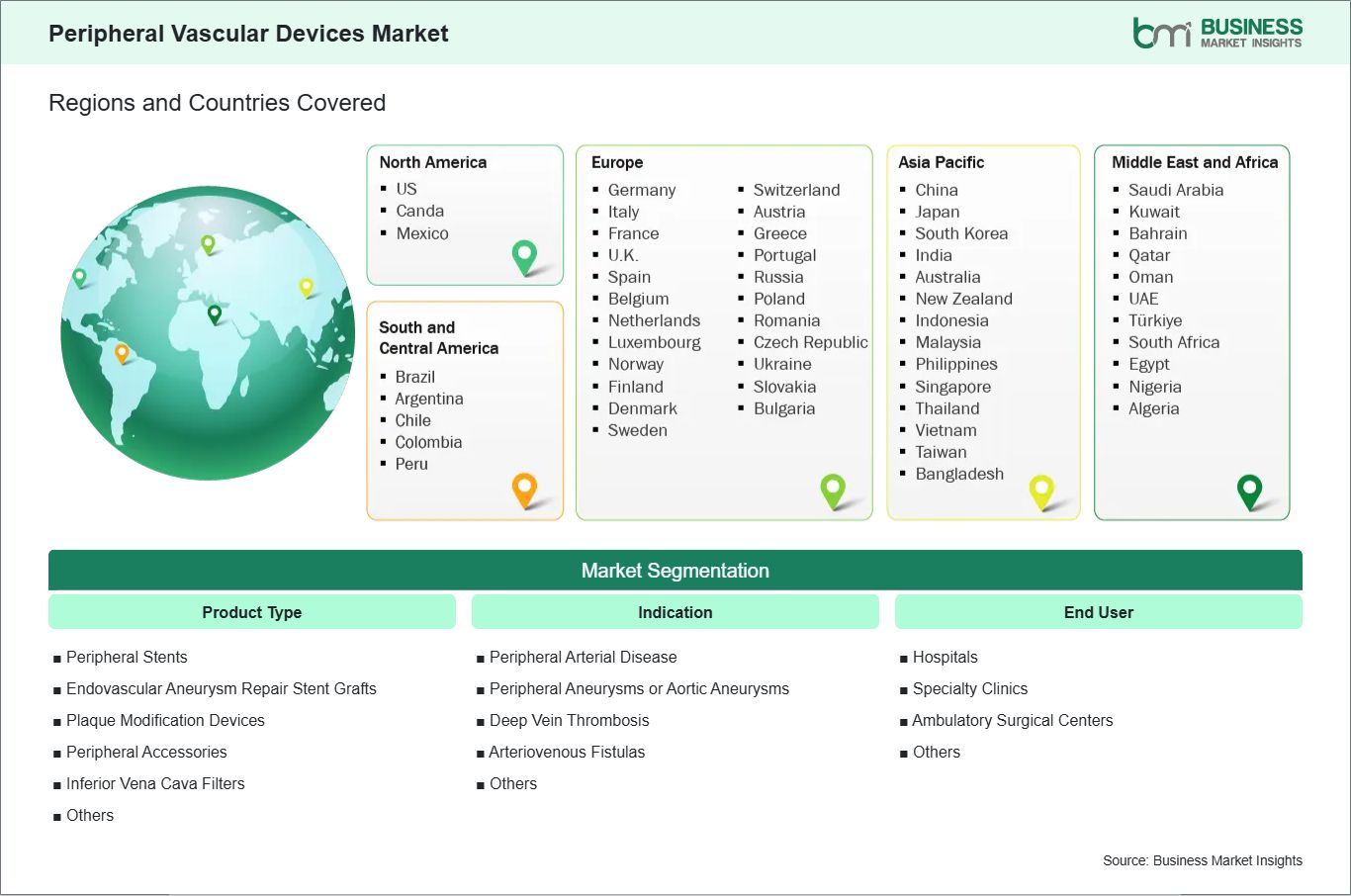
Key segments that contributed to the derivation of the Peripheral Vascular Devices Market analysis are product type, indication, and end user.
- By Product Type, the market is segmented into Peripheral Stents, Endovascular Aneurysm Repair Stent Grafts, Plaque Modification Devices, Peripheral Accessories, Inferior Vena Cava Filters, and Others.
- By Indication, the market is segmented into Peripheral Arterial Disease, Peripheral Aneurysms or Aortic Aneurysms, Deep Vein Thrombosis (DVT), Arteriovenous Fistulas, and Others.
- By End User, the market is segmented into Hospitals, Specialty Clinics, Ambulatory Surgical Centers, and Others.
Market Forces
Peripheral Vascular Devices Market Drivers and Opportunities
Rising Prevalence of Vascular Diseases
Peripheral Arterial Disease (PAD), which causes narrowed arteries and restricted blood flow outside of the heart and brain, is strongly associated with common chronic conditions. The incidence of these peripheral vascular illnesses is rising significantly due to key risk factors such as the expanding geriatric population (as vascular issues increase with age), the global epidemic of diabetes, and the rising rates of hypertension and obesity linked to sedentary lifestyles. As these underlying conditions become more widespread across both developed and emerging economies, the corresponding patient pool requiring diagnosis and interventional treatment (such as angioplasty, stenting, and atherectomy) expands dramatically. This creates sustained, essential demand for devices used to restore adequate blood flow and prevent severe complications such as amputation.
Growing Demand for Minimally Invasive Techniques
The significant opportunity in the market stems from the continuous advancement of medical technology, enabling minimally invasive treatment options and the development of high-value, specialized, novel devices. There is a pronounced and growing preference among both patients and healthcare providers for minimally invasive endovascular procedures over traditional open surgery. These procedures, which utilize devices including catheters and guidewires, offer benefits such as reduced recovery times, lower complication rates, and improved patient comfort. The market is capitalizing on device innovation, particularly the development of Drug-Eluting Balloons (DEBs) and Drug-Eluting Stents (DESs), which locally deliver medication to the artery wall to prevent restenosis (re-narrowing). Furthermore, new technologies such as intravascular lithotripsy (IVL) for cracking calcified plaque and bioresorbable scaffolds are expanding the range of treatable blockages, enhancing procedural success, and driving premium pricing.
Size and Share Analysis
Peripheral Vascular Devices Market Size and Share Analysis
The Peripheral Vascular Devices Market demonstrates steady growth, with size and share analysis revealing evolving trends and competitive positioning among key players. The report further examines subsegments categorized within Product type, Indication, and End user, offering insights into their contribution to overall market performance.
For instance, Peripheral stents hold a significant share of the market. These are typically used to treat narrowed or blocked peripheral arteries, helping to restore adequate blood flow and reduce symptoms of conditions such as Peripheral Artery Disease (PAD). This type of product is widely utilized in interventional cardiology and radiology procedures due to its effectiveness in long-term vessel patency.
Report Coverage
Peripheral Vascular Devices Market Report Coverage and Deliverables
The "Peripheral Vascular Devices Market Size and Forecast (2022 - 2033)" report provides a detailed analysis of the market covering the following areas:
- Peripheral Vascular Devices Market size and forecast at global, regional, and country levels for all the key market segments covered under the scope
- Peripheral Vascular Devices Market trends, as well as market dynamics such as drivers, restraints, and key opportunities
- Peripheral Vascular Devices Market analysis covering key market trends, global and regional framework, major players, regulations, and recent market developments
- Industry landscape and competition analysis covering market concentration, heat map analysis, prominent players, and recent developments for the Peripheral Vascular Devices Market
- Detailed company profiles, including SWOT analysis
Geographic Insights
Peripheral Vascular Devices Market Geographic Insights
The geographical scope of the Peripheral Vascular Devices Market report is divided into five regions: North America, Asia Pacific, Europe, the Middle East & Africa, and South & Central America.
For instance, the European market is primarily propelled by the region's rapidly aging population, which is highly susceptible to peripheral arterial disease (PAD) and other related vascular disorders. The market benefits significantly from well-established universal healthcare systems, sophisticated diagnostic capabilities, and favorable reimbursement policies for minimally invasive endovascular procedures.
This region is further marked by the higher adoption of the current therapeutic devices, including drug-eluting balloons and stents, due to the continued transition towards innovative and less invasive methods of therapy for complicated lesions. Moreover, high healthcare spending and a large number of sub-specialty centers for cardiovascular interventions in significant economies such as Germany and France are critical reasons. The continued focus on clinical research and development of the next-generation peripheral vascular devices furthers the treatment landscape, bolstering the consistent growth trajectory of the market.
Industry Activity
Recent Developments
The Peripheral Vascular Devices Market is evaluated by gathering qualitative and quantitative data post-primary and secondary research, which includes important corporate publications, association data, and databases. A few of the key developments in the Peripheral Vascular Devices Market are:
- In October 2025, Medtronic, a global leader in healthcare technology, announced the full distribution of the Neuroguard IEP™ System (Neuroguard) after a successful limited market distribution. This milestone follows the announcement earlier this year of its exclusive U.S. distribution agreement with Raleigh, North Carolina-based Contego Medical.
- In December 2024, Terumo Interventional Systems (TIS) announced the launch and commercial availability of its R2P™ NaviCross® peripheral support catheter in the U.S., further expanding the company’s radial-to-peripheral (R2P) portfolio. The R2P NaviCross catheter, now available in a 200 cm length, is designed for optimized performance in R2P procedures. Its double-braided, stainless-steel construction is engineered for superior trackability and torque control for lesion crossing in more complex procedures.
Trust & Transparency
Research Methodology
The market analysis combines proprietary research with secondary data from government agencies, company disclosures, regulatory filings, industry databases and expert interviews. Market estimates are validated through data triangulation, cross-market benchmarking and analyst
review.
View Full Research Methodology
Key Sources Referred:
World Bank - Global Trade IndicatorsWorld Trade Organization (WTO)International Monetary Fund (IMF)International Trade Administration (ITA)Company WebsitesCompany Annual ReportsCompany Investor Presentations