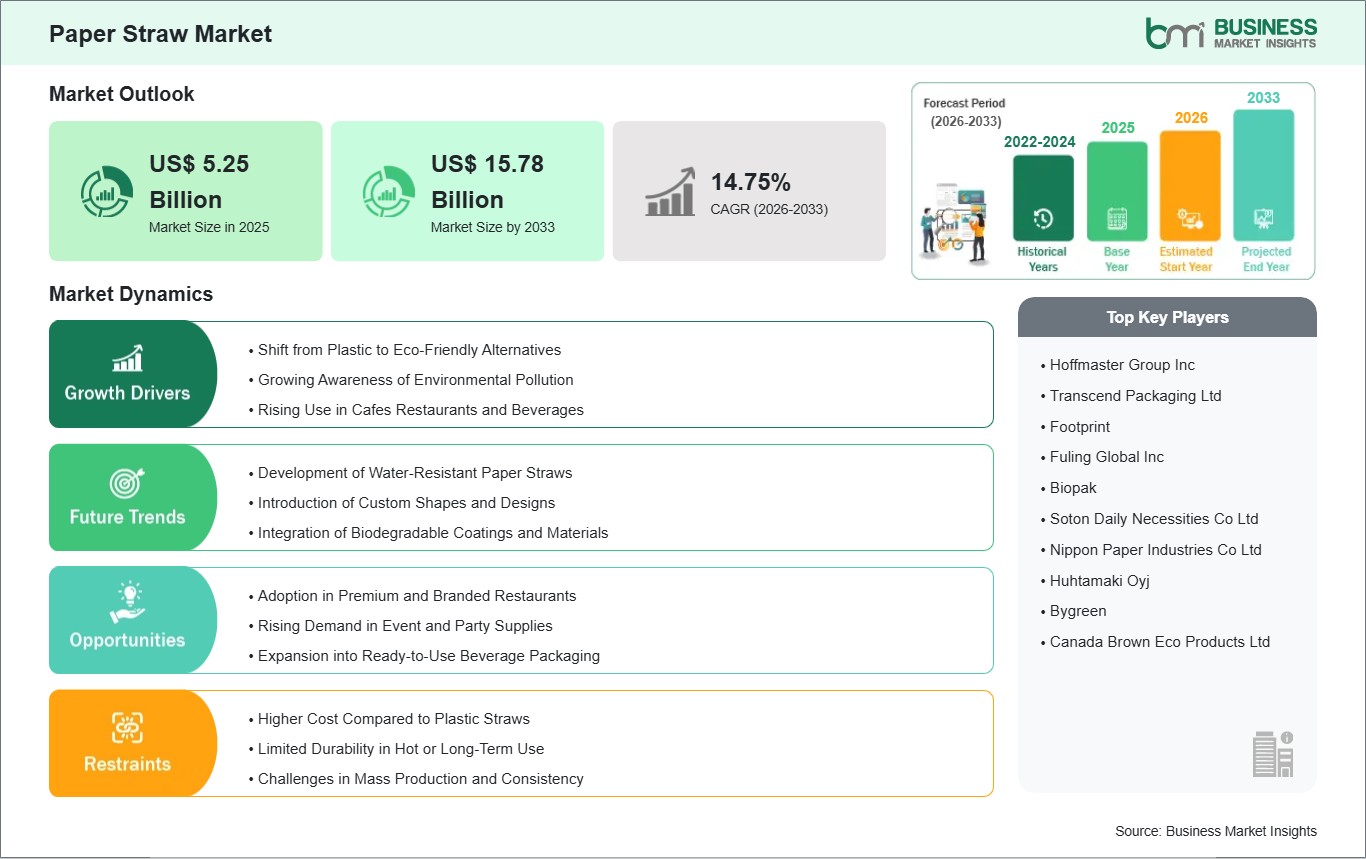
The Paper Straw Market size is expected to reach US$ 15.78 billion by 2033 from US$ 5.25 billion in 2025. The market is estimated to record a CAGR of 14.75% from 2026 to 2033.
The global paper straw market is growing significantly due to the increasing focus on environmental protection and sustainability. The paper straw has been considered a credible solution compared to conventional plastic straws because of the plastic single-use item ban in key markets, along with the rise in demand for eco-friendly alternatives. In terms of food service, quick service restaurants, cafes, bars, and packaged ready-to-drink beverages, paper straws have emerged as a mainstream sustainable accessory, consistent with a broader move towards a circular economy.
Apart from the ban on plastic single-use items, brand activities and company ESG strategies are also driving the shift towards biodegradable and compostable paper-based solutions that have a low environmental impact and high performance. In addition, advances in paper materials and production have made paper straws stronger and less soggy, and have provided design options for customization in terms of size, color, and print design.
However, there are challenges associated with the market as well, which may act as a roadblock in the future adoption of these straws. These challenges include performance perceptions related to structural integrity in a liquid state and cost perceptions relative to traditional plastic-based alternatives in foodservice operations. Further, quality consistency in a range of climatic and usage scenarios is another area of focus for manufacturers in the industry. The growing global trend towards more sustainable alternatives and a favorable policy framework make the paper straw market a significant part of a broader sustainable packaging ecosystem.

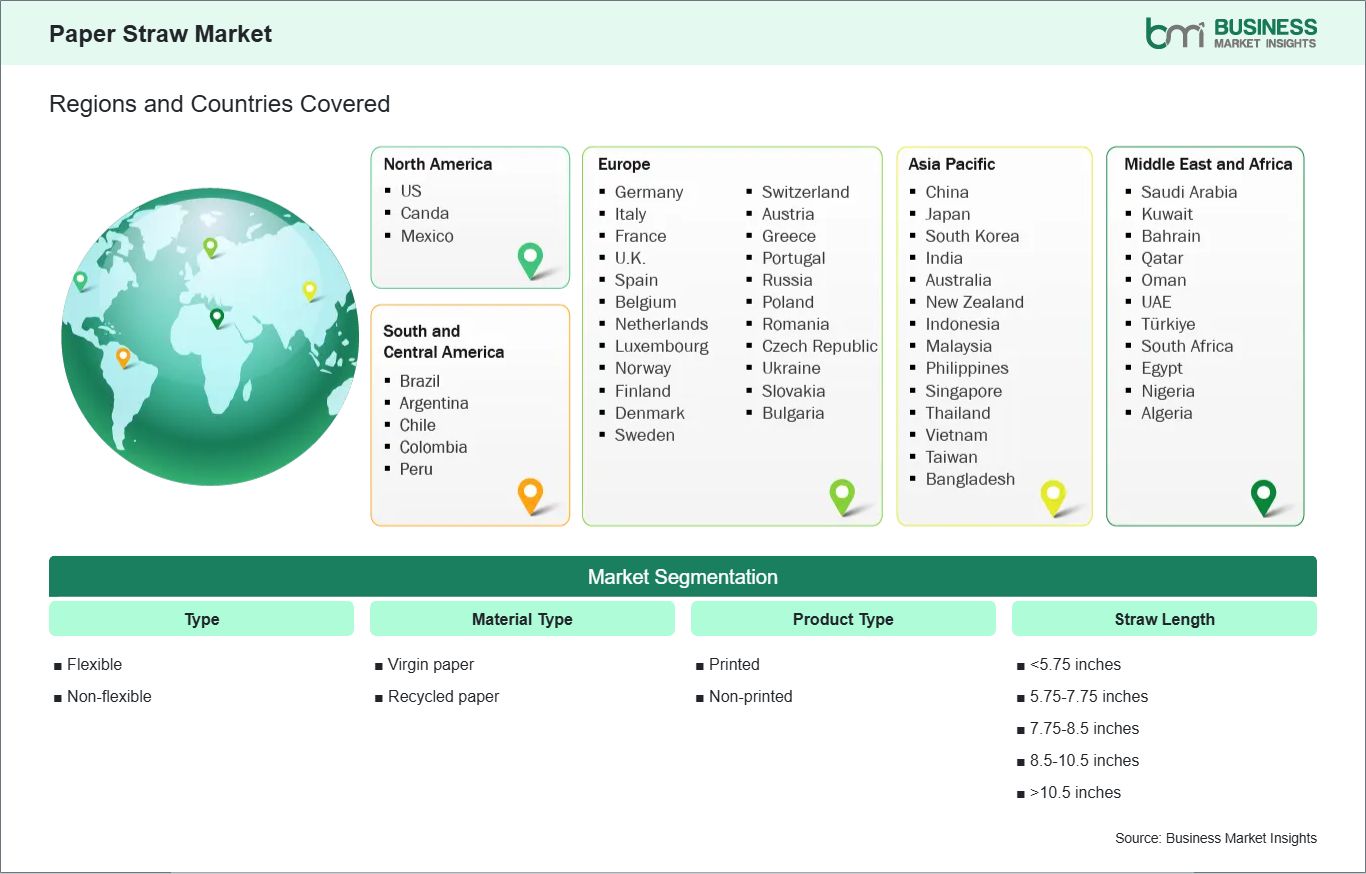
Key segments that contributed to the derivation of the paper straw market analysis are type, material type, product type, straw length, straw diameter, and end-use application.
The global paper straw market has expanded significantly as businesses and consumers increasingly prioritize sustainable alternatives to single-use plastic. Growing awareness of environmental issues and the negative impact of plastic pollution has created a strong demand for biodegradable and compostable packaging solutions. Paper straws are widely recognized for their eco-friendly characteristics, as they are derived from renewable resources and can break down naturally without harming ecosystems. This trend reflects a broader shift in consumer behavior, where sustainability has become a critical factor influencing purchasing decisions and brand perception.
Innovation in materials and design has also played a major role in ensuring the popularity of paper straws. Manufacturers are coming up with materials that are not only environmentally friendly but also strong and efficient for different types of drinks, such as hot drinks, cool cocktails, and fizzy drinks. The new design and paper materials ensure that the paper straws do not lose their strength and shape after a short period of use. This is a major improvement over the previous paper straws that were not strong for a long period and could not compete with plastic straws.
The shift from plastic straws to paper straws is further encouraged by the alignment of packaging solutions with business sustainability strategies. Food and beverage businesses are embracing the use of paper straws in their business processes as a strategy to reduce their negative impacts on the environment. By embracing environmentally friendly straws in their business processes, businesses are in a position to demonstrate their commitment to sustainability while attracting environmentally conscious consumers in the market. The shift to paper straws worldwide emphasizes the significance of packaging as a consideration in contemporary business processes.
Premium and branded restaurants are emerging as key drivers of global paper straw adoption, as these establishments emphasize both environmental responsibility and the overall customer experience. Paper straws are increasingly being used not just for their functionality but also as a visual signal of a brand’s commitment to sustainability. By offering eco-friendly alternatives, restaurants can enhance their service quality while reinforcing their brand image, creating a positive impression that resonates with customers who value environmentally conscious practices.
This shift towards the adoption of paper straws in restaurants has led to the development of premium straws by the manufacturer. These premium straws come with different features, which ensure the quality and aesthetic appeal of the straws. They can be used to enhance the quality and appeal of the drinks, as well as ensure the integrity of the straws. This shift towards the adoption of premium straws is evident in the growing demand for them in restaurants.
Beyond functionality, paper straws also offer a significant opportunity for differentiation among competing foodservice brands. The use of paper straws provides a restaurant with an opportunity to engage customers on the sustainability front and align itself with the overall corporate social responsibility agenda. The use of sustainable paper straws in beverages provides a restaurant with an opportunity to align itself with the global sustainability movement and thereby boost customer loyalty. The global acceptance of paper straws in premium and branded foodservice is a result of a combination of sustainability awareness and product and brand strategies.
The paper straw market is experiencing steady growth, with market size and share analysis reflecting evolving treatment preferences and competitive dynamics among key players. The report evaluates important subsegments categorized within type, material type, product type, straw length, straw diameter, and end-use application, highlighting their respective contributions to overall market performance.
By type, the Flexible subsegment dominated the Paper Straw market in 2025. Flexible paper straws provide better usability and convenience for consumers, making them highly preferred in beverages, which drives their widespread adoption.
Based on material type, the Virgin Paper subsegment dominated the Paper Straw market in 2025. Virgin paper offers higher strength, durability, and quality consistency compared to recycled paper, supporting its strong demand in the market.
In terms of product type, the Non-Printed subsegment dominated the Paper Straw market in 2025. Non-printed straws are cost-effective and widely accepted for general use, reinforcing the dominance of this segment.
On the basis of straw length, the 7.75 - 8.5 Inches subsegment dominated the Paper Straw market in 2025. This length is considered ideal for most beverage containers, driving its widespread adoption in foodservice and household applications.
By straw diameter, the 0.196 - 0.25 Inches subsegment dominated the Paper Straw market in 2025. Straws in this diameter range provide optimal flow and strength for a variety of drinks, enhancing their preference among users.
In terms of end-use application, the Foodservice subsegment dominated the Paper Straw market in 2025. Foodservice establishments require high volumes of disposable straws that are eco-friendly and convenient, supporting strong market growth for this segment.
| Report Attribute | Details |
|---|---|
| Market size in 2025 | US$ 5.25 Billion |
| Market Size by 2033 | US$ 15.78 Billion |
| Global CAGR (2026 - 2033) | 14.75% |
| Historical Data | 2022-2024 |
| Forecast period | 2026-2033 |
| Segments Covered | By Type
|
|
Regions and Countries Covered
| |
| North America | US, Canada, Mexico |
| Europe | Belgium, Austria, Finland, Denmark, Greece, Poland, Romania, Russia, Ukraine, Czech Republic, Slovakia, Bulgaria, Italy, Luxembourg, Germany, Switzerland, France, Netherlands, Norway, Portugal, Spain, Sweden, United Kingdom |
| Asia-Pacific | Australia, China, India, Japan, South Korea, Indonesia, Malaysia, Philippines, Singapore, Thailand, Vietnam, Bangladesh, New Zealand, Taiwan |
| South and Central America | Brazil, Argentina, Peru, Chile, Colombia |
| Middle East and Africa | Bahrain, Kuwait, Oman, Qatar, Saudi Arabia, United Arab Emirates, Turkiye, South Africa, Egypt, Algeria, Nigeria |
| Market leaders and key company profiles |
|
The "Paper Straw Market Size and Forecast (2022 - 2033)" report provides a detailed analysis of the market covering below areas:
The geographical scope of the Paper Straw market report is divided into five regions: North America, Asia Pacific, Europe, Middle East & Africa, and South & Central America. The Paper Straw market in North America is expected to grow during the forecast period.
North America is the leader in the global paper straw market due to an initial drive by regulators to ban single-use plastics, high levels of environmental advocacy, and a strong commitment to sustainability by stakeholders. In this market, paper straws have moved from being a niche product to a mainstream alternative in foodservice and retail outlets, especially in urban environments where waste management and recycling are high. The overall attitude of consumers in North America is geared towards sustainable options that are visibly seen to be environmentally friendly and sustainable. The paper straw market has benefited from this attitude due to its high visibility as a sustainable product.
The foodservice industry in North America, which includes multinational quick-service restaurants and independent foodservice and beverage outlets, has adopted paper straws not only to comply with the ban on plastics but also to demonstrate brand commitment to sustainability. Innovation is also evident in the market, with the introduction of paper straws with improved wet strength, mouthfeel, and printing for brand images, which addressed the earlier issues related to the performance and appearance of straws. Industry support and public sector policies also add to the stability in the market, which is evident in the overall market scenario. Logistical challenges related to supply consistency in the large geography of North America and cost structures in the price-sensitive foodservice sector also add to the challenges. The dominance of the North American market in terms of regulatory frameworks, consumer demand, and sustainable innovation is still dictating the direction of the global paper straw market.

The paper straw market is evaluated by gathering qualitative and quantitative data post primary and secondary research, which includes important corporate publications, association data, and databases. A few of the key developments in the paper straw market are:
The Paper Straw Market is valued at US$ 5.25 Billion in 2025, it is projected to reach US$ 15.78 Billion by 2033.
As per our report Paper Straw Market, the market size is valued at US$ 5.25 Billion in 2025, projecting it to reach US$ 15.78 Billion by 2033. This translates to a CAGR of approximately 14.75% during the forecast period.
The Paper Straw Market report typically cover these key segments-
The historic period, base year, and forecast period can vary slightly depending on the specific market research report. However, for the Paper Straw Market report:
The Paper Straw Market is populated by several key players, each contributing to its growth and innovation. Some of the major players include:
The Paper Straw Market report is valuable for diverse stakeholders, including:
Essentially, anyone involved in or considering involvement in the Paper Straw Market value chain can benefit from the information contained in a comprehensive market report.
Please tell us your area of interest
(Market Segments/ Regions and Countries/ Companies)