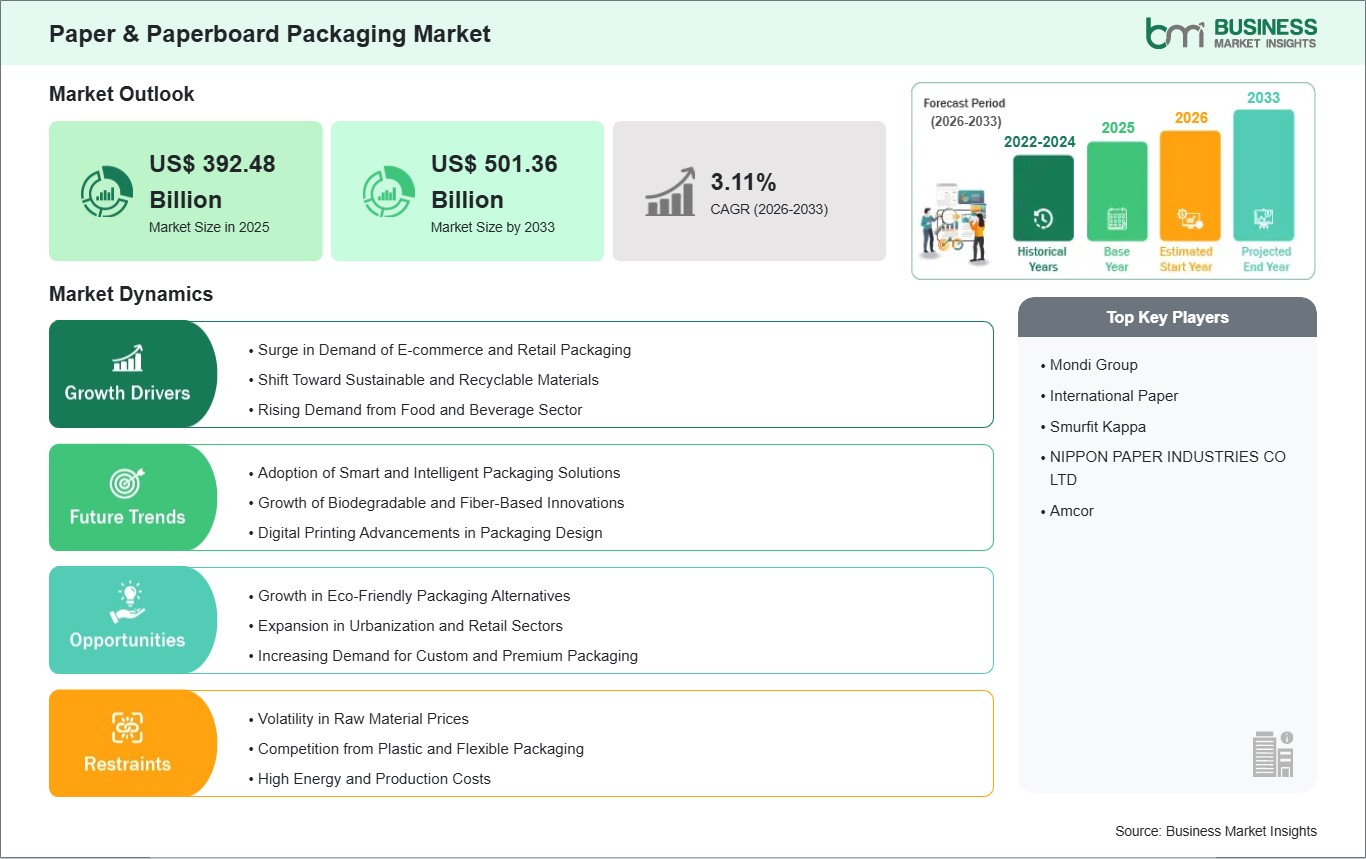
The Paper & Paperboard Packaging Market size is expected to reach US$ 501.36 Billion by 2033 from US$ 392.48 Billion in 2025. The market is estimated to record a CAGR of 3.11% from 2026 to 2033.
The paper and paperboard packaging market, at a global level, is witnessing a paradigm shift, driven by a higher emphasis on sustainability, environmental responsibility, and a circular economy approach at a global level. This has led to a transformation of the paper and paperboard packaging market, not only in terms of functionality but also as a tool to create brand differentiation, consumer engagement, and communicate sustainability messages to consumers. There has been a higher awareness of environmental issues, particularly with regard to plastic usage, along with stringent government regulations in various countries to restrict plastic usage, thereby driving the paper and paperboard packaging market. Advances in material science have also led to a higher performance level of paper and paperboard-based packaging, thereby making them suitable to meet consumer and logistical needs.
Despite a positive growth pattern, the paper and paperboard packaging industry is facing several challenges, such as a greater reliance on forestry-based materials, which is causing a fluctuating pattern of supply and cost for the industry. Additionally, technology challenges are also faced by the industry in different packaging materials, such as liquid or oxygen-sensitive packaging materials. However, due to an increasing focus on sustainable packaging by different brands around the world, the demand for sustainable packaging is also increasing. The paper and paperboard packaging industry is seen as a key enabler of sustainable packaging solutions around the world.

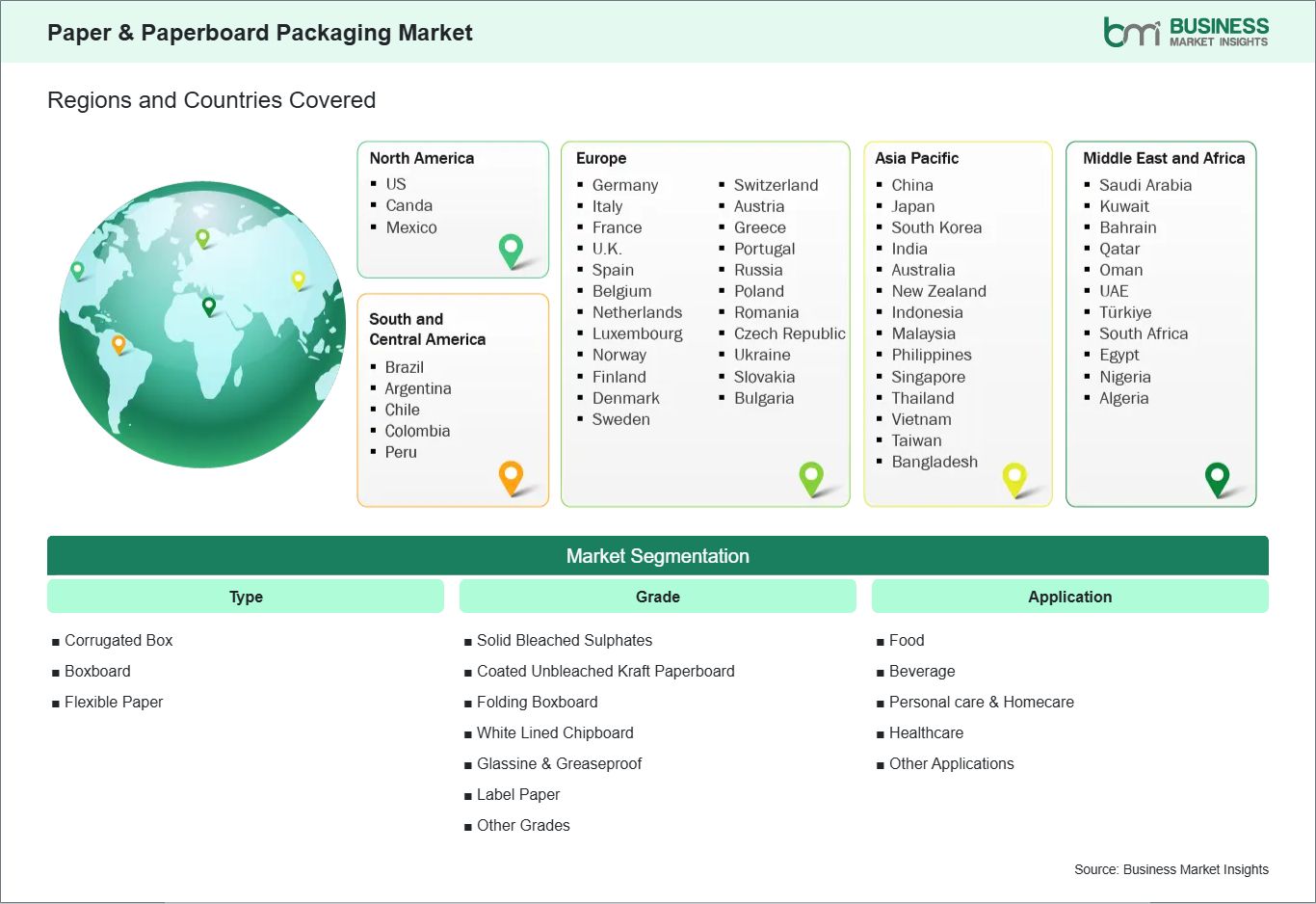
Key segments that contributed to the derivation of the paper & paperboard packaging market analysis are type, grade, and application.
The global paper and paperboard packaging market is experiencing a remarkable surge, largely fueled by the expansion of e‑commerce and evolving retail demands. As consumer expectations continue to shift toward convenience, speed, and reliability, packaging has become an essential element not just for product protection but also for enhancing the overall customer experience. Paper and paperboard offer significant advantages in this context due to their versatility, lightweight nature, and strength, making them suitable for a wide range of products, from fragile items to bulk shipments. Packaging now serves as a strategic touchpoint where businesses can convey brand value and leave a lasting impression on consumers.
The growing prominence of e‑commerce has also prompted innovation in packaging design, emphasizing both functionality and aesthetics. Companies are investing in modular, foldable, and customizable packaging solutions that improve efficiency while providing a premium unboxing experience. Features such as reinforced corners, reusable inserts, and high-quality printing allow brands to deliver products securely while communicating their identity and values through packaging. The demand for packaging that balances protection, visual appeal, and user convenience has therefore become a key driver in the global market, transforming packaging into an integral part of the consumer journey.
In addition, the growing sophistication of global supply chains necessitates packaging solutions that maximize storage, transportation, and handling efficiency. Packaging designs that reduce material consumption, transportation costs, and structural failure are now essential for businesses to operate efficiently. As these factors combine to support the growth of e-commerce, improved consumer experience, and supply chain optimization, the opportunities for paper and paperboard packaging to satisfy several business needs at once will only continue to grow. As the global market for packaging develops further, it is likely to become a means to achieve business efficiency and brand awareness.
Sustainability is also a key driving factor for the global paper and paperboard packaging market. With the increasing realization of the challenges facing the environment, companies are focusing more and more on packaging materials that are sustainable and have a positive impact on the environment. Paper and paperboard are seen to be an important part of sustainable packaging due to their recyclable nature and the ability to be reused multiple times. The focus on sustainable packaging is changing the standards of the industry and is encouraging companies to be innovative in the materials and methods being developed for packaging. Companies are also recognizing the importance of sustainability and are focusing on it as an integral part of packaging.
Innovation in eco-friendly packaging has focused on enhancing performance while reducing environmental impact. Minimalistic designs, lightweight structures, and modular formats allow packaging to meet functional requirements while using fewer resources. Water-based coatings, biodegradable adhesives, and reusable inserts further increase sustainability without compromising product protection or aesthetic appeal. Businesses are increasingly integrating sustainability considerations into the early stages of packaging development, ensuring that products are designed with environmental responsibility in mind. This approach helps brands strengthen their reputation, meet consumer expectations for ethical practices, and demonstrate a proactive commitment to global environmental goals.
Beyond design and materials, the growth of eco-friendly packaging has implications across the entire supply chain. From sourcing renewable raw materials to optimizing manufacturing processes and improving recyclability, companies are adopting holistic strategies that reduce environmental footprints. Paper and paperboard packaging are now recognized as versatile solutions capable of delivering both performance and sustainability. As consumer and corporate demand for environmentally responsible packaging continues to grow, the global market is likely to witness further innovation, with paper-based materials playing a central role in shaping the future of packaging across industries.

The paper & paperboard packaging market is experiencing steady growth, with market size and share analysis reflecting evolving treatment preferences and competitive dynamics among key players. The report evaluates important subsegments categorized within type, grade, and application, highlighting their respective contributions to overall market performance.
By type, the Corrugated Box subsegment dominated the Paper & Paperboard Packaging market in 2025. Corrugated boxes offer excellent strength, durability, and protection for a wide range of goods, making them highly suitable for logistics and shipping applications, which drives their widespread adoption.
Based on grade, the Solid Bleached Sulphates (SBS) subsegment dominated the Paper & Paperboard Packaging market in 2025. SBS provides superior printability, stiffness, and hygienic properties, making it ideal for high-quality packaging, supporting strong demand for this grade.
In terms of application, the Food subsegment dominated the Paper & Paperboard Packaging market in 2025. Food packaging requires safety, barrier protection, and sustainability, reinforcing the dominance of this segment in the market.
| Report Attribute | Details |
|---|---|
| Market size in 2025 | US$ 392.48 Billion |
| Market Size by 2033 | US$ 501.36 Billion |
| Global CAGR (2026 - 2033) | 3.11% |
| Historical Data | 2022-2024 |
| Forecast period | 2026-2033 |
| Segments Covered | By Type
|
|
Regions and Countries Covered
| |
| North America | US, Canada, Mexico |
| Europe | Belgium, Austria, Finland, Denmark, Greece, Poland, Romania, Russia, Ukraine, Czech Republic, Slovakia, Bulgaria, Italy, Luxembourg, Germany, Switzerland, France, Netherlands, Norway, Portugal, Spain, Sweden, United Kingdom |
| Asia-Pacific | Australia, China, India, Japan, South Korea, Indonesia, Malaysia, Philippines, Singapore, Thailand, Vietnam, Bangladesh, New Zealand, Taiwan |
| South and Central America | Brazil, Argentina, Peru, Chile, Colombia |
| Middle East and Africa | Bahrain, Kuwait, Oman, Qatar, Saudi Arabia, United Arab Emirates, Turkiye, South Africa, Egypt, Algeria, Nigeria |
| Market leaders and key company profiles |
|
The "Paper & Paperboard Packaging Market Size and Forecast (2022 - 2033)" report provides a detailed analysis of the market covering below areas:
The geographical scope of the Paper & Paperboard Packaging market report is divided into five regions: North America, Asia Pacific, Europe, Middle East & Africa, and South & Central America. The Paper & Paperboard Packaging market in North America is expected to grow during the forecast period.
North America is the leading segment in the global paper and paperboard packaging industry due to a mix of industrial infrastructure, technological capabilities, and early adopters of sustainability initiatives. It has been at the forefront in enforcing stringent environmental regulations and business sustainability initiatives that encourage the use of renewable and recyclable materials instead of conventional plastic materials. This has led to a high demand for paperboard cartons, corrugated containers, molded fiber packaging materials, and more in various industries like food and beverages, personal care, pharmaceuticals, and e-commerce. There is a growing trend in North American consumers towards eco-friendly packaging materials that highlight sustainability, recyclability, and eco-innovation in packaging, thus prompting manufacturers to develop innovative packaging solutions in terms of lightweight materials, high-quality coatings, and attractive graphics that meet functional and brand requirements.
Additionally, there is a strong recycling system in place in North America, which includes recycling collected materials and reintroducing recycled fibers into new packaging materials in line with the circular economy framework. There is a significant investment in research and development activities by North American manufacturers in exploring new avenues in the use of paperboard packaging materials in high-barrier packaging and liquid packaging applications, which were previously dominated by plastic materials. Despite these advancements, challenges remain, including regional disparities in recycling capabilities, raw material price fluctuations, and supply chain logistics in meeting the demand across urban and rural areas. North America continues to act as a global benchmark for sustainable packaging adoption, driving technological innovation, regulatory compliance, and environmentally responsible practices in the paper and paperboard packaging sector worldwide.

The paper & paperboard packaging market is evaluated by gathering qualitative and quantitative data post primary and secondary research, which includes important corporate publications, association data, and databases. A few of the key developments in the paper & paperboard packaging market are:
The Paper & Paperboard Packaging Market is valued at US$ 392.48 Billion in 2025, it is projected to reach US$ 501.36 Billion by 2033.
As per our report Paper & Paperboard Packaging Market, the market size is valued at US$ 392.48 Billion in 2025, projecting it to reach US$ 501.36 Billion by 2033. This translates to a CAGR of approximately 3.11% during the forecast period.
The Paper & Paperboard Packaging Market report typically cover these key segments-
The historic period, base year, and forecast period can vary slightly depending on the specific market research report. However, for the Paper & Paperboard Packaging Market report:
The Paper & Paperboard Packaging Market is populated by several key players, each contributing to its growth and innovation. Some of the major players include:
The Paper & Paperboard Packaging Market report is valuable for diverse stakeholders, including:
Essentially, anyone involved in or considering involvement in the Paper & Paperboard Packaging Market value chain can benefit from the information contained in a comprehensive market report.
Please tell us your area of interest
(Market Segments/ Regions and Countries/ Companies)