
Packaging Inks Market Outlook: Size, Share, Trends, Growth Analysis, Competitive Landscape & Forecast, 2026-2033

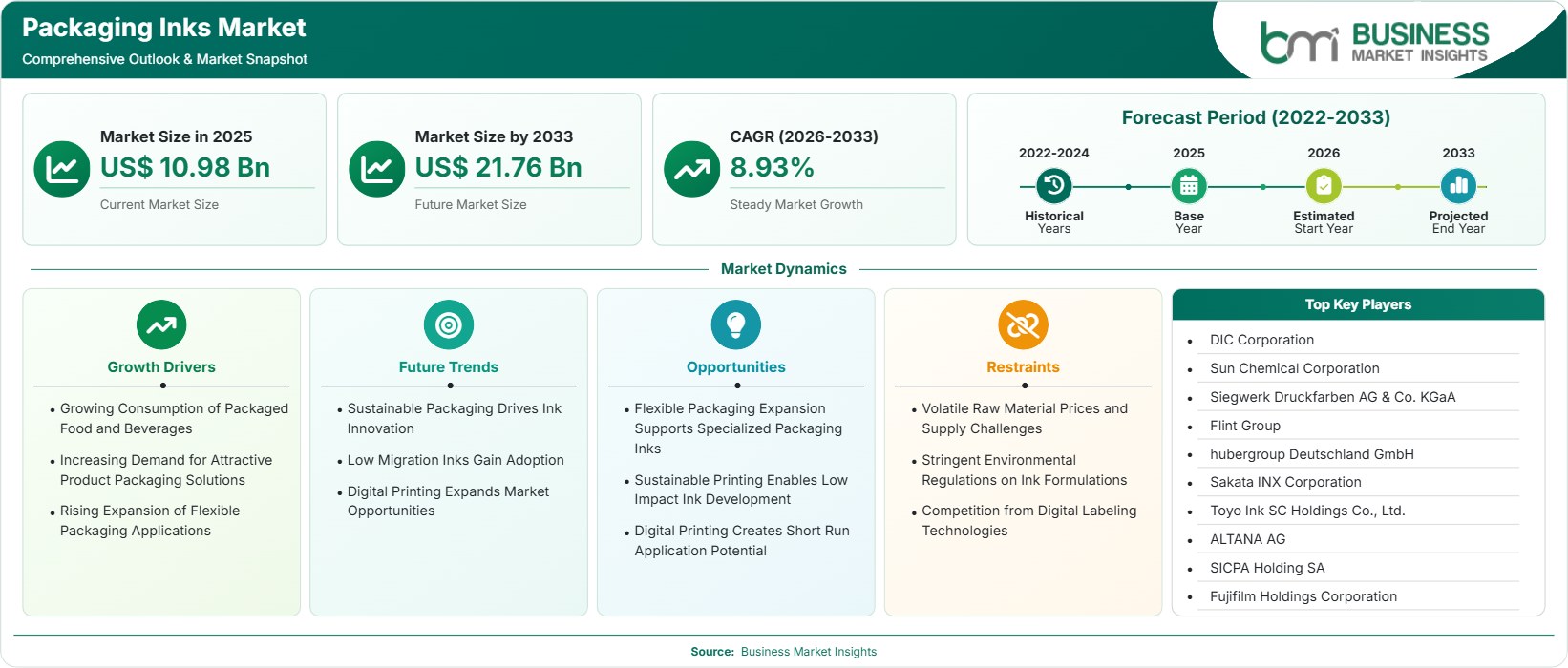
The Packaging Inks Market size was valued at US$ 10.98 Billion in 2025 and is projected to reach US$ 21.76 Billion by 2033, growing at a CAGR of 8.93% during 2026–2033. Rising packaged food consumption, e-commerce shipments, sustainable printing technologies, low-VOC formulations, and regulatory compliance requirements are accelerating innovation, while recyclable packaging formats create new revenue opportunities.

Report Coverage
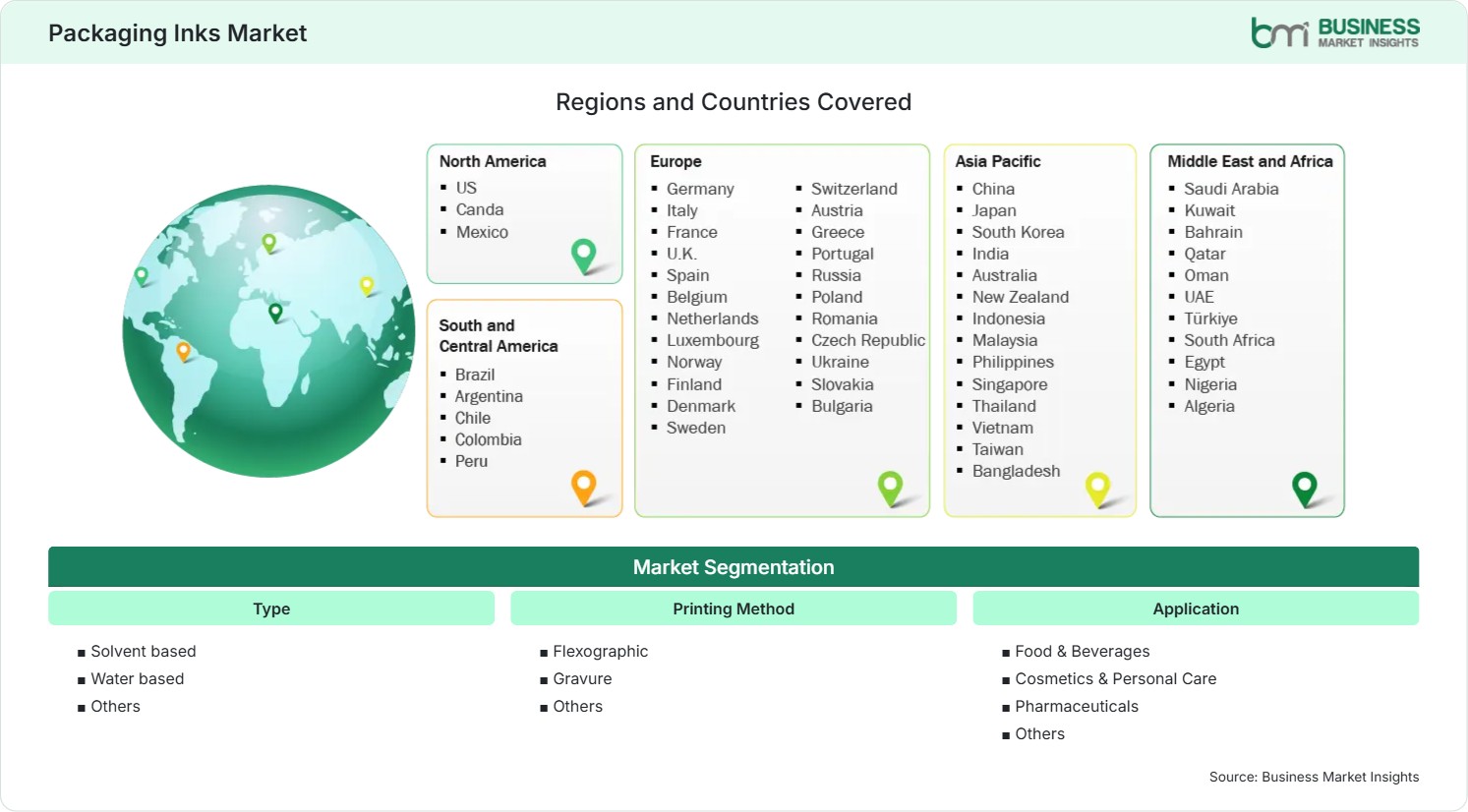
  • Type: Solvent based, Water based, Others
  • Printing Method: Flexographic, Gravure, Others
  • Application: Food & Beverages, Cosmetics & Personal Care, Pharmaceuticals, Others
US$ 10.98 Bn Market size in 2025
US$ 21.76 Bn Market Size by 2033
8.93% CAGR, 2026 - 2033
2026-2033 Forecast Period

AI Overview

Packaging Inks Market Summary

  • North America Region: Holds a market share of 34%–37% in 2025, growing with a CAGR of 7.4%–8.0% during 2026–2033. Demand is supported by food packaging regulations, premium labeling, flexible packaging expansion, recycled substrate adoption, digital workflow integration, and investments in sustainable water-based formulations across consumer industries. US market benefits from strong converter investments and packaged food demand, advancing at approximately 7.6%–8.2% CAGR.
  • Fastest Growing Region: Asia Pacific holds 27%–30% share in 2025 and expands at 10.4%–11.2% CAGR. Urbanization, manufacturing expansion, packaged food consumption, retail modernization, pharmaceutical production, and export-oriented packaging industries continue generating substantial opportunities for suppliers and converters.
  • Leading Segment: Food & Beverages accounts for 41%–44% share in 2025 and grows at 8.8%–9.5% CAGR. Strong packaged food output, branding requirements, shelf differentiation, regulatory compliance, and migration-safe printing solutions sustain consistent long-term demand across packaging applications.
  • High Growth Segment: Water-based inks represent 30%–33% share in 2025 and advance at 10.0%–10.8% CAGR. Environmental regulations, lower emissions, recycling compatibility, sustainable packaging commitments, and technological improvements are accelerating adoption across flexible packaging and labels.
  • Key Market Opportunity: Circular packaging ecosystems are increasing demand for de-inkable, low-migration, recyclable, and bio-derived formulations, enabling suppliers to commercialize premium sustainable products and expand relationships with global brand owners.
  • Major Market Players: DIC Corporation, Sun Chemical Corporation, Siegwerk Druckfarben AG & Co. KGaA, Flint Group, hubergroup Deutschland GmbH, Sakata INX Corporation, Toyo Ink SC Holdings Co., Ltd., ALTANA AG, SICPA Holding SA, Fujifilm Holdings Corporation.
Strategic Insights

Packaging Inks Market: Strategic Insights

Packaging Inks Market Strategic Framework
FREE PDF
Request your free sample
Request free sample
Stakeholder View

Key Takeaways

  • The value chain is becoming more integrated as resin suppliers, pigment producers, ink manufacturers, converters, and brand owners collaborate to improve recyclability and food-contact compliance.
  • Food, beverage, and pharmaceutical packaging applications offer the strongest volume upside because packaging quality and regulatory requirements continue increasing globally.
  • Innovation is shifting toward water-based, UV-curable, low-migration, and bio-derived formulations capable of supporting circular economy objectives without sacrificing print quality.
  • India, Indonesia, Vietnam, and other manufacturing-driven economies present attractive investment opportunities due to rising packaged goods consumption and expanding converter capacity.
  • Strategic acquisitions and partnerships increasingly focus on sustainability technologies, specialty pigments, digital printing capabilities, and regional distribution expansion.
  • Advanced color management, shorter production runs, and customized packaging campaigns are supporting demand for high-performance specialty ink systems.
Geographic Outlook

Packaging Inks Market Regional Highlights

North America Packaging Inks Market

North America accounted for approximately 34%–37% of revenue in 2025 and is projected to expand at a CAGR of 7.4%–8.0% through 2033. The region benefits from mature packaging infrastructure, strong packaged food consumption, and advanced sustainability initiatives. Packaging Inks Market share remains substantial because brand owners increasingly require recyclable packaging and compliant food-contact printing solutions. Growth is supported by investments in water-based technologies, premium labeling, pharmaceutical packaging, and digital printing integration across packaging production facilities.

  • Strong demand for packaged food and beverages supports consistent ink consumption across labels, cartons, pouches, and flexible packaging formats.
  • Regulatory emphasis on low-VOC technologies is encouraging transition toward sustainable formulations and improved environmental performance.
  • E-commerce fulfillment growth is increasing labeling and corrugated packaging printing requirements throughout distribution networks.
  • Brand differentiation strategies continue driving premium graphics, specialty effects, and advanced color consistency requirements.
  • Pharmaceutical and healthcare packaging expansion strengthens demand for compliant, traceable, and high-performance printing systems.

US Packaging Inks Market

The United States represented 73%–76% of regional revenue in 2025 and is expected to grow at a CAGR of 7.6%–8.2% through 2033. Consumer packaged goods, healthcare products, and food packaging remain primary demand generators. Strong converter modernization activity and sustainability targets are accelerating adoption of lower-emission technologies. Investment in flexible packaging production and digital workflows continues supporting long-term market competitiveness and innovation.

  • Food safety requirements encourage adoption of low-migration formulations suitable for sensitive packaging applications.
  • Investments in automation and high-speed printing improve productivity and support advanced packaging designs.
  • Growing pharmaceutical output enhances requirements for secure and traceable packaging graphics.
  • Premium consumer products drive strong demand for visually appealing and durable printed packaging.

Europe Packaging Inks Market

Europe held approximately 26%–29% share in 2025 and is anticipated to expand at a CAGR of 7.8%–8.6% through 2033. Sustainability regulations and circular economy initiatives remain major market influences. Germany leads regional demand, while Eastern European countries exhibit faster expansion. Producers are increasingly investing in recyclable packaging compatibility, water-based chemistries, and advanced food-contact-compliant technologies to satisfy evolving regulatory requirements.

  • Germany remains the leading national market, supported by packaging innovation and industrial manufacturing strength.
  • Poland and other Central European markets register stronger growth, with CAGR generally above regional averages.
  • Regulatory frameworks encourage reduced emissions and broader adoption of environmentally responsible ink technologies.
  • Consumer preference for sustainable packaging continues influencing purchasing and sourcing strategies.
  • Expansion of premium labeling supports specialty coating and high-performance printing demand.

Asia Pacific Packaging Inks Market

Asia Pacific has a 27%–30% market share in 2025 and registers the highest CAGR of 10.4%–11.2% until 2033. Urbanization, high disposable incomes, rising drug production, and high demand for packaged food have driven regional growth. China is the largest market, while India is one of the fastest-growing markets. The Packaging Inks Market growth within the region can be attributed to manufacturing investments, export packaging requirements, and retail modernization.

  • China remains the dominant market due to extensive packaging manufacturing capacity.
  • India demonstrates strong growth supported by consumer demand and expanding packaging conversion infrastructure.
  • Growth in organized retail is increasing packaging quality expectations and branding requirements.
  • Pharmaceutical manufacturing expansion supports specialized and compliant printing applications.
  • Export-oriented industries require advanced packaging aesthetics and durability performance.

Rest of World Packaging Inks Market

Rest of World captured a 9%-12% market share in 2025 and is anticipated to expand at a CAGR of 8.5%-9.3% through 2033. South and Central America will gain from their food processing and packaging needs. The markets in the Middle East and Africa are driven by consumer goods production, population growth, and diversification initiatives. Demand continues to strengthen as packaging standards improve across multiple consumer-facing industries.

  • Brazil remains the leading Latin American market, supported by consumer goods production and food exports.
  • Mexico benefits from manufacturing integration and packaging-related industrial investment.
  • Saudi Arabia records noteworthy expansion linked to industrial diversification initiatives.
  • UAE packaging modernization supports premium labeling and specialty product demand.
  • Regional urbanization trends continue enhancing packaged product consumption patterns.
Global Market Geography
FREE PDF
Request your free sample
Request free sample
Segment Analysis

Packaging Inks Market Segmentation

Type

The type category reflected the industry's technological basis. Solvent-type formulations retained the market leadership, capturing a market share of 48%–52%, whereas water-based inks posted the fastest growth rate at 10.0%–10.8% CAGR. The Packaging Inks Market scope is set to grow further owing to environmental objectives that promote improvements in ink formulations without sacrificing printability and performance.

  • Solvent-based: Widely used for flexible packaging applications requiring strong adhesion, fast drying, high durability, and reliable performance across challenging substrates and demanding production environments.
  • Water-based: Adoption is accelerating because of reduced emissions, sustainability commitments, regulatory compliance advantages, and compatibility with recyclable packaging initiatives pursued by major brand owners.

Printing Method

The choice of printing method depends on production size, substrate suitability, and cost-effectiveness. The flexographic print process had an approximate market share of 45%–48% in 2025 and a compound annual growth rate of 9.0%–9.6% for the forecast period. Packaging Inks Market trends show an increase in high-speed flexible packaging and label manufacturing systems.

  • Flexographic: Preferred for labels, corrugated packaging, and flexible packaging because it delivers high productivity, substrate versatility, and cost-effective large-volume production capabilities.
  • Gravure: Maintains strong relevance in premium packaging requiring image quality consistency, long production runs, and superior print performance for consumer-facing applications.

Application

The application requirement depends heavily on consumers' consumption habits and regulatory policies. Food & Beverages were the leading market segment, accounting for 41% to 44% and forecast to grow at a CAGR of 8.8% to 9.5%. The packaging inks market size depends on the penetration of packaged products, the need for brand differentiation, and rising compliance standards.

  • Food & Beverages: Growth is supported by packaged food demand, branding investments, migration-safe requirements, and expansion of modern retail distribution networks worldwide.
  • Cosmetics & Personal Care: Premium packaging aesthetics, product differentiation requirements, and increasing beauty product consumption continue supporting advanced printing solution adoption.
  • Pharmaceuticals: Traceability requirements, regulatory compliance standards, and rising healthcare product demand generate opportunities for specialized, high-performance packaging ink systems.
Market Forces

Packaging Inks Market Dynamics

Key Market Drivers

Expansion of Global Packaged Food Consumption

Food packaging remains the largest end-use application for specialty printing inks. According to international food industry and retail trends, demand for packaged and convenience foods continues to increase across developed and emerging markets. This directly supports the Packaging Inks Market growth, as there is always a need for labeling, branding, compliance, and differentiation when a new packaging form emerges. Innovative packaging bags, boxes, sleeves, and labeling are now more commonly made from compounds that ensure color retention and meet food contact criteria. Consumer preference for ready-to-use products, advancements in retail infrastructure, and increased consumption of packaged drinks all ensure high demand.

Sustainability Regulations Supporting Water-Based Technologies

Volatile organic compound emission restrictions have been driving increased adoption of alternative chemistry in the Environmental Regulations category. Brand owners have begun to emphasize recyclable packaging materials and environmentally sustainable sourcing programs. Packaging Inks Market trends have thus led to a preference for environmentally friendly formulations that would aid circular packaging processes. Companies have been conducting R&D work to enhance drying time, printability, and substrate adaptability. With intense regulatory activity seen in North America and Europe, along with environmentally sustainable efforts by international consumer goods companies, the shift towards better products has been encouraged. The resulting transition supports premium pricing opportunities while improving environmental performance across packaging value chains.

Growth of E-Commerce and Logistics Packaging

Global e-commerce expansion has increased requirements for printed corrugated packaging, labels, tracking identifiers, and branded shipping materials. Packaging suppliers require durable and scalable printing solutions capable of handling high-volume production environments. Higher parcel volumes, product traceability requirements, and customized packaging solutions will drive the adoption of superior formulas. Factors that boost the Packaging Inks market growth include shorter production cycles and personalized packaging programs enabled by advanced printing technologies. With retailers' continued efforts to provide a better customer experience through their branded packaging, demand for specialized inks is expected to grow further.

Key Market Opportunities

Commercialization of Circular Packaging Solutions

The move towards a circular economy presents opportunities to develop unique product portfolios. The owners of the brands are interested in solutions that are de-inkable, recyclable, compostable, and have low migration levels, and are appropriate for contemporary recycling technologies. According to Packaging Inks Market Forecasts, significant investment opportunities exist for companies that can achieve performance targets and meet sustainability objectives. Those businesses that develop unique formulas appropriate for use in mono-material packaging will create strong ties with international consumer goods companies. As packaging recyclability becomes a competitive differentiator, manufacturers with proven environmental performance credentials are likely to capture higher-value contracts and premium market positioning across multiple application categories.

High-Growth Opportunities in Emerging Asia

Growing disposable incomes, urbanization, and the demand for packaged consumer products drive continuous change in Asia’s packaging industry. Nations like India, Indonesia, Vietnam, and the Philippines are boosting their production capacity for packaging materials for both local and exported goods. The ink business can capitalize on growing investments in flexible packaging, labels, and pharmaceutical packaging. Infrastructure improvements, along with retail organization, help boost the efficiency of distribution processes and facilitate the consumption of packaged products. Companies that establish regional production and technical support facilities can gain certain competitive advantages.

Advanced Functional and Smart Packaging Applications

New opportunities are emerging through smart packaging technology that incorporates traceability, security, and consumer engagement features. The latest advances in printing technologies are increasingly used for authentication, inventory, and interactive product experiences. More attention is being paid to high-performing formulations that can deliver strong profits. Industries including pharmaceuticals, premium beverages, and cosmetics are especially responsive to innovations in packaging. There is also growing interest in product transparency and protection against counterfeiting, thereby further increasing demand. Suppliers who combine functional performance with sustainability goals can tap into differentiated markets.

Market Restraints and Challenges

Raw Material Price Volatility

Factor: The packaging ink industry is heavily dependent on pigments, resins, solvents, and specialized additives, and on their prices, which are affected due to supply issues, energy market fluctuations, and geopolitics. Impact: The manufacturer's profitability can be hard to sustain, given the varying costs incurred. There is also an issue of price stability in case there are long-term commitments. The issue becomes even more complicated when small manufacturers are involved, since they lack the necessary leverage and cannot maintain a varied stock. There are other factors, such as the persistent volatility, that can make it even harder to compete regionally.

Complex Regulatory Compliance Requirements

Factor: The use of packaging in applications such as food and pharmaceuticals is now subject to progressively tighter safety, migration, labeling, and environmental standards across multiple regions. Impact: This increases development expenses and qualification times and makes documentation more burdensome. The manufacturer must always invest in testing, certification, and new formulations to remain in the market. The variation in regulation from region to region also makes marketing strategies more difficult for international manufacturers. These pressures can delay product launches and require ongoing research expenditures, creating operational challenges despite strong underlying demand.

Company Analysis

Competitive Landscape

Packaging Inks Market analysis indicates competition is centered on sustainable formulations, food-safe technologies, global manufacturing networks, and advanced printing performance capabilities.

Company Name

Overview

Products and Services relevant to this market

DIC Corporation

Global specialty chemicals and printing inks leader with extensive packaging industry presence.

Packaging inks, pigments, functional materials, gravure and flexographic solutions.

Sun Chemical Corporation

Major global supplier serving food, beverage, pharmaceutical, and consumer goods packaging markets.

Low-migration inks, packaging coatings, pigments, sustainable printing technologies.

Siegwerk Druckfarben AG & Co. KGaA

Leading family-owned printing ink producer focused on packaging innovation and compliance.

Flexible packaging inks, label solutions, food-safe and circular packaging products.

Flint Group

Global provider of print consumables with strong packaging segment expertise.

Flexographic inks, gravure systems, coatings, color management services.

hubergroup Deutschland GmbH

International ink specialist emphasizing sustainable product development.

Water-based inks, solvent systems, packaging printing formulations.

Sakata INX Corporation

Prominent global ink manufacturer with strong packaging application portfolio.

Packaging inks, pigments, coatings, specialty printing technologies.

Toyo Ink SC Holdings Co., Ltd.

Diversified materials company serving packaging and printing industries.

UV inks, water-based inks, packaging materials and coatings.

ALTANA AG

Specialty chemicals group serving printing and packaging performance requirements.

Additives, coatings, specialty materials supporting packaging inks.

SICPA Holding SA

Known for security and traceability printing expertise globally.

Security inks, authentication solutions, specialized packaging applications.

Fujifilm Holdings Corporation

Technology-driven company with growing industrial and packaging printing capabilities.

Digital printing systems, inkjet inks, packaging graphics solutions.

Trust & Transparency

Research Methodology

The market analysis combines proprietary research with secondary data from government agencies, company disclosures, regulatory filings, industry databases and expert interviews. Market estimates are validated through data triangulation, cross-market benchmarking and analyst review.

View Full Research Methodology

Questions Answered

Frequently Asked Questions

Which application segment generates the largest revenue?

Food and beverage packaging remains the leading application because of large production volumes, strict labeling requirements, branding needs, and sustained consumer demand.

What does the Packaging Inks Market Report typically analyze?

The Market Report generally evaluates market size, segmentation, competitive dynamics, regional trends, technological developments, sustainability initiatives, and future growth opportunities.

How are sustainability goals influencing product development?

Manufacturers are increasingly developing water-based, recyclable-compatible, low-migration, and bio-derived formulations to help packaging value chains achieve environmental compliance objectives.

Which region offers the strongest growth potential?

Asia Pacific presents the strongest opportunity due to urbanization, retail modernization, manufacturing growth, expanding healthcare industries, and rising packaged consumer goods consumption.

What factors are driving demand for packaging inks?

Demand is supported by packaged food consumption, e-commerce packaging expansion, pharmaceutical production growth, branding requirements, and sustainability-driven adoption of advanced low-emission formulations.

Access the Full Packaging Inks Market Report

Get segment-level forecasts, regional estimates, competitive benchmarking, company profiles and downloadable Excel datasets.

Access the full Packaging Inks Market Report
350 pages PDF & Excel | 2026-09-04