Market Summary
Executive Summary and Global Market Analysis
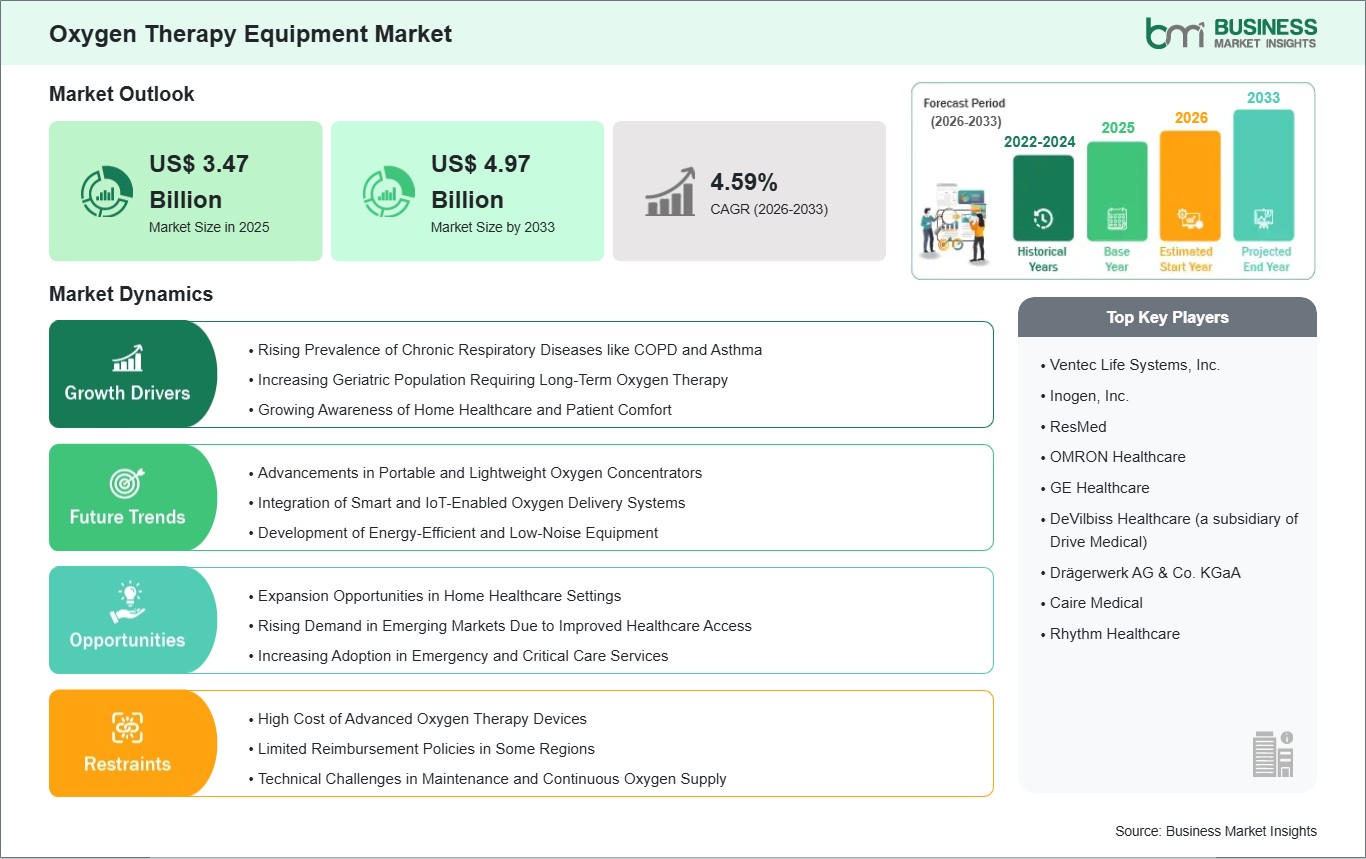
Oxygen therapy equipment comprises a suite of medical devices designed to deliver supplemental oxygen to patients whose lungs are unable to absorb adequate amounts from ambient air. These devices provide critical support for life-sustaining treatment in conditions such as chronic obstructive pulmonary disease (COPD), asthma, sleep apnea, and pneumonia across hospitals, ambulatory surgical centers, and home-care environments. Market growth is primarily driven by the increasing global prevalence of chronic respiratory diseases, which is associated with aging populations and environmental pollution, as well as the rapid adoption of home-based healthcare. In addition, the transition to smart, Internet of Things (IoT)-enabled devices is enhancing patient safety by enabling real-time monitoring of oxygen saturation and remote adjustment of flow rates by clinicians.
Several challenges may impede market growth. High capital and maintenance costs for advanced portable concentrators present significant barriers in low-income regions. Stringent regulatory and reimbursement requirements, such as the National Competitive Bidding (NCB) program in the United States, frequently reduce profit margins for home-care providers. The industry also faces constraints related to safety risks, including fire hazards and the clinical dangers of oxygen toxicity when oxygen levels are not precisely controlled.
Despite these challenges, the market presents substantial opportunities, including the integration of telemedicine with respiratory care and the rapid advancement of ultra-lightweight battery technologies that extend device runtime. The adoption of high-flow oxygen therapy in non-intensive care unit (non-ICU) settings and the development of artificial intelligence (AI)-driven predictive analytics for chronic obstructive pulmonary disease (COPD) exacerbations are also anticipated to drive long-term market growth.
Segment Analysis
Oxygen Therapy Equipment Market Segmentation
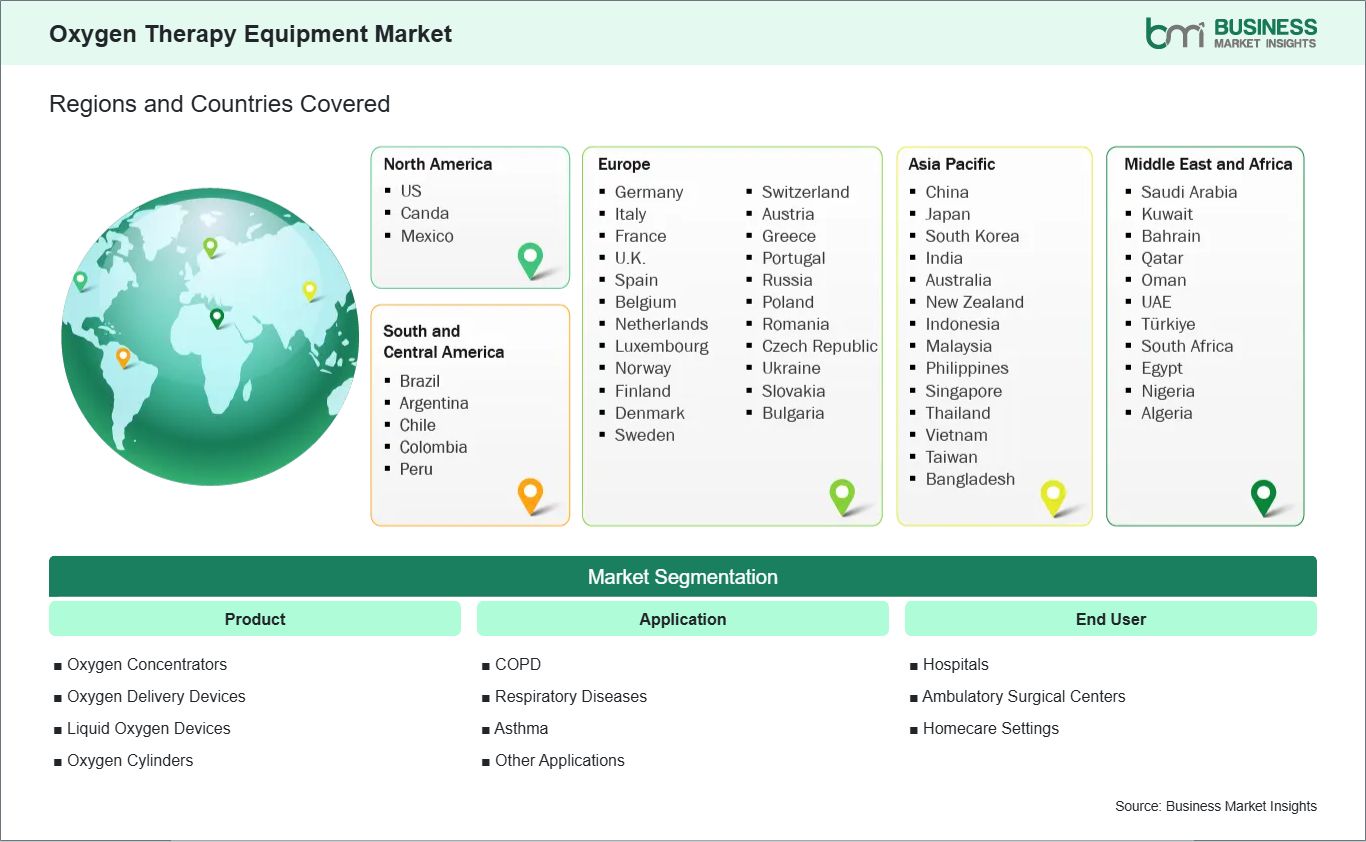
Key segments that contributed to the derivation of the Oxygen Therapy Equipment market analysis are product, application, and end user.
- By Product, the market is segmented into Oxygen Concentrators, Oxygen Delivery Devices, Liquid Oxygen Devices, and Oxygen Cylinders.
- By Application, the market is divided into COPD, Respiratory Diseases, Asthma, and Others.
- By End User, the market is categorized into Hospitals, Ambulatory Surgical Centers and Homecare Settings.
Market Forces
Oxygen Therapy Equipment Market Drivers and Opportunities
Rising Respiratory Burden and the Move Toward Home-Based Care
The primary driver of the Oxygen Therapy Equipment Market is the global increase in chronic respiratory conditions, particularly Chronic Obstructive Pulmonary Disease (COPD), which remains the principal application for these devices. The rising prevalence of COPD, asthma, and sleep apnea, intensified by aging populations and increasing pollution, is a significant factor driving sustained equipment procurement. Additionally, the expansion of home healthcare and remote patient monitoring (RPM) further accelerates market growth, as both patients and payers increasingly prefer home-based oxygen therapy to reduce costs and minimize infection risks. This trend directly increases demand for ultra-portable, user-friendly concentrators. Technological advancements, such as the integration of Internet of Things (IoT) and smart connectivity, also serve as key drivers, enabling real-time data tracking and allowing clinicians to monitor patient adherence and oxygen saturation remotely.
Advancements in battery technology also represent a critical catalyst, as next-generation lithium-sulfur batteries enable ultra-light portable oxygen concentrators (POCs) with run-times exceeding six hours at standard settings. Collectively, these factors, including the increasing prevalence of respiratory diseases, the decentralization of healthcare delivery, and enhanced digital connectivity, support a robust and high-growth trajectory for oxygen therapy solutions.
AI-Native Pulse Delivery and Emerging Market Infrastructure
A significant opportunity exists in the integration of oxygen therapy equipment with artificial intelligence-driven feedback systems. Advanced smart concentrators are being developed with algorithms that automatically adjust oxygen flow in real time according to patient breath rate and physical activity, thereby optimizing therapy and improving battery efficiency. Additionally, the development of non-invasive ventilation (NIV) hybrid systems, which combine oxygen supplementation with pressure support for acute hypercapnic respiratory failure, enables manufacturers to address a wider spectrum of complex clinical requirements within a single device.
The expansion of healthcare infrastructure in emerging economies, particularly in the Asia-Pacific (APAC) and Middle East and Africa (MEA) regions, represents a substantial opportunity as both governmental and private sector investments in oxygen generation plants and backup systems increase to ensure reliable supply in rural clinics. In addition to hardware advancements, the emergence of integrated Device-as-a-Service (DaaS) subscription models allows manufacturers to oversee equipment maintenance and refills for home-based patients, thereby generating consistent and recurring revenue streams. Companies prioritizing noise-optimized whisper technology and pioneering wearable oxygen delivery systems are well positioned to lead the global oxygen therapy equipment market.
Size and Share Analysis
Oxygen Therapy Equipment Market Size and Share Analysis
The Oxygen Therapy Equipment market demonstrates steady growth, with size and share analysis revealing evolving trends and competitive positioning among key players. The report further examines subsegments categorized within product, application, and end user, offering insights into their contribution to overall market performance.
Based on product, the Oxygen Concentrators and Oxygen Delivery Devices subsegment holds a significant market presence, representing the primary engines of technological innovation. Oxygen Concentrators, particularly portable variants, are indispensable for the Active Patient demographic, utilizing pressure swing adsorption (PSA) technology to provide a continuous, high-purity supply without the need for heavy, refillable tanks. A notable trend is the surge in the Oxygen Delivery Devices subsegment, specifically high-flow nasal cannulas and ergonomic masks, which are registering higher interest. These devices are becoming essential for Critical Care and Post-Operative Recovery, offering heated and humidified oxygen delivery that significantly improves patient comfort and reduces airway irritation compared to legacy dry-gas delivery methods.
Report Coverage
Oxygen Therapy Equipment Market Report Coverage and Deliverables
The "Oxygen Therapy Equipment Market Size and Forecast (2022–2033)" report provides a detailed analysis of the market covering below areas:
- Oxygen Therapy Equipment market size and forecast at global, regional, and country levels for all the key market segments covered under the scope
- Oxygen Therapy Equipment market trends, as well as market dynamics such as drivers, restraints, and key opportunities
- Oxygen Therapy Equipment market analysis covering key market trends, global and regional framework, major players, regulations, and recent market developments
- Industry landscape and competition analysis covering market concentration, heat map analysis, prominent players, and recent developments for the Oxygen Therapy Equipment market
- Detailed company profiles, including SWOT analysis
Geographic Insights
Oxygen Therapy Equipment Market Geographic Insights
The geographical scope of the Oxygen Therapy Equipment market report is divided into five regions: North America, Asia Pacific, Europe, Middle East & Africa, and South & Central America.
North America remains the leading market due to a high prevalence of respiratory disorders such as COPD and asthma, as well as a comprehensive reimbursement framework that promotes the adoption of home-based oxygen therapy. Europe maintains a significant market share, supported by growing awareness of early respiratory diagnosis and a robust healthcare infrastructure that facilitates integrated chronic disease management. The Asia Pacific region represents the fastest-growing market, driven by rapid urbanization, increasing pollution, and large-scale government initiatives in China and India to enhance medical oxygen infrastructure in response to recent global health challenges.
The Asia-Pacific Oxygen Therapy Equipment Market is segmented into China, Japan, South Korea, India, Australia, and the Rest of Asia Pacific. China serves as a primary growth driver, with domestic manufacturing of oxygen concentrators expanding significantly to address both local and international demand. In India, the home healthcare sector is experiencing rapid growth, and portable oxygen concentrators are increasingly preferred by patients seeking mobility and independence. Japan leads in the development of ultra-lightweight and energy-efficient oxygen systems designed for its aging population. Australia is experiencing greater adoption of IoT-enabled devices for remote patient monitoring.
Industry Activity
Recent Developments
The Oxygen Therapy Equipment market is evaluated by gathering qualitative and quantitative data post primary and secondary research, which includes important corporate publications, association data, and databases. A few of the key developments in the Oxygen Therapy Equipment market are:
- In June 2025, Inogen, Inc. launched the Voxi™ 5 Stationary Oxygen Concentrator in the United States, expanding its home oxygen therapy portfolio. Developed in collaboration with Yuwell Medical, the device delivers 1–5 L/min continuous flow oxygen and is designed to enhance affordability, durability, and accessibility for long-term care patients. This launch strengthens Inogen`s position in the homecare oxygen therapy segment and expands its market reach through existing sales channels.
- In January 2025, Inogen, Inc. entered into a strategic collaboration with Yuwell Medical to expand its respiratory product portfolio, strengthen its R&D pipeline, and enhance global market reach. As part of the agreement, Yuwell committed a $27.2 million equity investment in Inogen, supporting expansion in the U.S. and accelerating entry into the Chinese market.
Trust & Transparency
Research Methodology
The market analysis combines proprietary research with secondary data from government agencies, company disclosures, regulatory filings, industry databases and expert interviews. Market estimates are validated through data triangulation, cross-market benchmarking and analyst
review.
View Full Research Methodology
Key Sources Referred:
World Bank – Global Trade IndicatorsWorld Trade Organization (WTO)(International Monetary Fund )IMFInternational Trade Administration (ITA)Company websiteCompany annual reportsCompany investor presentations