Market Summary
Executive Summary and Global Market Analysis
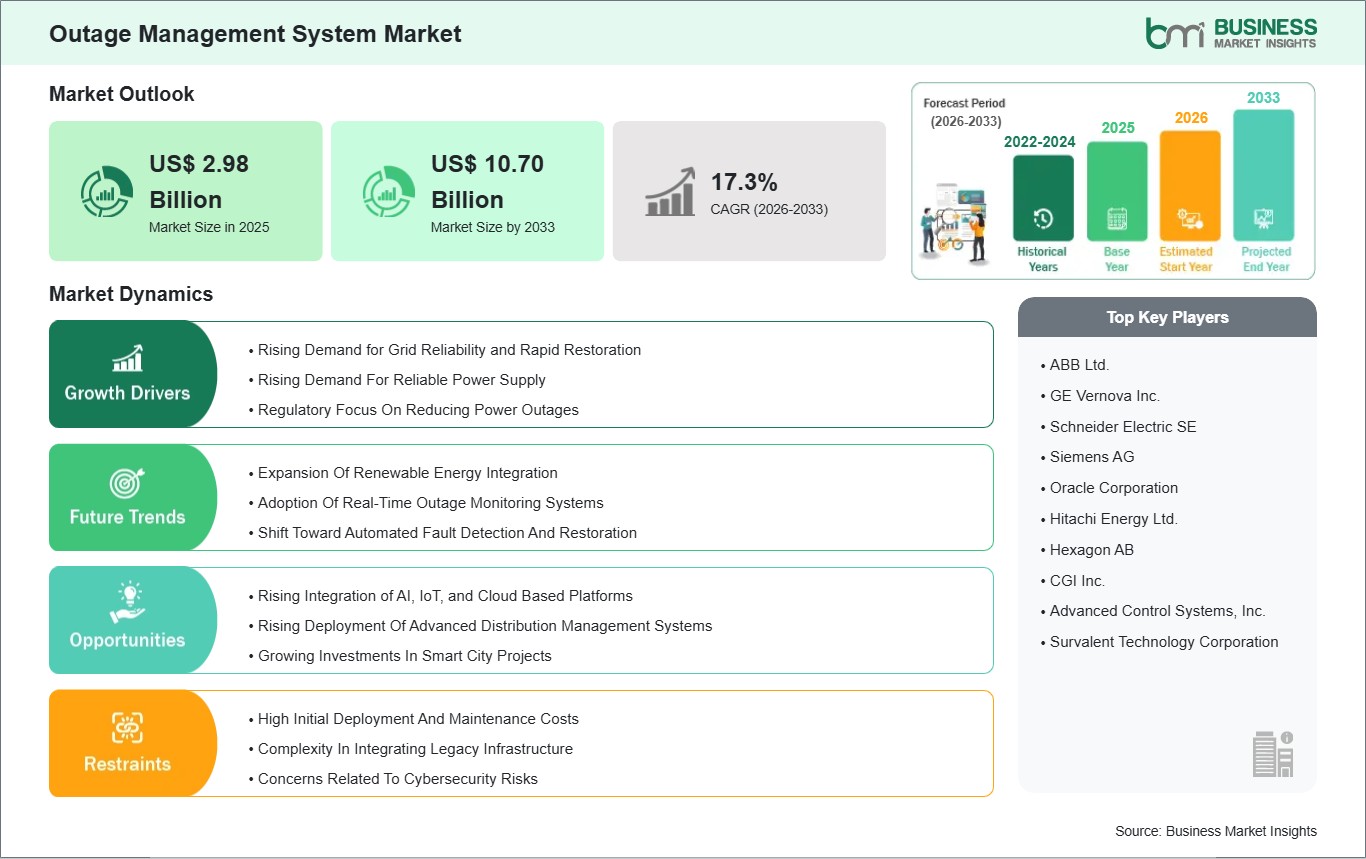
An outage management system (OMS) refers to a specialized software platform engineered to identify, track, and facilitate the restoration of power during electrical grid disturbances. By integrating data from geographic information systems (GIS), advanced metering infrastructure (AMI), and supervisory control and data acquisition (SCADA) systems, an OMS enables utilities to localize faults and optimize the deployment of repair crews. This technology is fundamental to maintaining grid reliability and minimizing the System Average Interruption Duration Index (SAIDI) for utility providers. Market expansion is being propelled by the global requirement for grid modernization, the rising frequency of climate-induced weather events, and substantial institutional investment in smart grid infrastructure to support a more resilient energy ecosystem.
However, several factors may restrain market progression. The high capital intensity associated with deploying comprehensive OMS platforms, particularly when integrating with decades-old legacy assets, remains a significant hurdle for smaller municipal and cooperative utilities. The industry also faces technical challenges regarding the data quality gap in GIS records, as inaccurate spatial data can undermine the effectiveness of automated fault-location algorithms. Additionally, the increasing digitalization of grid operations has expanded the attack surface for sophisticated cyber threats, necessitating complex and ongoing investments in network security and data encryption. These hurdles, compounded by a persistent shortage of specialized personnel proficient in both electrical engineering and big-data analytics, increase operational complexity and the total cost of ownership.
Despite these hurdles, the market outlook remains favorable. Opportunities are emerging through the adoption of artificial intelligence and machine learning, which enable predictive outage modeling by correlating historical data with real-time weather patterns. The expansion of distributed energy resources (DERs) and microgrids is gaining traction, necessitating more sophisticated OMS capabilities for bidirectional power flow management. Furthermore, the growth of cloud-native and SaaS deployment models aligns with global goals for operational scalability and cost-efficiency. Collectively, these innovations position the outage management system industry for sustained long-term development as a cornerstone of the transition toward a decentralized and self-healing smart grid.
Segment Analysis
Outage Management System Market Segmentation
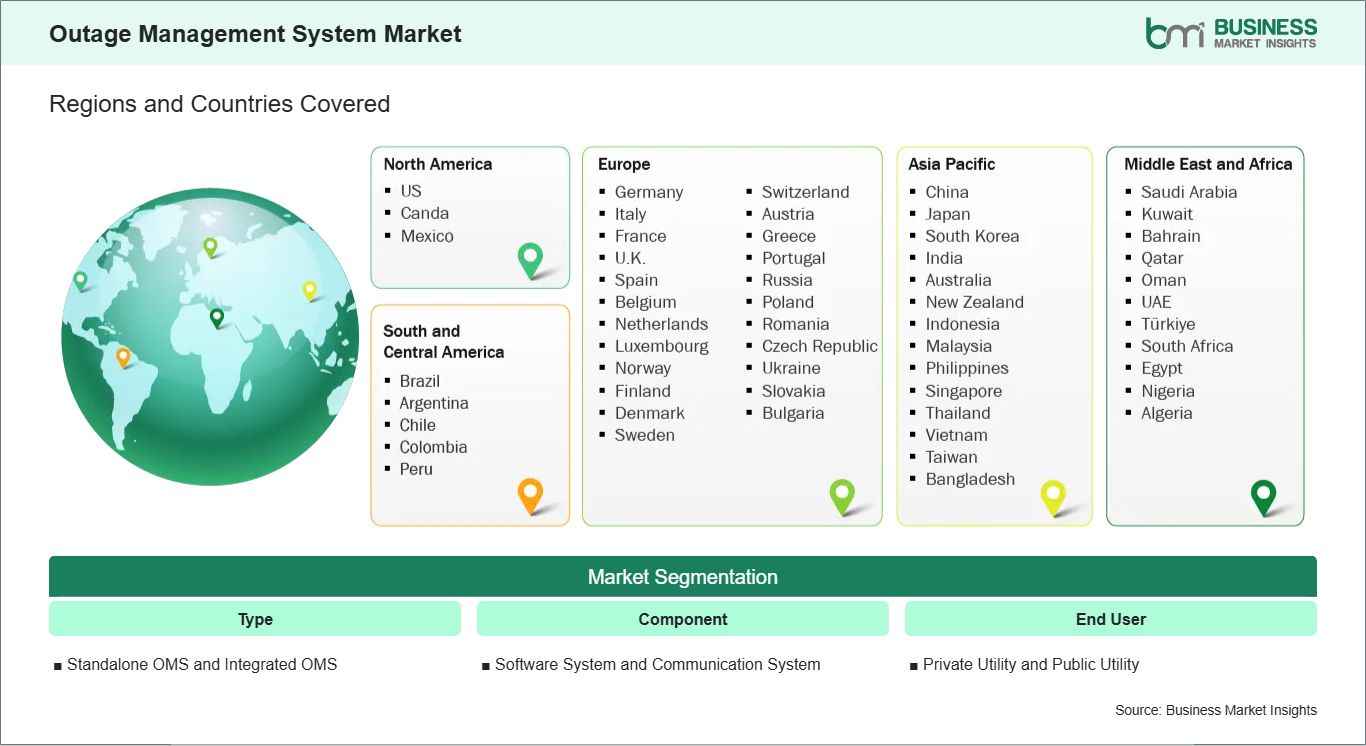
Key segments that contributed to the derivation of the Outage Management System market analysis are type, component, and end user.
- By Type, the market is segmented into Standalone OMS and Integrated OMS.
- By Component, the market is divided into Software System and Communication System.
- By End User, the market is categorized into Private Utility and Public Utility.
Market Forces
Outage Management System Market Drivers and Opportunities
Rising Demand for Grid Reliability and Rapid Restoration
The outage management system (OMS) market is being driven by the growing need for reliable electricity supply, efficient fault detection, and rapid service restoration. With rising global energy demand and increasing dependence on digital infrastructure, utilities are under pressure to minimize downtime and improve customer satisfaction. OMS platforms provide real‑time visibility into grid conditions, enabling operators to quickly identify outages, dispatch crews, and restore service. The expansion of smart grids and distributed energy resources is amplifying demand, as these complex networks require advanced monitoring and coordination tools. Regulatory mandates emphasizing resilience, service quality, and disaster preparedness are reinforcing adoption, particularly in regions prone to extreme weather events. Additionally, the rising integration of renewable energy sources is creating operational challenges that OMS solutions help address. Collectively, grid modernization, regulatory compliance, and the need for efficient outage response are propelling sustained growth in the global outage management system market.
Rising Integration of AI, IoT, and Cloud‑Based Platforms
Opportunities in the outage management system market are expanding through the integration of artificial intelligence, IoT sensors, and cloud‑based platforms. AI‑enabled OMS solutions can deliver predictive insights, automate fault detection, and optimize crew dispatch, reducing downtime and operational costs. IoT‑connected devices such as smart meters and sensors are creating new pathways for adoption, offering granular visibility into grid performance and enabling proactive maintenance. Cloud‑based OMS platforms are gaining traction due to their scalability, cost efficiency, and ability to support remote collaboration, making them ideal for utilities of all sizes. The growing emphasis on customer engagement is opening opportunities, as OMS solutions increasingly integrate with mobile apps and communication platforms to provide real‑time outage updates and service transparency. Additionally, the expansion of microgrids, renewable integration, and smart city projects is driving demand for advanced OMS capabilities. Vendors who focus on developing interoperable, AI‑driven, and cloud‑enabled solutions are well‑positioned to capture growth, underscoring a transformative trajectory for the global outage management system market.
Size and Share Analysis
Outage Management System Market Size and Share Analysis
Based on Type, the Standalone OMS subsegment holds a strong presence in the market. These systems are indispensable for utilities seeking dedicated platforms to manage outages, offering reliability and focused functionality. The Integrated OMS subsegment is essential for organizations adopting advanced grid modernization strategies, combining OMS with other utility systems such as GIS, SCADA, and CIS to enhance efficiency and real‑time decision‑making.
Report Coverage
Outage Management System Market Report Coverage and Deliverables
The "Outage Management System Market Size and Forecast (2022 - 2033)" report provides a detailed analysis of the market covering below areas:
- Market size and forecast at global, regional, and country levels for all market segments covered under the scope
- Market trends, as well as drivers, restraints, and opportunities
- Market analysis covering key trends, global and regional framework, major players, and recent developments
- Market concentration, heat map analysis, prominent players, and recent developments
- Detailed company profiles, including SWOT analysis
Geographic Insights
Outage Management System Market Geographic Insights
The geographical scope of the Outage Management System market report is divided into five regions: North America, Asia Pacific, Europe, Middle East & Africa, and South & Central America.
North America maintains a preeminent position within the global industry, a standing solidified by the region's advanced utility infrastructure and the aggressive modernization of aging electrical grids. The regional landscape is characterized by high-stakes investments in the United States and Canada, where the transition toward Advanced Distribution Management Systems (ADMS) and smart grid architectures has become a strategic priority. This market leadership is further supported by stringent regulatory mandates from the Federal Energy Regulatory Commission (FERC) and the North American Electric Reliability Corporation (NERC), which require utilities to uphold rigorous reliability metrics (SAIDI/SAIFI) and minimize restoration times during frequent climate-induced weather events.
Technological progression in the United States and Canada is largely driven by a decisive shift toward AI-Powered Predictive Outage Models and Cloud-Native Platforms. These advanced systems utilize machine learning to analyze historical data, weather patterns, and real-time grid health to anticipate potential asset failures before they occur. Furthermore, the region is witnessing an increasing utilization of Integrated Outage Management Systems (OMS) that provide a seamless interface with Geographic Information Systems (GIS) and Advanced Metering Infrastructure (AMI). This focus on "Intelligent Grid Visibility" allows North American utilities to automate fault localization and streamline mobile workforce dispatching, significantly reducing the economic impact of large-scale power interruptions.
Industry Activity
Recent Developments
The Outage Management System market is evaluated by gathering qualitative and quantitative data post primary and secondary research, which includes important corporate publications, association data, and databases. A few of the key developments in the Outage Management System market are:
- In December 2025, ABB announced an agreement to acquire IPEC Limited, a UK-based provider of electrical infrastructure monitoring and diagnostics technology. The acquisition strengthens ABB`s predictive maintenance and monitoring capabilities, enabling early detection of equipment failures and reducing downtime across critical sectors, including utilities and data centers. The integration is expected to enhance grid reliability and support advanced outage prevention solutions.
- In November 2025, Schneider Electric launched the One Digital Grid Platform, an AI-enabled solution designed to help utilities modernize grid operations. The platform integrates planning, asset management, and operational tools while providing real-time outage restoration estimates to improve response during storms and grid disruptions. The launch strengthens digital grid capabilities and supports more resilient and efficient outage management for utilities.
Trust & Transparency
Research Methodology
The market analysis combines proprietary research with secondary data from government agencies, company disclosures, regulatory filings, industry databases and expert interviews. Market estimates are validated through data triangulation, cross-market benchmarking and analyst
review.
View Full Research Methodology
Key Sources Referred:
World Bank & Global Trade Indicators World Trade Organization (WTO) (International Monetary Fund )IMF International Trade Administration (ITA) Company website Company annual reports Company investor presentations