Market Summary
Executive Summary and Global Market Analysis
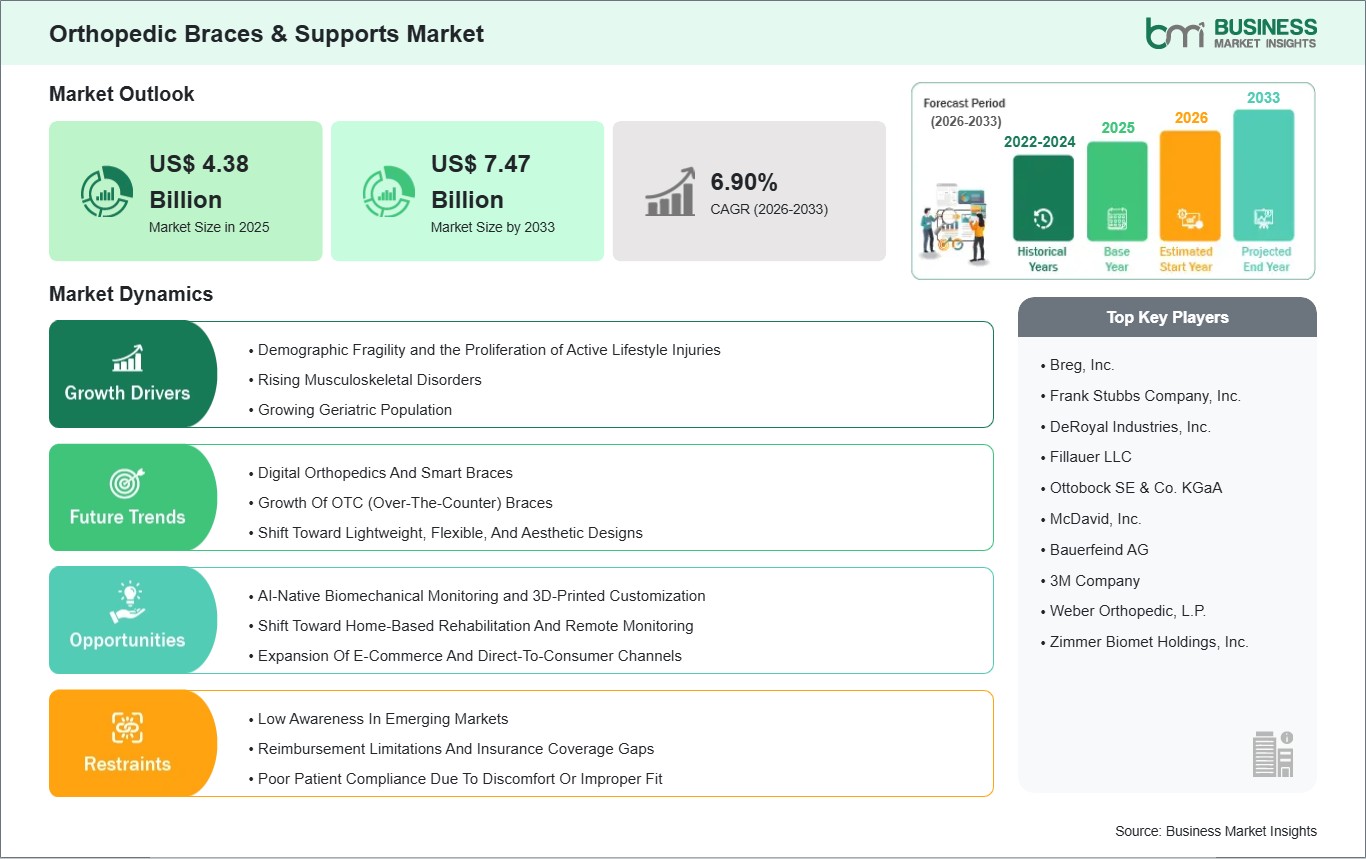
Orthopedic braces and supports refer to a specialized category of medical devices and durable equipment designed to stabilize, align, and support musculoskeletal structures. These tools are primarily utilized to facilitate healing after an injury, manage chronic conditions, and enhance physical functionality. Market expansion is fundamentally driven by the global aging population, who exhibit a higher vulnerability to degenerative conditions such as osteoarthritis and osteoporosis. Furthermore, the shift toward proactive physical well-being and the rising incidence of sports-related and unintentional traumatic injuries, such as ligament tears and fractures, are accelerating the demand for stabilizing equipment. The integration of digital health technologies and the increasing availability of over-the-counter (OTC) solutions are further broadening market accessibility and improving patient compliance.
However, several factors can restrain market growth. The high cost of premium, customized, and smart-sensor-enabled braces can be a significant barrier for patients in regions with limited insurance coverage. Inconsistent reimbursement frameworks for home-use orthopedic supports often limit the procurement of advanced technological systems. Additionally, the industry faces constraints due to patient non-compliance, frequently caused by discomfort or skin irritation associated with prolonged use of traditional rigid materials. The lack of standardized clinical evidence regarding the long-term efficacy of certain bracing-mediated treatments can also influence physician prescribing patterns.
Despite these hurdles, the market holds significant opportunities in the adoption of 3D printing and anatomical modeling for the production of lightweight, patient-specific supports. The rise of connected smart braces which provide clinicians with posture and mobility analytics, and the expansion of e-commerce distribution channels are expected to support long-term development within the sector.
Segment Analysis
Orthopedic Braces & Supports Market Segmentation
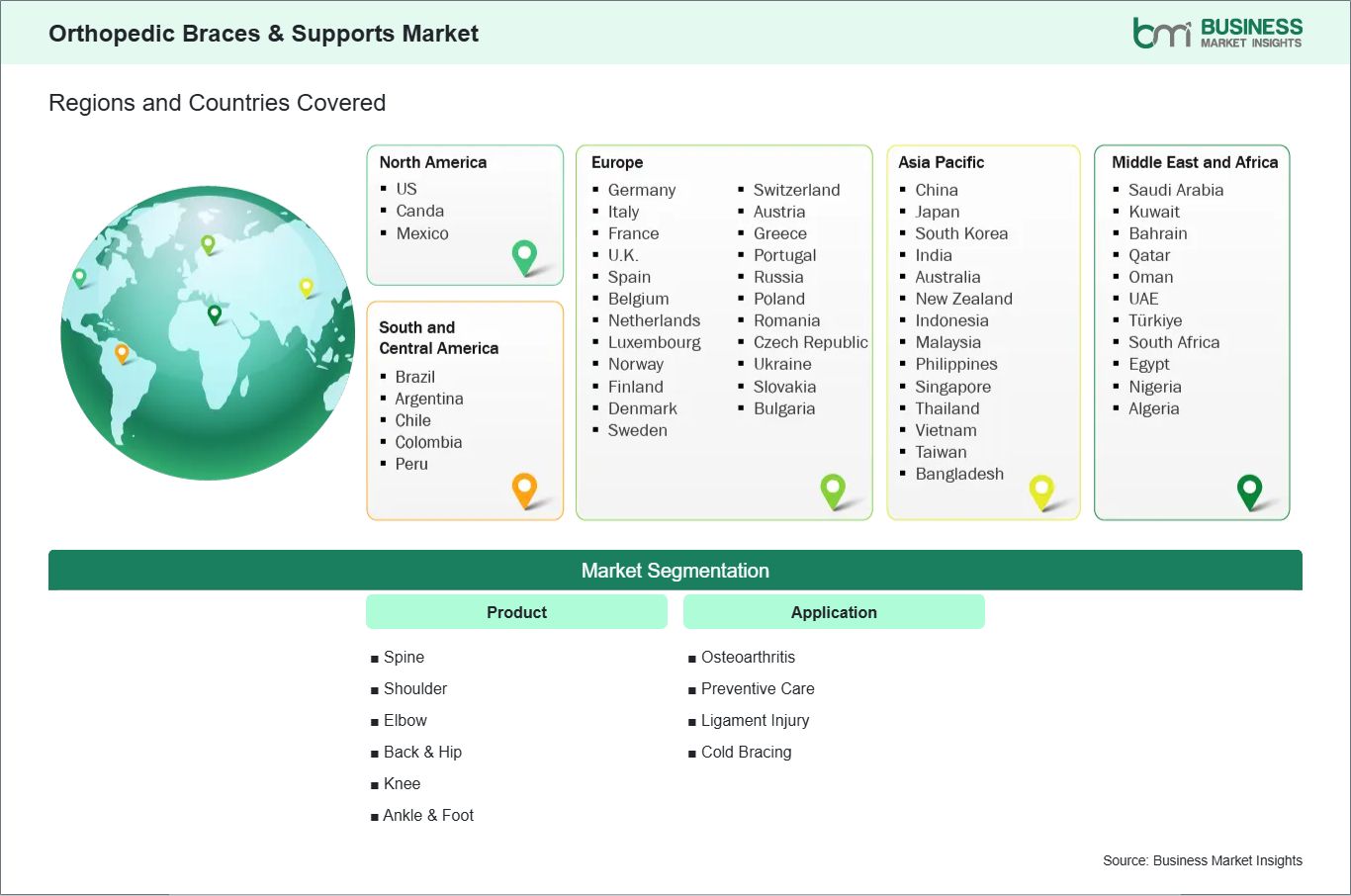
Key segments that contributed to the derivation of the Orthopedic Braces & Supports market analysis are product and application.
- By Product, the market is segmented into Spine, Shoulder, Elbow, Back & Hip, Knee, and Ankle & Foot.
- By Application, the market is divided into Osteoarthritis, Preventive Care, Ligament Injury, and Cold Bracing.
Market Forces
Orthopedic Braces & Supports Market Drivers and Opportunities
Demographic Fragility and the Proliferation of Active Lifestyle Injuries
The primary driver for the Orthopedic Braces & Supports Market is the systemic global rise in musculoskeletal disorders and age-related bone fragility. The Increasing Prevalence of Osteoarthritis, Rheumatoid Arthritis, and Osteoporosis acts as a foundational catalyst, as an aging population requires reliable joint stabilization to maintain basic mobility and prevent falls. This momentum is further propelled by the Rising Incidence of Sports-Related Injuries and Road Traffic Accidents; as more individuals engage in high-impact physical activities and amateur sports, the demand for prophylactic and rehabilitative bracing, particularly for ligament tears (ACL/MCL), has intensified. In the technological sphere, the Rapid Adoption of High-Performance, Breathable Materials serves as a critical driver, with advanced textiles and memory foams replacing traditional heavy plastics to improve patient compliance and long-term comfort. Furthermore, the Expansion of Ambulatory Surgical Centers (ASCs) and Home-Care Rehabilitation is decentralizing the point of care, creating a robust demand for over-the-counter (OTC) and professional-grade braces that support patient independence during post-operative recovery. Together, these factors, geriatric health trends, injury rates, and the shift toward non-invasive care, ensure a resilient and technologically advancing growth path for the global orthopedic braces & supports market.
AI-Native Biomechanical Monitoring and 3D-Printed Customization
A significant high-value opportunity lies in the convergence of Orthopedic Braces with Artificial Intelligence (AI) and the Internet of Things (IoT). Next-generation smart braces are being developed with embedded sensors that track range of motion, muscle activity, and pressure distribution, allowing clinicians to remotely monitor rehabilitation progress and adjust therapy protocols based on objective data. There is also a major growth frontier in the development of 3D-Printed Patient-Specific Orthotics; by utilizing 3D body scanning and additive manufacturing, companies can produce custom-fit braces that conform perfectly to a patient`s unique anatomy, significantly reducing skin irritation and optimizing biomechanical support. Furthermore, the expansion of E-commerce and Direct-to-Consumer (DTC) Distribution Channels presents a lucrative opportunity, as digital platforms allow manufacturers to reach patients directly with specialized preventive supports for workplace ergonomics and fitness enthusiasts. Beyond physical hardware, the rise of Bioresorbable and Eco-Friendly Material Innovation offers a unique frontier, particularly in Western markets where healthcare systems are prioritizing sustainable procurement and carbon-neutral supply chains. Manufacturers who focus on Modular Hybrid Designs, combining soft elasticity with rigid stabilization, and those pioneering Predictive Analytics for Injury Prevention are positioned to lead the global orthopedic braces & supports market.
Size and Share Analysis
Orthopedic Braces & Supports Market Size and Share Analysis
Based on the application, the Ligament Injury and Osteoarthritis subsegment holds the primary market presence, representing the highest volume of professional recommendations. Ligament Injury is indispensable for the market, driven by the persistent demand for bracing in the wake of sports-related trauma and surgical reconstructions of the anterior cruciate ligament. A notable trend is the surge in the Preventive Care subsegment, which is registering significant traction. In this application, braces are becoming essential for Proactive Joint Safeguarding, where active individuals and athletes strategically utilize soft and elastic supports to reduce the risk of injury during high-impact activities. Furthermore, the Cold Bracing segment is registering focused growth in the post-operative vertical, where the integration of thermal therapy and compression is increasingly favored for Accelerated Recovery Protocols to manage acute inflammation and pain without pharmacological over-reliance.
Report Coverage
Orthopedic Braces & Supports Market Report Coverage and Deliverables
The "Orthopedic Braces & Supports Market Size and Forecast (2022–2033)" report provides a detailed analysis of the market covering below areas:
- Orthopedic Braces & Supports market size and forecast at global, regional, and country levels for all market segments covered under the scope
- Orthopedic Braces & Supports market trends, as well as drivers, restraints, and opportunities
- Orthopedic Braces & Supports market analysis covering key trends, global and regional framework, major players, regulations, and recent developments
- Industry landscape and competition analysis covering market concentration, heat map analysis, prominent players, and recent developments for the Orthopedic Braces & Supports market
- Detailed company profiles, including SWOT analysis
Geographic Insights
Orthopedic Braces & Supports Market Geographic Insights
The geographical scope of the Orthopedic Braces & Supports market report is divided into five regions: North America, Asia Pacific, Europe, Middle East & Africa, and South & Central America.
North America maintains the primary market position, supported by a highly developed healthcare infrastructure, substantial clinical volume of sports-related injuries, and favorable reimbursement frameworks that encourage the adoption of advanced stabilization devices. Europe represents a mature market segment where growth is sustained by a robust framework for geriatric care and an increasing institutional focus on non-invasive rehabilitation for osteoarthritis and ligament injuries. Asia Pacific is identified as the most rapidly advancing region, propelled by accelerating healthcare modernization, an expanding geriatric population in China and Japan, and significant public investments in specialized orthopedic and trauma centers.
The Asia-Pacific Orthopedic Braces & Supports Market is segmented into China, Japan, South Korea, India, Australia, and the Rest of Asia Pacific. China serves as a central engine for regional growth, driven by a high prevalence of chronic joint disorders and government initiatives to modernize regional hospital surgical suites. India is experiencing a notable surge in demand as private healthcare providers invest in advanced rehabilitation technologies to address the rising volume of road traffic accidents and sports injuries. Japan and South Korea continue to lead in technological adoption, prioritizing the use of lightweight, 3D-printed patient-specific supports and miniaturized instrumentation tailored for geriatric patients with osteoporotic conditions.
Industry Activity
Recent Developments
The Orthopedic Braces & Supports market is evaluated by gathering qualitative and quantitative data post primary and secondary research, which includes important corporate publications, association data, and databases. A few of the key developments in the Orthopedic Braces & Supports market are:
- In January 2025, Aspen Medical Products completed the acquisition of Advanced Orthopaedics, expanding its bracing and supports portfolio beyond spine products. The acquisition enhances Aspen`s global reach, strengthens its market position, and provides patients and clinicians with a broader range of mobility, pain management, and restorative solutions.
- In January 2024, OrthoPediatrics Corp. acquired Boston Orthotics & Prosthetics, expanding its Specialty Bracing Division and pediatric orthotic portfolio. The acquisition strengthens non-surgical pediatric orthopedic care, enhances access to advanced braces and orthoses, and supports improved outcomes for children with scoliosis and neuromuscular conditions.
Trust & Transparency
Research Methodology
The market analysis combines proprietary research with secondary data from government agencies, company disclosures, regulatory filings, industry databases and expert interviews. Market estimates are validated through data triangulation, cross-market benchmarking and analyst
review.
View Full Research Methodology
Key Sources Referred:
World Bank – Global Trade IndicatorsWorld Trade Organization (WTO)(International Monetary Fund )IMFInternational Trade Administration (ITA)Company websiteCompany annual reportsCompany investor presentations