
Organic Farming Market Outlook: Size, Share, Trends, Growth Analysis, Competitive Landscape & Forecast, 2026-2033

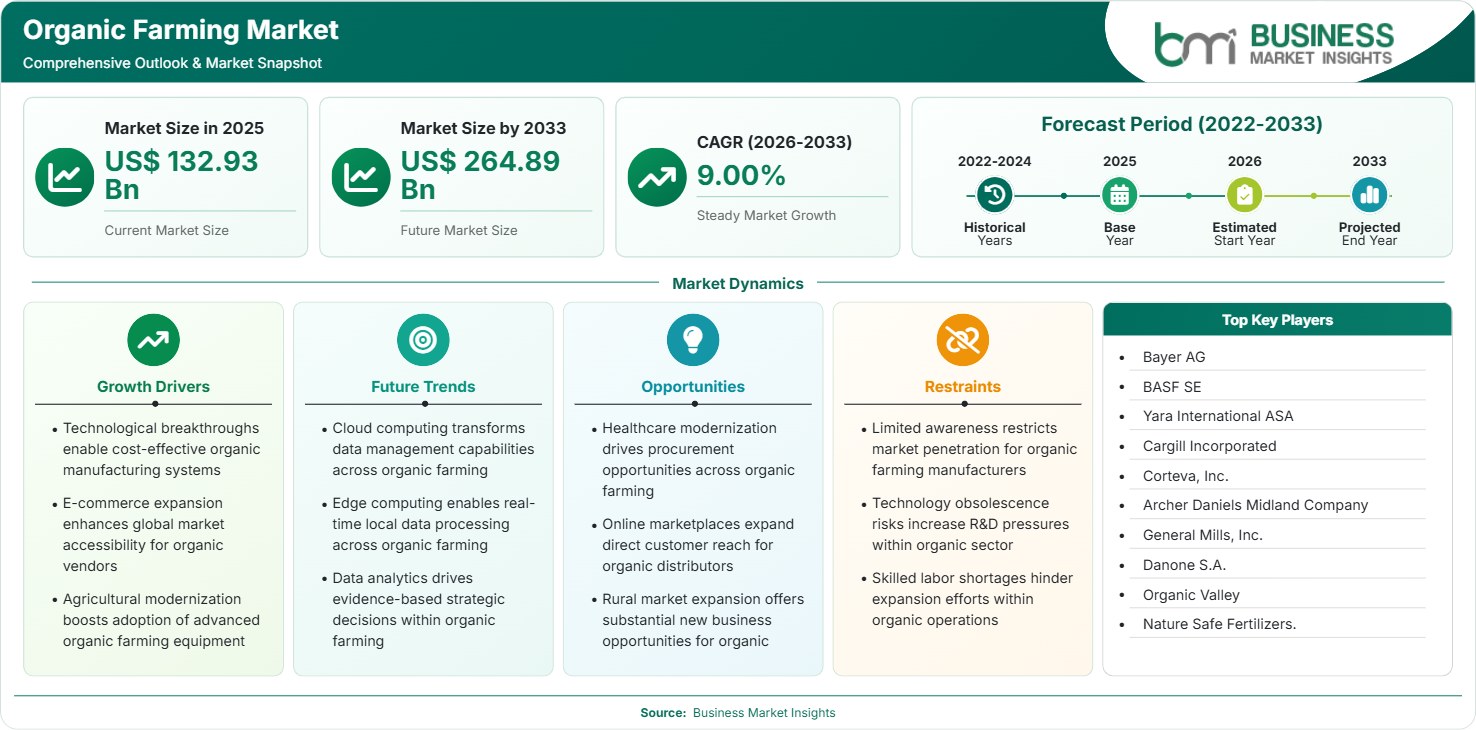
The Organic Farming Market size was valued at US$ 132.93 Billion in 2025 and is projected to reach US$ 264.89 Billion by 2033, growing at a CAGR of 9.00% during 2026–2033. Rising consumer demand for certified organic food, supportive agricultural policies, soil health improvement initiatives, expanding export opportunities, premium product pricing, and regenerative agriculture investments are creating strong growth momentum and long-term opportunities.

Report Coverage
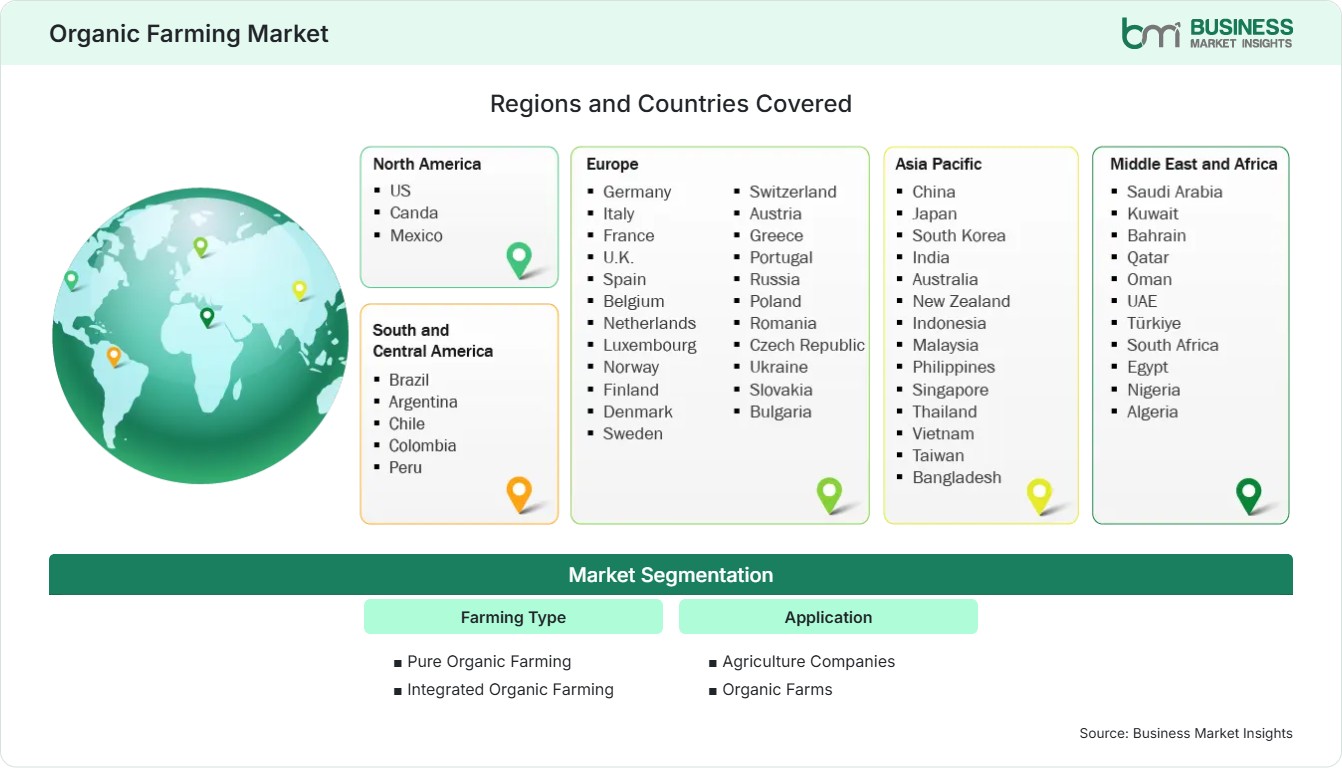
  • Farming Type: Pure Organic Farming, Integrated Organic Farming
  • Application: Agriculture Companies, Organic Farms
US$ 132.93 Bn Market size in 2025
US$ 264.89 Bn Market Size by 2033
9.00% CAGR, 2026 - 2033
2026-2033 Forecast Period

AI Overview

Organic Farming Market Summary

  • North America Region: North America holds a market share of 34%–37% in 2025, growing with a CAGR of 8.2%–8.8% during 2026–2033. Demand for certified produce, retail penetration, farm subsidies, digital traceability adoption, and regenerative cultivation investments support expansion across commercial farming ecosystems and agricultural value chains. The U.S. represents the largest regional contributor, supported by premium food demand and CAGR of 8.3%–8.9%.
  • Fastest Growing Region: Asia Pacific holds a market share of 24%–27% in 2025, advancing with a CAGR of 10.2%–10.8% during 2026–2033. Expanding middle-class consumption, government incentives, export-oriented production, sustainable agriculture programs, certification infrastructure development, and growing environmental awareness continue accelerating regional adoption across major farming economies.
  • Leading Segment: Pure Organic Farming accounts for a 58%–61% share in 2025 and grows at 8.8%–9.4% CAGR. Strong certification demand, premium crop pricing, export compliance requirements, soil fertility preservation, and consumer preference for chemical-free agricultural products strengthen segment leadership globally.
  • High Growth Segment: Agriculture Companies hold 52%–55% share in 2025 and expand at 9.5%–10.1% CAGR. Corporate sustainability mandates, supply chain transparency programs, contract farming models, organic ingredient sourcing strategies, and rising institutional demand stimulate accelerated investment decisions worldwide.
  • Key Market Opportunity: Expansion of climate-smart farming systems integrating biological inputs, digital monitoring, carbon-credit participation, regenerative practices, and export certification frameworks offers attractive revenue opportunities across emerging and developed agricultural economies.
  • Major Market Players: Bayer AG, BASF SE, Yara International ASA, Cargill Incorporated, Corteva, Inc., Archer Daniels Midland Company, General Mills, Inc., Danone S.A., Organic Valley, and Nature Safe Fertilizers.
Strategic Insights

Organic Farming Market: Strategic Insights

Organic Farming Market Strategic Framework
FREE PDF
Request your free sample
Request free sample
Stakeholder View

Key Takeaways

  • Supply chains are increasingly integrating growers, certification agencies, processors, distributors, and retailers under traceability-focused ecosystems that improve transparency and pricing efficiency.
  • Agriculture Companies represent the strongest commercial opportunity due to greater procurement scale, sustainability targets, and investment capacity for certified production programs.
  • Biological crop protection products, precision nutrient management, and digital farm monitoring platforms are reshaping productivity and compliance management across cultivation systems.
  • Asia Pacific offers compelling investment potential as governments expand sustainable agriculture incentives while domestic consumption and export demand continue rising.
  • Strategic partnerships between food brands, agricultural input providers, and farming cooperatives are becoming a preferred route for scaling certified production capacity.
  • Carbon credit programs and regenerative agriculture initiatives are creating supplementary revenue streams beyond conventional crop sales.
Geographic Outlook

Organic Farming Market Regional Highlights

North America Organic Farming Market

North America accounts for 34%–37% of the organic farming market share in 2025 and is projected to grow at a CAGR of 8.2%–8.8% through 2033. Strong consumer purchasing power, extensive retail distribution networks, mature certification systems, and growing regenerative agriculture investments support regional leadership. The United States contributes the majority of regional revenue, while Canada expands certified acreage through government-supported sustainability initiatives. Premium product pricing and supply chain transparency remain central drivers. Organic Farming Market growth continues to benefit from institutional procurement and environmentally focused farming policies.

  • Large retailers continue expanding organic product portfolios, increasing demand certainty for certified producers and processors across multiple agricultural categories.
  • Regenerative agriculture programs are encouraging adoption of soil-health practices while improving farm resilience and sustainability performance metrics.
  • Digital traceability systems strengthen compliance management, supporting export competitiveness and consumer confidence in certified products.
  • Investment in biological crop inputs supports reduced synthetic chemical dependence and aligns with environmental sustainability objectives.

US Organic Farming Market

The United States accounts for 78%–82% of North American revenue in 2025 and is projected to grow at a CAGR of 8.3%–8.9% through 2033. Consumer preference for high-quality food products, well-developed retail channels, and stringent enforcement of organic certification facilitate market growth. Food processors are increasingly incorporating certified ingredients into their branded products, and institutional buyers and foodservice organizations are increasing their purchasing commitments. Technological innovation and sustainability-focused agricultural investments continue supporting productivity improvements and market competitiveness.

  • Organic packaged food categories continue expanding through supermarket and e-commerce channels, supporting demand stability.
  • Producers increasingly adopt biological pest-management strategies to improve certification compliance and environmental outcomes.
  • Contract-farming arrangements enable long-term supply assurance for processors and consumer brands.
  • Sustainability commitments from major food companies encourage greater certified ingredient sourcing.

Europe Organic Farming Market

Europe has a market share of 28%–31%, with a CAGR of 8.7%–9.3%. The regulatory environment, environmental goals, and consumer awareness drive demand for the product in member nations. Germany is the leading revenue generator in the region, but the Eastern Europe segment shows a higher growth rate. Sustainability and biodiversity policies adopted by the EU continue driving conversion towards certified production. Increasing export demand and consumption of premium food products drive producers' economics.

  • Germany leads regional consumption, supported by mature retail networks and premium food preferences.
  • Poland and Romania demonstrate higher growth potential, recording modeled expansion rates above regional averages.
  • EU sustainability and biodiversity frameworks encourage conversion of conventional agricultural land.
  • Producer cooperatives enhance operational efficiency and strengthen access to export markets.
  • Organic dairy, fruits, and vegetables remain important value-generating cultivation categories.

Asia Pacific Organic Farming Market

The Asia Pacific region accounts for 24%-27% of the market share by 2025 and will experience a CAGR of 10.2%-10.8% from 2023 to 2033. The growth will be driven by growing disposable income, food safety consciousness, exports, and government support. The leading market in this region is China, while India shows rapid growth in certification schemes and natural farming activities. Domestic consumption, processing, and retailing are becoming drivers of competitiveness in this region. Infrastructure development and sustainable agricultural policies continue to support long-term expansion opportunities.

  • China leads regional revenue generation through growing domestic demand and export-oriented production systems.
  • India is among the fastest-growing countries, supported by certification initiatives and farmer training programs.
  • Increasing urban consumer awareness strengthens demand for premium agricultural products.
  • Government incentives encourage sustainable land management and environmentally responsible cultivation methods.
  • Export opportunities for certified crops continue attracting investment into processing infrastructure.

Rest of World Organic Farming Market

The Rest of World segment accounts for 11%-14% of the market in 2025 and is projected to expand at a CAGR of 9.4%-10.0% through 2033. The South and Central America region is supported by exports of specialty crops and other agricultural products. On the other hand, the Middle East and Africa are seeing increased participation in sustainability projects, water-efficient farming techniques, and international certifications. Brazil is the leading contributor in the region, while some Gulf states are investing in controlled-environment agriculture.

  • Brazil remains a major producer with expanding export opportunities for certified agricultural products.
  • Mexico benefits from proximity to North American markets and established certification frameworks.
  • Gulf countries invest in sustainable cultivation technologies and controlled agricultural systems.
  • African producers gain opportunities through fair-trade and certified export programs.
  • International development initiatives support technical training and certification accessibility.
Global Market Geography
FREE PDF
Request your free sample
Request free sample
Segment Analysis

Organic Farming Market Segmentation

Farming Type

This segment indicates the production base of the Organic Farming Market. Farming Type holds the largest share in terms of revenue generation, accounting for 58% to 61% of the market by 2025, with a forecast CAGR of 8.8% to 9.4%. The adoption of the same is enabled by consumer confidence, certification requirements, sustainability goals, and the premium pricing structures across domestic and export markets.

  • Pure Organic Farming: Relies exclusively on organic inputs and approved cultivation practices, supporting premium certification standards, stronger export positioning, enhanced soil health outcomes, and growing consumer preference for chemical-free agricultural products.
  • Integrated Organic Farming: Combines multiple sustainable agricultural techniques to improve resource efficiency, optimize productivity, strengthen biodiversity, and support long-term environmental and economic resilience across farming operations.

Application

The application dynamics depend on buying behavior and production size requirements. The Agriculture Companies account for 52% to 55% of the market share by 2025 and are forecast to have a 9.5% to 10.1% CAGR, making them the fastest-growing segment. Organic Farming Market trends include corporate sustainability pledges, purchasing contracts, certified ingredients, and the development of traceable supply chains.

  • Agriculture Companies: Large-scale procurement requirements, sustainability commitments, and integrated sourcing models encourage certified production expansion while supporting operational efficiency and long-term supply reliability.
  • Organic Farms: Independent and cooperative farming operations maintain strong participation through direct market access, certification compliance, premium pricing opportunities, and increasing consumer demand for sustainable agricultural products.
Market Forces

Organic Farming Market Dynamics

Key Market Drivers

Growing Demand for Certified Organic Food Products

Increasingly, consumers are showing greater interest in foods produced without artificial fertilizers and pesticides. According to data from FiBL and IFOAM, there are 99 million hectares of organically produced land worldwide, and organic food sales exceed €136 billion, indicating increasing demand for organic food not only in developing but also in developed countries. This increasing demand is due to issues regarding food safety and sustainability, and purchasing decisions. Retailers are allocating more shelf space to certified foods, while food manufacturers are using more organic ingredients. Institutional purchases by educational institutions, hospitals, and hospitality establishments are contributing to this upward trend in demand visibility for growers and processors, supporting broader market expansion.

Expansion of Sustainable Agriculture Policies

Governments across the world are adopting agricultural policies focused on climate resilience, biodiversity enhancement, and soil protection. Various incentive schemes that facilitate certification and farmer education in sustainable agriculture are helping to foster the growth of crop cultivation. Various regulatory constraints imposed on certain synthetic agrochemicals are driving a shift toward biological systems in agriculture. Various government funding schemes in Europe, North America, and the Asia-Pacific region are facilitating farmers' access to certification. With the growing emphasis on sustainability in agriculture, farmers' motivation to cultivate using appropriate methods is increasing.

Advancements in Biological Inputs and Farm Technology

Innovations in biofertilizers, biostimulants, microbial crop products, and precision agriculture devices are driving operational efficiencies. Advanced digital monitoring systems help farmers leverage their resources effectively while staying true to certification requirements. Monitoring fields using drones, satellite imagery, and soil health analytics helps derive meaningful insights to enhance productivity. Research spending by agricultural technology firms has led to the development of sustainable biological solutions. Increased visibility and lower reliance on inputs make such solutions economically viable.

Key Market Opportunities

Scaling Carbon Farming and Regenerative Agriculture Programs

Carbon sequestration projects have created new revenue avenues for certified producers. Financial rewards associated with soil carbon development promote the use of cover cropping, crop rotation, and other conservation practices in tandem with organic farming. The use of carbon credits is gaining prominence as an additional revenue stream for agricultural businesses. The regenerative form of agriculture is an appealing choice for investors owing to its sustainability and alignment with environmental reporting requirements. Organic Farming Market Forecasts have been incorporating the role of carbon value chains, given their growing involvement in the industry.

Export Market Penetration in Emerging Economies

Young agricultural economies have great potential to expand the production of certified exports for lucrative foreign markets. Investments in the infrastructure of certification, quality assurance, and post-harvest logistics improve competitiveness. Producers in Latin America, Asia, and Africa take advantage of favorable climates, which allow them to grow diverse crops. Foreign consumers still require reliable partners able to provide sustainable and traceable agricultural products. An export orientation is beneficial for obtaining higher prices and fostering rural economic growth. As certification becomes more accessible, new entrants gain opportunities to participate in higher-margin agricultural supply chains.

Growth of Organic Ingredients in Processed Foods

Food processors are beginning to include certified ingredients in their processed foods, drinks, nutritional products, and meat alternatives. Businesses are using brand differentiation when procuring traceable agricultural ingredients. Clean-label consumer demand will lead to commitments to purchase ingredients for several years. Food processing companies have continued to invest in certified organic manufacturing facilities. Value-added food sectors have experienced rapid growth, thus offering opportunities to farmers, cooperatives, and food processors. Enhanced integration between agricultural production and food manufacturing supports higher margins and more stable market demand.

Market Restraints and Challenges

Higher Production Costs and Certification Expenses

Factor: Organic cultivation often requires more labor-intensive management practices, extended transition periods, and ongoing certification investments. Impact: Higher operating costs may reduce profitability for smaller producers and create barriers to market entry. Yield variability during conversion periods can further affect financial performance. Producers must also invest in recordkeeping, audits, and compliance systems to maintain certification status. While premium pricing can offset some expenses, not all market channels provide sufficient returns. These cost considerations remain significant challenges for farmers evaluating transition from conventional production models.

Supply Chain Fragmentation and Limited Input Availability

Factor: Access to approved organic seeds, biological inputs, technical expertise, and certified processing infrastructure remains uneven across regions. Impact: Supply chain inefficiencies can increase operational complexity and limit production scalability. Producers in developing markets often face challenges related to logistics, storage, and certification support services. Inconsistent availability of approved agricultural inputs can affect productivity and compliance outcomes. Fragmented value chains may also reduce bargaining power for smaller operators. Addressing these structural limitations is essential for sustaining long-term industry growth and market competitiveness.

Company Analysis

Competitive Landscape

Organic Farming Market analysis indicates competition is shaped by agricultural input innovation, sustainability programs, certification expertise, and vertically integrated supply chains.

Company Name

Overview

Products and Services relevant to this market

Bayer AG

Global agriculture leader focused on sustainable farming systems and regenerative agriculture initiatives.

Biological solutions, seed technologies, digital farming tools, sustainability programs.

BASF SE

Agricultural solutions provider supporting environmentally responsible crop production.

Biological crop protection, soil management technologies, sustainable agriculture services.

Yara International ASA

Major plant nutrition company advancing sustainable farming productivity.

Organic-compatible nutrition products, crop advisory solutions, precision agriculture services.

Cargill Incorporated

Global agribusiness company engaged in sustainable sourcing programs.

Agricultural supply-chain services, sustainable procurement, farmer engagement initiatives.

Corteva, Inc.

Agriculture technology company focused on resilient farming systems.

Seed technologies, biological products, agronomic support solutions.

Archer Daniels Midland Company

Global processor and agricultural supply-chain operator.

Organic ingredient sourcing, processing services, agricultural procurement programs.

General Mills, Inc.

Food manufacturer investing in regenerative and sustainable agriculture initiatives.

Organic ingredient procurement, farmer partnerships, sustainability programs.

Danone S.A.

Consumer food company emphasizing sustainable agricultural sourcing.

Organic dairy supply chains, regenerative agriculture partnerships.

Organic Valley

Farmer-owned cooperative specializing in certified organic products.

Organic farming support, dairy production, market access services.

Nature Safe Fertilizers

Specialized provider of organic fertilizer products for commercial agriculture.

Organic fertilizers, soil nutrition products, crop fertility solutions.

Trust & Transparency

Research Methodology

The market analysis combines proprietary research with secondary data from government agencies, company disclosures, regulatory filings, industry databases and expert interviews. Market estimates are validated through data triangulation, cross-market benchmarking and analyst review.

View Full Research Methodology

Questions Answered

Frequently Asked Questions

What does an Organic Farming Market Report typically evaluate?

A Market Report generally assesses market size, competitive positioning, regional performance, technology adoption, regulatory developments, investment trends, and future growth outlook.

Which region presents the strongest future investment potential?

Asia Pacific offers substantial opportunities due to rising demand, government support, expanding export activity, certification growth, and increasing consumer awareness.

How does organic farming contribute to environmental sustainability?

It supports soil biodiversity, reduces synthetic chemical use, improves water management, enhances ecosystem resilience, and encourages long-term land conservation practices.

What crops are most commonly cultivated under certified organic systems?

Fruits, vegetables, cereals, oilseeds, pulses, coffee, tea, spices, and dairy-feed crops represent major certified cultivation categories across global markets.

What factors are accelerating adoption of organic farming worldwide?

Consumer preference for clean-label foods, sustainability regulations, premium pricing opportunities, expanding certification programs, and growing awareness of soil-health benefits are key adoption drivers.

Access the Full Organic Farming Market Report

Get segment-level forecasts, regional estimates, competitive benchmarking, company profiles and downloadable Excel datasets.

Access the full Organic Farming Market Report
350 pages PDF & Excel | 2026-08-31