Operational Technology Market Outlook (2022-2033)

Historic Data: 2022-2024   |   Base Year: 2025   |   Forecast Period: 2026-2033
Report Content: Market Scope, Market Segmentation, Market Dynamics, and Competitive Analysis

Report Coverage:
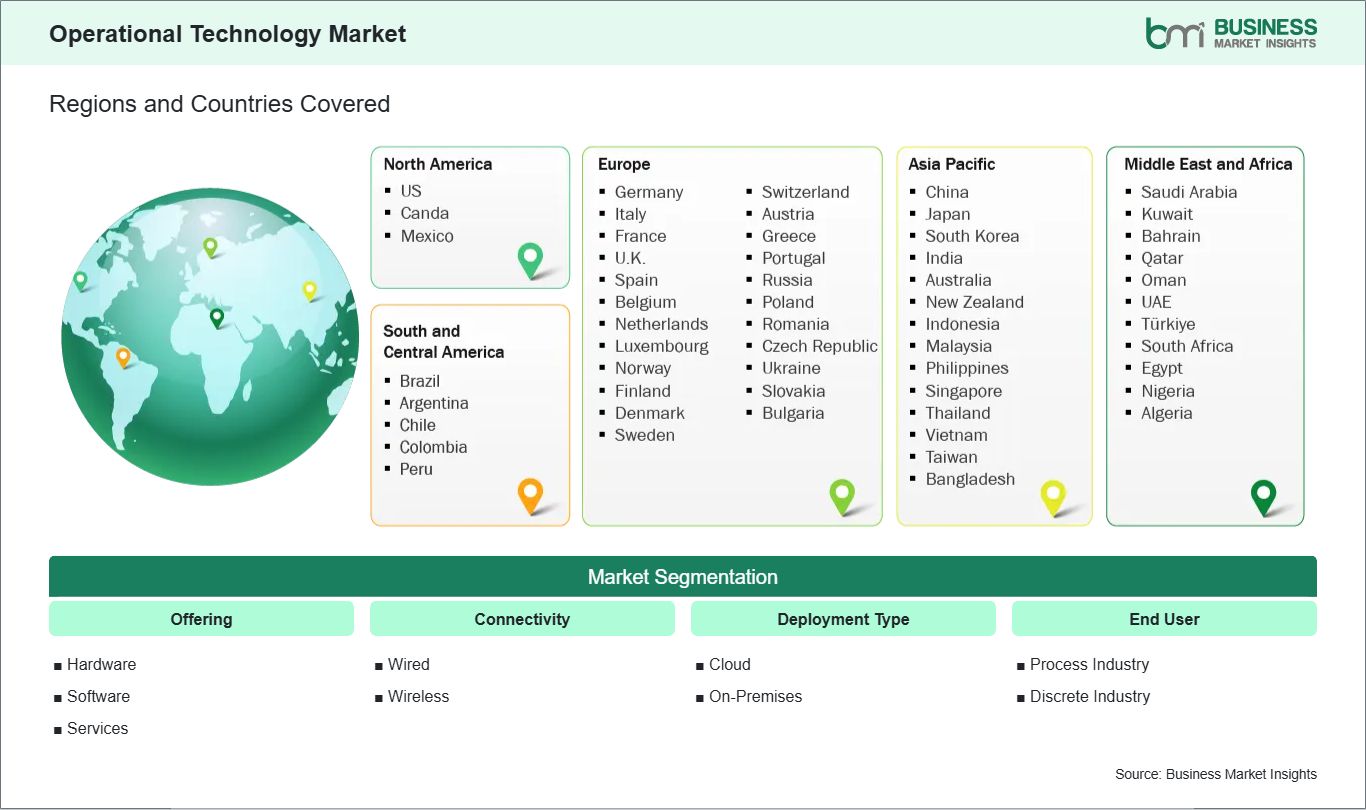
  • Offering (Hardware, Software, Services)
  • Connectivity (Wired, Wireless )
  • Deployment Type (Cloud, On-Premises)
  • End User (Process Industry, Discrete Industry)

No. of Pages: 382
Report Code: BMIPUB00034103
Category: Electronics and Semiconductor
Operational Technology Market

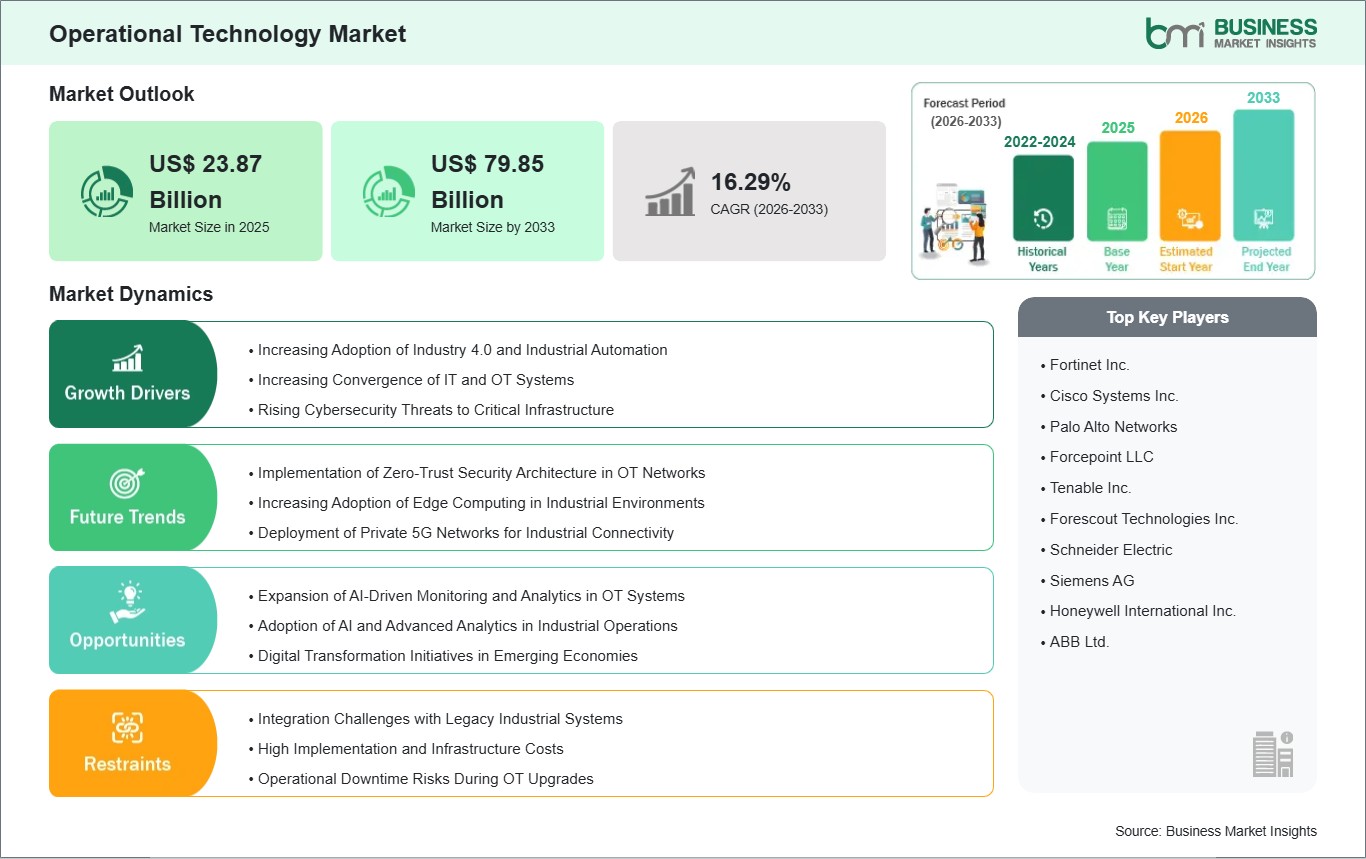
The Operational Technology Market size is expected to reach US$ 79.85 Billion by 2033 from US$ 23.87 Billion in 2025. The market is estimated to record a CAGR of 16.29% from 2026 to 2033.

Executive Summary and Global Market Analysis:

The operational technology market is expanding steadily as industries continue to modernize production environments and critical infrastructure. Operational technology systems play an important role in monitoring, controlling, and managing industrial operations across sectors such as manufacturing, energy, oil and gas, utilities, transportation, and mining. Organizations are increasingly adopting connected control systems, industrial networks, and automation platforms to improve operational visibility and efficiency. Key factors driving growth include the increasing adoption of industrial automation, digital transformation initiatives and the shift toward smart factories and digitally connected industrial environments.

In addition, energy price volatility, along with the increase in emissions reporting requirements, is upping the ante for companies to invest in cutting-edge operational technology solutions that can support real-time monitoring and process control. But across many fields, the ingredients of the alchemic formula sensors, controls, data platforms are appearing. Initiatives emphasizing predictive maintenance and asset optimization are prompting interest in deploying more advanced monitoring systems. Artificial intelligence and similar technologies are also helping companies extract more value from data in the industrial environment. However, certain challenges continue to affect market growth. Many industrial facilities still operate legacy infrastructure that can be difficult to integrate with modern digital platforms. Upgrading these systems often requires high investment and careful system planning. In addition, concerns related to cybersecurity and protection of industrial networks remain an important restraint, as connected operational environments can be vulnerable to cyber threats if not properly secured.

Operational Technology Market - Strategic Insights:

global-market-strategic-framework
Get more information on this report

Operational Technology Market Segmentation Analysis:

Key segments that contributed to the derivation of the operational technology market analysis are offering, connectivity, deployment type, and end user.

  • By offering, the operational technology market is segmented into hardware, software, and services. The hardware segment dominated the market in 2025.
  • Based on connectivity, the operational technology market is classified into wired and wireless. The wired segment dominated the market in 2025.
  • On the basis of deployment type, the operational technology market is segmented into cloud and on-premises. The on-premises segment dominated the market in 2025.
  • In terms of end user, the operational technology market is segmented into process industry and discrete industry. The process industry segment dominated the market in 2025.

Operational Technology Market Drivers and Opportunities:

Increasing Adoption of Industry 4.0 and Industrial Automation

The growing adoption of Industry 4.0 practices is a major driver for the operational technology market. Industries such as manufacturing, energy, oil and gas, and utilities are increasingly integrating digital technologies with physical equipment to improve productivity and operational efficiency. Operational technology systems such as industrial control systems, sensors, and programmable logic controllers enable real-time monitoring and control of machines and production processes. As companies move toward smart factories and automated facilities, the demand for OT solutions continues to expand. These systems help reduce manual intervention, improve equipment performance, and support better decision-making across industrial environments.

Manufacturers across North America and Europe are actively upgrading legacy industrial infrastructure with automated and connected systems. Smart production lines, robotics, and advanced process control technologies are becoming more common in sectors such as automotive, chemicals, and electronics manufacturing. In addition, governments in these regions are promoting digital transformation initiatives to strengthen industrial competitiveness. As a result, industries are investing in OT platforms that allow seamless integration between machines, control systems, and enterprise software. This shift toward digitalized industrial environments continues to strengthen the demand for operational technology solutions.

Rapid industrial expansion across Asia Pacific is also contributing to the growth of OT adoption. Countries such as China, India, South Korea, and Southeast Asian economies are investing heavily in modern manufacturing infrastructure and industrial automation. Growing industrial production, rising labor costs, and the need for higher operational efficiency are encouraging manufacturers to deploy advanced OT systems. These technologies enable predictive maintenance, process optimization, and remote monitoring of industrial assets. As industries worldwide continue to adopt Industry 4.0 frameworks, operational technology will remain a critical component of modern industrial operations.

Expansion of AI-Driven Monitoring and Analytics in OT Systems

The growing integration of artificial intelligence within operational technology systems is creating significant opportunities in the market. Industrial facilities generate large volumes of operational data through sensors, controllers, and connected machines. AI-powered analytics tools can process this data to identify patterns, detect anomalies, and provide insights into equipment performance. As industries focus on improving operational efficiency and reducing downtime, AI-enabled monitoring systems are becoming an important addition to OT environments. These technologies help operators identify potential issues early and optimize industrial processes more effectively.

Industries in North America and Europe are increasingly adopting AI-based monitoring platforms to enhance asset management and operational visibility. Energy utilities, manufacturing plants, and transportation infrastructure operators are deploying AI tools that analyze machine data and operational parameters in real time. These solutions support predictive maintenance by identifying equipment faults before they lead to failures. In addition, AI-driven analytics help companies improve production planning, manage energy consumption, and optimize supply chain operations. As organizations focus on digital transformation, the role of intelligent monitoring within OT systems is expected to grow.

Asia Pacific also presents strong opportunities for AI-enabled operational technology solutions. The region’s expanding manufacturing base and rapid digitalization are encouraging companies to adopt advanced analytics platforms. Governments and technology providers are supporting initiatives that promote smart manufacturing and industrial innovation. AI-driven monitoring tools can improve factory efficiency, enhance product quality, and reduce operational disruptions. As industrial operations become more complex and data-driven, the integration of artificial intelligence with operational technology systems is expected to play a key role in improving industrial performance worldwide.

Operational Technology Market Size and Share Analysis:

The global operational technology market is experiencing steady growth, with market size and share analysis reflecting evolving treatment preferences and competitive dynamics among key players. The report evaluates important subsegments categorized within offering, connectivity, deployment type, and end user, highlighting their respective contributions to overall market performance.

By offering, the operational technology market is segmented into hardware, software, and services. The hardware segment dominated the market in 2025, due to the extensive deployment of physical control components such as programmable logic controllers (PLCs), distributed control systems (DCS), sensors, actuators, and industrial networking equipment that form the core infrastructure of industrial automation and monitoring systems.

Based on connectivity, the operational technology market is classified into wired and wireless. The wired segment dominated the market in 2025, due to its high reliability, low latency, and strong security capabilities required for real-time communication in industrial control systems and critical infrastructure environments.

By deployment type, the operational technology market is segmented into cloud and on-premises. The on-premises segment dominated the market in 2025, due to industries prioritizing data security, operational control, and minimal latency for mission-critical industrial operations and sensitive operational data management.

Based on end user, the operational technology market is segmented into process industry and discrete industry. The process industry segment dominated the market in 2025, due to the widespread use of continuous process monitoring and automation systems across sectors such as oil and gas, chemicals, power generation, and pharmaceuticals.

Operational Technology Market Report Highlights:

Report Attribute Details
Market size in 2025 US$ 23.87 Billion
Market Size by 2033 US$ 79.85 Billion
Global CAGR (2026 - 2033)16.29%
Historical Data 2022-2024
Forecast period 2026-2033
Segments Covered By Offering
  • Hardware
  • Software
  • Services
By Connectivity
  • Wired
  • Wireless
By Deployment Type
  • Cloud
  • On-Premises
By End User
  • Process Industry
  • Discrete Industry
Regions and Countries Covered
North America US, Canada, Mexico
Europe Belgium, Austria, Finland, Denmark, Greece, Poland, Romania, Russia, Ukraine, Czech Republic, Slovakia, Bulgaria, Italy, Luxembourg, Germany, Switzerland, France, Netherlands, Norway, Portugal, Spain, Sweden, United Kingdom
Asia-Pacific Australia, China, India, Japan, South Korea, Indonesia, Malaysia, Philippines, Singapore, Thailand, Vietnam, Bangladesh, New Zealand, Taiwan
South and Central America Brazil, Argentina, Peru, Chile, Colombia
Middle East and Africa Bahrain, Kuwait, Oman, Qatar, Saudi Arabia, United Arab Emirates, Turkiye, South Africa, Egypt, Algeria, Nigeria
Market leaders and key company profiles
  • Fortinet Inc.
  • Cisco Systems Inc.
  • Palo Alto Networks
  • Forcepoint LLC
  • Tenable Inc.
  • Forescout Technologies Inc.
  • Schneider Electric
  • Siemens AG
  • Honeywell International Inc.
  • ABB Ltd.
Get more information on this report

Operational Technology Market Report Coverage and Deliverables:

The "Operational Technology Market Size and Forecast (2022 - 2033)" report provides a detailed analysis of the market covering below areas:

  • Operational Technology market size and forecast at the regional and country levels for segments covered under the scope
  • Operational Technology market trends, as well as drivers, restraints, and opportunities
  • Operational Technology market analysis covering key trends, regional framework, major players, regulations, and recent developments
  • Industry landscape and competition analysis covering market concentration, heat map analysis, prominent players, and recent developments for the Operational Technology market
  • Detailed company profiles, including SWOT analysis

Operational Technology Market Geographic Insights:

The geographical scope of the operational technology market report is divided into: North America, Asia Pacific, Europe, Middle East & Africa, and South & Central America. North America held the largest share in 2025.

North America dominates the operational technology market due to its strong industrial base and early adoption of advanced automation technologies. Industries across the region have been actively investing in digital transformation and smart manufacturing initiatives. Manufacturing facilities, energy companies, and utilities are increasingly integrating connected sensors, industrial control systems, and advanced monitoring platforms to improve operational performance. The presence of well-established industrial infrastructure and strong technology adoption continues to support the growth of operational technology solutions across the region. The region also benefits from the presence of major technology providers and automation companies that continuously develop advanced industrial control and monitoring solutions.

Many organizations in North America are focusing on improving operational efficiency, strengthening asset management, and enhancing industrial safety through the use of modern operational technology platforms. These solutions allow companies to monitor equipment in real time, optimize production processes, and reduce operational disruptions. Government initiatives supporting industrial modernization and infrastructure development further contribute to the strong adoption of operational technology in the region. In addition, industries in North America are increasingly integrating artificial intelligence, cloud platforms, and data analytics into industrial environments. This combination of strong industrial demand, advanced technological capabilities, and continued investment in digital transformation has helped North America maintain its leading position in the global operational technology market.

global-market-geography
Get more information on this report

Operational Technology Market Research Report Guidance:

  • The report includes qualitative and quantitative data in the Operational Technology market across offering, connectivity, deployment type, end user, and geography.
  • The report starts with the key takeaways (chapter 2), highlighting the key trends and outlook of the Operational Technology market.
  • Chapter 3 focuses on the research methodology of the study.
  • Chapter 4 includes ecosystem analysis.
  • Chapter 5 highlights the major industry dynamics in the Operational Technology market, including factors that are driving the market, prevailing deterrents, potential opportunities, as well as future trends. Impact analysis of these drivers and restraints is also covered in this section.
  • Chapter 6 discusses the Operational Technology market scenario, in terms of historical market revenues, and forecast till the year 2033.
  • Chapters 7 to 11 cover the Operational Technology market segments by offering, connectivity, deployment type, and end user, and geography across North America, Europe, Asia Pacific, the Middle East and Africa, and South and Central America. They cover the market revenue, forecast, and factors driving the market.
  • Chapter 12 describes the competitive analysis along with the heat map analysis for the key players operating in the market.
  • Chapter 13 describes the industry landscape analysis. It provides detailed descriptions of business activities such as market initiatives, new developments, mergers, and joint ventures globally, along with a competitive landscape.
  • Chapter 14 provides detailed profiles of the major companies operating in the Operational Technology market. Companies have been profiled on the basis of their key facts, business descriptions, products, financial overview, SWOT analysis, and key developments.
  • Chapter 15, i.e., the appendix, is inclusive of a brief overview of the company, list of abbreviations, and disclaimer.

Operational Technology Market News and Key Development:

The operational technology market is evaluated by gathering qualitative and quantitative data post primary and secondary research, which includes important corporate publications, association data, and databases. A few of the key developments in the Operational Technology market are:

  • In October 2025, Siemens AG announced the launch of SINEC Secure Connect, a Zero Trust security platform designed to secure industrial networks and operational technology (OT) environments, helping organizations protect connected industrial infrastructure and manage remote access securely.
  • In September 2025, Mitsubishi Electric Corporation announced its plan to acquire Nozomi Networks in a deal valued at around US$ 1 billion to strengthen its operational technology and industrial cybersecurity capabilities for critical infrastructure and manufacturing sectors.
  • In July 2025, Trustwave announced the launch of a comprehensive operational technology (OT) security services portfolio, along with a partnership with Nozomi Networks to enhance monitoring, analytics, and managed detection capabilities for industrial environments and critical infrastructure.

Key Sources Referred:

  • International Electrotechnical Commission
  • Institute of Electrical and Electronics Engineers
  • International Organization for Standardization
  • Bureau of Indian Standards
  • Central Electricity Authority
  • Ministry of Power
  • Indian Electrical and Electronics Manufacturers' Association
  • European Committee for Electrotechnical Standardization
  • VDE Association for Electrical Electronic & Information Technologies
  • Company Websites
  • Company Annual Reports
  • Company Investor Presentations
The List of Companies - Operational Technology Market
  • Fortinet Inc.
  • Cisco Systems Inc.
  • Palo Alto Networks
  • Forcepoint LLC
  • Tenable Inc.
  • Forescout Technologies Inc.
  • Schneider Electric
  • Siemens AG
  • Honeywell International Inc.
  • ABB Ltd.
Frequently Asked Questions
How big is the Operational Technology Market?

The Operational Technology Market is valued at US$ 23.87 Billion in 2025, it is projected to reach US$ 79.85 Billion by 2033.

What is the CAGR for Operational Technology Market by (2026 - 2033)?

As per our report Operational Technology Market, the market size is valued at US$ 23.87 Billion in 2025, projecting it to reach US$ 79.85 Billion by 2033. This translates to a CAGR of approximately 16.29% during the forecast period.

What segments are covered in this report?

The Operational Technology Market report typically cover these key segments-

  • Offering (Hardware, Software, Services)
  • Connectivity (Wired, Wireless )
  • Deployment Type (Cloud, On-Premises)
  • End User (Process Industry, Discrete Industry)

What is the historic period, base year, and forecast period taken for Operational Technology Market?

The historic period, base year, and forecast period can vary slightly depending on the specific market research report. However, for the Operational Technology Market report:

  • Historic Period : 2022-2024
  • Base Year : 2025
  • Forecast Period : 2026-2033
  • Who are the major players in Operational Technology Market?

    The Operational Technology Market is populated by several key players, each contributing to its growth and innovation. Some of the major players include:

  • Fortinet Inc.
  • Cisco Systems Inc.
  • Palo Alto Networks
  • Forcepoint LLC
  • Tenable Inc.
  • Forescout Technologies Inc.
  • Schneider Electric
  • Siemens AG
  • Honeywell International Inc.
  • ABB Ltd.
  • Who should buy this report?

    The Operational Technology Market report is valuable for diverse stakeholders, including:

    • Investors: Provides insights for investment decisions pertaining to market growth, companies, or industry insights. Helps assess market attractiveness and potential returns.
    • Industry Players: Offers competitive intelligence, market sizing, and trend analysis to inform strategic planning, product development, and sales strategies.
    • Suppliers and Manufacturers: Helps understand market demand for components, materials, and services related to concerned industry.
    • Researchers and Consultants: Provides data and analysis for academic research, consulting projects, and market studies.
    • Financial Institutions: Helps assess risks and opportunities associated with financing or investing in the concerned market.

    Essentially, anyone involved in or considering involvement in the Operational Technology Market value chain can benefit from the information contained in a comprehensive market report.

    Available Report Formats

    pdf-format excel-format pptx-format
    Buy Now
    Sales Assistance
    +1 646 791 7070 (US & UK)
    Customization Form

    Please tell us your area of interest
    (Market Segments/ Regions and Countries/ Companies)