Market Summary
Executive Summary and Global Market Analysis
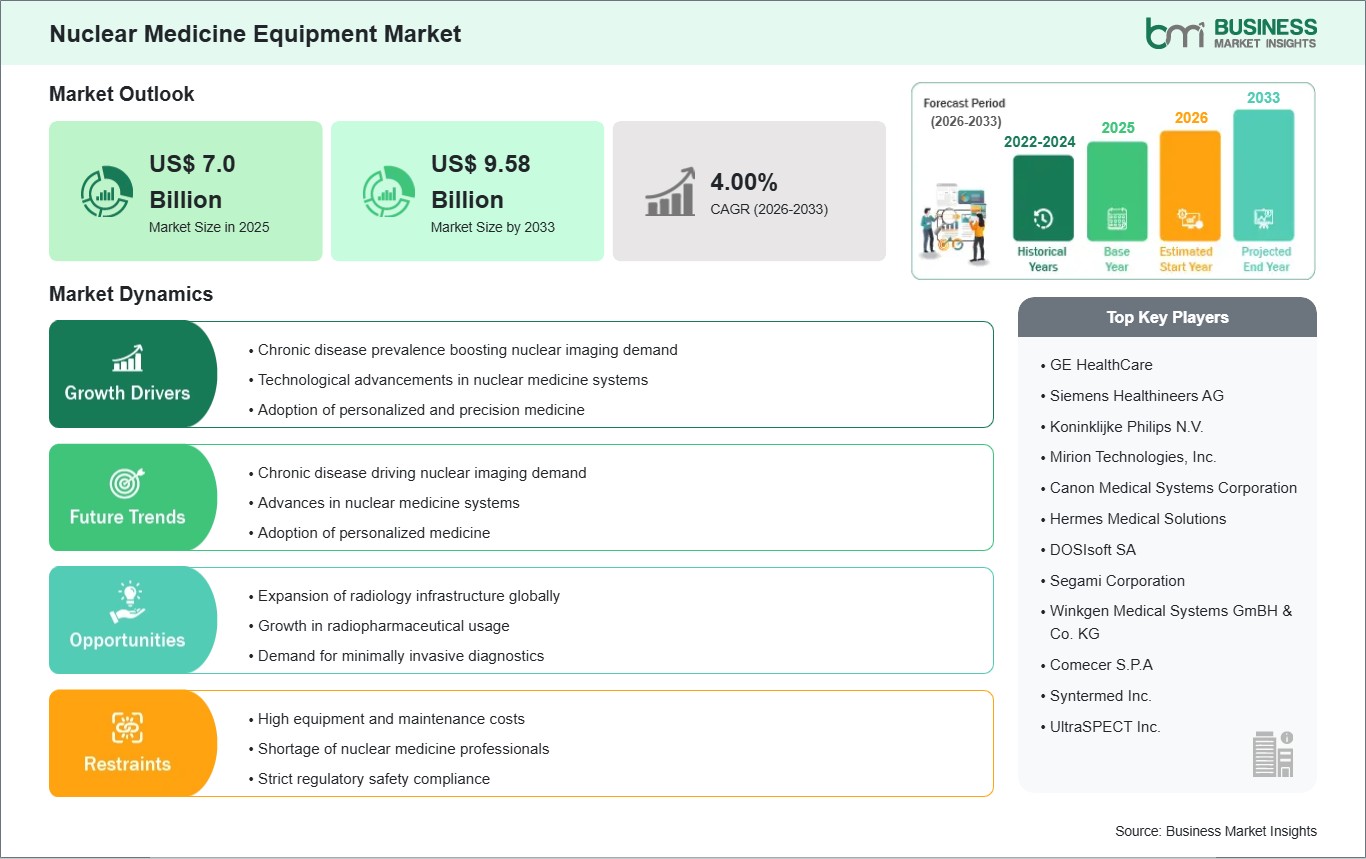
Nuclear Medicine Equipment serves a fundamental purpose in worldwide disease diagnosis and treatment because it provides advanced imaging and treatment methods for various medical needs. The systems run vital operations for oncology research and cardiology practice and neurology work and orthopedic treatment and thyroid disorder management. Nuclear medicine equipment provides several advantages which create high diagnostic accuracy together with early disease detection and functional imaging methods and targeted therapeutic methods. The market growth is driven by three factors which include the increasing occurrence of cancer and cardiovascular diseases together with the expanding elderly population and the rising need for precise medical tests. The improvement of image quality together with operational performance and decision-making processes in healthcare settings results from technological growth in PET systems and SPECT systems and hybrid imaging technologies and software development.
The market faces multiple challenges which include expensive equipment fees and restricted access to radioisotopes and demanding regulatory standards and the requirement for specialized facilities and qualified staff members. The industry experiences vulnerability to supply chain interruptions and reimbursement restrictions that affect healthcare systems in various ways. The market presents major opportunities which emerge from two factors that create new uses for radiopharmaceuticals and increase healthcare facility development in developing nations and drive adoption of hybrid imaging technologies. The global market expansion will benefit from ongoing research efforts in molecular imaging and the creation of new therapeutic radiotracers.
Segment Analysis
Nuclear Medicine Equipment Market Segmentation
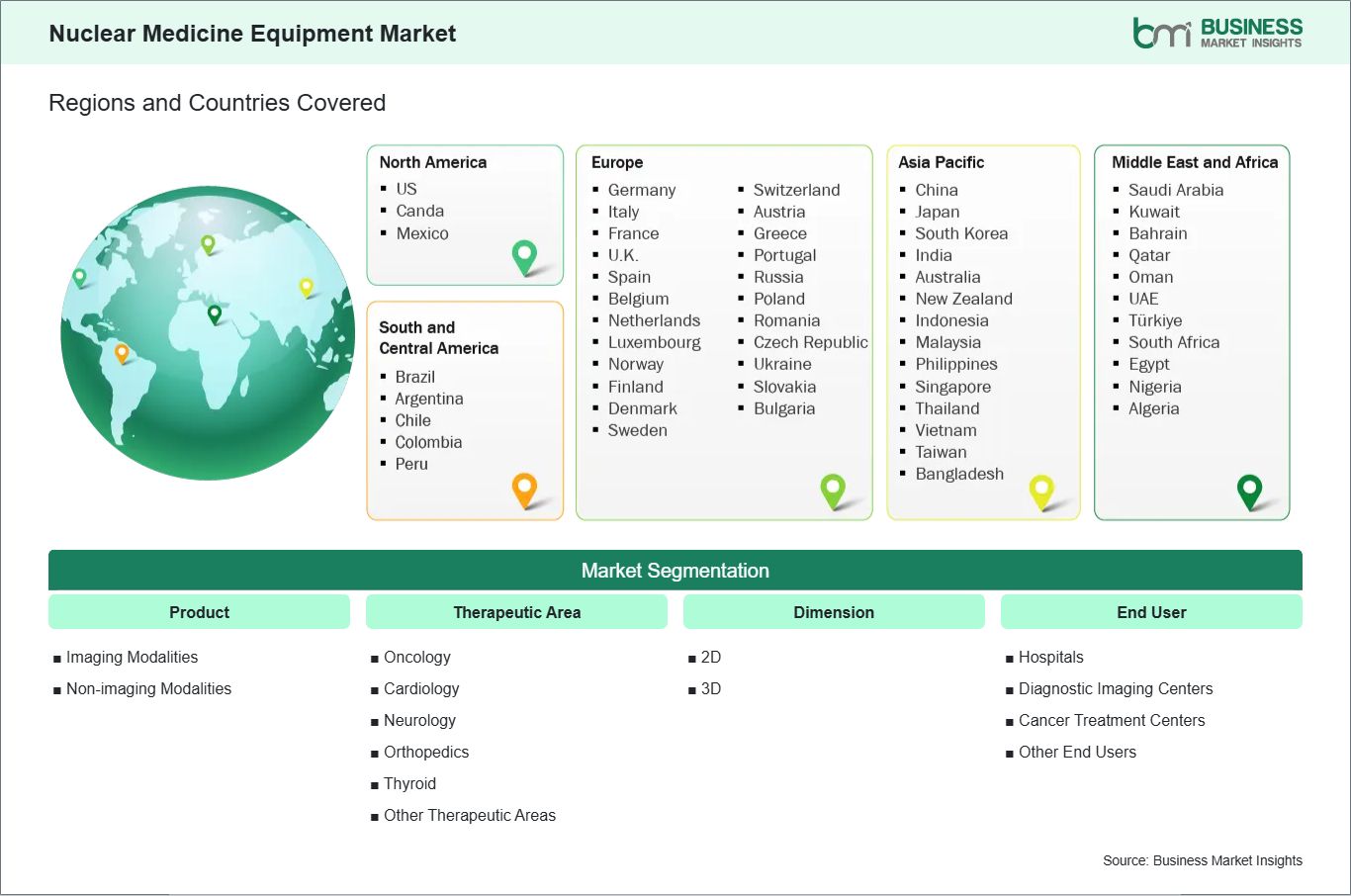
Key segments that contributed to the derivation of the nuclear medicine equipment market analysis are Product, Therapeutic Area, Dimension, End User.
- By product, the nuclear medicine equipment market is bifurcated into imaging modalities [PET, SPECT, Gamma Imaging] and non-imaging modalities [GM Counter, Dose Calibrator]. The imaging modalities segment dominated the market in 2025.
- By therapeutic area, the market is bifurcated into oncology, cardiology, neurology, orthopedics, thyroid, other therapeutic areas. The oncology segment held the largest share of the market in 2025.
- By dimension, the market is segmented into 2D and 3D. The 3D segment held the largest share of the market in 2025.
- By end user, the market is segmented into hospitals, diagnostic imaging centers, cancer treatment centers, other end users. The diagnostic imaging centers segment held the largest share of the market in 2025
Market Forces
Nuclear Medicine Equipment Market Drivers and Opportunities
Rising Prevalence of Cancer and Cardiovascular Diseases
The nuclear medicine equipment market experiences growth because the worldwide increase of cancer and cardiovascular diseases creates more demand for medical equipment. The healthcare industry needs nuclear medicine systems because the combination of aging populations and lifestyle risk factors and rising chronic disease rates requires them to have precise functional imaging and focused treatment methods.
According to global health statistics from leading cancer and cardiac associations millions of new cancer and cardiovascular cases are diagnosed every year while the demand for early detection and precise therapy continues to increase. The growth occurs because people now live longer and disease knowledge has increased and people can access better medical treatment. Hospitals and diagnostic centers are adopting PET and SPECT imaging systems to improve their diagnostic capabilities and patient management processes which drives the nuclear medicine equipment market growth as the disease burden increases.
Major medical imaging companies such as GE HealthCare Siemens Healthineers Philips and Canon Medical have expanded their global presence while significantly influencing clinical practices by introducing hybrid imaging systems and advanced radiopharmaceutical solutions. Nuclear medicine equipment can provide metabolic and molecular insights which exceed what conventional imaging provides, so it has the capacity to fulfill the needs of clinical work. Nuclear imaging provides more accurate disease tracking which enables doctors to develop personalized treatment plans according to patient needs, while standalone anatomical imaging systems lack this capability.
Technological Advancements and Expanding Healthcare Infrastructure
The nuclear medicine equipment market experiences strong expansion because of ongoing advancements in detector technology and hybrid imaging systems and radiotracer development. The system improves patient outcomes through two main functions which include enhanced image resolution and shorter scan durations and digital workflow system connectivity.
The developed regions have created new business opportunities through their increased healthcare infrastructure spending and establishment of additional cancer treatment centers and implementation of favorable reimbursement systems. Emerging economies are also strengthening diagnostic capabilities through public and private partnerships. The worldwide healthcare market will see sustained demand for nuclear medicine equipment because of rising research activities in molecular imaging and theranostics and increasing implementation of precision medicine methods
Size and Share Analysis
Nuclear Medicine Equipment Market Size and Share Analysis
By product, the nuclear medicine equipment market is bifurcated into imaging modalities [PET, SPECT, Gamma Imaging] and non-imaging modalities [GM Counter, Dose Calibrator]. The imaging modalities segment dominated the market in 2025. Imaging modalities dominate due to widespread adoption of PET and SPECT systems for accurate disease diagnosis, superior imaging capabilities, expanding clinical applications, and higher capital value compared to non-imaging supportive equipment.
By therapeutic area, the market is bifurcated into oncology, cardiology, neurology, orthopedics, thyroid, other therapeutic areas. The oncology segment held the largest share of the market in 2025. Oncology leads the market owing to rising global cancer prevalence, strong demand for early detection and staging, increasing use of PET imaging, and expanding applications of radiopharmaceuticals in cancer diagnosis and treatment monitoring.
By dimension, the market is segmented into 2D and 3D. The 3D segment held the largest share of the market in 2025. The 3D segment dominates because it offers enhanced image clarity, improved lesion localization, better anatomical detail, and superior diagnostic confidence compared to 2D imaging, supporting precision medicine and advanced clinical decision-making.
By end user, the market is segmented into hospitals, diagnostic imaging centers, cancer treatment centers, other end users. The diagnostic imaging centers segment held the largest share of the market in 2025. Diagnostic imaging centers hold the largest share due to high patient volumes, specialized imaging infrastructure, cost-effective outpatient services, and increasing referrals for advanced nuclear imaging procedures from hospitals and physicians
Report Coverage
Nuclear Medicine Equipment Market Report Coverage and Deliverables
The "Nuclear Medicine Equipment Market Size and Forecast (2022–2033)" report provides a detailed analysis of the market covering below areas:
- Nuclear medicine equipment market size and forecast at global, regional, and country levels for all the key market segments covered under the scope
- Nuclear medicine equipment market trends, as well as market dynamics such as drivers, restraints, and key opportunities
- Nuclear medicine equipment market analysis covering key market trends, global and regional framework, major players, regulations, and recent market developments
- Industry landscape and competition analysis covering market concentration, heat map analysis, prominent players, and recent developments for the nuclear medicine equipment market
- Detailed company profiles, including SWOT analysis
Geographic Insights
Nuclear Medicine Equipment Market Geographic Insights
The geographical scope of the nuclear medicine equipment market report is divided into five regions: North America, Asia Pacific, Europe, Middle East & Africa, and South & Central America. The nuclear medicine equipment market in North America is expected to grow significantly during the forecast period.
The North American nuclear medicine equipment market is segmented into the United States, Canada, and Mexico. The region is experiencing robust growth, driven by rising prevalence of cancer and cardiovascular diseases, increasing adoption of PET and SPECT imaging systems, and expanding use of radiopharmaceuticals for diagnosis and therapy. Major economies like the United States and Canada are leading the way, supported by advanced healthcare infrastructure, strong research and development initiatives, and favorable reimbursement frameworks for nuclear imaging procedures.
The region is also witnessing increased adoption of hybrid imaging technologies, 3D PET/CT systems, and automated workflow solutions particularly relevant for oncology, cardiology, and neurology applications. Expansion of diagnostic imaging centers, cancer treatment facilities, and specialized nuclear medicine programs enhancing patient access and operational efficiency. Additionally, the growing emphasis on early disease detection, integration of molecular imaging into precision medicine, and ongoing regulatory support are positioning North America as a key hub in the global nuclear medicine equipment ecosystem. High healthcare expenditure, continuous technological innovation, and strategic collaborations further solidify the region`s dominant market position.
Industry Activity
Recent Developments
The nuclear medicine equipment market is evaluated by gathering qualitative and quantitative data post primary and secondary research, which includes important corporate publications, association data, and databases. A few of the key developments in the nuclear medicine equipment market are:
- In June 2025, at this year`s Society of Nuclear Medicine and Molecular Imaging (SNMMI) Annual Meeting, GE HealthCare is spotlighting the future of precision care with its innovative portfolio of theranostics-enabling solutions designed to help drive clinical and operational excellence. Making its debut, GE HealthCare`s MIM Software introduces LesionID Pro with automated zero-click pre-processingi – an AI-powered innovation to help aid physician decision making and therapy response monitoring.
- In August 2025, The Society of Nuclear Medicine and Molecular Imaging (SNMMI) is proud to announce the launch of the Global Radiopharmaceutical Trial Finder a revolutionary, AI-powered platform designed to help researchers, clinicians and patients instantly discover radiopharmaceutical clinical trials that meet their specific needs. This initiative represents a concrete step toward SNMMI s goal of ensuring patient access to life-changing nuclear medicine procedures.
- In October 2024, Mediso introduced the AnyScan TRIO SPECT/CT, TheraMAX scanner at the European Association of Nuclear Medicine meeting, designed for theranostic imaging and radioisotope therapies, with the first installation at University Hospital Regensburg, Germany
Trust & Transparency
Research Methodology
The market analysis combines proprietary research with secondary data from government agencies, company disclosures, regulatory filings, industry databases and expert interviews. Market estimates are validated through data triangulation, cross-market benchmarking and analyst
review.
View Full Research Methodology
Key Sources Referred:
World Bank – Global Trade IndicatorsAmerican Medical Association (AMA)National Center for Biotechnology Information (NCBI)National Library of Medicine (NLM)Centers for Disease Control and Prevention (CDC)Company websiteNational Institutes of Health (NIH)International Hospital Federation (IHF)Company annual reportsCompany investor presentations