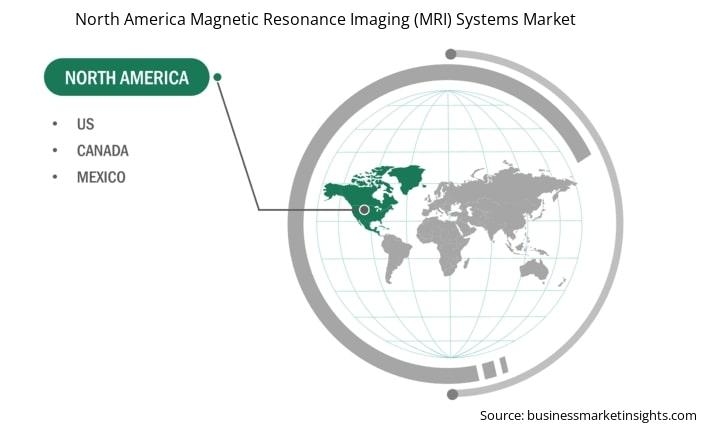
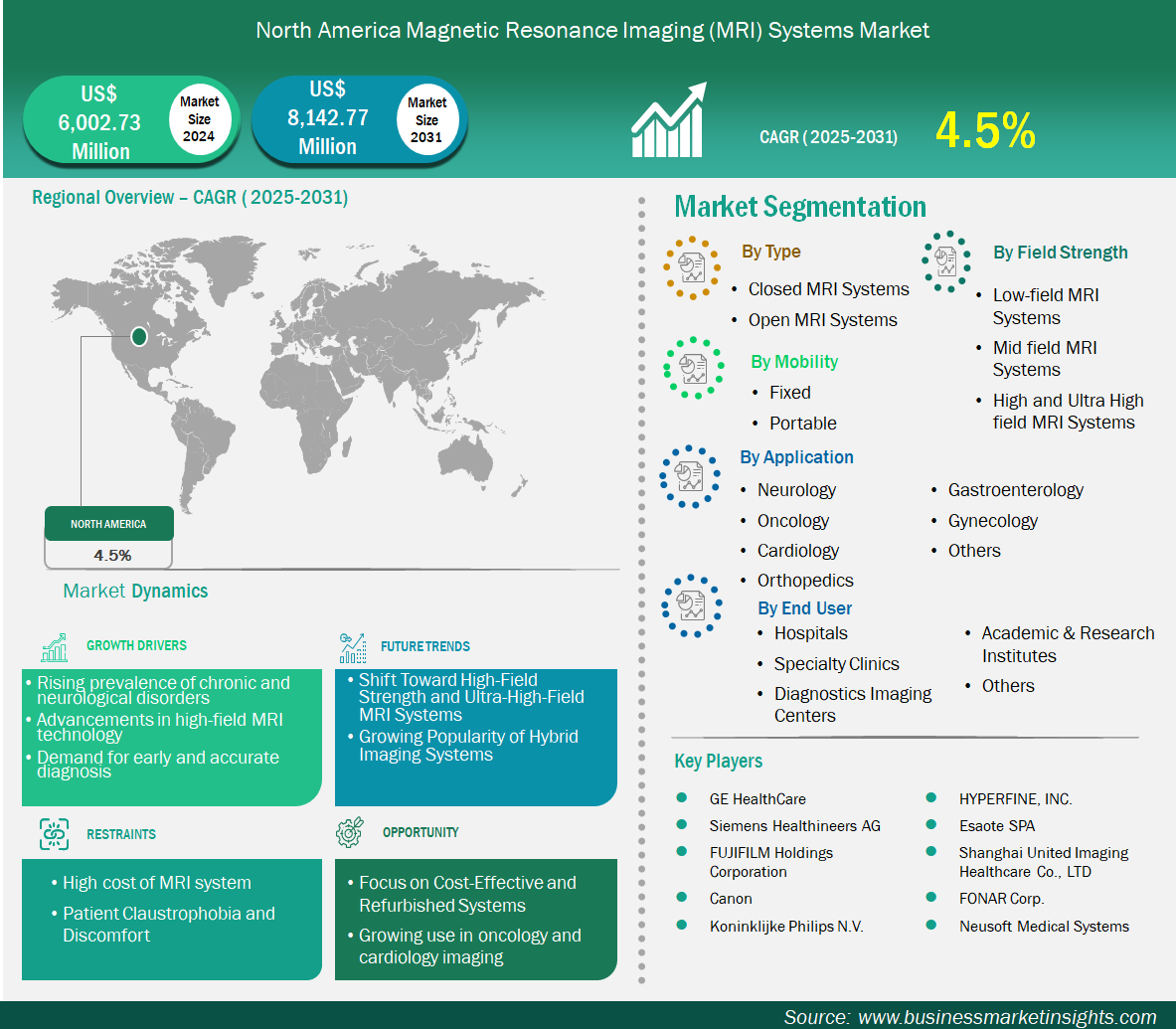
The North America magnetic resonance imaging (MRI) systems market size is expected to reach US$ 8,142.77 million by 2031 from US$ 6,002.73 million in 2024. The market is estimated to record a CAGR of 4.5% from 2025 to 2031.
Executive Summary and North America Magnetic Resonance Imaging (MRI) Systems Market Analysis:
North America represents a highly mature and dominant market for MRI systems, driven by its sophisticated healthcare infrastructure and significant public and private healthcare expenditure. The region has a high density of hospitals, diagnostic centers, and research institutions, all of which contribute to a strong demand for advanced imaging modalities. The market is also supported by a high prevalence of chronic and lifestyle-related diseases, such as neurological disorders, cardiovascular conditions, and cancer, which necessitate precise and early diagnostic tools. The rapid adoption of new technologies and a well-established reimbursement framework further solidifies the region's leading position in the global market.
The market is also shaped by a strong emphasis on patient comfort and accessibility. The increasing demand for open MRI systems and wide-bore machines is a notable trend, particularly to accommodate claustrophobic and bariatric patients. This focus on patient-centric care is a key differentiator for the North American market, driving innovation not just in image quality but also in system design. The presence of major global manufacturers and a competitive landscape also ensures a continuous stream of new and innovative products.
North America Magnetic Resonance Imaging (MRI) Systems Market Segmentation Analysis:
Key segments that contributed to the derivation of the magnetic resonance imaging (MRI) systems market analysis are type, field strength, mobility, application, and end user.
- By type, the magnetic resonance imaging (MRI) systems market is segmented into closed MRI systems and open MRI systems. The closed MRI systems segment dominated the market in 2024.
- By field strength, the magnetic resonance imaging (MRI) systems market is segmented into low-field MRI systems, mid field MRI systems, and high & ultra-high field MRI systems. The mid field MRI systems segment dominated the market in 2024.
- By mobility, the market is segmented into fixed and portable. The fixed segment dominated the market in 2024.
- By application, the magnetic resonance imaging (MRI) systems market is segmented into neurology, oncology, cardiology, orthopedics, gastroenterology, gynecology, and others. The neurology segment dominated the market in 2024.
- By end user, the market is segmented into hospitals, specialty clinics, diagnostics imaging centers, academic & research institutes, and others. The hospitals segment held the largest share of the market in 2024.
North America Magnetic Resonance Imaging (MRI) Systems Market Outlook
North America dominates the global MRI systems market, supported by its strong healthcare infrastructure, high healthcare spending, and wide adoption of advanced imaging technologies. The region has a large patient pool with chronic and neurological diseases, including rising cases of Alzheimer’s disease and other neurodegenerative disorders, which significantly boost the need for MRI in early and accurate diagnosis. For instance, according to the Alzheimer's Disease Facts and Figures, an annual report released by the Alzheimer's Association, an estimated 7.2 million Americans aged 65 and older are living with Alzheimer's in 2025. This number is projected to rise to nearly 13 million by 2050 without significant medical breakthroughs.
Additionally, the increasing prevalence of brain cancer is driving higher demand for advanced imaging solutions to support treatment planning and monitoring. For instance, according to the GLOBOCAN 2022 report, approximately 28,126 new cases of brain and central nervous system cancer were diagnosed in North America in 2022. Whereas there were around 21,314 deaths from brain cancer in North America in 2022.
Moreover, the presence of leading manufacturers, continuous product launches, and faster regulatory clearances further strengthen the market. For instance, frequent FDA approvals of new MRI technologies help providers adopt more efficient and patient-friendly systems. For instance, on June 26, 2025, Siemens Healthineers AG, a global medical technology company, announced that it has received Food and Drug Administration clearance for the Magnetom Flow.Ace, its first 1.5 tesla platform for magnetic resonance (MR) imaging with a closed helium circuit and no quench pipe, significantly reducing reliance on helium.
Rising innovation, such as portable and helium-free MRI systems, is also shaping the regional landscape, expanding accessibility across urban and rural settings. Although high costs remain a challenge, insurance coverage and well-developed reimbursement structures make MRI more accessible. Altogether, North America is expected to maintain its leading position throughout the forecast period.
North America Magnetic Resonance Imaging (MRI) Systems Market Country Insights
Based on country, the North America magnetic resonance imaging (MRI) systems market is segmented into the United States, Canada, and Mexico. The United States held the largest share in 2024.
The United States is the dominant player in the global Magnetic Resonance Imaging (MRI) systems market, driven by high healthcare expenditure, advanced medical infrastructure, and a growing focus on early diagnosis and precision medicine. The country benefits from the presence of leading MRI system manufacturers, including GE Healthcare, Siemens Healthineers, and Philips, which continually introduce technologically advanced systems such as high-field and ultra-high-field MRI scanners. For instance, in May 2024, United Imaging Healthcare Co., Ltd., a China-based multinational medical technology company, announced that the US Food and Drug Administration (FDA) has approved their uMR Jupiter 5T MRI system. Widespread adoption of AI-assisted imaging and the integration of hybrid imaging modalities, such as PET/MRI, have further strengthened market growth.
Additionally, increasing prevalence of chronic diseases, including neurological disorders, cardiovascular diseases, and cancer, has fueled demand for MRI systems in hospitals, diagnostic imaging centers, and research facilities. Government initiatives supporting healthcare innovation and reimbursement policies for diagnostic imaging also play a critical role. Moreover, ongoing research in faster scanning technologies, low-field portable systems, and patient-friendly designs is expected to sustain the country’s leadership in the MRI market. Overall, the US continues to set global benchmarks for MRI adoption and technological advancement, making it the largest and most mature market globally.
North America Magnetic Resonance Imaging (MRI) Systems Market Company Profiles
GE HealthCare, Siemens Healthineers AG, FUJIFILM Holdings Corporation, Canon Inc., Koninklijke Philips N.V., HYPERFINE, INC., Esaote SPA, Shanghai United Imaging Healthcare Co., LTD, FONAR Corp., and Neusoft Medical Systems are among the key players operating in the market. These players adopt strategies such as expansion, product innovation, and mergers and acquisitions to stay competitive in the market and offer innovative products to their consumers.
North America Magnetic Resonance Imaging (MRI) Systems Market Research Methodology:
The following methodology has been followed for the collection and analysis of data presented in this report:
- Secondary Research
The research process begins with comprehensive secondary research, utilizing both internal and external sources to gather qualitative and quantitative data for each market. Commonly referenced secondary research sources include, but are not limited to:
- Company websites, annual reports, financial statements, broker analyses, and investor presentations
- Industry trade journals and other relevant publications
- Government documents, statistical databases, and market reports
- News articles, press releases, and webcasts specific to companies operating in the market
Note: All financial data included in the Company Profiles section has been standardized to US$. For companies reporting in other currencies, figures have been converted to US$ using the relevant exchange rates for the corresponding year.
- Primary Research
Business Market Insights conducts a significant number of primary interviews each year with industry stakeholders and experts to validate and analyze the data and gain valuable insights. These research interviews are designed to:
- Refine findings from secondary research
- Enhance the expertise and market understanding of the analysis team
- Gain insights into market size, trends, growth patterns, competitive dynamics, and future prospects
Primary research is conducted via email interactions and telephone interviews with industry experts across various markets, categories, segments, and sub-segments in different regions. Participants typically include:
- Industry stakeholders: Vice Presidents, business development managers, market intelligence managers, and national sales managers
- External experts: Valuation specialists, research analysts, and key opinion leaders with industry-specific expertise
Key Sources Referred:
- The World Bank World Development Indicators
- World Health Organization (WHO)
- Center for Disease Control and Prevention (CDC)
- American Society of Radiologic Technologists
- Society for Magnetic Resonance in Medicine (ISMRM)
- Global Cancer Observatory
- Company website
- Company annual reports
- Company investor presentations
North America Magnetic Resonance Imaging (MRI) Systems Market Strategic Insights
North America Magnetic Resonance Imaging (MRI) SystemsMarket Report Highlights
| Report Attribute | Details |
| Market size in 2024 | US$ 6,002.73 Million |
| Market Size by 2031 | US$ 8,142.77 Million |
| CAGR (2025 - 2031) | 4.5% |
| Historical Data | 2021-2023 |
| Forecast period | 2025-2031 |
| Segments Covered |
By Type
|
|
Regions and Countries Covered
|
|
| North America | US, Canada, Mexico |
| Market leaders and key company profiles |
|
North America Magnetic Resonance Imaging (MRI) Systems Market Country and Regional Insights