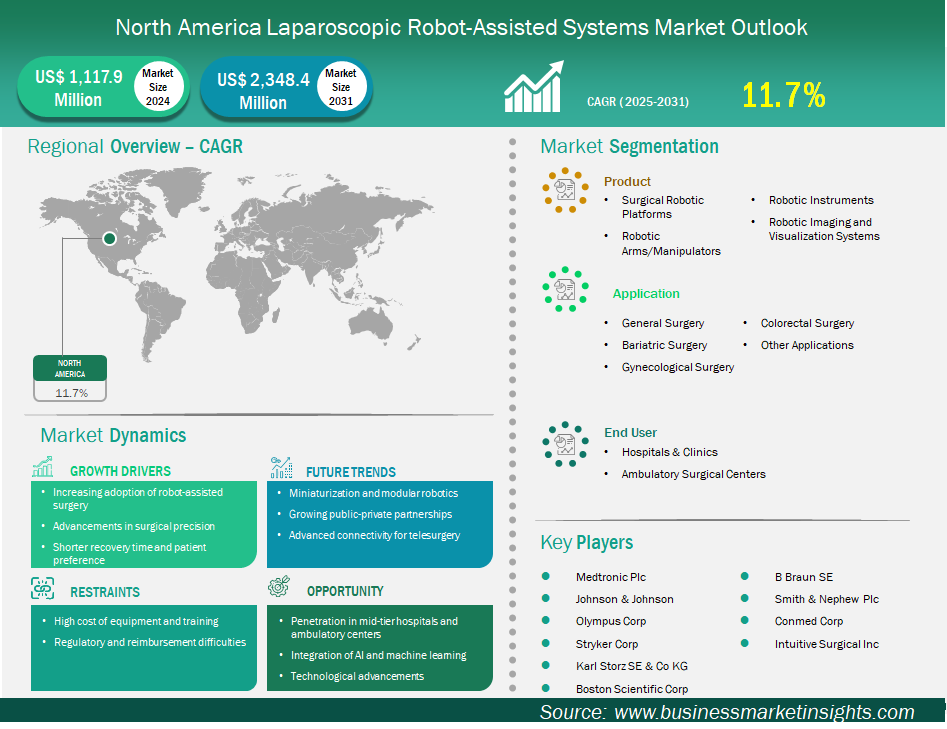
The North America laparoscopic robot-assisted systems market size is expected to reach US$ 2,348.4 million by 2031 from US$ 1,117.9 million in 2024. The market is estimated to record a CAGR of 11.7% from 2025 to 2031.
Executive Summary and North America Laparoscopic Robot-Assisted Systems Market Analysis:
The laparoscopic robot-assisted systems market in North America is experiencing significant growth driven by increasing adoption of robotic-assisted surgery, advancements in surgical precision, and shorter recovery times and patient preference. The North American laparoscopic robot-assisted surgical system market is characterized by its advanced technological maturity and a leading worldwide market position, driven by highly favourable reimbursement environments and a high installed base of sophisticated robotic systems. The segment is undergoing a fundamental transition away from legacy multi-port laparoscopy, with robotic-assisted procedures, steadily gaining market share, especially in advanced and medium-complexity surgical segments. Consequently, the value proposition of the market is increasingly shifting away from capital equipment sales to include high-margin, recurring revenue streams from specialized instruments, accessories, software, and full-service/maintenance contracts. In addition, although general surgery remains the largest application area, accounting for more than a quarter of the procedure volume. The growth path is tied to government efforts and strong funding commitment for the development of medical technology innovations, coupled with a unified emphasis on patient safety and surgical accuracy throughout leading hospital chains.
North America Laparoscopic Robot Assisted Systems Market Segmentation Analysis:
Key segments that contributed to the derivation of the laparoscopic robot-assisted systems market analysis are product, application, and end user.
- By product, the laparoscopic robot-assisted systems market is segmented into surgical robotic platforms, robotic arms/manipulators, robotic instruments, and robotic imaging and visualization systems. The surgical robotic platforms segment dominated the market in 2024. Surgical robotic platforms are the largest product segment due to the high initial investment cost of the advanced robotic systems and the continuous need for these systems by healthcare providers to enhance surgical outcomes.
- In terms of application, the market is segmented into general surgery, bariatric surgery, gynecological surgery, colorectal surgery, and other applications. The general surgery segment held the largest market share in 2024. General surgery is the largest application segment due to its diversified application across a wide array of high-volume procedures and the versatility of robotic systems in performing complex procedures with greater precision.
- By end user, the market is segmented into hospitals and clinics, and ambulatory surgical centers. The hospitals and clinics segment held the largest market share in 2024. Hospitals and clinics are the largest end-user segment due to their financial capability to make significant capital investments in high-cost robotic systems, high procedure volumes, and their role as centers for complex surgeries.
North America Laparoscopic Robot-Assisted Systems Market Outlook
The future direction of the North American laparoscopic robotic-assisted systems market will be set by two technological and operational imperatives: the aggressive rollout of Artificial Intelligence (AI) and the structural transition to Ambulatory Surgical Centers (ASCs). The technological environment is evolving from simply delivering greater dexterity and visualization to embedding AI for real-time surgical guidance, predictive analytics for pre-operative planning, and enhancing post-operative outcomes. The overall long-term effect of AI workflow optimization is expected to contribute a substantial percentage to the market's growth, redefining surgical protocols and enhancing efficiency. At the same time, a huge opportunity lies in the growing penetration of surgical robots into ASCs. These outpatient departments, which already account for a significant portion of all surgical volume in the United States at a lower cost baseline than typical hospital outpatient departments, are increasingly utilizing smaller, more flexible, and affordable robotic systems. This isn't merely about cost savings; it is about making minimally invasive robotic procedures more widely available, responding to the increasingly desired same-day discharge and quicker recovery. In addition, the market stands to gain from the growing diversity of applications, moving away from the historic strongholds of urology and gynecology, with new fields such as neurosurgery expected to exhibit some of the highest growth rates, particularly with the use of AI-assisted, sub-millimetre accuracy for procedures.
North America Laparoscopic Robot-Assisted Systems Market Country Insights
Based on country, the North America laparoscopic robot-assisted systems market is segmented into the United States, Canada, and Mexico. The United States held the largest share in 2024.
The market in North America has unique features, driven by country-specific healthcare policies and market maturity. The United States retains its leadership in regional market share, reinforced by a high incidence of chronic conditions, an entrenched culture of embracing premium-priced medical technologies, and the availability of supportive reimbursement policies, particularly in the form of Medicare coverage determinations and private-payer parity that provides stable procedural economics for robotic procedures. This supportive fiscal environment has led to the US having a high concentration of installed robotic surgical systems in hospitals and a quicker rate of adoption in ASCs. The opposite is the case in Canada, where a more centralized public health system tends to result in a slower, more contemplative procurement cycle for expensive capital equipment, such as robotic systems. While adoption is strong in large urban hubs and universities, market growth hinges significantly on provincial funding allocations and strategic public-private partnerships to increase the accessibility of robotic surgery in smaller, regional hospitals. Lastly, Mexico's share of the North American market is largely driven by its growing position in the medical tourism sector. Demand in the country is less universal population-driven and more driven by high-paying domestic patients and overseas visitors seeking high-quality, minimally invasive care.
North America Laparoscopic Robot Assisted Systems Market Company Profiles
Medtronic Plc; Johnson & Johnson; Olympus Corp; Stryker Corp; Karl Storz SE & Co KG, Boston Scientific Corp, B Braun SE, Smith & Nephew Plc, Conmed Corp, and Intuitive Surgical Inc., are among the key players operating in the market. These players adopt strategies such as expansion, product innovation, and mergers and acquisitions to stay competitive in the market and offer innovative products to their consumers.
North America Laparoscopic Robot-Assisted Systems Market Research Methodology:
The following methodology has been followed for the collection and analysis of data presented in this report:
Secondary Research
The research process begins with comprehensive secondary research, utilizing both internal and external sources to gather qualitative and quantitative data for each market. Commonly referenced secondary research sources include, but are not limited to:
- Company websites, annual reports, financial statements, broker analyses, and investor presentations
- Industry trade journals and other relevant publications
- Government documents, statistical databases, and market reports
- News articles, press releases, and webcasts specific to companies operating in the market
Note: All financial data included in the Company Profiles section has been standardized to US$. For companies reporting in other currencies, figures have been converted to US$ using the relevant exchange rates for the corresponding year.
Primary Research
Business Market Insights conducts a significant number of primary interviews each year with industry stakeholders and experts to validate and analyze the data and gain valuable insights. These research interviews are designed to:
- Refine findings from secondary research
- Enhance the expertise and market understanding of the analysis team
- Gain insights into market size, trends, growth patterns, competitive dynamics, and future prospects
Primary research is conducted via email interactions and telephone interviews with industry experts across various markets, categories, segments, and sub-segments in different regions. Participants typically include:
- Industry stakeholders: Vice Presidents, business development managers, market intelligence managers, and national sales managers
- External experts: Valuation specialists, research analysts, and key opinion leaders with industry-specific expertise
Key Sources Referred:
- World Health Organization (WHO)
- The World Bank Group
- Worldometer
- The Lancet
- BMC Medical Education
- Eurostat
North America Laparoscopic Robot Assisted Systems Market Strategic Insights
North America Laparoscopic Robot Assisted SystemsMarket Report Highlights
| Report Attribute | Details |
| Market size in 2024 | US$ 1,117.9 Million |
| Market Size by 2031 | US$ 2,348.4 Million |
| CAGR (2025 - 2031) | 11.7% |
| Historical Data | 2021-2023 |
| Forecast period | 2025-2031 |
| Segments Covered |
By Product
|
|
Regions and Countries Covered
|
|
| North America | United States, Canada, Mexico |
| Market leaders and key company profiles |
|
North America Laparoscopic Robot Assisted Systems Market Country and Regional Insights