Analysis By Type (Semi-Electric Bed, Electric Bed, and Manual Bed), Usage (Acute Care Bed, Long-term Care Bed, Psychiatric Care Bed, and Others), Application (Non-Intensive Care Bed and Intensive Care Bed), and End User (Hospitals & Clinics, Elderly Care Facilities, Ambulatory Surgical Centers, and Home Care Settings)
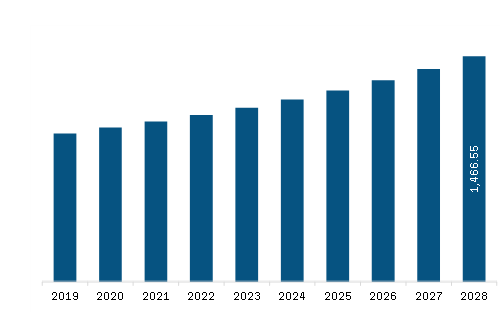
The hospital bed market in North America is expected to grow from US$ 1,083.38 million in 2022 to US$ 1,466.55 million by 2028; it is estimated to grow at a CAGR of 5.2% from 2022 to 2028.
Growing Preference for Highly Equipped Hospital Bed with Innovative Features
According to a report by the National Institute of Health (NIH), there is a high demand for equipped, facilitated bed, which help prevent other physiological complications among patients, which include bedsores. According to the Mayo Foundation for Medical Education and Research (MFMER) report, a patient suffering from bedsores has medical conditions limiting the ability to change positions or cause them to spend most of their time in a bed or chair. For example, bedsores fall into several stages based on depth, severity, and other characteristics such as the degree of skin and tissue damage ranging from changes in skin color to a severe injury involving muscle and bone. However, the development of information technology (IT) in healthcare, i.e., healthcare IT based medical equipment’s such as smart hospital bed, involving the use of wireless sensor networks (WSNs), has resulted in easy and quick service acting as a solution to prevent bedsores in motionless and disabled patients. With simple applications (apps), hospital bed has been transformed into highly networked appliances, which are categorized as Class 2 Medical Devices seeking electronic intelligence. For example, modern hospital bed is equipped with a monitor screen that shows the health status of patients and enables remote transmission of data to the nurse station. Additional modules include tilt accelerometers and motor drives to control the tilt of bed, powered wheels to facilitate the movement of the patient to different areas of the hospital, USB, and Ethernet ports to aid in connectivity with a PC or a hospital network, and an LCD screen and keypad for the user interface, which allow healthcare providers to offer comfort to patients. In October 2020, Stryker announced the launch of ""ProCuity,"" which is the first and only wireless hospital bed available in the market. This newly launched product is designed to help reduce the fall of patients in hospitals, improve the efficiencies and safety of nurses, and lower hospital operating costs. This bed can connect seamlessly to nurse call systems without the use of cables and wires.
Market Overview
The North America hospital bed market is segmented in the US, Canada, and Mexico. The growth of the market in North America is attributed to the increasing adoption of healthcare smart beds in acute care or long-term care facilities. For example, the Harvard Medical School reveals in a published study that using respiratory rate sensing technology and heart-rate sensing technology, when incorporated in hospital bed such as bedide monitors and EarlySense's under-the-mattress, helps reduce such events among the patients by 86%. Such aforementioned factors are responsible for the growth of the hospital bed market in North America. The US has the highest rates of intensive care beds among high-income countries and the highest overall hospital capacity in North America.
North America Hospital Bed Market Revenue and Forecast to 2028 (US$ Million)
North America Hospital bed market Segmentation
The North America hospital bed market is segmented on the basis of type, usage, application, end user, and country. Based on type, the market is segmented into semi-electric bed, electric bed, and manual bed. The semi-electric bed segment held the largest market share in 2022.
Based on usage, the market is segmented into acute care bed, long-term care bed, psychiatric care bed, and others. The acute care bed segment held the largest market share in 2022. Based on application, the market is bifurcated into non-intensive care bed and intensive care bed. The non-intensive care bed segment held a larger market share in 2022. Based on end user, the market is categorized into hospitals & clinics, elderly care facilities, ambulatory surgical centers, and home care settings. The hospitals & clinics segment held the largest market share in 2022. Based on country, the market is segmented into the US, Canada, and Mexico. The US dominated the market in 2022. Hill Rom Holding inc. (Baxter); Stryker Corporation; Arjo Medical Devices; Invacare Corporation; Paramount Bed Holdings Co., Ltd.; GF Health Products Inc.; Malvestio Spa; Span America (Savaria Corporation); Savion Industries; and STIEGELMEYER GMBH & CO.KG are among the leading companies operating in the North America hospital bed market.
North America Hospital Bed Market Strategic Insights
Get more information on this report
North America Hospital Bed Market Segmentation Analysis
North America Hospital Bed Market Report Highlights
North America Hospital Bed Report Scope
Report Attribute
Details
Market size in 2022
US$ 1,083.38 Million
Market Size by 2028
US$ 1,466.55 Million
CAGR (2022 - 2028)
5.2%
Historical Data
2020-2021
Forecast period
2023-2028
Segments Covered
By Type
Semi-Electric Bed
Electric Bed
Manual Bed
By Usage
Acute Care Bed
Long-term Care Bed
Psychiatric Care Bed
By Application
Non-Intensive Care Bed
Intensive Care Bed
By End User
Hospitals & Clinics
Elderly Care Facilities
Ambulatory Surgical Centers
Home Care Settings
Regions and Countries Covered
North America
US, Canada, Mexico
Market leaders and key company profiles
Hill Rom Holding inc. (Baxter)
Stryker Corporation
Arjo Medical Devices
Invacare Corporation
Paramount Bed Holdings Co., Ltd.
GF Health Products Inc.
Malvestio Spa
Span America (Savaria Corporation)
Savion Industries
STIEGELMEYER GMBH & CO.KG
Get more information on this report
North America Hospital Bed Market Country and Regional Insights
Get more information on this report
Identical Market Reports with other Region/Countries
The List of Companies - North America Hospital Bed Market
Hill Rom Holding inc. (Baxter)Stryker CorporationArjo Medical DevicesInvacare CorporationParamount Bed Holdings Co., Ltd.GF Health Products Inc.Malvestio SpaSpan America (Savaria Corporation)Savion IndustriesSTIEGELMEYER GMBH & CO.KG
Frequently Asked Questions
How big is the North America Hospital Bed Market?
The North America Hospital Bed Market is valued at US$ 1,083.38 Million in 2022, it is projected to reach US$ 1,466.55 Million by 2028.
What is the CAGR for North America Hospital Bed Market by (2022 - 2028)?
As per our report North America Hospital Bed Market, the market size is valued at US$ 1,083.38 Million in 2022, projecting it to reach US$ 1,466.55 Million by 2028. This translates to a CAGR of approximately 5.2% during the forecast period.
What segments are covered in this report?
The North America Hospital Bed Market report typically cover these key segments-
Type (Semi-Electric Bed, Electric Bed, Manual Bed)
Usage (Acute Care Bed, Long-term Care Bed, Psychiatric Care Bed)
Application (Non-Intensive Care Bed, Intensive Care Bed)
End User (Hospitals & Clinics, Elderly Care Facilities, Ambulatory Surgical Centers, Home Care Settings)
What is the historic period, base year, and forecast period taken for North America Hospital Bed Market?
The historic period, base year, and forecast period can vary slightly depending on the specific market research report. However, for the North America Hospital Bed Market report:
Historic Period : 2020-2021
Base Year : 2022
Forecast Period : 2023-2028
Who are the major players in North America Hospital Bed Market?
The North America Hospital Bed Market is populated by several key players, each contributing to its growth and innovation. Some of the major players include:
Hill Rom Holding inc. (Baxter)
Stryker Corporation
Arjo Medical Devices
Invacare Corporation
Paramount Bed Holdings Co., Ltd.
GF Health Products Inc.
Malvestio Spa
Span America (Savaria Corporation)
Savion Industries
STIEGELMEYER GMBH & CO.KG
Who should buy this report?
The North America Hospital Bed Market report is valuable for diverse stakeholders, including:
Investors: Provides insights for investment decisions pertaining to market growth, companies, or industry insights. Helps assess market attractiveness and potential returns.
Industry Players: Offers competitive intelligence, market sizing, and trend analysis to inform strategic planning, product development, and sales strategies.
Suppliers and Manufacturers: Helps understand market demand for components, materials, and services related to concerned industry.
Researchers and Consultants: Provides data and analysis for academic research, consulting projects, and market studies.
Financial Institutions: Helps assess risks and opportunities associated with financing or investing in the concerned market.
Essentially, anyone involved in or considering involvement in the North America Hospital Bed Market value chain can benefit from the information contained in a comprehensive market report.





 Get Free Sample For North America Hospital Bed Market