Analysis – by Simulator Type (Compact Simulator and Full-Scale Simulator), Vehicle Type (Car Simulator, Truck and Bus Driving Simulator, and Others), End User (Driving Training Center, Automotive OEM, and Others)
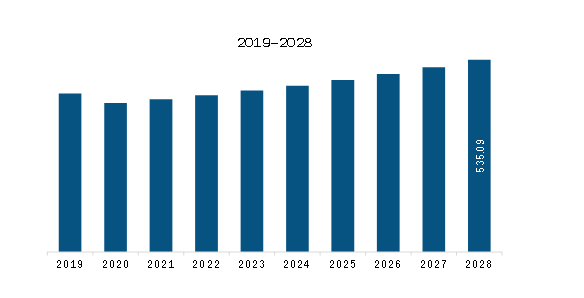
The driving training simulator market in North America is expected to grow from US$ 436.58 million in 2022 to US$ 535.09 million by 2028. It is estimated to grow at a CAGR of 3.4% from 2022 to 2028.
Simulation for Training Autonomous Vehicle Driving Systems Algorithm
Autonomous vehicles must undergo extensive research and testing in various environments to be used on the road. It is difficult to experience the uncommon and hazardous events required for thorough autonomous vehicle validation. These issues are addressed by NVIDIA DRIVe Sim, a physically accurate simulation platform that can produce synthetic data close to real-world situations. With DRIVE Sim, autonomous vehicle (AV) engineers can increase output, efficiency, and test coverage while reducing real-world driving and speeding up time to market. Using high-fidelity and physically accurate simulation, the driving simulator develops a cost-efficient, scalable method of introducing self-driving cars to the road. It uses foundational technologies, such as artificial intelligence (AI), to provide a robust, cloud-based computing platform that can produce a variety of real-world situations for the creation and validation of AV. A drive Simulator builds digital twins of actual settings using precision map data and can create datasets to test or train a vehicle's decision-making or perception systems. It can also be connected to the AV stack in software-in-the-loop (SIL) or hardware-in-the-loop (HIL) configurations to verify the entire integrated systems. Automakers are making significant investments in autonomous vehicle technology and forming alliances to develop exceptional autonomous vehicles since they require a lot of data to be collected and processed. The complete data set is shared among IoT-enabled vehicles and wirelessly uploaded to a cloud system, which is then analyzed and used to enhance automation. Here is a snapshot of the developments in the driving training stimulator market:
After commissioning the most modern Delta S3 DIL simulator, Honda R&D Co. extended its long-term partnership with Ansible Motion in December 2021. At its Sakura engineering site, the adaptable simulator's greater motion space and enhanced dynamic range will make it possible to build future road and race vehicles and the technologies that go with them efficiently.
Volvo Group and NVIDIA inked a contract in March 2021 to work together to create autonomous machines and commercial cars' decision-making systems. The final system will be developed to safely manage autonomous driving on public roads and highways using NVIDIA's end-to-end artificial intelligence platform for training, simulation, and in-vehicle computing.
Companies are investing in autonomous vehicle technology due to the rising demand for safer automobiles, which is the main factor behind the rise in the driving simulator market.
Market Overview
North American countries, such as the US, Canada, and Mexico, are very advanced in terms of road infrastructure and adopting the latest driving solutions. In the US, every year, sports events are conducted by several top automobiles and sports teams, such as Formula 1, Nascar, and Moto GP. These events are also becoming popular globally. Drivers participating in these events practice and use simulator solutions. The driving simulator is effectively used for studying driver and vehicle interaction and developing new vehicle systems. The driving simulator is necessary as drivers get a virtual experience of actual driving in a safe and tightly controlled environment. For example, in the U.S., Driving Tests provides free online driving simulator and is trusted by Driving School Association of the Americas, National Sheriff’s Association.
North America Driving Training Simulator Market Revenue and Forecast to 2028 (US$ Million)
North America Driving Training Simulator Market Segmentation
Based on simulator type, the market is segmented into compact simulator and full scale simulator. The full scale simulator segment held the larger market share in 2022.
Based on vehicle type, the market is categorized into car simulator, truck and bus driving simulator, and others. The car simulator segment held the largest market share in 2022.
Based on end user, the North America driving training simulator market is segmented into driving training centres, automotive OEMS, and others. The driving training centres segment held the largest market share in 2022.
Based on country, the market is segmented into the US, Canada, and Mexico. The US dominated the market share in 2022.
AUTOSIM AS; Adacel Technologies Limited; CRUDEN B. V.; DALLARA; ECA Group; IPG Automotive GmbH; Moog Inc.; NVIDIA CORPORATION; TECKNOTROVE; and VI-GRADE GMBH are the leading companies operating in the driving training simulator market in the region.
North America Driving Training Simulator Market Strategic Insights
Get more information on this report
North America Driving Training Simulator Market Segmentation Analysis
North America Driving Training Simulator Market Report Highlights
North America Driving Training Simulator Report Scope
Report Attribute
Details
Market size in 2022
US$ 436.58 Million
Market Size by 2028
US$ 535.09 Million
CAGR (2022 - 2028)
3.4%
Historical Data
2020-2021
Forecast period
2023-2028
Segments Covered
By Simulator Type
Compact Simulator
Full-Scale Simulator
By Vehicle Type
Car Simulator
Truck and Bus Driving Simulator
By End User
Driving Training Center
Automotive OEM
Regions and Countries Covered
North America
US, Canada, Mexico
Market leaders and key company profiles
AUTOSIM AS
Adacel Technologies Limited
DALLARA
ECA Group
IPG Automotive GmbH
Moog Inc.
NVIDIA CORPORATION
TECKNOTROVE
VI-GRADE GMBH
Get more information on this report
North America Driving Training Simulator Market Country and Regional Insights
Get more information on this report
Identical Market Reports with other Region/Countries
The List of Companies - North America Driving Training Simulator Market
AUTOSIM AS Adacel Technologies LimitedDALLARA ECA GroupIPG Automotive GmbHMoog Inc. NVIDIA CORPORATIONTECKNOTROVEVI-GRADE GMBH
Frequently Asked Questions
How big is the North America Driving Training Simulator Market?
The North America Driving Training Simulator Market is valued at US$ 436.58 Million in 2022, it is projected to reach US$ 535.09 Million by 2028.
What is the CAGR for North America Driving Training Simulator Market by (2022 - 2028)?
As per our report North America Driving Training Simulator Market, the market size is valued at US$ 436.58 Million in 2022, projecting it to reach US$ 535.09 Million by 2028. This translates to a CAGR of approximately 3.4% during the forecast period.
What segments are covered in this report?
The North America Driving Training Simulator Market report typically cover these key segments-
Simulator Type (Compact Simulator, Full-Scale Simulator)
Vehicle Type (Car Simulator, Truck and Bus Driving Simulator)
End User (Driving Training Center, Automotive OEM)
What is the historic period, base year, and forecast period taken for North America Driving Training Simulator Market?
The historic period, base year, and forecast period can vary slightly depending on the specific market research report. However, for the North America Driving Training Simulator Market report:
Historic Period : 2020-2021
Base Year : 2022
Forecast Period : 2023-2028
Who are the major players in North America Driving Training Simulator Market?
The North America Driving Training Simulator Market is populated by several key players, each contributing to its growth and innovation. Some of the major players include:
AUTOSIM AS
Adacel Technologies Limited
DALLARA
ECA Group
IPG Automotive GmbH
Moog Inc.
NVIDIA CORPORATION
TECKNOTROVE
VI-GRADE GMBH
Who should buy this report?
The North America Driving Training Simulator Market report is valuable for diverse stakeholders, including:
Investors: Provides insights for investment decisions pertaining to market growth, companies, or industry insights. Helps assess market attractiveness and potential returns.
Industry Players: Offers competitive intelligence, market sizing, and trend analysis to inform strategic planning, product development, and sales strategies.
Suppliers and Manufacturers: Helps understand market demand for components, materials, and services related to concerned industry.
Researchers and Consultants: Provides data and analysis for academic research, consulting projects, and market studies.
Financial Institutions: Helps assess risks and opportunities associated with financing or investing in the concerned market.
Essentially, anyone involved in or considering involvement in the North America Driving Training Simulator Market value chain can benefit from the information contained in a comprehensive market report.





 Get Free Sample For North America Driving Training Simulator Market