
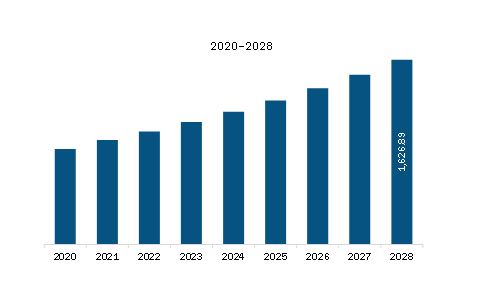
The carbon fiber market in North America is expected to grow from US$ 995.94 million in 2022 to US$ 1626.89 million by 2028. It is estimated to grow at a CAGR of 8.5% from 2022 to 2028.
Rising Demand for Carbon Fiber in Wind Energy Industry is Fuelling North America Carbon Fiber Market
Growing demand to utilize renewable resources has led to a surge in the installation and demand for wind farms, with large tracts of land and coastal areas devoted to the operation of wind turbines. Wind turbine manufacturers strive to produce more efficient and longer blades that lighter in weight. Advanced composite materials such as carbon fiber are widely used in wind turbines, specifically for manufacturing blades. The companies operating in the market have discovered that the longer the blades are on a turbine, the more energy can be generated. Carbon fiber plays a very important role in the wind energy industry. Large blades are typically designed by stiffness and deflection, rather than taking into consideration the material strength. The high stiffness characteristic of carbon fiber reduces blade deflection, allowing a larger tower diameter for a given blade-to-tower clearance. Carbon fiber is added in the spar cap, which is the backbone of the blade. Moreover, the carbon fibers are an effective alternative to the glass fibers used in the wind turbines. They show higher stiffness and lower density as compared to the glass fibers, thus, allowing the thinner, stiffer and lighter blades. Furthermore, they have relatively low damage tolerance, compressive strength, and ultimate strain. Therefore, carbon fibers are most used in the fabrication of wind turbine blades. Carbon fiber has proven to be an enabling technology for turbine manufacturers. These companies use carbon fiber in select structural parts of the blades and taking advantage of the lighter weight blades throughout the turbine system. Lighter blades require less robust turbine and tower components, so the cascading cost is also saved. All these factors are significantly driving the growth of carbon fiber market.
North America Carbon Fiber Market Overview
The North America carbon fiber market is divided into the US, Canada, and Mexico. The rising demand for carbon fiber especially across the aerospace industry in the region is significantly driving the market growth. Carbon fiber is majorly used in aerospace applications to fabricate engine blades, brackets, interior components, propellers/rotors, single aisle wings, and wide-body wings. Governments of various countries in North America have significantly invested in technology and research programs in the aerospace sector. The region is a hub for a few major aircraft manufacturing companies such as Raytheon Technologies Corporation, The Boeing Company, and The Lockheed Martin Corporation. The growth in end-use industries is creating opportunities for carbon fiber manufacturers to expand their production capacities in North America. Further, the manufacturers of carbon fiber are partnering with the industry players to cater to the rising product demand. For instance, in July 2022, Hexcel signed a partnership agreement with Dassault to supply carbon fiber prepreg for the Falcon 10X program to manufacture carbon fiber-based aircraft wings. Such developments are expected to provide lucrative growth opportunities for the carbon fiber manufacturers across North America over the forecast period.
North America Carbon Fiber Market Revenue and Forecast to 2028 (US$ Million)
North America Carbon Fiber Market Segmentation
The North America carbon fiber market is segmented into raw material, application, end use industry and country.
Based on raw material, the North America carbon fiber market is segmented into polyacrylonitrile-based and pitch-based. The polyacrylonitrile-based segment held a larger North America carbon fiber market share in 2022.
Based on application, the North America carbon fiber market is segmented into composite materials, microelectrodes, and others. The Composite Materials segment held the largest North America carbon fiber market share in 2022.
Based on end use industry, the North America carbon fiber market is segmented into automotive, aerospace and defense, building and construction, sporting goods, wind energy, textiles, marine, and others. The aerospace and defense segment held the largest North America carbon fiber market share in 2022.
Based on country, the North America carbon fiber market has been categorized into the US, Canada, and Mexico. The US dominated the North America carbon fiber market share in 2022.
SGL Carbon SE; DowAksa Advanced Composite Material Industries Ltd Co; Formosa Plastics Corp; Hexcel Corp; Hyosung Advanced Materials Corp; Kureha Corp; Solvay SA; Teijin Ltd; Toray Industries Inc; and Mitsubishi Chemical Corp are the leading companies operating in the carbon fiber market in the region.
North America Carbon Fiber Market Strategic Insights

North America Carbon Fiber Market Report Highlights
| Report Attribute | Details |
| Market size in 2022 | US$ 995.94 Million |
| Market Size by 2028 | US$ 1626.89 Million |
| CAGR (2022 - 2028) | 8.5% |
| Historical Data | 2020-2021 |
| Forecast period | 2023-2028 |
| Segments Covered |
By Raw Material
|
|
Regions and Countries Covered
|
|
| North America | US, Canada, Mexico |
| Market leaders and key company profiles |
|
North America Carbon Fiber Market Country and Regional Insights



