Analysis By Type (Transmission, Engine, Electric Propulsion, Fuel Cell, Driveline, Chassis, and Others), Vehicle Type (Commercial Vehicle, and Passenger Car), and Propulsion Type (ICE and Electric)
No. of Pages:117
Report Code:
TIPRE00029282
Category:
Technology, Media and Telecommunications
North America Automotive System Simulation Software Market
The North America automotive system simulation software market is expected to reach US$ 739.96 million by 2028 from US$ 320.81 million in 2021. It is expected to grow at a CAGR of 12.7% from 2021 to 2028.
The automotive sector is continuously working on offering enhanced functionalities in vehicles, with a major focus on automated driving, advanced infotainment, safety technologies, and other functionalities. Incorporating electronic components related to these functionalities is catalyzing the evolution of the topology of systems, hardware, and software, thereby creating a dynamic electrical/electronic vehicle system architecture (E/E architecture). For example, Continental introduced a high-performance computer (HPC), a central hub between a vehicle and the digital world, to create an effective service-oriented vehicle system architecture.
Furthermore, a shift from primary vehicle domain architectures toward E/E architectures with high-performance servers and zone system simulation software is creating a high demand for automobile system simulation software to ensure the efficiency of the architecture during the design and development stage. Compared to conventional testing methods, these software products enable new, cost-effective vehicle testing. Bosch has developed new E/E architectures that ensure the manageability of these advanced vehicle systems. It is done by transitioning towards centralized E/E architecture using a few high-performance vehicle computers instead of individual control units. Furthermore, integrating the E/E architecture with the mechanical components and systems of vehicles, such as combustion engines, chassis, and battery systems, creates a significant need for accurate simulation software to create realistic simulations of environments for vehicle efficiency analysis and safety testing. dSPACE GmbH, a renowned simulations software provider, offers automotive simulation model (ASM) tool suites, which run recreations of various systems, including combustion engines, electric motors, and vehicle dynamics systems.
There are three main stages of the automotive software development process: Implementation of core functions, such as adapting functionality for specific vehicle platforms, verification and validation of intended functionality, and system integration of software modules. These stages increase the complexity of automotive functions in areas such as AD, connected services, energy, or infotainment, thereby creating a massive demand for simulation software products for sufficient testing of the integrated systems before the initiation of designing and production of vehicles. A wide range of components developed by different manufacturers and automotive OEMs has led to a need for cross-modal functionality of automotive software, thereby driving the demand for automotive system simulation software solutions. For example, a modular control unit kit by Bosch enables efficient scaling of an E/E platform whose implementation requires good simulation for testing its performance in different models.
With new features and technologies, vendors can attract new customers and expand their footprints in emerging markets. This factor is likely to drive the North America automotive system simulation software market over the forecast period at a healthy CAGR.
North America Automotive System Simulation Software Market Revenue and Forecast to 2028 (US$ Million)
North America Automotive System Simulation Software Market Segmentation
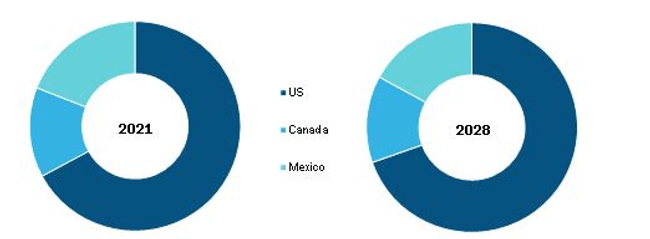
The North America automotive system simulation software market is segmented into type, vehicle type, and propulsion type. Based on type, the market is segmented into transmission, engine, electric propulsion, fuel cell, driveline, chassis, and others. Based on vehicle type, the market is segmented into commercial vehicles and passenger cars. Based on propulsion type, the market is segmented into ICE and electric. Geographically, the market is segmented into the US, Canada, and Mexico.
Modelon AB, IPG Automotive GmbH, ESI Group, Ansys Inc., Realtime Technologies, Hexagon AB, SimScale GmbH, Gamma Technologies LLC, Siemens AG, and dSPACE GmbH are the leading companies in the North America automotive system simulation software market.
North America Automotive System Simulation Software Market Strategic Insights
Get more information on this report
North America Automotive System Simulation Software Market Segmentation Analysis
North America Automotive System Simulation Software Market Report Highlights
North America Automotive System Simulation Software Report Scope
Report Attribute
Details
Market size in 2021
US$ 320.81 Million
Market Size by 2028
US$ 739.96 Million
CAGR (2021 - 2028)
12.7%
Historical Data
2019-2020
Forecast period
2022-2028
Segments Covered
By Type
Transmission
Engine
Electric Propulsion
Fuel Cell
Driveline
Chassis
By Vehicle Type
Commercial Vehicle
Passenger Car
By Propulsion Type
ICE
Electric
Regions and Countries Covered
North America
US, Canada, Mexico
Market leaders and key company profiles
Modelon AB
IPG Automotive GmbH
ESI Group
Ansys, Inc.
Realtime Technologies
Hexagon AB
SimScale GmbH
Gamma Technologies, LLC
Siemens AG
dSPACE GmbH
Get more information on this report
North America Automotive System Simulation Software Market Country and Regional Insights
Get more information on this report
Identical Market Reports with other Region/Countries
The List of Companies - North America Automotive System Simulation Software Market
Modelon AB IPG Automotive GmbH ESI Group Ansys, Inc. Realtime Technologies Hexagon AB SimScale GmbH Gamma Technologies, LLC Siemens AG dSPACE GmbH
Frequently Asked Questions
How big is the North America Automotive System Simulation Software Market?
The North America Automotive System Simulation Software Market is valued at US$ 320.81 Million in 2021, it is projected to reach US$ 739.96 Million by 2028.
What is the CAGR for North America Automotive System Simulation Software Market by (2021 - 2028)?
As per our report North America Automotive System Simulation Software Market, the market size is valued at US$ 320.81 Million in 2021, projecting it to reach US$ 739.96 Million by 2028. This translates to a CAGR of approximately 12.7% during the forecast period.
What segments are covered in this report?
The North America Automotive System Simulation Software Market report typically cover these key segments-
Type (Transmission, Engine, Electric Propulsion, Fuel Cell, Driveline, Chassis)
Vehicle Type (Commercial Vehicle, Passenger Car)
Propulsion Type (ICE, Electric)
What is the historic period, base year, and forecast period taken for North America Automotive System Simulation Software Market?
The historic period, base year, and forecast period can vary slightly depending on the specific market research report. However, for the North America Automotive System Simulation Software Market report:
Historic Period : 2019-2020
Base Year : 2021
Forecast Period : 2022-2028
Who are the major players in North America Automotive System Simulation Software Market?
The North America Automotive System Simulation Software Market is populated by several key players, each contributing to its growth and innovation. Some of the major players include:
Modelon AB
IPG Automotive GmbH
ESI Group
Ansys, Inc.
Realtime Technologies
Hexagon AB
SimScale GmbH
Gamma Technologies, LLC
Siemens AG
dSPACE GmbH
Who should buy this report?
The North America Automotive System Simulation Software Market report is valuable for diverse stakeholders, including:
Investors: Provides insights for investment decisions pertaining to market growth, companies, or industry insights. Helps assess market attractiveness and potential returns.
Industry Players: Offers competitive intelligence, market sizing, and trend analysis to inform strategic planning, product development, and sales strategies.
Suppliers and Manufacturers: Helps understand market demand for components, materials, and services related to concerned industry.
Researchers and Consultants: Provides data and analysis for academic research, consulting projects, and market studies.
Financial Institutions: Helps assess risks and opportunities associated with financing or investing in the concerned market.
Essentially, anyone involved in or considering involvement in the North America Automotive System Simulation Software Market value chain can benefit from the information contained in a comprehensive market report.




 Get Free Sample For North America Automotive System Simulation Software Market