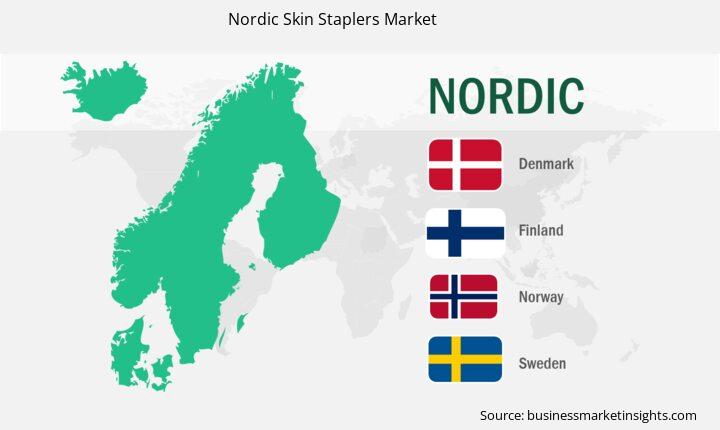
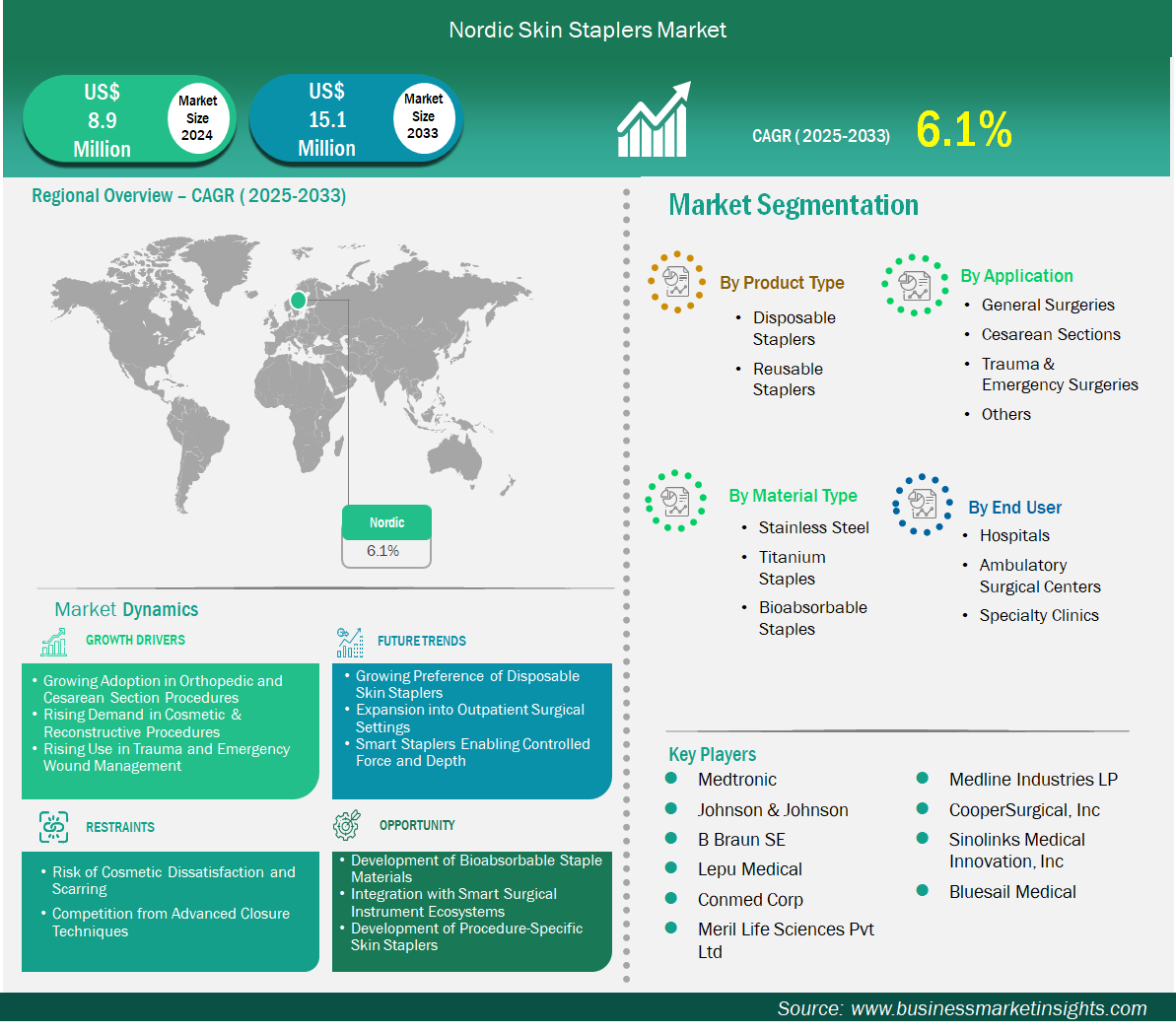
The Nordic skin staplers market size is expected to reach US$ 15.1 million by 2033 from US$ 8.9 million in 2024. The market is estimated to record a CAGR of 6.1% from 2025 to 2033.
Executive Summary and Nordic Skin Staplers Market Analysis:
The Nordic skin staplers market is growing steadily, supported by highly advanced healthcare systems, a strong emphasis on patient safety, and early adoption of innovative surgical technologies. The region is characterized by structured hospital networks, well-funded public health systems, and rigorous clinical standards that encourage the use of reliable wound-closure devices. Focus on efficiency, reduced infection risk, and better postoperative outcomes drives hospital procurement of modern stapling systems. Despite the market’s maturity, adoption varies slightly between countries due to differing national procurement policies and budget allocations. Sweden emerges as the leading country, benefiting from well-established surgical infrastructure, strong healthcare funding, and a culture of early adoption of medical innovations. Swedish hospitals prioritize advanced closure devices to improve surgical outcomes, maintain high procedural efficiency, and support faster patient recovery, setting a benchmark for the Nordic region.
Nordic Skin Staplers Market Segmentation Analysis:
Key segments that contributed to the derivation of the skin staplers market analysis are product type, material type, application, and end user.
- By product type, the skin staplers market is segmented into disposable staplers and reusable staplers. The disposable staplers segment dominated the market in 2024. Disposable skin staplers are predominantly preferred for superior infection control, pre-sterilization, convenience, and rapid wound closure in diverse clinical settings.
- By material type, the skin staplers market is segmented into stainless steel, titanium staples, and bioabsorbable staples. The stainless steel segment dominated the market in 2024. Stainless steel staples are widely used due to their strength, biocompatibility, cost-effectiveness, and reliable performance in general wound closure.
- By application, the skin staplers market is segmented into general surgery, cesarean sections, trauma & emergency surgeries, and others. The general surgery segment dominated the market in 2024. Skin staplers are broadly used for quick and efficient wound closure across a vast number of routine and complex general surgical procedures, making this the largest application.
- By end user, the market is segmented into hospitals, ambulatory surgical centers, and specialty clinics. The hospitals segment held the largest share of the market in 2024. Hospitals perform the vast majority of complex and high-volume surgical procedures across diverse specialties, making them the largest consumers of skin staplers.
Nordic Skin Staplers Market Outlook
A primary driver influencing the Nordic market is the increasing prevalence of outpatient and minimally invasive surgical procedures, which require fast, precise, and reliable wound closure. Clinics and day-care surgical centers favor skin staplers over traditional suturing because they reduce operating time, enhance closure consistency, and minimize postoperative complications. Surgeon training and continuous professional development programs across the region support the correct and efficient use of stapling devices. Furthermore, the growing focus on cosmetic outcomes and patient-centered care encourages hospitals to invest in high-quality staplers that ensure precise closure and better aesthetic results. This driver strengthens demand for skin staplers across both public and private healthcare facilities, particularly in Sweden, where innovative surgical techniques are widely implemented.
Nordic Skin Staplers Market Country Insights
Based on country, the Nordic skin staplers market is further segmented into Sweden, Norway, Denmark, and Finland. Sweden held the largest share in 2024.
Sweden dominates the Nordic skin staplers market due to its mature healthcare infrastructure, high surgical volumes, and early integration of advanced medical technologies. Hospitals extensively utilize staplers across trauma, orthopedic, reconstructive, and general surgeries, supported by a strong network of suppliers and continuous clinician training programs. Sweden’s focus on minimally invasive procedures, emergency care, and enhanced recovery protocols promotes widespread adoption of stapling devices that improve operational efficiency and reduce infection risk. The country also benefits from well-organized procurement systems and strong collaboration with domestic and international medical device manufacturers, ensuring consistent availability of cutting-edge staplers. This leadership reinforces Sweden’s role as the innovation hub in the Nordic region, setting standards for surgical efficiency, precision, and patient outcomes across neighboring countries.
Nordic Skin Staplers Market Company Profiles
Medtronic, Johnson & Johnson, B. Braun SE, Lepu Medical, Conmed Corp, Meril Life Sciences Pvt Ltd, Medline Industries LP, CooperSurgical Inc, Sinolinks Medical Innovation Inc, and Bluesail Medical are among the key players operating in the market. These players adopt strategies such as expansion, product innovation, and mergers and acquisitions to stay competitive in the market and offer innovative products to their consumers.
Nordic Skin Staplers Market Research Methodology:
The following methodology has been followed for the collection and analysis of data presented in this report:
Secondary Research
The research process begins with comprehensive secondary research, utilizing both internal and external sources to gather qualitative and quantitative data for each market. Commonly referenced secondary research sources include, but are not limited to:
- Company websites, annual reports, financial statements, broker analyses, and investor presentations
- Industry trade journals and other relevant publications
- Government documents, statistical databases, and market reports
- News articles, press releases, and webcasts specific to companies operating in the market
Note: All financial data included in the Company Profiles section has been standardized to US$. For companies reporting in other currencies, figures have been converted to US$ using the relevant exchange rates for the corresponding year.
Primary Research
Business Market Insights conducts a significant number of primary interviews each year with industry stakeholders and experts to validate and analyze the data and gain valuable insights. These research interviews are designed to:
- Refine findings from secondary research
- Enhance the expertise and market understanding of the analysis team
- Gain insights into market size, trends, growth patterns, competitive dynamics, and future prospects
Primary research is conducted via email interactions and telephone interviews with industry experts across various markets, categories, segments, and sub-segments in different regions. Participants typically include:
- Industry stakeholders: Vice Presidents, business development managers, market intelligence managers, and national sales managers
- External experts: Valuation specialists, research analysts, and key opinion leaders with industry-specific expertise
Key Sources Referred:
- The World Bank
- World Health Organization (WHO)
- Center for Disease Control and Prevention (CDC)
- Wound Healing Society (WHS)
- The Interprofessional Wound Care Association (IWCA)
- European Wound Management Association
- Company website
- Company annual reports
- Company investor presentations
Nordic Skin Staplers Market Strategic Insights
Nordic Skin StaplersMarket Report Highlights
| Report Attribute | Details |
| Market size in 2024 | US$ 8.9 Million |
| Market Size by 2033 | US$ 15.1 Million |
| CAGR (2025 - 2033) | 6.1% |
| Historical Data | 2022-2023 |
| Forecast period | 2025-2033 |
| Segments Covered |
By Product Type
|
|
Regions and Countries Covered
|
|
| Nordic | Sweden, Denmark, Norway, Finland |
| Market leaders and key company profiles |
|
Nordic Skin Staplers Market Country and Regional Insights