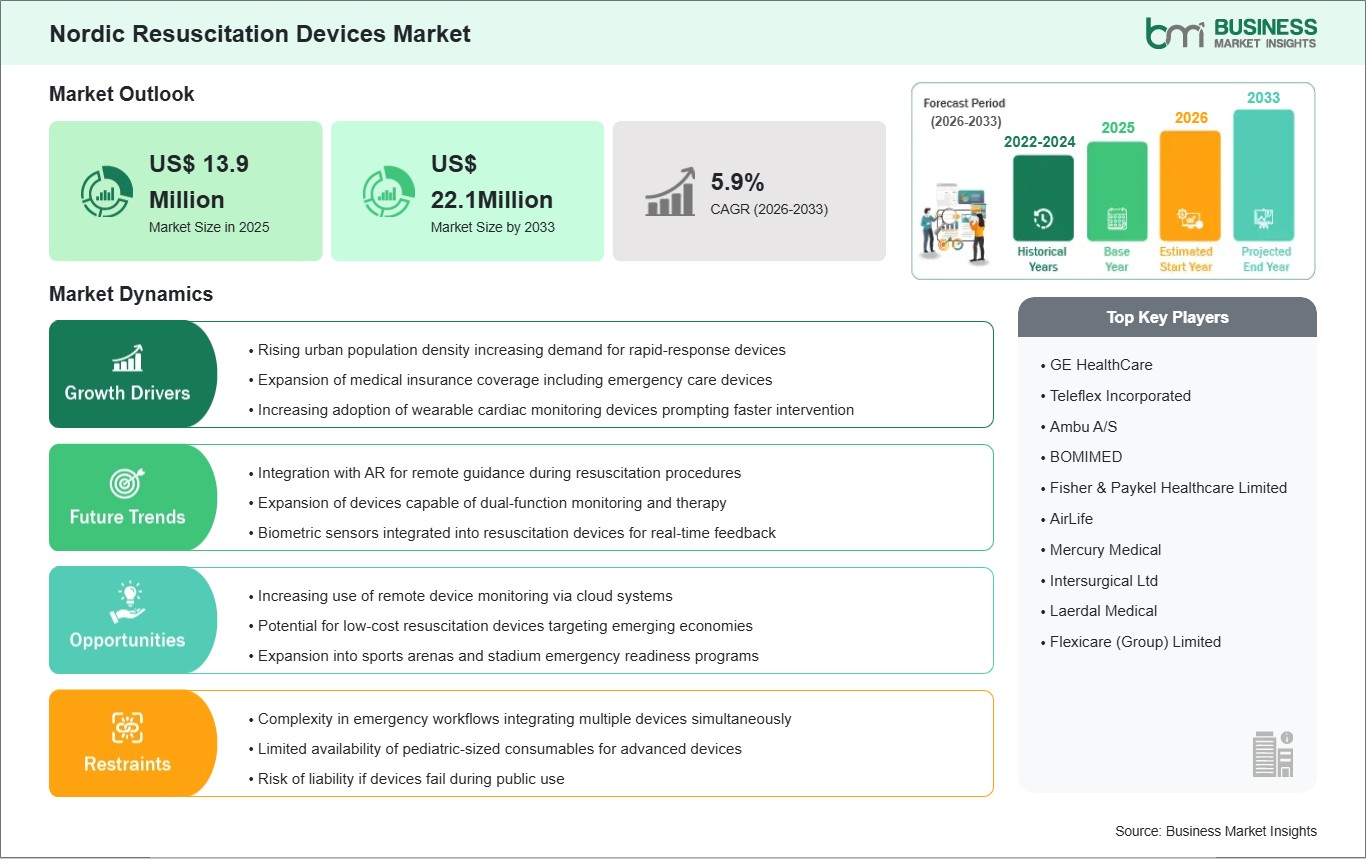
The Nordic Resuscitation devices market size is expected to reach US$ 13.9 million by 2033 from US$ 22.1 million in 2025. The market is estimated to record a CAGR of 5.9% from 2026 to 2033.
The Nordic resuscitation devices market is characterized by highly advanced healthcare systems, strong emergency response frameworks, and a deep integration of digital health technologies into critical care delivery. This region demonstrate high levels of efficiency when it comes to handling cardiac emergencies due to well-developed healthcare systems within the region and increased awareness regarding the practice of early defibrillation. The major drivers for demand for devices such as AEDs, advanced ventilators, manual resuscitators, and airway management equipment include the aging population, prevalence of cardiovascular conditions, and emphasis on fast results in dealing with cardiac emergencies. The leader in the market is Sweden due to its efficient healthcare system and effective programs regarding public access defibrillation, along with investment in pre-hospital emergency medical services. One of the major factors propelling market growth in the Nordics is the availability of public-access defibrillator systems installed in transport facilities, workplaces, educational institutions, and recreation centers, which increases the chances of survival for patients experiencing cardiac arrest outside hospital premises. There is also the presence of a robust training culture related to first aid and CPR, thus ensuring the optimum use of the available resuscitation equipment. Another important factor is the region's high level of digital connectivity, facilitating real-time emergency systems management and monitoring. The market does face some restraints, including high initial costs involved in procuring the latest technological advancements in medical technology equipment and reduced growth in demand volume due to saturation in terms of healthcare penetration. The spread of geographies may also pose challenges to fast emergency response in remote locations, especially in northern regions.

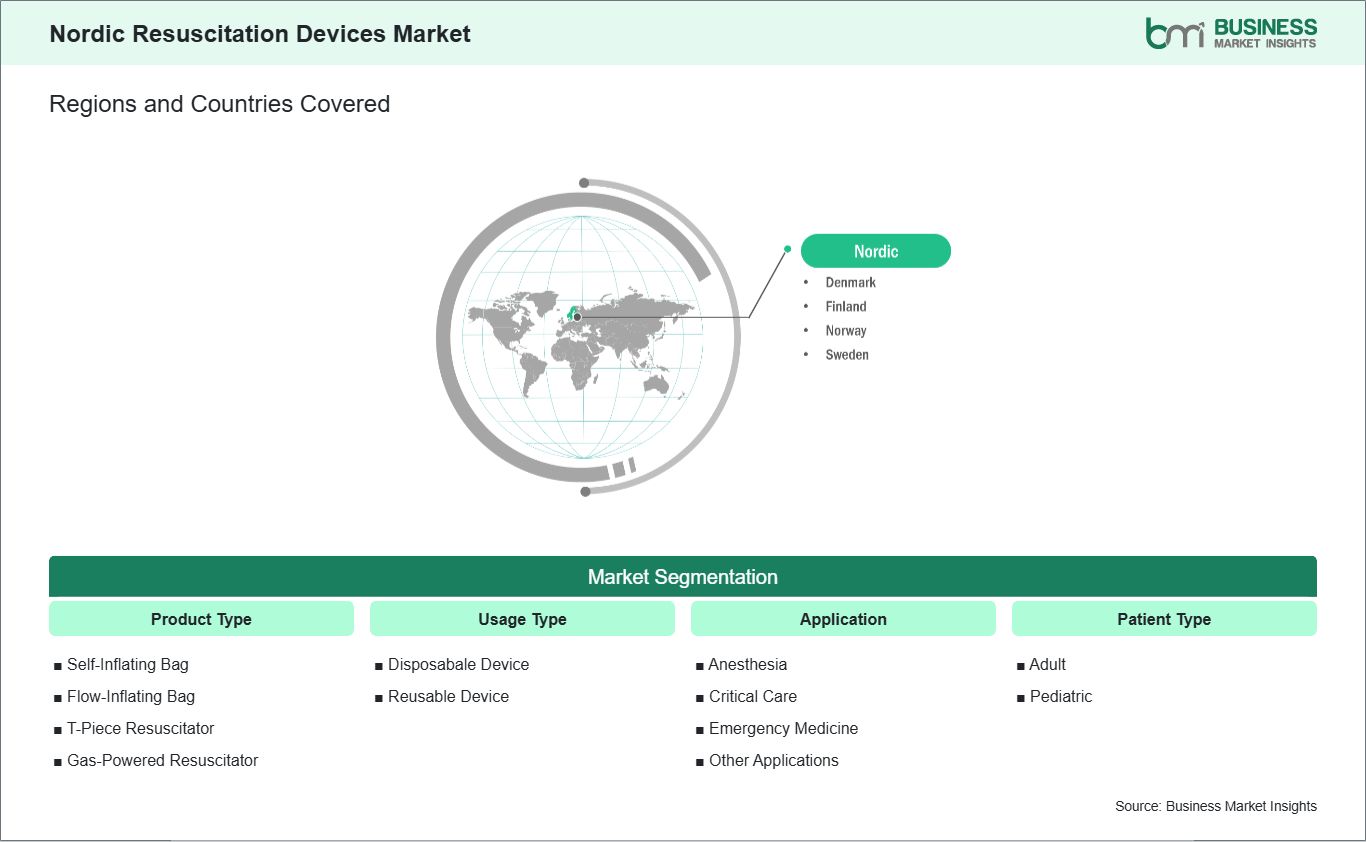
Key segments that contributed to the derivation of the Nordic resuscitation devices market analysis are product type, usage type, application, patient type, and end user.
The Nordic region, which includes Sweden, Norway, Denmark, Finland, and Iceland, is witnessing a consistent trend of urbanization in cities like Stockholm, Oslo, Copenhagen, Helsinki, and Reykjavik. As the population density in these urban centers rises, the emergency medical services face an increased challenge of providing timely care for patients suffering from acute coronary syndromes and respiratory problems. The urban setting with its tall buildings, traffic congestion, and deteriorating infrastructure places added emphasis on the need for timely availability of resuscitative equipment such as AEDs and ventilation kits.
Nordic countries have well-established centralization in their healthcare system coupled with its public funding, yet there are some lags in timely responses in dense areas and during severe climate conditions. In addition, winters bring extra restrictions for patients mobility in Finland and northern Sweden. All that is why being prepared for first responses by using resuscitation devices in transport hubs, shopping complexes, schools, and offices becomes increasingly popular. It seems that nowadays emphasis is made on putting portable resuscitation devices in places where bystanders can take actions before any professional rescuers.
Moreover, increased attention paid to cardiovascular problems in big cities makes preventive measures in case of emergencies more important. Now more cities introduce their own online maps for searching an AED device within minutes. Hospitals and local authorities provide emergency kit standardization in all public places. With growing urbanization, easy-to-use resuscitation devices become crucial for providing effective aid to patients.
Nordic healthcare systems are among the most digitally advanced globally, making the region a strong adopter of cloud-based monitoring for medical devices, including resuscitation equipment. Hospitals in Sweden, Denmark, and Finland are increasingly integrating AEDs and ventilators into centralized digital ecosystems, enabling real-time monitoring of device readiness, battery status, and maintenance cycles. This ensures that critical resuscitation tools are always operational when emergencies occur.
Cloud-based healthcare architecture is directly associated with the national policies for e-healthcare. In this context, Norway and Denmark have set up digital networks for their entire countries which enable smooth data transfer from emergency centers to hospitals. In this network, resuscitation equipment that comes with connectivity capabilities can provide information about the number of uses for a cardiac emergency, aiding in the analysis after the event.
In addition, cloud integration eliminates operational inefficiencies for those healthcare organizations having to control vast numbers of emergency devices at remote locations like airports, ferry ports, and other places. Cloud-based predictive maintenance helps detect any potential failure of an emergency device before this problem actually happens. Therefore, it is likely that cloud-enabled resuscitation devices will gradually become a part of any emergency system in Nordic countries.

The Nordic resuscitation devices market is experiencing steady growth, with market size and share analysis reflecting evolving treatment preferences and competitive dynamics among key players. The report evaluates important subsegments categorized within product type, usage type, application, patient type, and end user, highlighting their respective contributions to overall market performance.
By product type, the self-inflating bag subsegment dominated the market in 2025, because they are easy to use and do not require external gas or power sources, making them ideal for emergencies. They allow precise manual control of ventilation, which is crucial in critical care. Their portability makes them suitable for both hospital wards and transport situations.
Based on usage type, the disposable devices subsegment dominated the market in 2025 due to their ability to prevent cross-contamination and infection. They eliminate the need for complex sterilization processes, saving time and reducing operational costs. In high-volume hospital settings, disposables improve workflow efficiency. This makes them highly preferred in emergency rooms, ICUs, and surgical units.
On the basis of application, the anesthesia subsegment dominated the market in 2025, because resuscitation devices are essential for safe ventilation during induction and recovery. They provide backup support if mechanical ventilators fail. Their precise control helps manage patients with varying lung compliances. Hospitals rely on these devices to prevent hypoxia and ensure patient safety during surgeries.
In terms of patient type, the adult subsegment dominated the market in 2025, because they experience more surgical procedures and critical emergencies than pediatric populations. Their larger lung capacity requires devices designed for adult ventilation. High prevalence of cardiac and respiratory conditions in adults increases usage frequency.
Based on end user, the hospitals subsegment dominated the market in 2025 due to constant emergency and surgical care needs. Icus, operating rooms, and emergency departments require rapid access to resuscitation devices. High patient volume and stringent safety protocols make hospitals the key market driver. Their centralized procurement and standardized protocols ensure widespread device adoption.
| Report Attribute | Details |
|---|---|
| Market size in 2025 | US$ 13.9 Million |
| Market Size by 2033 | US$ 22.1Million |
| CAGR (2026 - 2033) | 5.9% |
| Historical Data | 2022-2024 |
| Forecast period | 2026-2033 |
| Segments Covered | By Product Type
|
|
Regions and Countries Covered
| |
| Nordic | Sweden, Denmark, Norway, Finland |
| Market leaders and key company profiles |
|
The "Nordic Resuscitation Devices Market Size and Forecast (2022–2033)" report provides a detailed analysis of the market covering below areas:
The geographical scope of the Nordic Resuscitation devices market report is divided into: Sweden, Norway, Denmark, and Finland. Sweden held the largest share in 2025.
Sweden dominates the Nordic resuscitation devices market due to its highly structured healthcare system and long-standing commitment to improving cardiac arrest survival outcomes. This country has set up one of the most comprehensive systems of public access defibrillation within Europe, guaranteeing the availability of automated external defibrillators in airports, railway stations, stadiums, and other community facilities. Such an extensive network of defibrillation is aided by a well-organized nationwide program for awareness on the importance of immediate action and CPR, thereby making practical use of the equipment very easy. In addition, the hospitals and EMS in Sweden are equipped with state-of-the-art systems for ventilation support, transport defibrillators, and airways management equipment. One of the distinguishing elements of the Swedish market is that it has an incredibly well-coordinated emergency response system that involves the use of technology for the quick identification of available defibrillators and efficient ambulance rerouting. The country's strong focus on medical research and clinical training programs in emergency medicine contributes to the adoption of new resuscitation technologies. Nonetheless, the main problem facing the market is the extremely high cost of maintenance and upgrading of sophisticated equipment in vast territories, especially in thinly populated northern parts of the country. In addition, market growth is constrained by the presence of an extensive number of devices in metropolitan centers. Nevertheless, the Swedish market still dominates the Nordic region of resuscitation devices.

The Nordic resuscitation devices market is evaluated by gathering qualitative and quantitative data post primary and secondary research, which includes important corporate publications, association data, and databases. A few of the key developments in the Nordic resuscitation devices market are:
The Nordic Resuscitation Devices Market is valued at US$ 13.9 Million in 2025, it is projected to reach US$ 22.1Million by 2033.
As per our report Nordic Resuscitation Devices Market, the market size is valued at US$ 13.9 Million in 2025, projecting it to reach US$ 22.1Million by 2033. This translates to a CAGR of approximately 5.9% during the forecast period.
The Nordic Resuscitation Devices Market report typically cover these key segments-
The historic period, base year, and forecast period can vary slightly depending on the specific market research report. However, for the Nordic Resuscitation Devices Market report:
The Nordic Resuscitation Devices Market is populated by several key players, each contributing to its growth and innovation. Some of the major players include:
The Nordic Resuscitation Devices Market report is valuable for diverse stakeholders, including:
Essentially, anyone involved in or considering involvement in the Nordic Resuscitation Devices Market value chain can benefit from the information contained in a comprehensive market report.
Please tell us your area of interest
(Market Segments/ Regions and Countries/ Companies)