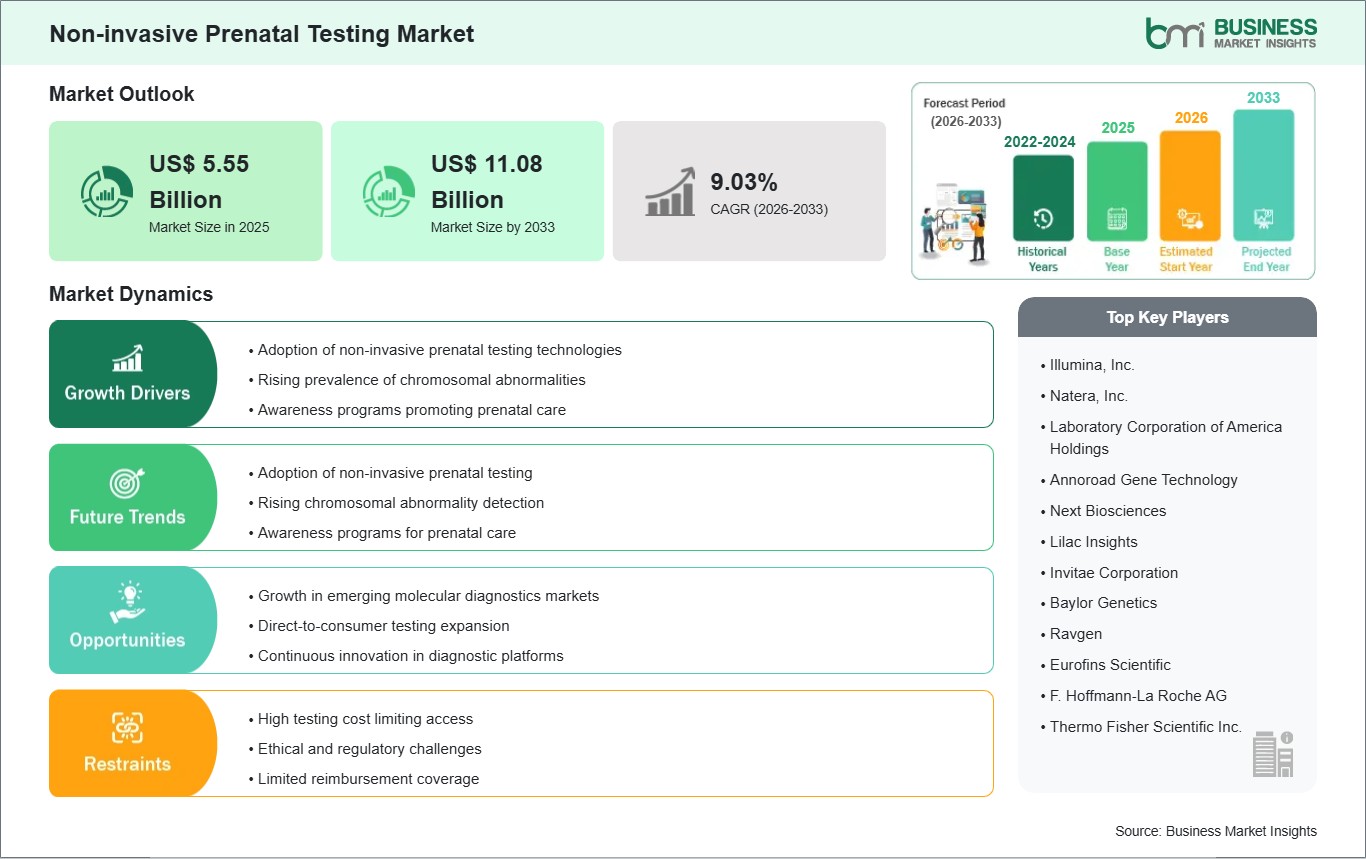
The non-invasive prenatal testing market size is expected to reach US$ 11.08 billion by 2033 from US$ 5.55 billion in 2025. The market is estimated to record a CAGR of 9.03% from 2026 to 2033
Non-invasive Prenatal Testing (NIPT) serves as an essential component of contemporary global prenatal healthcare because it provides pregnant women with safe and accurate tests to detect chromosomal disorders which do not jeopardize their unborn children. The test effectively detects Down syndrome and Edwards syndrome and Patau syndrome and other genetic conditions. NIPT offers multiple benefits through its capability to identify medical conditions at an early stage while maintaining accurate test results which leads to less invasive tests and greater safety for both mothers and their unborn children. The market growth is driven by three factors which include the increasing age of mothers and their rising knowledge about prenatal tests and the rising incidence of chromosomal disorders. The test's accuracy and clinical usefulness have improved through technological progress in next-generation sequencing bioinformatics and the development of new testing methods.
The market faces multiple growth constraints due to three main factors which include expensive testing procedures and insufficient reimbursement options in specific areas and the ethical and regulatory challenges that exist in various nations. The industry experiences its effects from two main factors which include unequal access to healthcare services and differences in prenatal screening protocols. The market presents major growth prospects because developing countries are building new healthcare facilities and more people are using cell-free DNA testing and there is a rising need for non-invasive tests which help diagnose medical conditions. The market will experience global growth because advanced laboratory automation systems get combined with ongoing research work in genomic medicine.

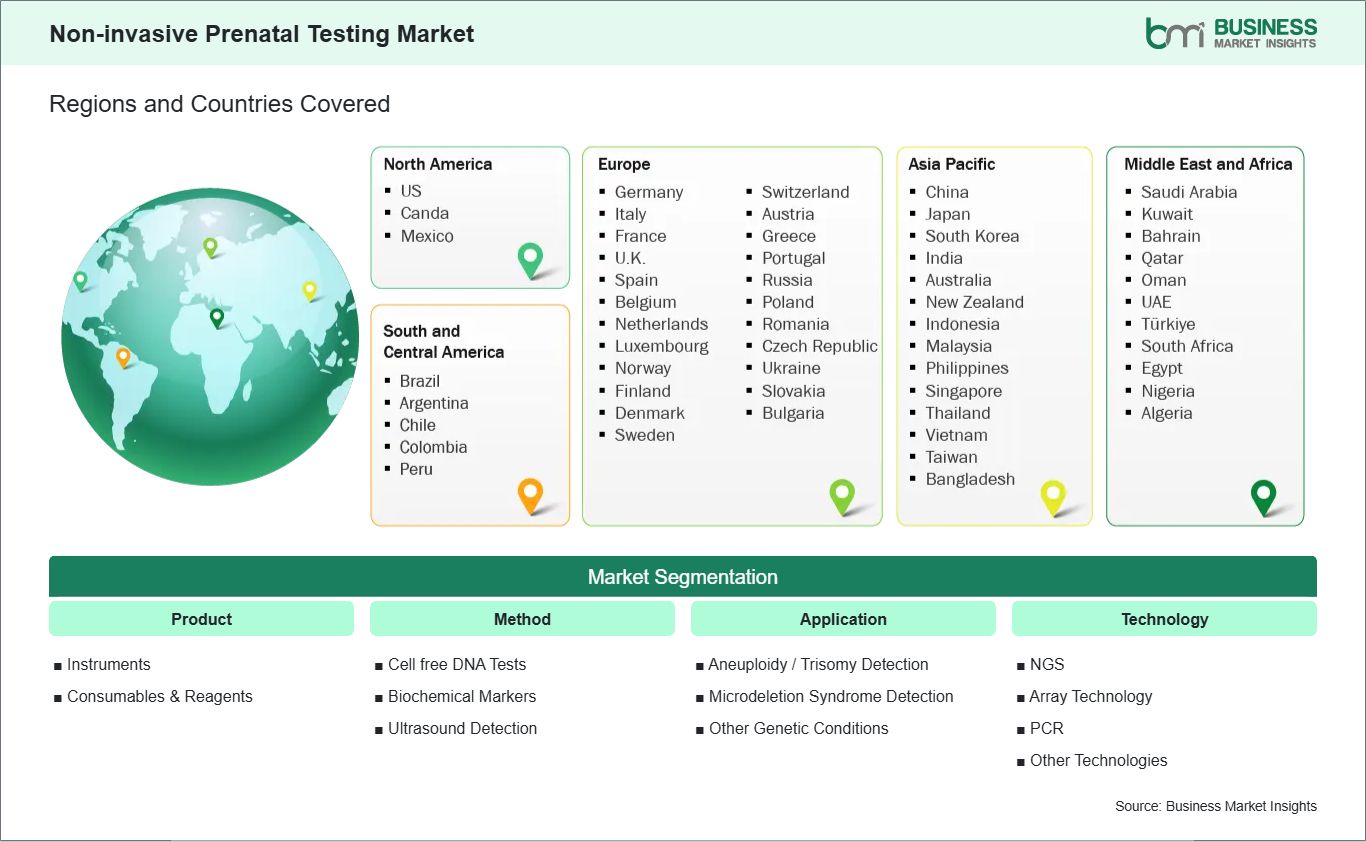
Key segments that contributed to the derivation of the non-invasive prenatal testing market analysis are Product, Method, Application, Technology, End User.
The global trend of increasing maternal age has become a key factor that drives growth in the non-invasive prenatal testing (NIPT) market. The demand for precise early prenatal screening solutions has risen because women now choose to become mothers at later stages in their lives which increases their chances of having chromosomal abnormalities. NIPT now serves as an essential element of present-day obstetric practice because it provides highly accurate results through a simple maternal blood test which detects fetal genetic disorders.
According to global health statistics from major public health organizations the occurrence of chromosomal disorders including Down syndrome shows a considerable rise during pregnancies that affect women who are 35 years old and older. The growth is associated with delayed pregnancies, improved access to reproductive healthcare, and expanding awareness programs promoting early fetal screening. Expecting mothers need early genetic testing which has low risks thus the number of people who need non-invasive prenatal testing has increased.
The major diagnostic companies Roche Illumina Natera and BGI have developed their worldwide presence while their advanced cell-free DNA assays and expanded screening panels have shaped medical guidelines. Non-invasive prenatal testing provides accurate results with lower risk than invasive procedures such as amniocentesis which allows it to fulfill changing needs of both patients and medical professionals. NIPT enables healthcare professionals to make clinical decisions at earlier stages which helps them manage prenatal care better than traditional diagnostic methods do because NIPT produces fewer testing-related issues.
The non-invasive prenatal testing market experiences its most significant growth through ongoing advancements in next-generation sequencing technologies and bioinformatics platforms. The NIPT solutions show improved clinical performance because their new data analysis capabilities provide faster testing results and their testing system can identify additional microdeletions and uncommon genetic disorders. The combination of government support and better reimbursement practices and the growth of private medical facilities has created new market entry points for businesses to expand their operations into existing markets throughout both developed nations and developing nations. The increased collaboration between obstetricians and genetic counselors and diagnostic laboratories leads to better patient education and easier test access. The combination of rising preventive healthcare awareness and digital health platform integration with telemedicine for prenatal consultations will create continuous demand for non-invasive prenatal testing solutions which will extend throughout international markets.
By product, the non-invasive prenatal testing market is bifurcated into instruments and consumables & reagents. The consumables & reagents segment dominated the market in 2025. Consumables and reagents dominate due to their recurring usage in every NIPT procedure, ensuring continuous demand. High testing volumes, repeat purchases, and expanding laboratory operations significantly drive revenue contribution from this segment
By method, the market is bifurcated into cell free DNA (cfDNA) tests, biochemical markers, ultrasound detection. The cell free dna (cfDNA) tests segment held the largest share of the market in 2025. cfDNA tests lead the market because of their superior accuracy, high sensitivity, and early detection capability for chromosomal abnormalities, making them the preferred non-invasive screening method among clinicians and expectant mothers.
By application, the market is bifurcated into aneuploidy / trisomy detection, microdeletion syndrome detection, other genetic conditions. The aneuploidy / trisomy detection segment held the largest share of the market in 2025. Aneuploidy detection dominates owing to high global prevalence of trisomy conditions such as Down syndrome and strong clinical guidelines recommending routine screening, increasing adoption across developed and emerging healthcare systems.
By technology, the market is bifurcated into NGS, array technology, PCR, and others. The NGS segment held the largest share of the market in 2025. NGS holds the largest share due to its high-throughput capability, enhanced precision, scalability, and ability to detect multiple chromosomal abnormalities simultaneously, improving diagnostic confidence and expanding testing applications.
By end user, the market is segmented into diagnostic laboratories, hospitals and clinics, and others. The diagnostic laboratories segment held the largest share of the market in 2025. Diagnostic laboratories dominate as they possess advanced sequencing infrastructure, skilled professionals, high sample processing capacity, and established referral networks, making them primary providers of non-invasive prenatal testing services
| Report Attribute | Details |
|---|---|
| Market size in 2025 | US$ 5.55 Billion |
| Market Size by 2033 | US$ 11.08 Billion |
| Global CAGR (2026 - 2033) | 9.03% |
| Historical Data | 2022-2024 |
| Forecast period | 2026-2033 |
| Segments Covered | By Product
|
|
Regions and Countries Covered
| |
| North America | US, Canada, Mexico |
| Europe | Belgium, Austria, Finland, Denmark, Greece, Poland, Romania, Russia, Ukraine, Czech Republic, Slovakia, Bulgaria, Italy, Luxembourg, Germany, Switzerland, France, Netherlands, Norway, Portugal, Spain, Sweden, United Kingdom |
| Asia-Pacific | Australia, China, India, Japan, South Korea, Indonesia, Malaysia, Philippines, Singapore, Thailand, Vietnam, Bangladesh, New Zealand, Taiwan |
| South and Central America | Brazil, Argentina, Peru, Chile, Colombia |
| Middle East and Africa | Bahrain, Kuwait, Oman, Qatar, Saudi Arabia, United Arab Emirates, Turkiye, South Africa, Egypt, Algeria, Nigeria |
| Market leaders and key company profiles |
|
The "Non-invasive Prenatal Testing Market Size and Forecast (2022–2033)" report provides a detailed analysis of the market covering below areas:
The geographical scope of the non-invasive prenatal testing market report is divided into five regions: North America, Asia Pacific, Europe, Middle East & Africa, and South & Central America. The non-invasive prenatal testing market in North America is expected to grow significantly during the forecast period.
The North America non-invasive prenatal testing market is segmented into the United States, Canada, and Mexico. The region is experiencing robust growth, driven by increasing maternal age, rising awareness of early genetic screening, and strong clinical adoption of advanced prenatal diagnostic technologies. Major economies like the United States and Canada are leading the way, supported by well-established healthcare infrastructure, favorable reimbursement frameworks, and continuous innovation in genomic testing platforms.
The region is also witnessing increased adoption of advanced sequencing technologies, including next-generation sequencing-based cell-free DNA analysis, automated laboratory workflows, and enhanced bioinformatics toolsparticularly relevant for detecting chromosomal abnormalities and genetic conditions. Expansion of accredited diagnostic laboratories, alongside strategic collaborations between healthcare providers and testing companies, is improving accessibility and reducing turnaround times. Additionally, the growing emphasis on preventive maternal healthcare, expanding insurance coverage for prenatal screening, and rising patient preference for non-invasive procedures are positioning North America as a key hub in the global non-invasive prenatal testing ecosystem. Strong regulatory oversight and ongoing research initiatives further solidify the region`s dominant market position

The non-invasive prenatal testing market is evaluated by gathering qualitative and quantitative data post primary and secondary research, which includes important corporate publications, association data, and databases. A few of the key developments in the non-invasive prenatal testing market are:
The Non-invasive Prenatal Testing Market is valued at US$ 5.55 Billion in 2025, it is projected to reach US$ 11.08 Billion by 2033.
As per our report Non-invasive Prenatal Testing Market, the market size is valued at US$ 5.55 Billion in 2025, projecting it to reach US$ 11.08 Billion by 2033. This translates to a CAGR of approximately 9.03% during the forecast period.
The Non-invasive Prenatal Testing Market report typically cover these key segments-
The historic period, base year, and forecast period can vary slightly depending on the specific market research report. However, for the Non-invasive Prenatal Testing Market report:
The Non-invasive Prenatal Testing Market is populated by several key players, each contributing to its growth and innovation. Some of the major players include:
The Non-invasive Prenatal Testing Market report is valuable for diverse stakeholders, including:
Essentially, anyone involved in or considering involvement in the Non-invasive Prenatal Testing Market value chain can benefit from the information contained in a comprehensive market report.
Please tell us your area of interest
(Market Segments/ Regions and Countries/ Companies)