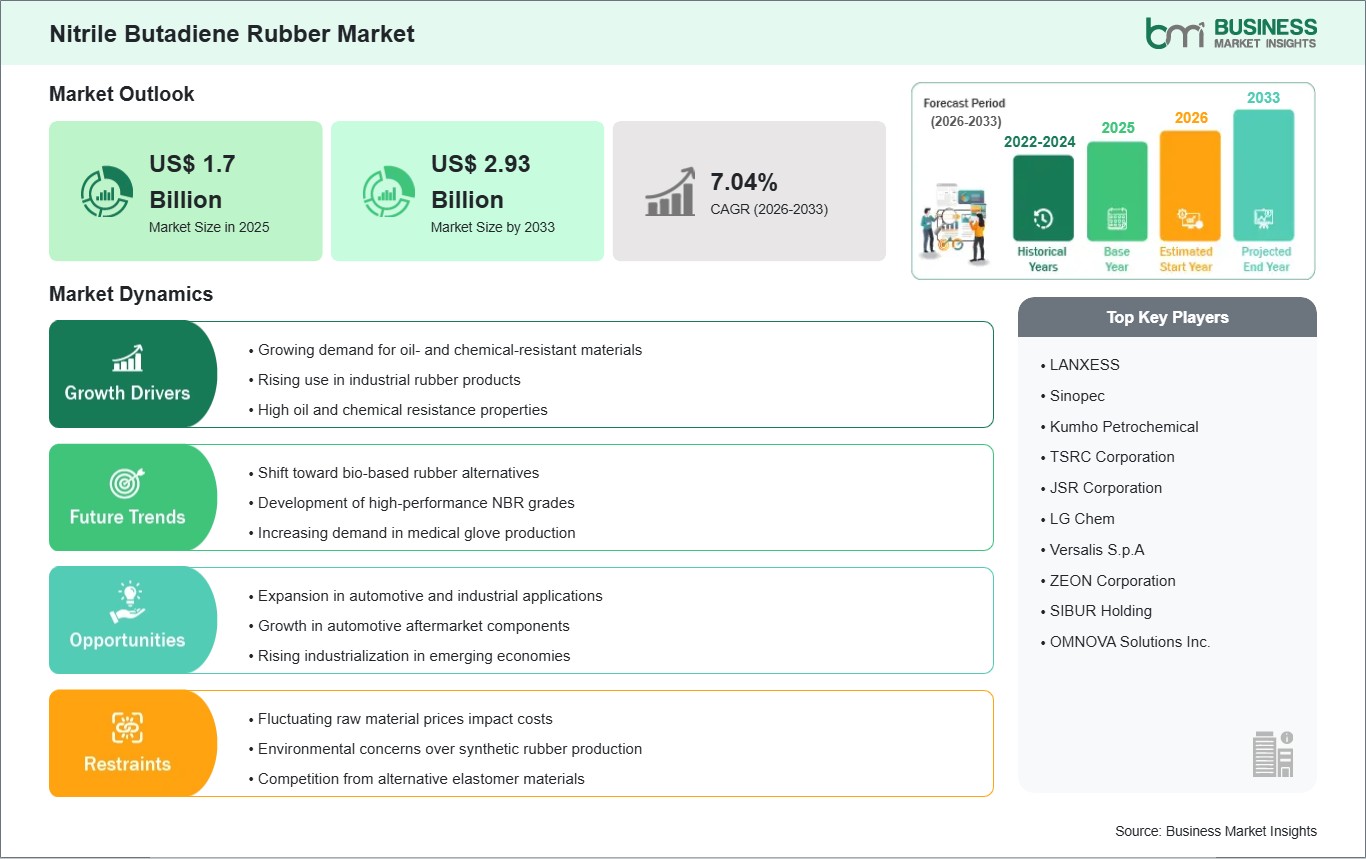
The Nitrile Butadiene Rubber Market size is expected to reach US$ 2.93 Billion by 2033 from US$ 1.7 Billion in 2025. The market is estimated to record a CAGR of 7.04% from 2026 to 2033.
The Nitrile Butadiene Rubber (NBR) market is growing continuously because of the excellent resistance of NBR to oils, fuels, and chemicals, which makes NBR the preferred choice for the automotive, oil, and gas industries, as well as industrial applications. The excellent properties of NBR to produce seals, gaskets, hoses, and gloves have established NBR as an essential material for industries that demand high durability even under the most stressful conditions and exposure to harsh chemicals. The increasing production of automobiles, especially in emerging economies, along with the increasing need for high-performance industrial materials, has also helped the NBR industry to grow significantly, thereby increasing the demand for NBR materials on a global scale. The increasing use of disposable industrial gloves has also helped the NBR industry to grow, as NBR is also used to produce industrial gloves that are required in the healthcare, food, and lab industries.
The NBR industry is also growing because of the increasing technological advancements in the field of polymers, which have enabled the production of high-acrylonitrile NBR materials that have excellent properties to resist oils, fuels, and chemicals, as well as excellent mechanical properties and low-temperature properties. Manufacturers are focusing on tailoring products for specific applications, such as fuel hoses, conveyor belts, and nitrile gloves, while maintaining cost-effectiveness. Strategic initiatives include backward integration with raw material suppliers and capacity expansion to address growing industrial demand. However, challenges such as the volatility of crude oil prices, which impact NBR production costs, and environmental regulations restricting synthetic rubber emissions, continue to affect market margins. Despite these factors, the outlook remains positive, supported by industrial growth, rising automotive demand, and the global emphasis on reliable, chemical-resistant synthetic rubbers.

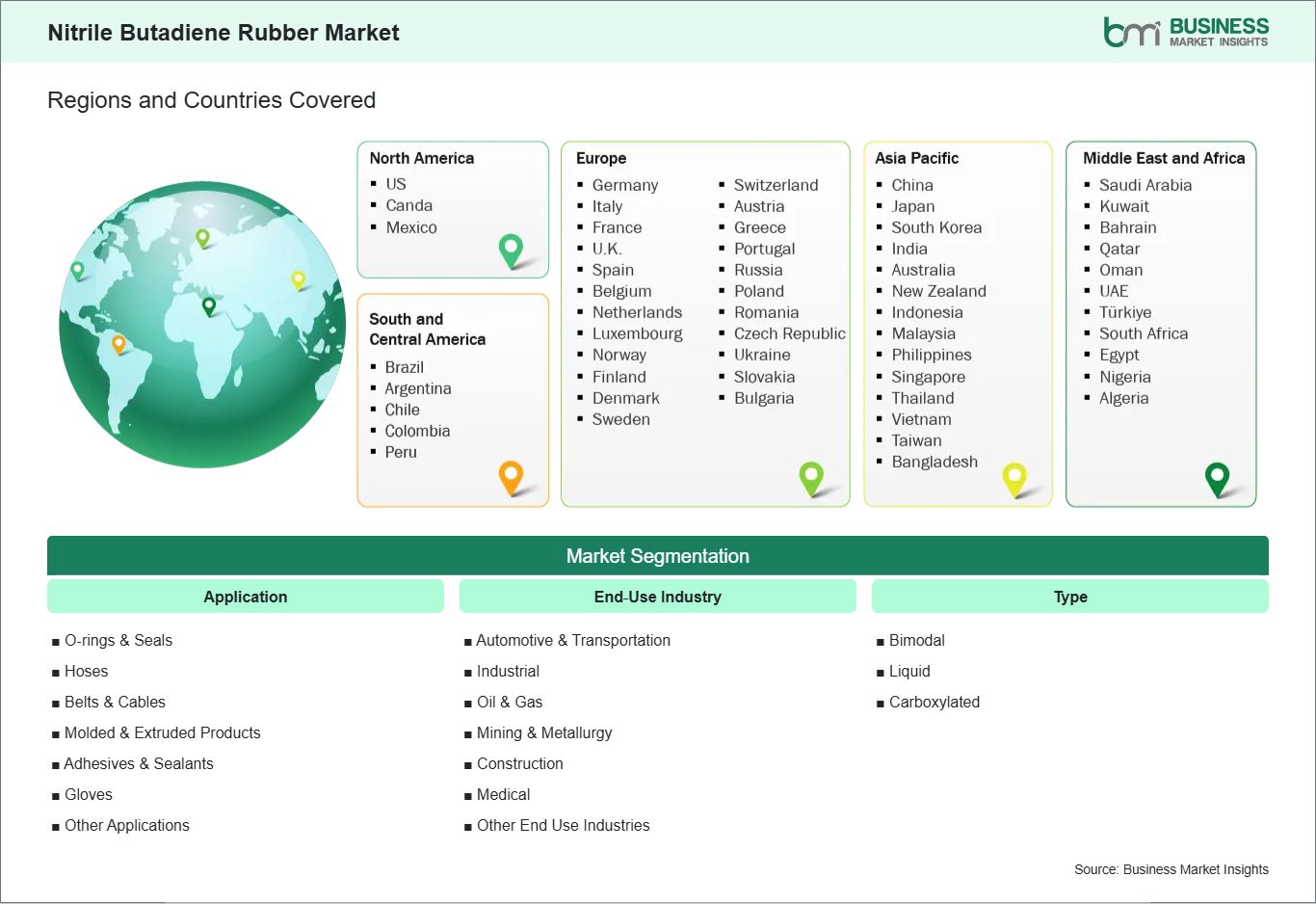
Key segments that contributed to the derivation of the NBR market analysis are application, end‑use industry, and type.
The growing need to use oil-resistant materials and chemicals is the key driver of the Nitrile Butadiene Rubber (NBR) market. NBR is considered to be one of the most important materials due to its excellent properties, including resistance to petroleum-based oils, fuels, and various chemicals. NBR has emerged as the most important material in the industry, as it has the ability to withstand harsh conditions of various chemicals.
Furthermore, the industrial sector is now focusing on materials that have the ability to withstand the wear and tear of the equipment in high-temperature and high-pressure conditions. NBR has the properties that enable the industrial sector to use this material for various applications, as it has the ability to perform well in harsh conditions for a long period of time.
Innovation in formulation and compounding has further strengthened NBR`s appeal. Manufacturers are enhancing properties such as tensile strength, elasticity, and chemical compatibility to meet specific application requirements. These improvements enable the production of specialized products tailored for automotive engines, hydraulic systems, and industrial machinery. As industries continue to demand high-performance, durable, and chemically resistant materials, NBR is expected to maintain strong market growth.
The NBR market is growing at a faster rate as it is increasingly being used in various applications. In the automobile industry, NBR is being used as fuel hoses, seals, O-rings, and gaskets. The major advantage of NBR is its excellent resistance to oils, fuels, and hydraulic fluids. Its high durability and elasticity at varying temperatures make it a popular choice as a component of automobiles, as it is constantly subjected to stress. This ensures the reliability of automobiles and increases their lifespan.
NBR is also being increasingly used in the industrial sector. In this sector, NBR is being used as manufacturing hoses, conveyor belts, gloves, and seals. Its ability to work well with harsh chemicals, oils, and high-pressure systems enables industries to operate efficiently while maintaining the safety of workers. The wide range of uses of NBR ensures its popularity as a component of custom-engineered products, meeting the requirements of industries.
Furthermore, ongoing advancements in compounding technologies have enhanced the performance characteristics of NBR. Modified grades offer improved heat resistance, abrasion strength, and oil compatibility, enabling the development of highly specialized products. As industries prioritize durability, chemical resistance, and safety, the adoption of NBR in automotive and industrial applications is expected to continue growing, reinforcing its importance as a critical elastomeric material.

The NBR market demonstrates steady growth, with size and share analysis highlighting evolving trends and competitive dynamics among key players. The report examines subsegments categorized within application, end‑use industry, and type, offering insights into their contribution to overall market performance.
By Application, the O‑rings & seals subsegment dominated the market in 2025, driven by its wide use across automotive, industrial, and oil & gas sectors.
Based on End‑Use Industry, the automotive & transportation subsegment dominated the market in 2025, owing to the rising demand for seals, gaskets, and hoses that meet stringent performance requirements.
On the basis of Type, the carboxylated subsegment dominated the market in 2025, supported by its enhanced physical properties and oil resistance that are critical for high‑performance applications.
| Report Attribute | Details |
|---|---|
| Market size in 2025 | US$ 1.7 Billion |
| Market Size by 2033 | US$ 2.93 Billion |
| Global CAGR (2026 - 2033) | 7.04% |
| Historical Data | 2022-2024 |
| Forecast period | 2026-2033 |
| Segments Covered | By Application
|
|
Regions and Countries Covered
| |
| North America | US, Canada, Mexico |
| Europe | Belgium, Austria, Finland, Denmark, Greece, Poland, Romania, Russia, Ukraine, Czech Republic, Slovakia, Bulgaria, Italy, Luxembourg, Germany, Switzerland, France, Netherlands, Norway, Portugal, Spain, Sweden, United Kingdom |
| Asia-Pacific | Australia, China, India, Japan, South Korea, Indonesia, Malaysia, Philippines, Singapore, Thailand, Vietnam, Bangladesh, New Zealand, Taiwan |
| South and Central America | Brazil, Argentina, Peru, Chile, Colombia |
| Middle East and Africa | Bahrain, Kuwait, Oman, Qatar, Saudi Arabia, United Arab Emirates, Turkiye, South Africa, Egypt, Algeria, Nigeria |
| Market leaders and key company profiles |
|
The "Nitrile Butadiene Rubber Market Size and Forecast (2022 - 2033)" report provides a detailed analysis of the market covering below areas:
The geographical scope of the Nitrile Butadiene Rubber Market report is divided into North America, Asia Pacific, Europe, Middle East & Africa, and South & Central America. North America held the largest share in 2025.
The NBR market exhibits varied growth trajectories shaped by industrial demand, regulatory standards, and sector-specific applications. North America dominates, driven by the U.S. and Canada`s mature automotive and oil & gas sectors. High adoption of NBR in fuel systems, seals, and industrial gloves, coupled with strong regulatory emphasis on chemical and mechanical safety, reinforces regional leadership.
Europe maintains steady growth, led by Germany, France, and Italy, were automotive manufacturing and industrial automation demand durable, high-performance elastomers. Strict environmental and safety regulations support the use of certified, high-quality NBR materials.
Asia Pacific is the fastest-growing region, with China, India, and Japan at the forefront due to rapid industrialization, rising automotive production, and increased demand for disposable gloves in healthcare and food industries. Expanding industrial infrastructure and investments in NBR manufacturing facilities are key drivers.
Middle East & Africa shows moderate growth, particularly in Gulf countries and South Africa, where oil & gas infrastructure development requires high-resistance NBR for seals, gaskets, and hoses capable of withstanding extreme conditions.
South & Central America demonstrates gradual expansion, with Brazil and Argentina leading due to rising automotive production and industrial equipment manufacturing. Growing awareness of the durability and chemical resistance benefits of NBR is encouraging adoption across multiple sectors.

The Nitrile Butadiene Rubber Market is evaluated by gathering qualitative and quantitative data post primary and secondary research, which includes important corporate publications, association data, and databases. A few of the key developments in the nitrile butadiene rubber market are:
The Nitrile Butadiene Rubber Market is valued at US$ 1.7 Billion in 2025, it is projected to reach US$ 2.93 Billion by 2033.
As per our report Nitrile Butadiene Rubber Market, the market size is valued at US$ 1.7 Billion in 2025, projecting it to reach US$ 2.93 Billion by 2033. This translates to a CAGR of approximately 7.04% during the forecast period.
The Nitrile Butadiene Rubber Market report typically cover these key segments-
The historic period, base year, and forecast period can vary slightly depending on the specific market research report. However, for the Nitrile Butadiene Rubber Market report:
The Nitrile Butadiene Rubber Market is populated by several key players, each contributing to its growth and innovation. Some of the major players include:
The Nitrile Butadiene Rubber Market report is valuable for diverse stakeholders, including:
Essentially, anyone involved in or considering involvement in the Nitrile Butadiene Rubber Market value chain can benefit from the information contained in a comprehensive market report.
Please tell us your area of interest
(Market Segments/ Regions and Countries/ Companies)