
Night Vision Driver Monitoring System Market Outlook: Size, Share, Trends, Growth Analysis, Competitive Landscape & Forecast, 2026-2033

Historic Data: 2022-2024   |   Base Year: 2025   |   Forecast Period: 2026-2033
Report Content: Market Scope, Market Segmentation, Market Dynamics, and Competitive Analysis

Report Coverage:
  • Technology (Infrared Imaging – Near Infrared / Active IR, Thermal Imaging, Visible Light Enhancement, AI / Machine Learning-based Vision Analytics, Sensor Fusion)
  • Vehicle Type (Passenger Vehicles, Commercial Vehicles)
  • Application (Driver Monitoring (DMS), Pedestrian Detection, Animal Detection, Night-time Object Detection / Obstacle Detection, Advanced Driver Assistance Systems (ADAS) Integration)

No. of Pages: 400
Report Code: BMIPUB00035383
Category: Automotive and Transportation
Night Vision Driver Monitoring System Market

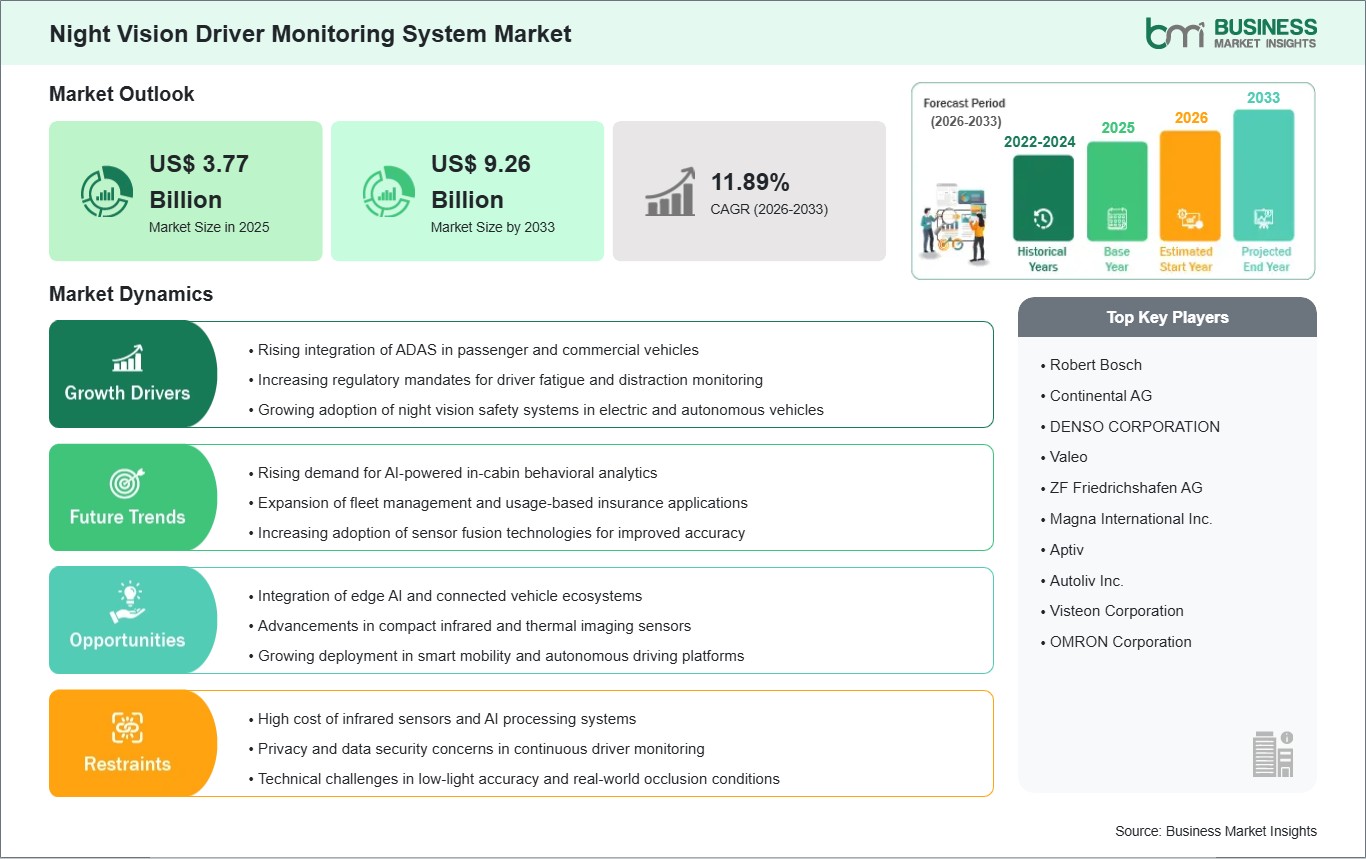
The Night Vision Driver Monitoring System Market size is expected to reach US$ 9.26 Billion by 2033 from US$ 3.77 Billion in 2025.The market is estimated to record a CAGR of 11.89% from 2026 to 2033.

Executive Summary and Global Market Analysis:

Night Vision Driver Monitoring System (DMS) refers to advanced in-cabin sensing solutions designed to continuously assess driver alertness, gaze behavior, and physiological cues under low-light and night-time driving conditions. These systems leverage infrared (IR) imaging, near-infrared (NIR) illumination, thermal sensing, and AI-powered computer vision algorithms to ensure reliable monitoring even in complete darkness. By simulating human-like visual interpretation in challenging lighting environments, night vision DMS technologies detect fatigue, distraction, microsleep events, and unsafe driving patterns in real time. This technology is becoming a core component of modern automotive safety architectures, particularly within Advanced Driver Assistance Systems (ADAS), semi-autonomous vehicles, and intelligent fleet management platforms. Market expansion is being driven by increasingly stringent global vehicle safety regulations, the rising adoption of in-cabin sensing mandates under safety rating programs such as NCAP, and the growing integration of AI-enabled driver safety features in passenger and commercial vehicles.

However, several factors may restrain market progression. The high cost of integrating infrared cameras, specialized NIR illumination modules, and edge AI processing units remains a significant barrier for mass-market vehicle adoption, particularly in price-sensitive automotive segments. The industry also faces technical challenges related to accuracy and reliability under varying real-world conditions, including occlusions from eyewear, facial hair, or extreme cabin lighting transitions. Privacy concerns surrounding continuous in-cabin monitoring further complicate large-scale deployment, as regulatory frameworks across regions impose strict data protection and user consent requirements. Additionally, computational constraints associated with real-time facial landmark detection and drowsiness prediction algorithms increase system power consumption and hardware complexity. Integration challenges with existing vehicle electronic control units (ECUs) and potential interference from ambient infrared sources further elevate system calibration requirements and total cost of ownership for OEMs.

Despite these challenges, the market outlook remains highly favorable as the industry transitions toward intelligent, safety-centric mobility ecosystems. Opportunities are emerging through the convergence of edge AI, sensor miniaturization, and vehicle-to-cloud connectivity, enabling highly responsive night vision DMS solutions capable of real-time behavioral analytics with minimal latency. The expansion of autonomous and semi-autonomous driving ecosystems is accelerating demand for continuous driver state monitoring as a fail-safe mechanism for human-machine interaction. Furthermore, the rise of usage-based insurance models and fleet telematics is creating new commercial avenues for driver behavior analytics and risk assessment. Ongoing advancements in multispectral imaging and deep learning-based fatigue detection are also enhancing system accuracy and robustness. Collectively, these developments position the night vision driver monitoring system market for sustained growth as a critical enabler of next-generation automotive safety and intelligent transportation systems.

Night Vision Driver Monitoring System Market - Strategic Insights:

global-market-strategic-framework
Get more information on this report

Night Vision Driver Monitoring System Market Segmentation Analysis:

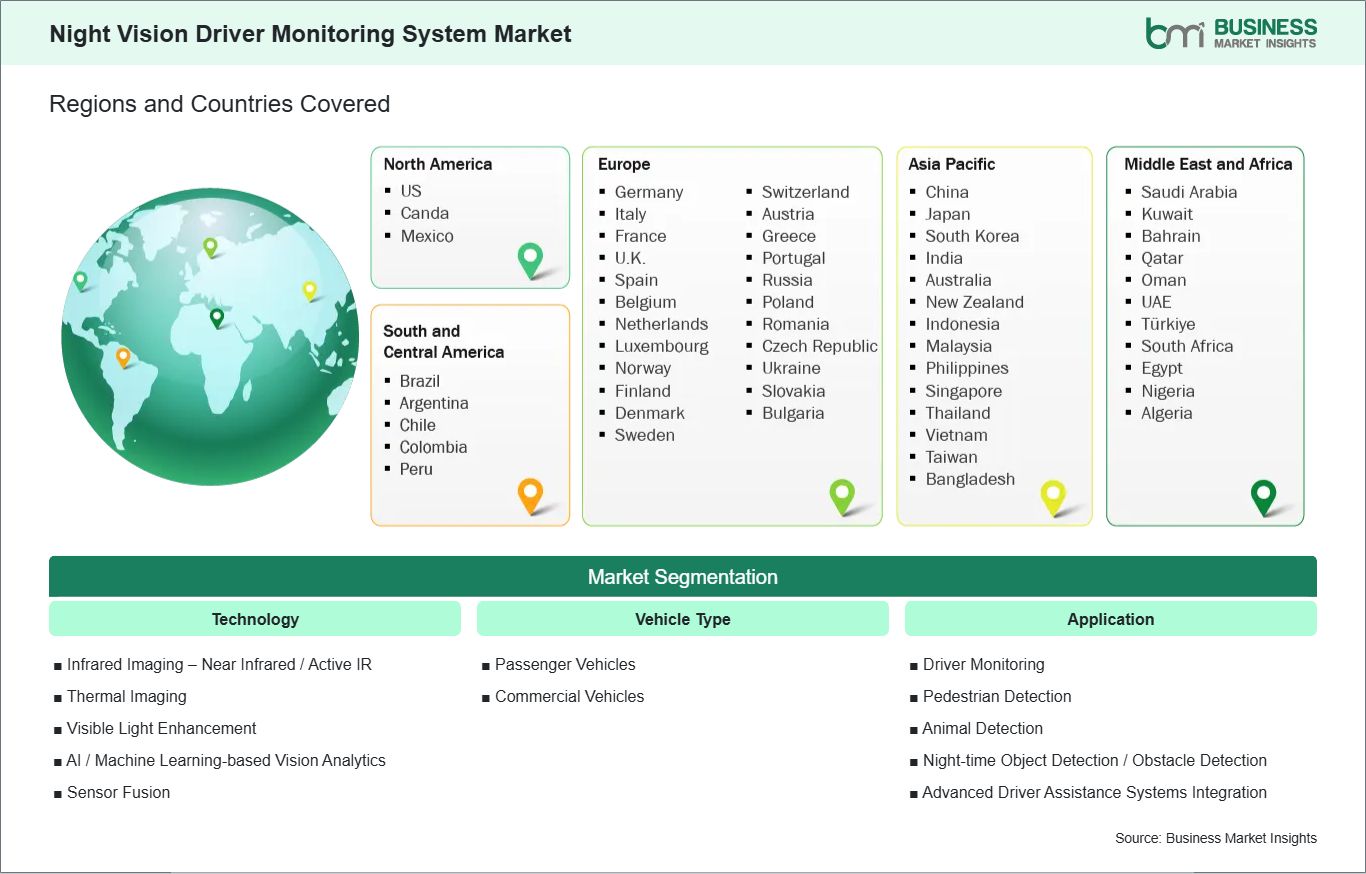
The night vision driver monitoring system market is segmented based on technology, vehicle type, and application, reflecting the increasing integration of intelligent sensing and AI-driven safety solutions across modern automotive systems.

By Technology

  • Infrared (Near-Infrared / Active IR): Utilizes NIR illumination to track driver eye movement, gaze direction, and facial behavior in low-light and night conditions
  • Thermal Imaging: Detects heat signatures to monitor driver presence, alertness, and physiological state regardless of visible lighting conditions
  • Visible Light Enhancement: Improves low-light cabin visibility by amplifying ambient light for clearer image capture and analysis
  • AI / Machine Learning-based Vision Analytics: Applies deep learning algorithms to interpret driver fatigue, distraction, and behavioral anomalies in real time
  • Sensor Fusion: Combines multiple data sources such as infrared, thermal, and visible imaging to enhance accuracy and reliability of driver monitoring

By Vehicle Type

  • Passenger Vehicles: Includes private cars and SUVs equipped with advanced safety and driver assistance features
  • Commercial Vehicles: Covers trucks, buses, and fleet vehicles where driver safety and fatigue monitoring are critical for operational efficiency

By Application

  • Driver Monitoring (DMS): Focuses on detecting drowsiness, distraction, and unsafe driving behavior to improve road safety
  • Pedestrian Detection: Identifies pedestrians in night-time environments to prevent collisions and enhance situational awareness
  • Animal Detection: Detects animals on roads during low-visibility conditions, reducing accident risks in rural and highway areas
  • Night-time Object Detection / Obstacle Detection: Identifies road obstacles such as debris, vehicles, or sudden hazards in darkness
  • Advanced Driver Assistance Systems (ADAS) Integration: Supports broader vehicle safety systems by feeding real-time driver and environment data into ADAS platforms
Night Vision Driver Monitoring System Market Drivers and Opportunities:

Rising Demand for Automotive Safety, Regulatory Compliance, and Intelligent In-Cabin Monitoring

The Night Vision Driver Monitoring System market is being driven by the increasing need for enhanced road safety, real-time driver behavior analysis, and compliance with stringent global automotive safety regulations. Unlike conventional driver monitoring solutions, night vision systems utilize infrared imaging, thermal sensing, and AI-based vision analytics to ensure accurate monitoring of driver alertness, gaze direction, and fatigue levels even in complete darkness. The rising integration of Advanced Driver Assistance Systems (ADAS) across passenger and commercial vehicles is significantly accelerating demand, as OEMs focus on reducing accidents caused by drowsy and distracted driving. Growing concerns over road fatalities, along with mandatory safety rating frameworks such as NCAP, are further strengthening adoption. Additionally, the expansion of electric and semi-autonomous vehicles is increasing the need for continuous driver state monitoring as a critical safety fallback mechanism.

In commercial fleets and long-haul transportation, night vision driver monitoring systems are gaining strong traction due to their ability to enhance operational safety, reduce driver-related risks, and improve regulatory compliance. The development of connected vehicle ecosystems and telematics platforms is further supporting adoption by enabling real-time monitoring and alert systems. Technological advancements in infrared sensors, low-light imaging modules, and edge AI processors are improving detection accuracy while reducing latency and system size. Collectively, these factors are driving sustained market growth, supported by the convergence of automotive intelligence, safety-driven innovation, and increasing deployment of in-cabin sensing technologies.

Rising Integration of AI, Sensor Fusion, and Autonomous Mobility Ecosystems

Opportunities in the Night Vision Driver Monitoring System market are expanding through the integration of artificial intelligence, sensor fusion technologies, and next-generation autonomous driving platforms. AI-powered systems are enabling advanced capabilities such as micro-expression detection, fatigue prediction, and real-time distraction analysis, significantly enhancing driver safety intelligence. The adoption of sensor fusion, combining infrared, thermal, and visible light enhancement technologies, is improving system robustness under diverse lighting and environmental conditions.

The evolution of autonomous and semi-autonomous vehicles is creating strong opportunities, where night vision driver monitoring acts as a critical redundancy layer to ensure safe human-machine interaction. Additionally, the growth of usage-based insurance and fleet analytics is opening new revenue streams through driver behavior profiling and risk assessment. Increasing investments in smart mobility infrastructure and intelligent transportation systems are further accelerating adoption. The emergence of privacy-preserving AI models and edge computing is addressing regulatory challenges, enabling wider acceptance across global markets. Furthermore, advancements in compact thermal imaging and energy-efficient night vision modules are reducing costs and improving scalability. Collectively, the convergence of AI, connected mobility, and intelligent sensing is positioning the night vision driver monitoring system market for sustained long-term expansion.

Night Vision Driver Monitoring System Market Size and Share Analysis:

The Night Vision Driver Monitoring System Market is projected to grow from US$ 3.77 Billion in 2025 to US$ 9.26 Billion by 2033 , registering a CAGR of 11.89% from 2026 to 2033.

By technology, infrared (Near-Infrared / Active IR) accounts for a significant share as it enables reliable driver monitoring in low-light and night-time conditions by tracking eye movement, gaze direction, and facial behavior with high precision. Thermal imaging continues to grow due to its ability to detect heat signatures for driver presence and fatigue monitoring irrespective of visible lighting conditions, making it highly suitable for safety-critical automotive applications. Visible light enhancement is gaining traction as it improves image clarity in challenging cabin environments, supporting more accurate behavioral analysis and object detection. AI / machine learning-based vision analytics is expanding rapidly, driven by its capability to interpret complex driver behaviors such as drowsiness, distraction, and microsleep events in real time. Sensor fusion is also witnessing strong adoption as it integrates infrared, thermal, and visible light data to improve accuracy, reliability, and robustness across diverse driving conditions.

By vehicle type, passenger vehicles dominate adoption due to the increasing integration of advanced driver assistance systems (ADAS) and in-cabin safety features in cars and SUVs, particularly in premium and mid-range segments. Commercial vehicles are experiencing strong growth as fleet operators prioritize driver safety, fatigue management, and regulatory compliance in long-haul transportation and logistics operations, where night-time driving risks are significantly higher.

Night Vision Driver Monitoring System Market Report Highlights:

Report Attribute Details
Market size in 2025 US$ 3.77 Billion
Market Size by 2033 US$ 9.26 Billion
Global CAGR (2026 - 2033)11.89%
Historical Data 2022-2024
Forecast period 2026-2033
Segments Covered By Technology
  • Infrared Imaging – Near Infrared / Active IR
  • Thermal Imaging
  • Visible Light Enhancement
  • AI / Machine Learning-based Vision Analytics
  • Sensor Fusion
By Vehicle Type
  • Passenger Vehicles
  • Commercial Vehicles
By Application
  • Driver Monitoring
  • Pedestrian Detection
  • Animal Detection
  • Night-time Object Detection / Obstacle Detection
  • Advanced Driver Assistance Systems Integration
Regions and Countries Covered
North America US, Canada, Mexico
Europe Germany, Italy, France, U.K., Spain, Belgium, Netherlands, Luxembourg, Norway, Finland, Denmark, Sweden, Switzerland, Austria, Greece, Portugal, Russia, Poland, Romania, Czech Republic, Ukraine, Slovakia, Bulgaria
Asia-Pacific China, Japan, South Korea, India, Australia, New Zealand, Indonesia, Malaysia, Philippines, Singapore, Thailand, Vietnam, Taiwan, Bangladesh
South and Central America Brazil, Argentina, Chile, Colombia, Peru
Middle East and Africa Saudi Arabia, United Arab Emirates, Kuwait, Bahrain, Qatar, Oman, Turkiye, South Africa, Egypt, Nigeria, Algeria
Market leaders and key company profiles
  • Robert Bosch
  • Continental AG
  • DENSO CORPORATION
  • Valeo
  • ZF Friedrichshafen AG
  • Magna International Inc.
  • Aptiv
  • Autoliv Inc.
  • Visteon Corporation
  • OMRON Corporation
Get more information on this report

Night Vision Driver Monitoring System Market Report Coverage and Deliverables:

The "Night Vision Driver Monitoring System Market Size and Forecast (2022–2033)" report provides a detailed analysis of the market covering below areas:

  • Night vision driver monitoring system market size and forecast at global, regional, and country levels for all market segments covered under the scope
  • Night vision driver monitoring system market trends, as well as drivers, restraints, and opportunities
  • Night vision driver monitoring system market analysis covering key trends, global and regional framework, major players, regulations, and recent developments
  • Industry landscape and competition analysis covering market concentration, heat map analysis, prominent players, and recent developments for the night vision driver monitoring system market
  • Detailed company profiles, including SWOT analysis

Night Vision Driver Monitoring System Market Geographic Insights:

The Night Vision Driver Monitoring System (DMS) Market shows diverse regional adoption patterns influenced by rising automotive safety regulations, increasing penetration of advanced driver assistance systems (ADAS), and growing demand for intelligent in-cabin monitoring technologies across passenger and commercial vehicles.

North America, being a highly advanced automotive and technology-driven region, holds a strong position in the market due to the presence of leading automotive OEMs, Tier-1 suppliers, and AI-based vision technology providers. The United States and Canada are witnessing increasing integration of night vision driver monitoring systems in premium vehicles, fleet management solutions, and autonomous driving platforms. The region is heavily focused on improving road safety standards and reducing accident rates caused by driver fatigue and distraction. Strong investments in infrared imaging, AI-based behavioral analytics, and connected vehicle ecosystems are further supporting market expansion. Additionally, well-established regulatory frameworks and rapid adoption of electric and semi-autonomous vehicles are accelerating deployment across multiple vehicle segments, including passenger cars and commercial fleets.

Asia Pacific is experiencing significant growth, driven by rapid automotive production, expanding middle-class vehicle ownership, and increasing adoption of smart mobility technologies. Countries such as China, Japan, South Korea, and India are actively integrating night vision driver monitoring systems into vehicles to enhance safety and comply with evolving regulatory standards. The region’s strong manufacturing base and cost-competitive electronics ecosystem are enabling large-scale deployment of infrared cameras, thermal sensing modules, and AI-enabled in-cabin monitoring systems. The growing demand for commercial transportation, logistics expansion, and ride-sharing services is further contributing to adoption, particularly in night-time and long-distance driving scenarios. Additionally, rising investments in automotive AI, semiconductor technologies, and smart transportation infrastructure are supporting continuous innovation in the region.

Both regions are contributing significantly to the growth of the Night Vision Driver Monitoring System Market, driven by technological advancements, increasing focus on road safety, and rising adoption of intelligent automotive sensing solutions across diverse vehicle platforms.

global-market-geography
Get more information on this report

Night Vision Driver Monitoring System Market Research Report Guidance:

  • The report includes qualitative and quantitative data for the night vision driver monitoring system market across technology, vehicle type, application, and geography.
  • The report starts with the key takeaways (chapter 2), highlighting the key trends and outlook of the night vision driver monitoring system market.
  • Chapter 3 focuses on the research methodology of the study.
  • Chapter 4 includes ecosystem analysis.
  • Chapter 5 highlights the major industry dynamics in the night vision driver monitoring system market, including factors that are driving the market, prevailing deterrents, potential opportunities, as well as future trends. Impact analysis of these drivers and restraints is also covered in this section.
  • Chapter 6 discusses the night vision driver monitoring system market scenario, in terms of historical market revenues, and forecast till the year 2033.
  • Chapters 7 to 10 cover night vision driver monitoring system market segments by technology, vehicle type, application, and geography across North America, Europe, Asia Pacific, Middle East and Africa, and South and Central America. They cover the market revenue, forecast, and factors driving the market.
  • Chapter 11 describes the competitive analysis along with the heat map analysis for the key players operating in the market.
  • Chapter 12 describes the industry landscape analysis. It provides detailed descriptions of business activities such as market initiatives, new developments, mergers, and joint ventures globally, along with a competitive landscape.
  • Chapter 13 provides detailed profiles of the major companies operating in the night vision driver monitoring system market. Companies have been profiled on the basis of their key facts, business descriptions, products and services, financial overview, SWOT analysis, and key developments.
  • Chapter 14, i.e., the appendix, is inclusive of a brief overview of the company, list of abbreviations, and disclaimer.

Night Vision Driver Monitoring System Market News and Key Development:

The night vision driver monitoring system market is evaluated by gathering qualitative and quantitative data post primary and secondary research, which includes important corporate publications, association data, and databases. A few of the key developments in the night vision driver monitoring system market are:

  • In May 2025, Omnivision has released the OX01N1B image sensor to make in-cabin automotive monitoring systems more cost-effective and energy efficient while improving performance. The OX01N1B is part of the larger Omnivision Nyxel Near Infrared (NIR) automotive sensor family.
  • In October 2022, Kyocera Corporation (President: Hideo Tanimoto) announced that it has developed an Automotive Night Vision System that can accurately identify collision-risk objects in low-visibility driving conditions, such as at night, or in rain, snow, fog, or smoke. The system is expected to reduce traffic accidents and promote safer driving. Kyocera's Automotive Night Vision features the first headlight in the world that can emit both white (RGB) and near-infrared (NIR) light on the same optical axis; this allows higher accuracy object recognition than alternative technologies. The system integrates RGB-NIR sensors and a unique "Image-Fusion AI Recognition Technology" developed by Kyocera for high performance object recognition. In addition, Kyocera has developed another generative AI feature to create training data for more cost-efficient learning and product development..

Key Sources Referred:

  • World Bank – Global Trade Indicators
  • World Trade Organization (WTO)
  • (International Monetary Fund )IMF
  • International Trade Administration (ITA)
  • Company website
  • Company annual reports
  • Company investor presentations
The List of Companies - Night Vision Driver Monitoring System Market
  • Robert Bosch
  • Continental AG
  • DENSO CORPORATION
  • Valeo
  • ZF Friedrichshafen AG
  • Magna International Inc.
  • Aptiv
  • Autoliv Inc.
  • Visteon Corporation
  • OMRON Corporation
Frequently Asked Questions
How big is the Night Vision Driver Monitoring System Market?

The Night Vision Driver Monitoring System Market is valued at US$ 3.77 Billion in 2025, it is projected to reach US$ 9.26 Billion by 2033.

What is the CAGR for Night Vision Driver Monitoring System Market by (2026 - 2033)?

As per our report Night Vision Driver Monitoring System Market, the market size is valued at US$ 3.77 Billion in 2025, projecting it to reach US$ 9.26 Billion by 2033. This translates to a CAGR of approximately 11.89% during the forecast period.

What segments are covered in this report?

The Night Vision Driver Monitoring System Market report typically cover these key segments-

  • Technology (Infrared Imaging – Near Infrared / Active IR, Thermal Imaging, Visible Light Enhancement, AI / Machine Learning-based Vision Analytics, Sensor Fusion)
  • Vehicle Type (Passenger Vehicles, Commercial Vehicles)
  • Application (Driver Monitoring (DMS), Pedestrian Detection, Animal Detection, Night-time Object Detection / Obstacle Detection, Advanced Driver Assistance Systems (ADAS) Integration)

What is the historic period, base year, and forecast period taken for Night Vision Driver Monitoring System Market?

The historic period, base year, and forecast period can vary slightly depending on the specific market research report. However, for the Night Vision Driver Monitoring System Market report:

  • Historic Period : 2022-2024
  • Base Year : 2025
  • Forecast Period : 2026-2033
  • Who are the major players in Night Vision Driver Monitoring System Market?

    The Night Vision Driver Monitoring System Market is populated by several key players, each contributing to its growth and innovation. Some of the major players include:

  • Robert Bosch
  • Continental AG
  • DENSO CORPORATION
  • Valeo
  • ZF Friedrichshafen AG
  • Magna International Inc.
  • Aptiv
  • Autoliv Inc.
  • Visteon Corporation
  • OMRON Corporation
  • Who should buy this report?

    The Night Vision Driver Monitoring System Market report is valuable for diverse stakeholders, including:

    • Investors: Provides insights for investment decisions pertaining to market growth, companies, or industry insights. Helps assess market attractiveness and potential returns.
    • Industry Players: Offers competitive intelligence, market sizing, and trend analysis to inform strategic planning, product development, and sales strategies.
    • Suppliers and Manufacturers: Helps understand market demand for components, materials, and services related to concerned industry.
    • Researchers and Consultants: Provides data and analysis for academic research, consulting projects, and market studies.
    • Financial Institutions: Helps assess risks and opportunities associated with financing or investing in the concerned market.

    Essentially, anyone involved in or considering involvement in the Night Vision Driver Monitoring System Market value chain can benefit from the information contained in a comprehensive market report.

    Available Report Formats

    pdf-format excel-format pptx-format
    Buy Now
    Sales Assistance
    +1 646 791 7070 (US & UK)
    Customization Form

    Please tell us your area of interest
    (Market Segments/ Regions and Countries/ Companies)