Market Summary
Executive Summary and Global Market Analysis
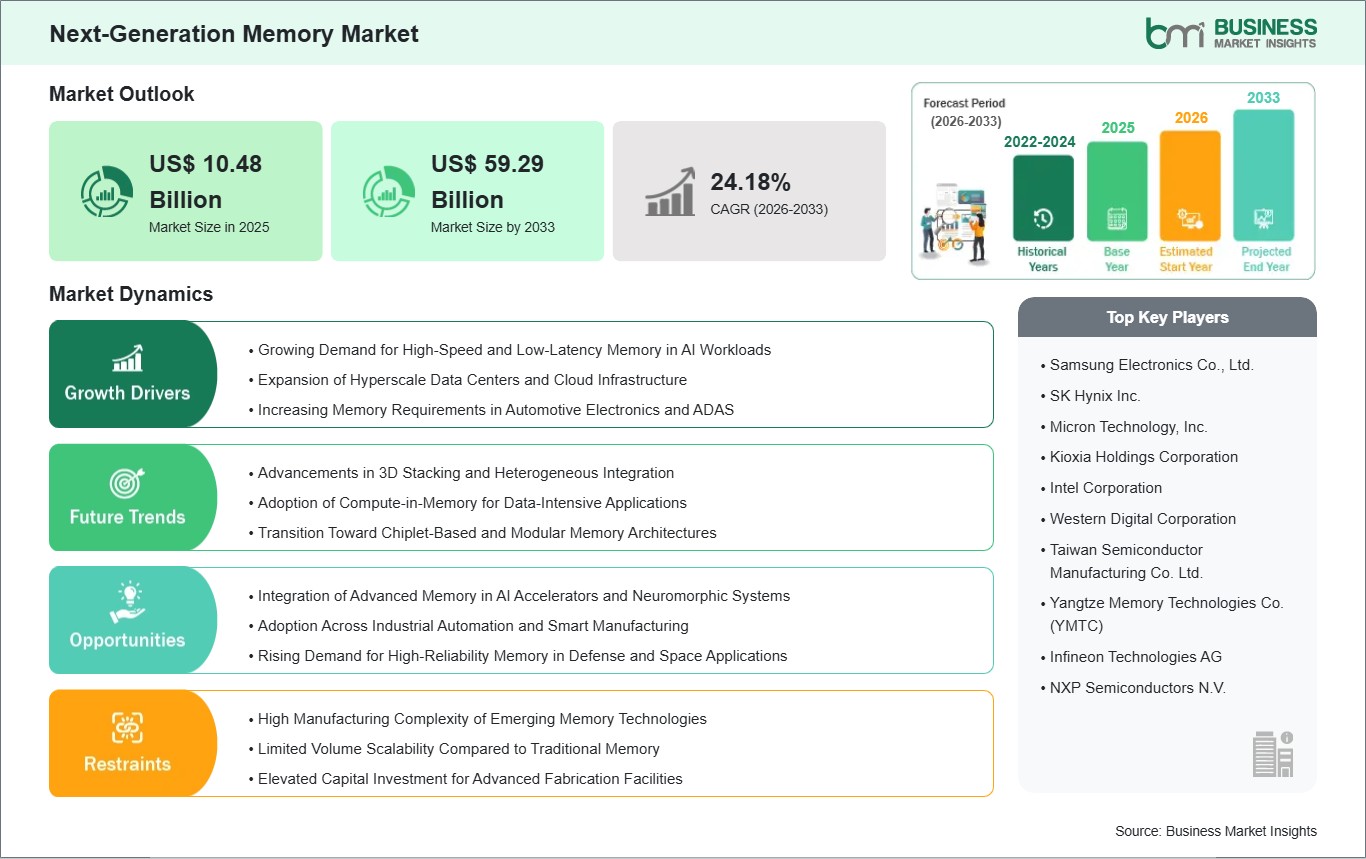
The worldwide next-generation memory market is influenced by the demand that rises through the following sectors: consumer electronics, data centers, automotive electronics, industrial automation, and IoT devices. The fast deployment of AI, edge computing, and high-performance computing is the main reason for the increased need for memory solutions that can offer a higher speed, a lower latency, an improved endurance, and a lower power consumption. So the market is expanding due to significant changes such as advanced 3D memory architectures, advanced process nodes, and heterogeneous integration, while new applications in autonomous vehicles, smart infrastructure, healthcare systems, and cloud platforms continue to increase market potential.
The market, however, is plagued by issues such as high R&D and fabrication costs, complicated manufacturing processes, limited high-volume production, and reliability concerns in early-stage technologies. Besides, supply chain dependencies and a lack of standardization slow down the rapid adoption. In spite of these limitations, continued innovation in energy, efficient memory technologies, increased capital expenditure on AI, centric computing, accelerated move towards electric and autonomous vehicles, and proliferation of Industry 4.0 initiatives are likely to drive the global market to register a steady growth over the forecast period.
Segment Analysis
Next-Generation Memory Market Segmentation
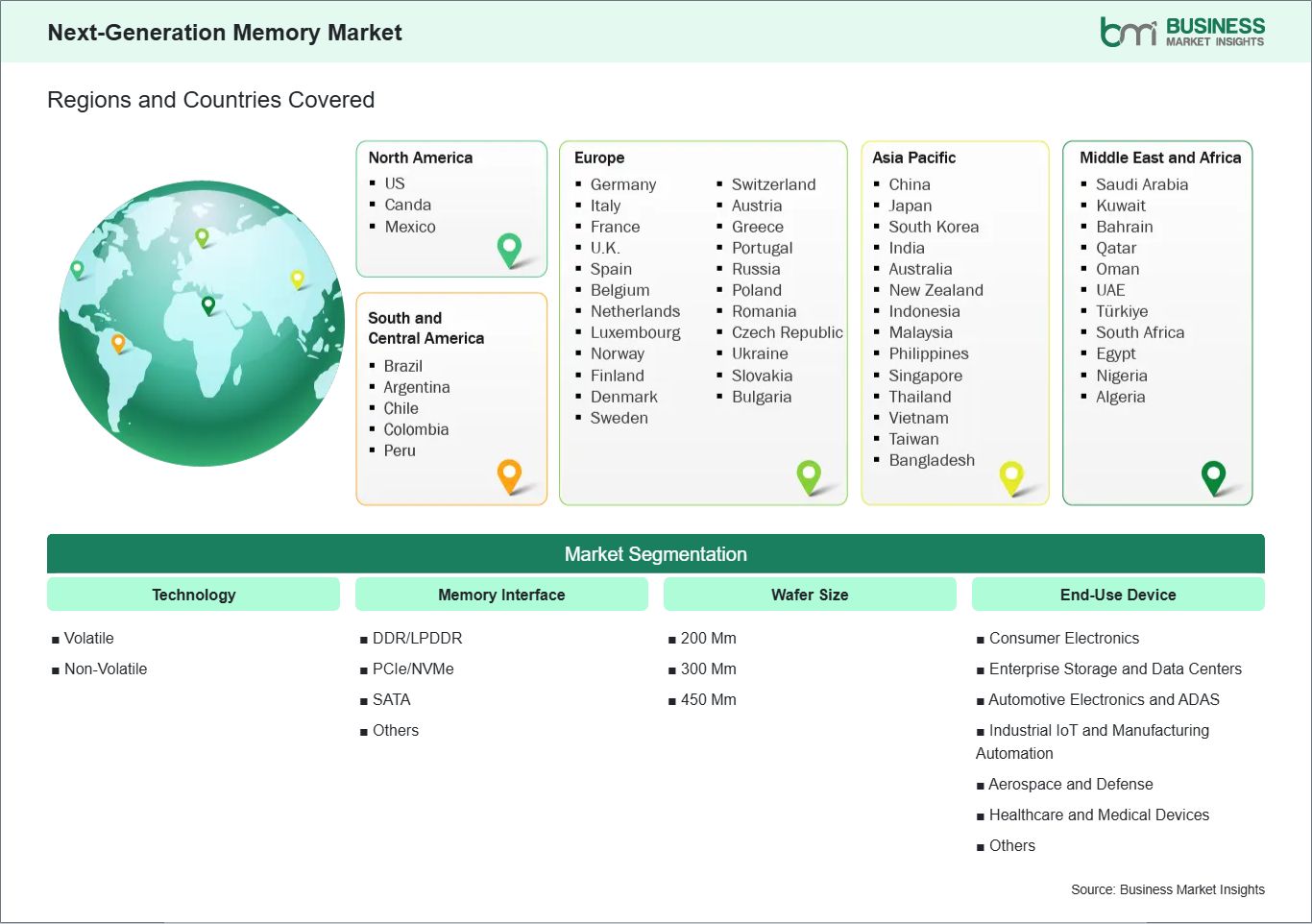
Key segments that contributed to the derivation of the next-generation memory market analysis are technology, memory interface, wafer size, and end-use device.
- By technology, the market is segmented into volatile and non-volatile memory. The non-volatile memory segment dominated the market in 2024.
- By memory interface, the market is categorized into DDR/LPDDR, PCIe/NVMe, SATA, and others (CXL, UCIe). The DDR/LPDDR segment held the largest share in the next-generation memory market in 2024.
- By end-use device, the market is segmented into consumer electronics, enterprise storage and data centers, automotive electronics and ADAS, industrial IoT and manufacturing automation, aerospace and defense, healthcare and medical devices, and others. The consumer electronics segment held the largest share in the next-generation memory market in 2024.
- By wafer size, the market is categorized into ≤ 200 mm, 300 mm, and 450 mm. The 300 mm wafers segment held the largest share in the next-generation memory market in 2024.
Market Forces
Next-Generation Memory Market Drivers and Opportunities
Growing Demand for High-Speed and Low-Latency Memory in AI Workloads
Next-generation memory demand is the main reason for the rapid adoption of artificial intelligence, machine learning, and data-intensive workloads, which have a major effect on data centers, enterprise storage systems, and edge devices. AI applications are the ones that require ultra-fast data access, low latency, and high bandwidth, which are very challenging for traditional memory technologies to deliver. Consequently, advanced memory solutions with faster read/write speeds, better endurance, and lower power consumption are becoming more popular. Also, the proliferation of real-time analytics, autonomous systems, and intelligent computing platforms is pushing up the demand for high-performance memory technologies worldwide even more.
Integration of Advanced Memory in AI Accelerators and Neuromorphic Systems
The next-generation memory innovations are gradually being deeply integrated into AI accelerators, neuromorphic processors, and heterogeneous computing architectures. Besides, the use of MRAM, ReRAM, and PCM as memory types helps compute, in memory and persistent memory functions, thus leading to the efficiency of data movement and the improvement of the overall system performance. These possibilities are breaking the limits of deep learning, edge AI, robotics, and high-performance computing, in which power efficiency and latency are of paramount importance. There will be uninterrupted market opportunities due to the continuous investments in memory-centric architectures, AI hardware innovation, and advanced semiconductor manufacturing.
Size and Share Analysis
Next-Generation Memory Market Size and Share Analysis
By technology, the market is segmented into volatile and non-volatile memory. Non-volatile memory holds a dominant share due to its data persistence, low power consumption, and suitability for AI, IoT, and edge computing applications.
By memory interface, the market is categorized into DDR/LPDDR, PCIe/NVMe, SATA, and others (CXL, UCIe). DDR/LPDDR accounts for a significant share, supported by widespread use in consumer electronics and enterprise systems.
By end-use device, the market is segmented into consumer electronics, enterprise storage and data centers, automotive electronics and ADAS, industrial IoT and manufacturing automation, aerospace and defense, healthcare and medical devices, and others. Consumer electronics lead the market due to rising data processing requirements.
By wafer size, the market is categorized into ≤ 200 mm, 300 mm, and 450 mm. 300 mm wafers dominate production owing to higher yield and cost efficiency.
Report Coverage
Next-Generation Memory Market Report Coverage and Deliverables
The "Next-Generation Memory Market Size and Forecast (2022–2033)" report provides a detailed analysis of the market covering below areas:
- Next-Generation Memory Market size and forecast at global, regional, and country levels for all the key market segments covered under the scope
- Next-Generation Memory Market trends, as well as market dynamics such as drivers, restraints, and key opportunities
- Next-Generation Memory Market analysis covering key market trends, global and regional framework, major players, regulations, and recent market developments
- Industry landscape and competition analysis covering market concentration, heat map analysis, prominent players, and recent developments for the next-generation memory market
- Detailed company profiles, including SWOT analysis
Geographic Insights
Next-Generation Memory Market Geographic Insights
The next-generation memory market is divided based on the geographical regions such as North America, Asia-Pacific, Europe, the Middle East & Africa, and South & Central America. Out of these, Asia-Pacific is anticipated to have the most rapid expansion throughout the prediction period, which is mainly due to the region's robust semiconductor manufacturing ecosystem, large volume of electronics production, and the increasing use of AI, data centers, automotive electronics, and industrial automation. China, Japan, South Korea, Taiwan, India, Vietnam, Malaysia, Singapore, and the Rest of the Asia Pacific are the major markets in the Asia Pacific region. It is home to the world's most advanced processes for memory fabrication, assembly, and packaging, which is supported by mature supply chains and substantial investment in leading-edge foundries and memory fabs. Advanced countries such as South Korea, China, Taiwan, and Japan command the massive volume production of DRAM, NAND, and emerging memory technologies, whereas the ever-increasing demand for AI servers, smartphones, electric vehicles, and IoT devices is, in turn, fuelling regional growth.
North America is still a very important market for memory innovation, AI-driven computing, and data center expansion, thanks to its strong R&D capabilities and the presence of major technology companies. Europe is a leading player in automotive electronics, industrial automation, and aerospace, benefiting from strict quality standards and increasing investments in semiconductor self-reliance.
Industry Activity
Recent Developments
The Next-Generation Memory Market is evaluated by gathering qualitative and quantitative data post primary and secondary research, which includes important corporate publications, association data, and databases. A few of the key developments in the next-generation memory market are:
- In December 2025, Leading semiconductor test equipment supplier Advantest Corporation (TSE: 6857) announced the M5241 Memory Handler, its next-generation handler developed to meet the performance, automation, and cost-efficiency demands of emerging high-performance memory devices—particularly those used in artificial intelligence (AI) applications.
- In October 2025, Applied Materials, Inc. introduced new semiconductor manufacturing systems that boost the performance of advanced logic and memory chips foundational to AI computing. The new products target three critical areas in the race to deliver ever more powerful AI chips: leading-edge logic including Gate-All-Around (GAA) transistors, high-performance DRAM including high-bandwidth memory (HBM), and advanced packaging to create highly integrated systems-in-a-package that optimize chip performance, power consumption and cost.
- In August 2025, Teradyne, Inc. (NASDAQ: TER), a leading provider of automated test equipment and advanced robotics, announced the launch of the Magnum 7H, a next-generation memory tester designed to meet the rigorous demands of testing high bandwidth memory (HBM) devices, integrated with GPUs and accelerators in high-performance, generative AI servers. The Magnum 7H is engineered to deliver high-parallelism, high-speed, and high-accuracy testing for HBM stacked die at scale. Volume shipments and HBM device production on Teradyne’s Magnum 7H have started ramping at the largest HBM manufacturers in the industry.
Trust & Transparency
Research Methodology
The market analysis combines proprietary research with secondary data from government agencies, company disclosures, regulatory filings, industry databases and expert interviews. Market estimates are validated through data triangulation, cross-market benchmarking and analyst
review.
View Full Research Methodology
Key Sources Referred:
World Bank – Global Trade IndicatorsWorld Trade Organization (WTO)(International Monetary Fund )IMFInternational Trade Administration (ITA)Company websiteCompany annual reportsCompany investor presentations