Market Summary
Executive Summary and Global Market Analysis
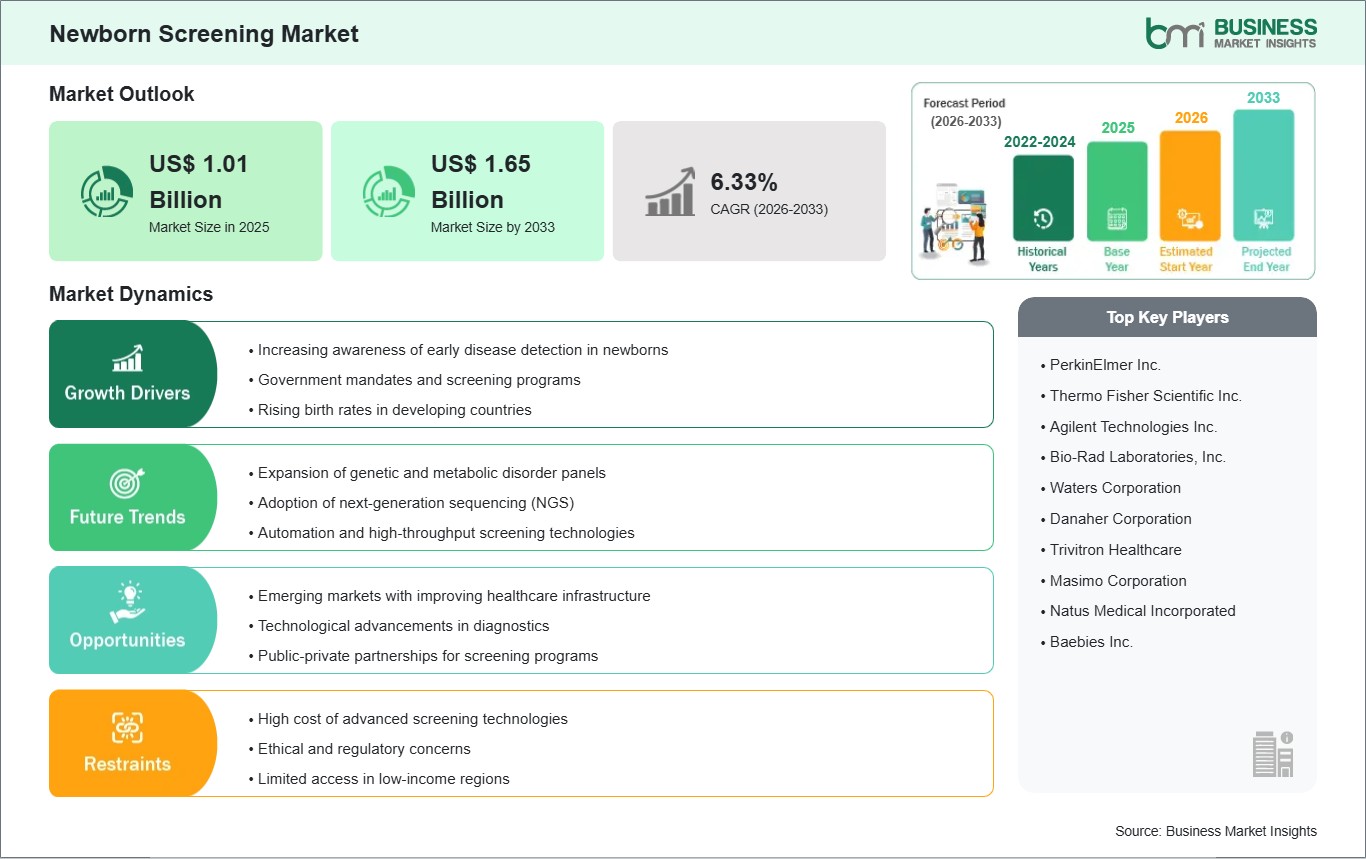
Newborn screening refers to a comprehensive public health service involving the early identification of infants who may be affected by certain genetic, metabolic, hormonal, and functional disorders. Market expansion is fundamentally driven by the rising global focus on preventive healthcare and the increasing prevalence of congenital and genetic disorders. Furthermore, the shift toward expanded screening panels, which now cover a broader range of rare conditions, and the integration of next-generation sequencing (NGS) are enhancing the accuracy of early diagnoses. Government-mandated programs and public health initiatives continue to serve as the backbone of the industry, ensuring that a high percentage of infants undergo standardized testing shortly after birth.
However, several factors can restrain market growth. The lack of specialized laboratory infrastructure and skilled healthcare professionals in certain developing regions remains a significant barrier to universal screening coverage. Inconsistent regional policies regarding the number of mandated tests can lead to disparities in care quality. Additionally, the industry faces constraints due to ethical and privacy concerns surrounding the long-term storage and use of genetic data obtained from newborn samples, which can occasionally result in parental hesitation or complex regulatory challenges.
Despite these hurdles, the market holds significant opportunities in the development of point-of-care (POC) testing devices that provide rapid results at the bedside. The rise of artificial intelligence (AI) for the automated interpretation of complex metabolic data and the expansion of private testing services, which offer supplemental screening beyond public mandates, are expected to support long-term development within the sector.
Segment Analysis
Newborn Screening Market Segmentation
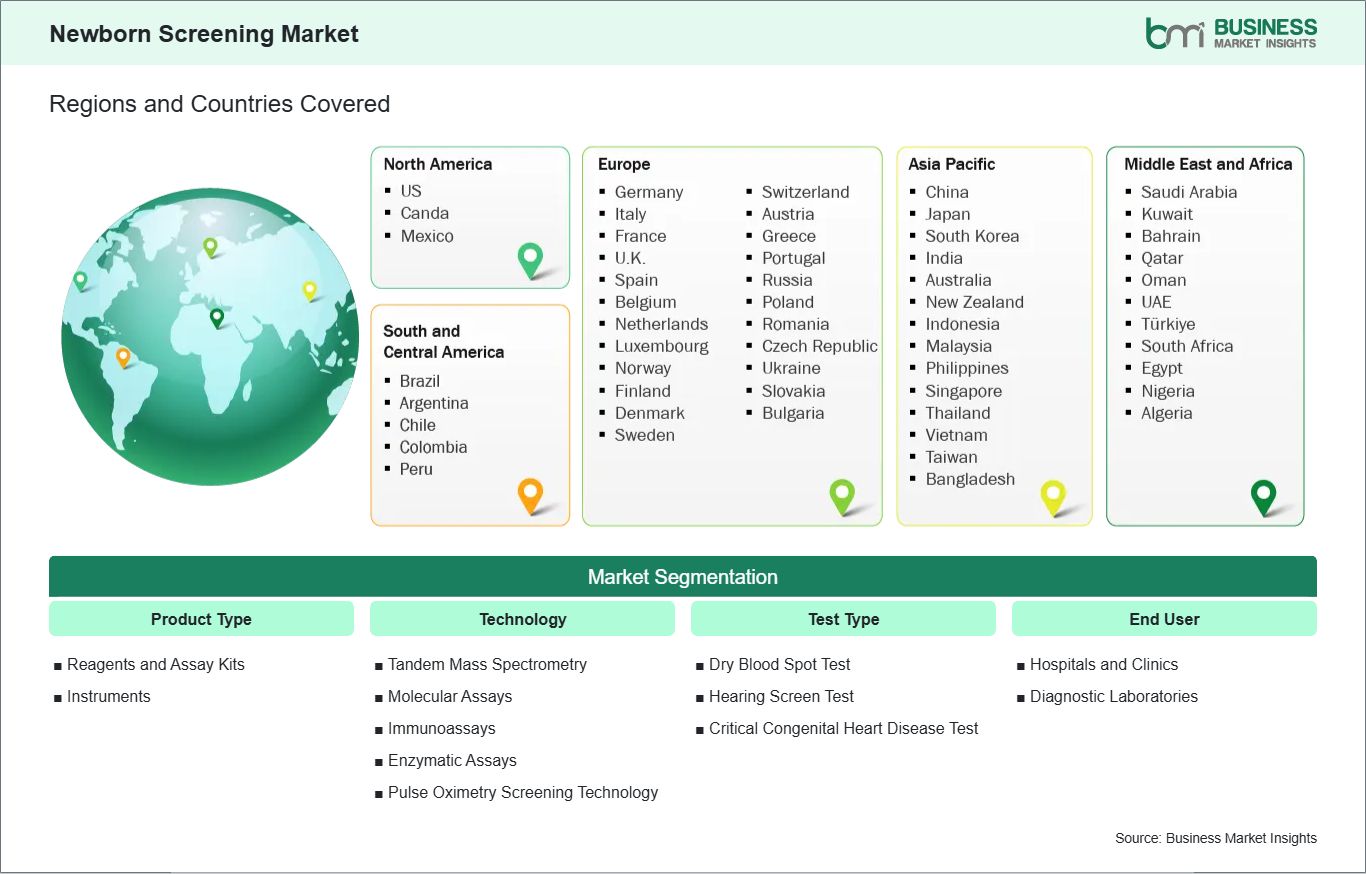
Key segments that contributed to the derivation of the Newborn Screening market analysis are product type, technology, test type, and end user.
- By Product Type, the market is segmented into Reagents and Assay Kits, Instruments.
- By Technology, the market is divided into Tandem Mass Spectrometry, Molecular Assays, Immunoassays, Enzymatic Assays, and Pulse Oximetry Screening Technology.
- By Test Type, the market is segmented into Dry Blood Spot Test, Hearing Screen Test, and Critical Congenital Heart Disease Test.
- By End User, the market is categorized into Hospitals and Clinics, and Diagnostic Laboratories.
Market Forces
Newborn Screening Market Drivers and Opportunities
Expanding National Mandates and the High-Throughput Automation
The primary driver for the Newborn Screening Market is the systemic global expansion of government-mandated screening panels and the rising prevalence of congenital anomalies. The Increasing Global Incidence of Rare Genetic and Metabolic Disorders acts as a foundational catalyst, as early identification is proven to drastically reduce the lifelong cost of care and improve survival rates. This momentum is further propelled by the Strategic Adoption of Tandem Mass Spectrometry (MS/MS) and Molecular Assays; these technologies have become the backbone of modern laboratories due to their ability to screen for dozens of metabolic disorders from a single dried blood spot (DBS) with high sensitivity and speed. In the technological sphere, the Rapid Integration of AI-Driven Data Interpretation serves as a critical driver, with machine-learning algorithms effectively reducing false-positive rates and streamlining the reporting process for high-volume public health laboratories. Furthermore, the Proliferation of Healthcare Infrastructure in Emerging Economies, particularly in the Asia-Pacific region, is driving a robust demand for centralized screening systems as countries seek to align their pediatric care standards with global best practices. Together, these factors, policy expansion, technological precision, and international infrastructure growth, ensure a robust and essential growth path for the global Newborn Screening Market.
Point-of-Care Molecular Testing and Whole-Genome Sequencing
A significant high-value opportunity lies in the convergence of Newborn Screening with Point-of-Care (POC) Molecular Diagnostics. Next-generation handheld devices are being developed to provide rapid, bed-side screening for critical conditions such as hearing loss and congenital heart defects (CCHD), allowing for immediate intervention before a neonate is discharged from the hospital. There is also a major growth frontier in the development of Whole-Genome Sequencing (WGS) as a First-Tier Screening Tool; while currently in pilot stages, the shift toward newborn sequencing offers the potential to identify every treatable genetic condition known to medicine, providing a lifelong genomic blueprint for personalized care. Furthermore, the expansion of Remote Screening and Telehealth-Enabled Follow-up presents a unique opportunity for rural and underserved regions, where digital platforms facilitate the secure transmission of results and remote consultation with specialists. Beyond hardware, the rise of Integrated Longitudinal Care Platforms offers a significant frontier, where screening data is linked with electronic health records to ensure seamless transitions from diagnosis to specialized treatment. Manufacturers who focus on Miniaturized Microfluidic Assays and those pioneering Automated Workflow Orchestration for High-Volume Labs are positioned to lead the global Newborn Screening Market.
Size and Share Analysis
Newborn Screening Market Size and Share Analysis
The Newborn Screening market demonstrates steady growth, with size and share analysis revealing evolving trends and competitive positioning among key players. The report examines subsegments categorized within product type, technology, test type, and end user, offering insights into their contribution to overall market performance.
Based on the technology, the Tandem Mass Spectrometry subsegment holds the primary market presence, serving as the versatile workhorse for metabolic screening. This technology is indispensable for the market, maintaining the largest influence due to its ability to detect a broad spectrum of inborn errors of metabolism from a single dried blood spot. A notable trend is the surge in the Molecular Assays and Pulse Oximetry subsegments, which are registering significant traction. Molecular Assays are becoming essential for Confirmatory Genetic Accuracy, strategically utilized to identify spinal muscular atrophy and severe combined immunodeficiency, effectively maintaining a dominant presence in advanced genomic screening programs. Furthermore, Pulse Oximetry Screening Technology is registering rapid expansion as a non-invasive standard for identifying critical congenital heart defects in the immediate post-natal period.
Report Coverage
Newborn Screening Market Report Coverage and Deliverables
The "Newborn Screening Market Size and Forecast (2022–2033)" report provides a detailed analysis of the market covering below areas:
- Newborn Screening market size and forecast at global, regional, and country levels for all market segments covered under the scope
- Newborn Screening market trends, as well as drivers, restraints, and opportunities
- Newborn Screening market analysis covering key trends, global and regional framework, major players, regulations, and recent developments
- Industry landscape and competition analysis covering market concentration, heat map analysis, prominent players, and recent developments for the Newborn Screening market
- Detailed company profiles, including SWOT analysis
Geographic Insights
Newborn Screening Market Geographic Insights
The geographical scope of the Newborn Screening market report is divided into five regions: North America, Asia Pacific, Europe, Middle East & Africa, and South & Central America.
North America maintains a prominent market position, supported by a highly standardized healthcare infrastructure, universal screening mandates across all jurisdictions, and significant investments in genomic research. Europe represents a mature and technologically sophisticated market where growth is sustained by a strong institutional emphasis on early intervention and the expansion of rare disease panels within national health frameworks. Asia Pacific is identified as the most rapidly advancing region, propelled by accelerating healthcare modernization, exceptionally high birth rates in emerging economies, and substantial public investments in diagnostic laboratory networks.
The Asia-Pacific Newborn Screening Market is segmented into China, Japan, South Korea, India, Australia, and the Rest of Asia Pacific. China serves as a central engine for regional expansion, driven by large-scale government programs to enhance maternal and child health and the increasing adoption of tandem mass spectrometry in specialized provincial laboratories. India is witnessing a notable transition as private healthcare providers and diagnostic chains expand their screening portfolios to address a rising awareness of metabolic and genetic disorders among the growing middle class. Japan continues to lead in the integration of high-specification screening technologies, focusing on the use of advanced molecular assays and pulse oximetry to ensure comprehensive neonatal care for its citizens.
Industry Activity
Recent Developments
The Newborn Screening market is evaluated by gathering qualitative and quantitative data post primary and secondary research, which includes important corporate publications, association data, and databases. A few of the key developments in the Newborn Screening market market are:
4
- In March 2025, LaCAR MDx Technologies acquired the Newborn Screening division of Baebies, Inc., integrating cutting-edge microfluidic technology for Lysosomal Storage Disease screening. The acquisition strengthens LaCAR`s U.S. presence, expands its global newborn screening portfolio, and accelerates innovation in neonatal diagnostics.
- In October 2025, Ahlstrom acquired EBF, a leading provider of newborn screening devices, strengthening its life sciences capabilities and expanding its diagnostic offerings. The acquisition enhances Ahlstrom`s position in the newborn screening market and broadens its specialty materials solutions for blood and urine testing.
Trust & Transparency
Research Methodology
The market analysis combines proprietary research with secondary data from government agencies, company disclosures, regulatory filings, industry databases and expert interviews. Market estimates are validated through data triangulation, cross-market benchmarking and analyst
review.
View Full Research Methodology
Key Sources Referred:
World Bank – Global Trade IndicatorsWorld Trade Organization (WTO)(International Monetary Fund )IMFInternational Trade Administration (ITA)Company websiteCompany annual reportsCompany investor presentations