Market Summary
Executive Summary and Global Market Analysis
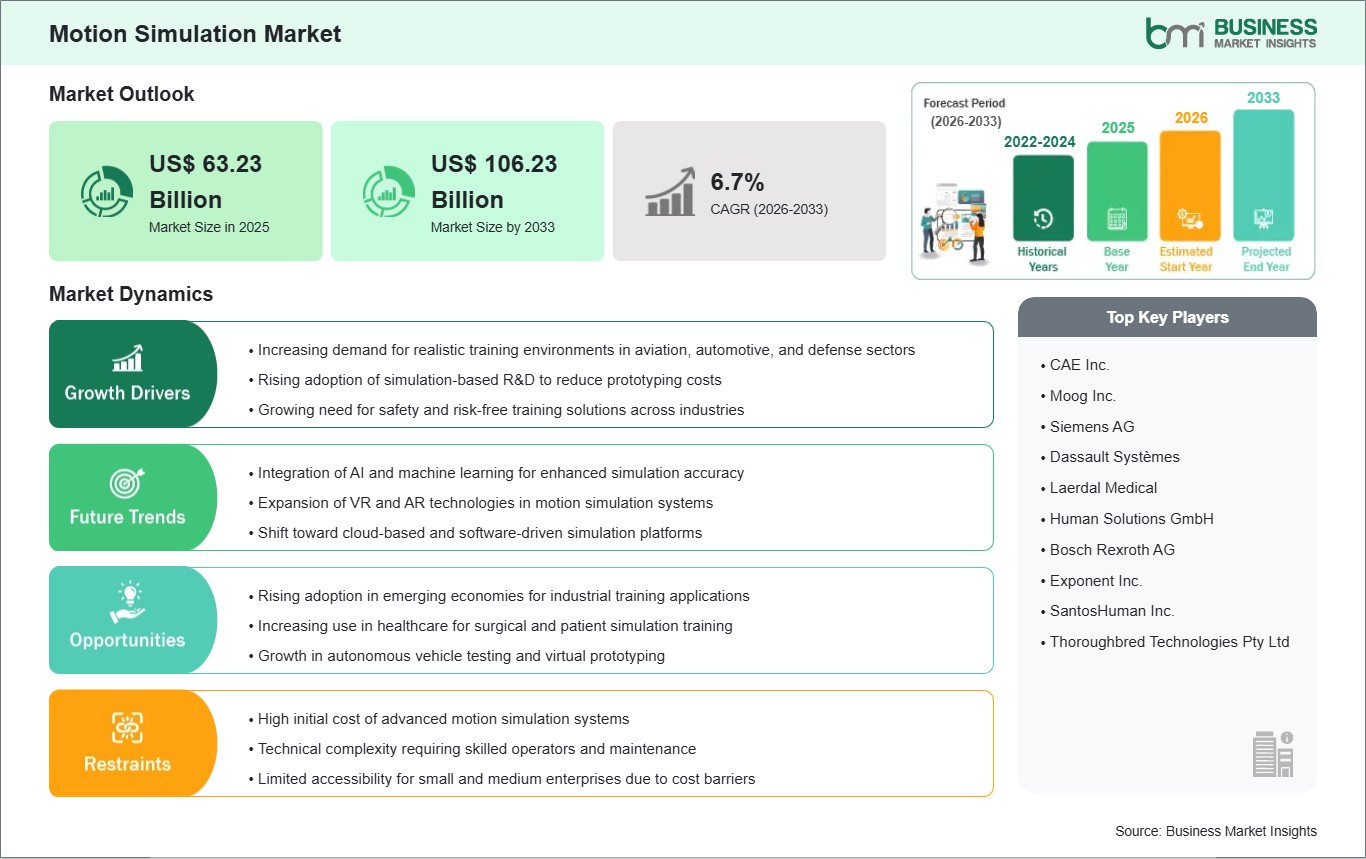
Motion simulation refers to the technological process of replicating the physical movements and sensations associated with a specific vehicle, environment, or event through the use of mechanical platforms and software. By utilizing various degrees of freedom provided by electric, hydraulic, or pneumatic actuators, these systems generate realistic cues, such as acceleration, tilt, and vibration, to immerse users in a virtual experience. This technology is fundamental to high-fidelity training, research, and entertainment across the aerospace, automotive, defense, and healthcare sectors. Market expansion is being propelled by the surge in demand for realistic pilot and driver training solutions, which reduce operational risks and costs, and by the rising integration of virtual reality (VR) and augmented reality (AR) into gaming and professional simulation environments.
However, several factors may restrain market progression. The high capital expenditure associated with professional-grade motion platforms, often involving sophisticated hardware and dedicated infrastructure, remains a primary barrier for smaller institutions and individual consumers. The industry also faces technical challenges regarding motion sickness and visual-vestibular mismatch, which can occur when physical cues do not align perfectly with visual inputs, potentially limiting user session lengths and training efficacy. Additionally, the lengthy certification and procurement cycles for safety-critical simulators can delay the deployment of next-generation systems in regulated sectors. These challenges increase the complexity of system development and require careful strategic investment in high-fidelity motion cueing algorithms and ergonomic design.
Despite these hurdles, the market outlook remains favorable. Opportunities are emerging through the adoption of Industry 4.0 and digital twin technologies, which enable real-time synchronization between physical assets and their simulated replicas for predictive maintenance and advanced testing. The expansion into medical simulation and rehabilitation is gaining traction, where motion-based systems are used to train surgeons in delicate procedures and assist patients in physical therapy. Furthermore, the growth of subscription-based and as-a-service commercial models aligns with institutional goals for operational flexibility, allowing organizations to access advanced simulation capabilities without massive upfront investments. Advanced techniques such as AI-driven behavioral modeling and cloud-based simulation platforms are also expanding capabilities, allowing for more adaptive and accessible training scenarios that were previously unattainable with standalone hardware. Collectively, these innovations position the motion simulation industry for sustained long-term development and central importance in the global digital training and immersive technology landscape.
Segment Analysis
Motion Simulation Market Segmentation
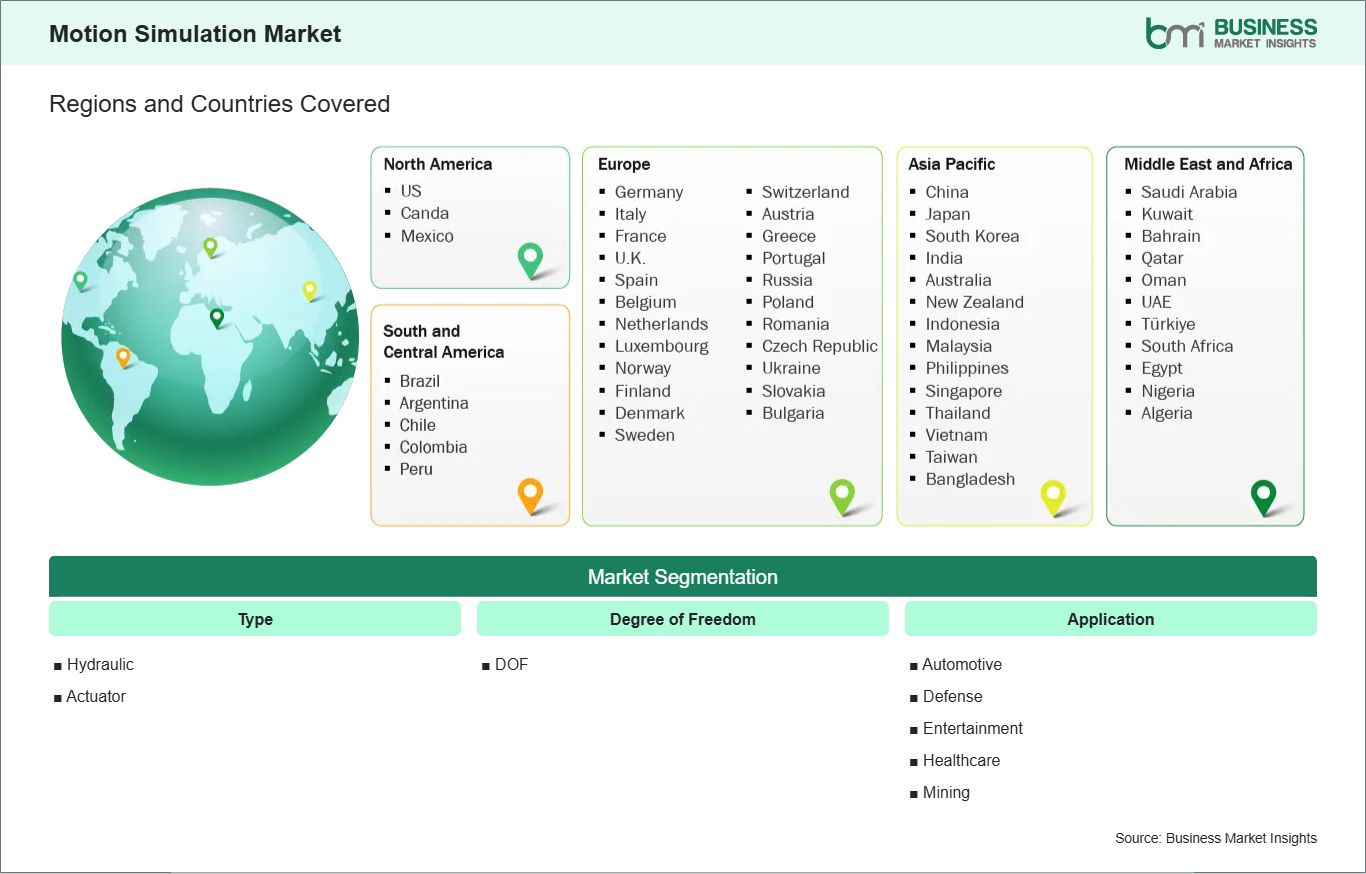
Key segments that contributed to the derivation of the Motion Simulation market analysis are type, degree of freedom, and application.
- By Type, the market is segmented into Hydraulic and Actuator.
- By Degree of Freedom (DOF), the market is divided into Two DOF, Three DOF, and Six DOF.
- By Application, the market is categorized into Automotive, Defense, Entertainment, Healthcare, and Mining.
Market Forces
Motion Simulation Market Drivers and Opportunities
Rising Adoption of Simulation Technologies in Automotive and Aerospace
A primary driver for the motion simulation market is the increasing reliance on advanced simulation technologies across automotive, aerospace, and defense industries. Automotive manufacturers are deploying motion simulators extensively for driver training, vehicle testing, and design validation, helping reduce costs and risks associated with physical prototypes while accelerating product development cycles. In aerospace and defense, simulators are indispensable for pilot training, mission rehearsal, and safety testing, offering highly realistic environments that enhance preparedness and minimize operational hazards. Healthcare is emerging as another promising sector, where motion simulation supports surgical training, rehabilitation programs, and ergonomic studies, improving patient outcomes and practitioner skills. The entertainment industry, particularly gaming, theme parks, and virtual reality, is also fueling demand by delivering immersive and interactive experiences. The convergence of cost efficiency, safety, and technological innovation is reinforcing adoption worldwide. Collectively, the expansion of automotive testing, aerospace training, healthcare applications, and entertainment experiences is propelling sustained growth in the global motion simulation market.
Advancing Virtual Reality, Haptic Technologies, and Smart Training Solutions
A significant opportunity in the motion simulation market lies in the integration of virtual reality, augmented reality, haptic technologies, and smart training platforms. As industries embrace digital transformation, motion simulators are evolving to deliver highly immersive and interactive experiences that replicate real-world conditions with greater accuracy. The adoption of haptic feedback systems is creating new pathways for medical training, industrial skill development, and defense applications, where tactile realism enhances learning outcomes. Smart manufacturing and industrial automation are also leveraging motion simulation for operator training and equipment testing, reducing downtime and improving efficiency. Beyond technological innovation, emerging markets in Asia-Pacific and Latin America present lucrative prospects due to rapid industrialization, infrastructure development, and government-led investments in defense and education. Vendors who focus on developing cost-effective, VR-enabled, and AI-driven simulation solutions tailored for diverse industries are well-positioned to capture new market segments. The convergence of immersive technologies, smart training, and regional expansion underscores a transformative growth trajectory for the global motion simulation market.
Size and Share Analysis
Motion Simulation Market Size and Share Analysis
The Motion Simulation market demonstrates steady growth, with size and share analysis revealing evolving trends and competitive positioning among key players. The report examines subsegments categorized within type, degree of freedom, and application, offering insights into their contribution to overall market performance.
Based on Type, the Hydraulic subsegment holds a strong presence in the market. These systems are indispensable due to their ability to deliver high force output and precise motion control, making them critical for applications that demand durability and heavy-duty performance. Their reliability in replicating real-world dynamics ensures consistent use across defense training and advanced automotive testing. Meanwhile, the Actuator subsegment is gaining traction, becoming essential for environments that prioritize compact design, energy efficiency, and lower maintenance. With their adaptability, actuator-driven simulators are strategically deployed in entertainment and healthcare, where smooth, responsive motion enhances user experience and training accuracy.
Report Coverage
Motion Simulation Market Report Coverage and Deliverables
The "Motion Simulation Market Size and Forecast (2022 - 2033)" report provides a detailed analysis of the market covering below areas:
- Market size and forecast at global, regional, and country levels for all market segments covered under the scope
- Market trends, as well as drivers, restraints, and opportunities
- Market analysis covering key trends, global and regional framework, major players, and recent developments
- Market concentration, heat map analysis, prominent players, and recent developments
- Detailed company profiles, including SWOT analysis
Geographic Insights
Motion Simulation Market Geographic Insights
The geographical scope of the Motion Simulation market report is divided into five regions: North America, Asia Pacific, Europe, Middle East & Africa, and South & Central America.
North America maintains a preeminent position within the global industry, a standing solidified by its status as a primary hub for aerospace, defense, and automotive innovation. The regional landscape is characterized by high-density clusters of technology providers and research institutions, particularly in the United States, where the integration of Six Degrees of Freedom (6-DOF) Systems has become a standard requirement for mission-critical training. This leadership is further supported by significant institutional investments in virtual and augmented reality frameworks, which are utilized to create high-fidelity environments for pilot instruction and tactical military exercises. Technological progression in the United States and Canada is largely driven by a decisive shift toward Electric and Actuator-Based Motion Platforms, which offer superior precision and reduced maintenance requirements compared to traditional hydraulic systems. Recent advancements involve the widespread adoption of AI-Driven Scenario Generation, allowing for the real-time simulation of complex edge-case scenarios in autonomous vehicle testing. Furthermore, the region is witnessing an increasing utilization of High-Fidelity Haptic Feedback, where sensory resistance is utilized to improve the efficacy of medical surgical training and physical rehabilitation programs. This focus on immersion and accuracy enables North American entities to meet rigorous safety certifications while simultaneously reducing the risks and costs associated with real-world operational training.
Industry Activity
Recent Developments
The Motion Simulation market is evaluated by gathering qualitative and quantitative data post primary and secondary research, which includes important corporate publications, association data, and databases. A few of the key developments in the Motion Simulation market are:
- In January 2026, Kumho Tire announced a partnership with Ansible Motion to develop next-generation digital tires using advanced driving simulation technology. The collaboration will integrate Ansible Motion`s Delta S3 Spin DIL simulator into Kumho`s R&D process to enhance virtual tire testing and performance verification. This development strengthens the adoption of motion simulation systems in automotive engineering, supporting faster, cost-efficient, and digitally driven product development.
- In September 2025, Cadence Design Systems announced a definitive agreement to acquire Hexagon`s Design & Engineering business, including MSC Software, for approximately €2.7 billion. The acquisition strengthens Cadence`s system design and analysis portfolio by adding advanced structural and multibody dynamics solutions such as MSC Nastran and Adams. This development reinforces growth in the motion simulation market by expanding capabilities in multibody motion analysis for automotive, aerospace, robotics, and physical AI applications.
Trust & Transparency
Research Methodology
The market analysis combines proprietary research with secondary data from government agencies, company disclosures, regulatory filings, industry databases and expert interviews. Market estimates are validated through data triangulation, cross-market benchmarking and analyst
review.
View Full Research Methodology
Key Sources Referred:
World Bank & Global Trade IndicatorsWorld Trade Organization (WTO)(International Monetary Fund )IMFInternational Trade Administration (ITA)Company websiteCompany annual reportsCompany investor presentations