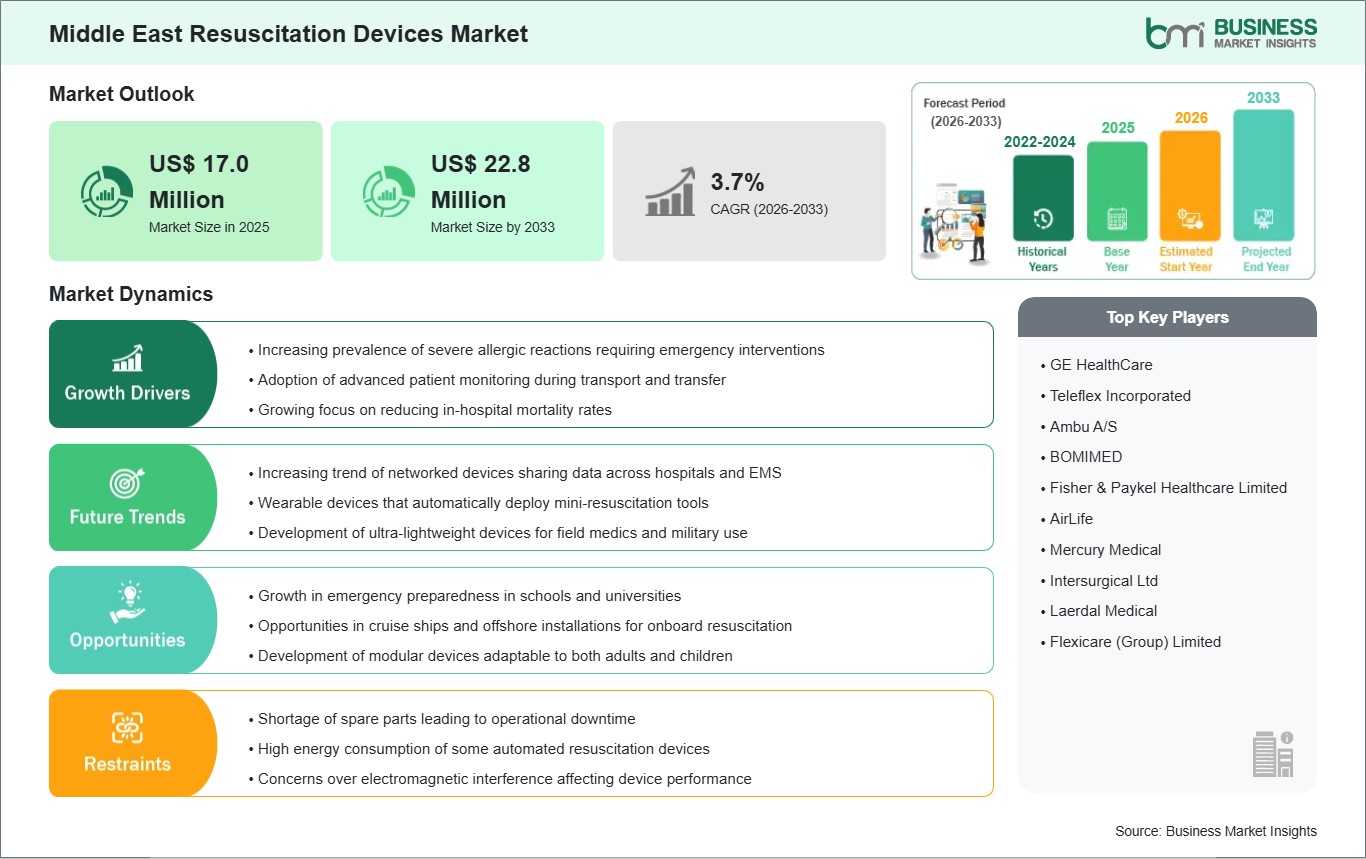
The Middle East Resuscitation devices market size is expected to reach US$ 22.8 million by 2033 from US$ 17.0 million in 2025. The market is estimated to record a CAGR of 3.7% from 2026 to 2033.
The dynamics of the Middle East resuscitation devices market are influenced by the speedy growth of healthcare facilities in the region, higher incidences of heart and lung emergencies, and the presence of a robust government drive to build emergency care facilities. The Middle East region has a dual approach towards healthcare development, in that while some regions have extremely sophisticated medical facilities, other parts have less developed emergency care facilities. Increasing demand for resuscitation devices, including defibrillators, manual resuscitators, airways, and mechanical ventilators, has been observed in the Middle East region. This has been attributed to the increase in the number of hospitals, cases of traumatic injuries, and growing importance of pre-hospital emergency services. The Middle East region currently has one of the fastest-growing resuscitation devices markets in the world, with Turkey being the leader in the field. A key growth factors in the Middle East are higher investments in emergency preparedness programs, especially within urban hospitals, ambulatory centers, and infrastructure facilities like airports and business centers. Higher recognition of sudden cardiac arrest management and better training of health care providers and paramedics are aiding in enhanced usage of devices. The region is confronted by challenges, such as non-uniformity of advanced emergency care centers within countries, dependence on imports of sophisticated technologies in some countries, and variations in training practices of health care professionals. In addition, geopolitical uncertainties in some regions may hinder healthcare infrastructure investments. On the whole, the Middle East resuscitation devices market is witnessing robust modernization trends, and Turkey is the key growth hub in the region.

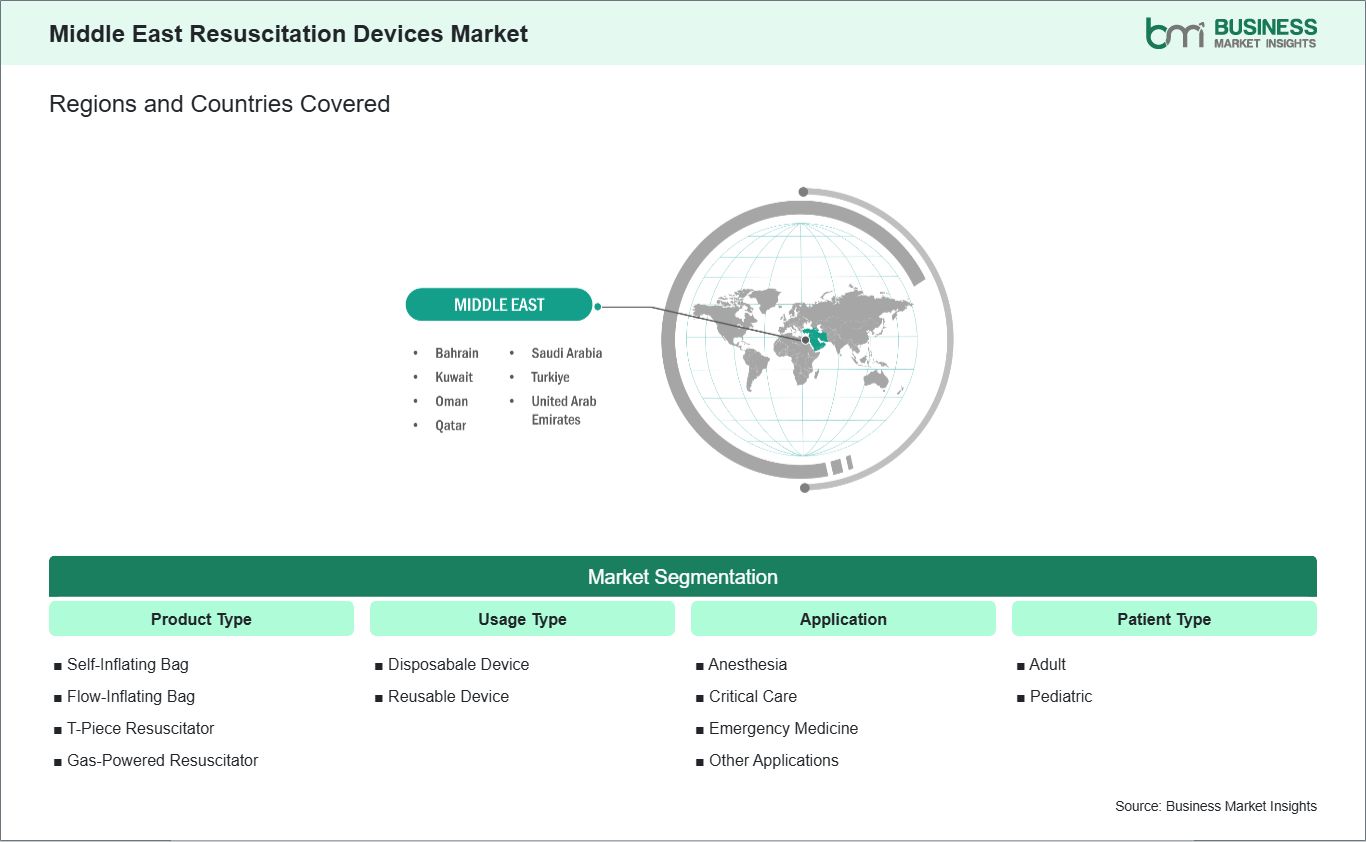
Key segments that contributed to the derivation of the Middle East resuscitation devices market analysis are product type, usage type, application, patient type, and end user.
The Middle Eastern area, including Saudi Arabia, United Arab Emirates, Qatar, Kuwait, and Oman, healthcare facilities have noted an increasing prevalence of cases involving severe allergic reactions, primarily those caused by foods and drugs. The urbanization of the area and the greater consumption of processed foodstuffs have led to more cases of allergic emergencies. Consequently, medical facilities have been turning to rapid-resuscitation devices and epinephrine dispensers as their first line of treatment against these allergic emergencies.
The issue of awareness has improved regarding anaphylaxis in educational facilities and public places. However, there are still significant gaps in terms of preparedness for such conditions. According to research based on clinical findings from a specific region, allergic reactions to food have become one of the most frequent emergencies that occur in educational facilities and require prompt action to avoid respiratory and cardiovascular failure. It has increased the need for defibrillators, airway devices, and portable resuscitators in schools, airports, and public spaces. The healthcare professionals recommend equipping hospitals and other high-volume organizations with emergency allergy kits together with resuscitation tools.
Additionally, the influx of expatriates into the region has made the allergy profile more diverse, thus complicating the process of managing such emergencies. Modern healthcare facilities in the Middle East region apply universal emergency protocols for dealing with anaphylaxis, which involve resuscitation devices and procedures aimed at treating allergies. In Dubai and Riyadh's tertiary hospitals, the emergency departments are becoming more equipped with resuscitation units at the point of care for acute anaphylaxis cases. With further awareness campaigns and higher diagnostic numbers, the need for innovative resuscitation solutions becomes apparent.
In the Middle Eastern region, There is an increasing focus within educational establishments throughout the Middle East region on implementing emergency readiness programs, especially in the school and university levels. The UAE and Saudi Arabia, for instance, have implemented national health and safety standards that promote medical preparedness through the availability of personnel and life-saving equipment in schools. As a result, there has been a rise in the use of resuscitation equipment in educational settings.
Among the most frequently occurring cases of illnesses within this age group include food allergies and asthma attacks. Emergency response capabilities are thus crucial for such occurrences. Several private and international institutions located in big cities, such as Dubai, Abu Dhabi, and Riyadh, have adopted emergency response stations with facilities for defibrillation, oxygen supply equipment, and basic resuscitation kits. Similarly, universities with a high number of students in residential colleges are developing their on-campus medical facilities, allowing for immediate action in the case of a heart or breathing emergency.
The change in regulations and culture has led to a rise in emergency preparedness courses. Educators, administrators, and campus security staff are undergoing training in cardiopulmonary resuscitation (CPR) and basic life support methods. It has resulted in increased demand for resuscitation devices that can be used by personnel without any professional medical knowledge during emergencies. With the growth in the construction of educational infrastructures within the region, especially in the expanding urban environments, resuscitation devices have become the norm in learning institutions.

The Middle East resuscitation devices market is experiencing steady growth, with market size and share analysis reflecting evolving treatment preferences and competitive dynamics among key players. The report evaluates important subsegments categorized within product type, usage type, application, patient type, and end user, highlighting their respective contributions to overall market performance.
By product type, the self-inflating Bag subsegment dominated the market in 2025, as they are easy to use and do not require external gas or power sources, making them ideal for emergencies. They allow precise manual control of ventilation, which is crucial in critical care. Their portability makes them suitable for both hospital wards and transport situations.
Based on usage type, the disposable devices subsegment dominated the market in 2025 due to their ability to prevent cross-contamination and infection. They eliminate the need for complex sterilization processes, saving time and reducing operational costs. In high-volume hospital settings, disposables improve workflow efficiency. This makes them highly preferred in emergency rooms, ICUs, and surgical units.
On the basis of application, the anesthesia subsegment dominated the market in 2025, as resuscitation devices are essential for safe ventilation during induction and recovery. They provide backup support if mechanical ventilators fail. Their precise control helps manage patients with varying lung compliances. Hospitals rely on these devices to prevent hypoxia and ensure patient safety during surgeries.
In terms of patient type, the adult subsegment dominated the market in 2025, as they experience more surgical procedures and critical emergencies than pediatric populations. Their larger lung capacity requires devices designed for adult ventilation. High prevalence of cardiac and respiratory conditions in adults increases usage frequency.
Based on end user, the hospitals subsegment dominated the market in 2025 due to constant emergency and surgical care needs. ICUs, operating rooms, and emergency departments require rapid access to resuscitation devices. High patient volume and stringent safety protocols make hospitals the key market driver. Their centralized procurement and standardized protocols ensure widespread device adoption.
| Report Attribute | Details |
|---|---|
| Market size in 2025 | US$ 17.0 Million |
| Market Size by 2033 | US$ 22.8 Million |
| CAGR (2026 - 2033) | 3.7% |
| Historical Data | 2022-2024 |
| Forecast period | 2026-2033 |
| Segments Covered | By Product Type
|
|
Regions and Countries Covered
| |
| Middle East | UAE, Saudi Arabia, Bahrain, Oman, Kuwait, Qatar, Turkiye |
| Market leaders and key company profiles |
|
The "Middle East Resuscitation devices market Size and Forecast (2022–2033)" report provides a detailed analysis of the market covering below areas:
The geographical scope of the Middle East resuscitation devices market report is divided into: the UAE, Saudi Arabia, Bahrain, Oman, Kuwait, Qatar, and Turkey. Turkey held the largest share in 2025.
Turkey dominates the Middle East resuscitation devices market due to its well-established healthcare infrastructure, expanding emergency medical services network, and growing domestic production capabilities in medical technologies. In addition, the state has succeeded in developing its hospital emergency departments, trauma centers, and ICU services; consequently, sophisticated resuscitation devices are becoming prevalent in hospitals, and such items include automated external defibrillators, transport ventilators, and comprehensive airway management devices. Turkey’s most significant cities include Istanbul, Ankara, and Izmir, acting as major healthcare hubs where both public and private healthcare organizations are embracing the latest international emergency care guidelines. Also, due to having a vibrant manufacturing sector, Turkey can provide affordable resuscitation products in the neighboring markets in the Middle East and Europe. One factor about Turkey’s market is that the country prioritizes strengthening its pre-hospital emergency services through investing in modern ambulance vehicles and training more paramedics. In addition, the nation’s public information campaigns concerning heart attacks and other emergencies have been raising awareness of the need for bystanders to engage in resuscitating people when necessary, resulting in the use of resuscitation devices in real-life situations. Nevertheless, it becomes difficult for the country to ensure uniform distribution of resuscitation equipment, especially in regions experiencing fewer economic developments, and economic instability may lead to difficulties in purchasing highly technical medical products. Despite these limitations, Turkey’s strategic geographic position, manufacturing strength, and continuous healthcare reforms firmly establish it as the dominant force in the Middle East resuscitation devices market.

The Middle East Resuscitation devices market is evaluated by gathering qualitative and quantitative data post primary and secondary research, which includes important corporate publications, association data, and databases. A few of the key developments in the Middle East Resuscitation devices market are:
The Middle East Resuscitation Devices Market is valued at US$ 17.0 Million in 2025, it is projected to reach US$ 22.8 Million by 2033.
As per our report Middle East Resuscitation Devices Market, the market size is valued at US$ 17.0 Million in 2025, projecting it to reach US$ 22.8 Million by 2033. This translates to a CAGR of approximately 3.7% during the forecast period.
The Middle East Resuscitation Devices Market report typically cover these key segments-
The historic period, base year, and forecast period can vary slightly depending on the specific market research report. However, for the Middle East Resuscitation Devices Market report:
The Middle East Resuscitation Devices Market is populated by several key players, each contributing to its growth and innovation. Some of the major players include:
The Middle East Resuscitation Devices Market report is valuable for diverse stakeholders, including:
Essentially, anyone involved in or considering involvement in the Middle East Resuscitation Devices Market value chain can benefit from the information contained in a comprehensive market report.
Please tell us your area of interest
(Market Segments/ Regions and Countries/ Companies)