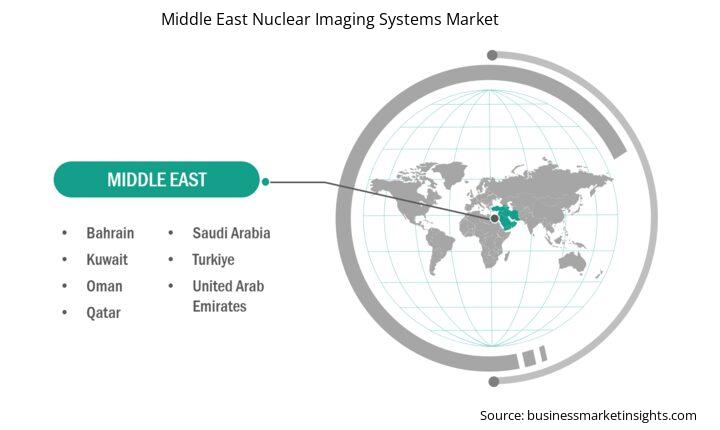
The Middle East nuclear imaging systems market size is expected to reach US$ 62.0 million by 2031 from US$ 55.2 million in 2024. The market is estimated to record a CAGR of 1.7% from 2025 to 2031.
Executive Summary and Middle East Nuclear Imaging Systems Market Analysis:
The Middle East nuclear imaging systems market is progressing through healthcare reforms and a focus on diagnostic precision. Countries are investing in hybrid imaging platforms to strengthen early detection and treatment planning, especially in oncology and cardiology. Saudi Arabia is the market leader with substantial infrastructure, governmental advocacy, and arrangements with international imaging companies. The UAE and Qatar have nuclear medicine initiatives underway, but the degree of Saudi Arabia's stature and depth of investment is clearly an advantage. Rising collaborations between several regional universities and healthcare organizations has led to development of novel radiopharmaceuticals. As government initiatives propel modernization of healthcare and digital health, nuclear imaging finds itself as a critical approach integrated into clinical workflows. Public-private partnerships and streamlined regulatory frameworks also contribute to the development of the market.
Middle East Nuclear Imaging Systems Market Segmentation Analysis:
Key segments that contributed to the derivation of the nuclear imaging systems market analysis are product type, application, and end user.
- By product type, the nuclear imaging systems market is segmented into SPECT systems, PET systems and hybrid systems. The PET systems segment dominated the market in 2024.
- By application, the nuclear imaging systems market is segmented into oncology, cardiology, neurology, endocrinology and others. The oncology segment dominated the market in 2024.
- By end user, the market is segmented into hospitals, specialty clinics, diagnostics imaging centers, academic & research Institutes and others. The hospitals segment held the largest share of the market in 2024.
Middle East Nuclear Imaging Systems Market Outlook
The nuclear imaging market in the Middle East is expanding, although the rate of uptake varies from country to country. PET/CT and SPECT/CT are becoming increasingly popular among hospitals and specialty clinics for imaging procedures, primarily in oncology and neurology groups. However, these smaller facilities have limited access to these modalities. Saudi Arabia is leading the region in imaging accessibility. The push for advanced imaging in the region is motivated by numerous factors, including Vision 2030 initiatives that are embracing advanced imaging in public and private health centers. The country's aim to reduce dependency on imports has increased the local radiopharmaceutical production. Urban and semi-urban areas are seeing the most growth, while rural regions remain underserved. Efforts to attract global medical device companies are boosting the availability of new systems, though rollout can be uneven. As hospitals try to streamline diagnostics and link imaging with digital records, nuclear imaging is becoming more central to clinical decision-making, particularly in larger, well-funded centers.
Middle East Nuclear Imaging Systems Market Country Insights
Based on country, the Middle East nuclear imaging systems market is further segmented into the UAE, Saudi Arabia, Bahrain, Oman, Kuwait, Qatar, and Turkiye. Saudi Arabia held the largest share in 2024.
Saudi Arabia is the leading country in Middle East nuclear imaging system market, due to its possession of highly established hospitals and substantial investments in healthcare. The country is establishing a network-based PET/CT and SPECT system with government support and local partnerships with foreign suppliers. The country has invested heavily into its local radiotracer production. Saudi Arabia also benefits from a rising pool of trained nuclear medicine specialists and well-defined regulatory frameworks that support advanced diagnostic practices. Demand is especially strong in oncology centers, where nuclear imaging is central to early cancer detection and treatment planning. In addition, the country is also a regional hub for medical tourism, this also increases demand for diagnostics imaging services. With continuous infrastructure development and innovation-focused initiatives, Saudi Arabia remains the key driver of nuclear imaging adoption in the region.
Middle East Nuclear Imaging Systems Market Company Profiles
GE HealthCare, Siemens Healthineers AG, Canon Inc., Koninklijke Philips N.V., SHIMADZU CORPORATION, United Imaging Healthcare Co., Ltd., Neusoft Medical Systems Co., Ltd., Mediso Ltd., Positron Corporation, and MiE GmbH are among the key players operating in the market. These players adopt strategies such as expansion, product innovation, and mergers and acquisitions to stay competitive in the market and offer innovative products to their consumers.
Middle East Nuclear Imaging Systems Market Research Methodology:
The following methodology has been followed for the collection and analysis of data presented in this report:
Secondary Research
The research process begins with comprehensive secondary research, utilizing both internal and external sources to gather qualitative and quantitative data for each market. Commonly referenced secondary research sources include, but are not limited to:
- Company websites, annual reports, financial statements, broker analyses, and investor presentations
- Industry trade journals and other relevant publications
- Government documents, statistical databases, and market reports
- News articles, press releases, and webcasts specific to companies operating in the market
Note: All financial data included in the Company Profiles section has been standardized to US$. For companies reporting in other currencies, figures have been converted to US$ using the relevant exchange rates for the corresponding year.
Primary Research
Business Market Insights conducts a significant number of primary interviews each year with industry stakeholders and experts to validate and analyze the data and gain valuable insights. These research interviews are designed to:
- Refine findings from secondary research
- Enhance the expertise and market understanding of the analysis team
- Gain insights into market size, trends, growth patterns, competitive dynamics, and future prospects
Primary research is conducted via email interactions and telephone interviews with industry experts across various markets, categories, segments, and sub-segments in different regions. Participants typically include:
- Industry stakeholders: Vice Presidents, business development managers, market intelligence managers, and national sales managers
- External experts: Valuation specialists, research analysts, and key opinion leaders with industry-specific expertise
Key Sources Referred:
- The World Bank
- World Health Organization (WHO)
- Center for Disease Control and Prevention (CDC)
- Society of Nuclear Medicine and Molecular Imaging (SNMMI)
- European Association of Nuclear Medicine (EANM)
- American College of Nuclear Medicine (ACNM)
- American Society of Nuclear Cardiology (ASNC)
- Global Cancer Observatory
- Company website
- Company annual reports
- Company investor presentations
Middle East Nuclear Imaging Systems Market Strategic Insights
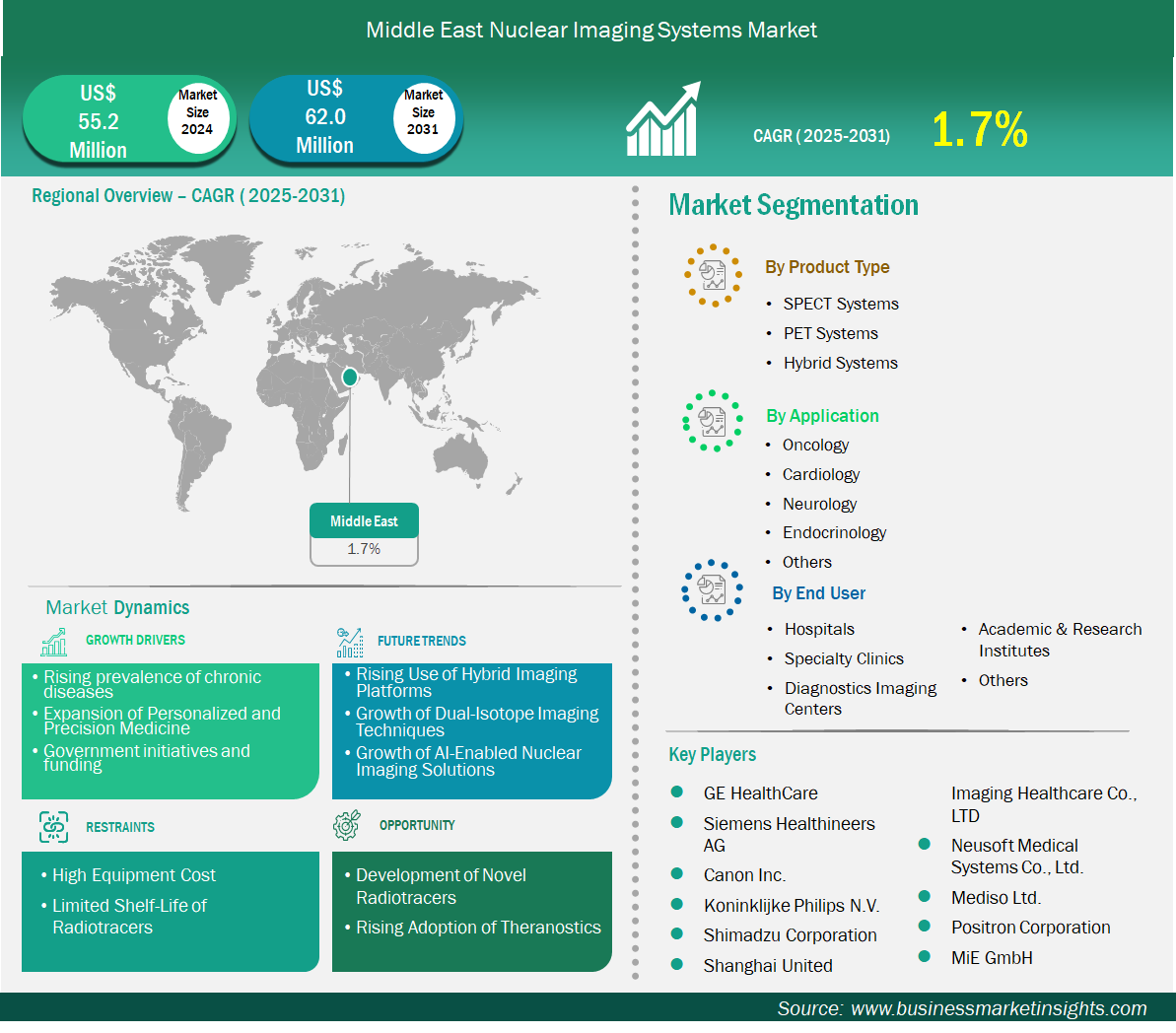
Middle East Nuclear Imaging SystemsMarket Report Highlights
| Report Attribute | Details |
| Market size in 2024 | US$ 55.2 Million |
| Market Size by 2031 | US$ 62.0 Million |
| CAGR (2025 - 2031) | 1.7% |
| Historical Data | 2021-2023 |
| Forecast period | 2025-2031 |
| Segments Covered |
By Product Type
|
|
Regions and Countries Covered
|
|
| Middle East | UAE, Saudi Arabia, Bahrain, Oman, Kuwait, Qatar, Turkiye |
| Market leaders and key company profiles |
|
Middle East Nuclear Imaging Systems Market Country and Regional Insights