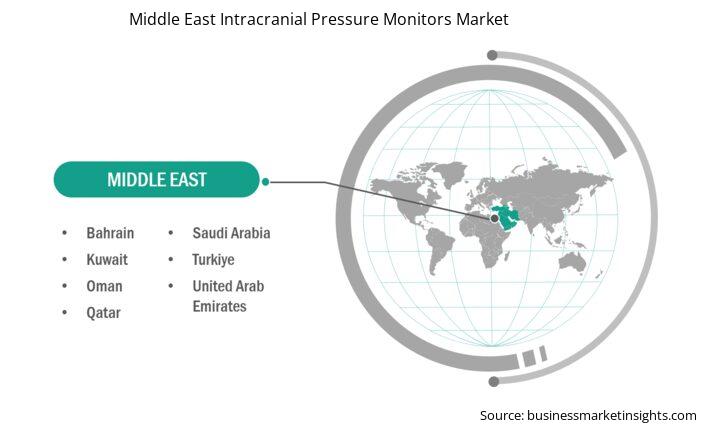
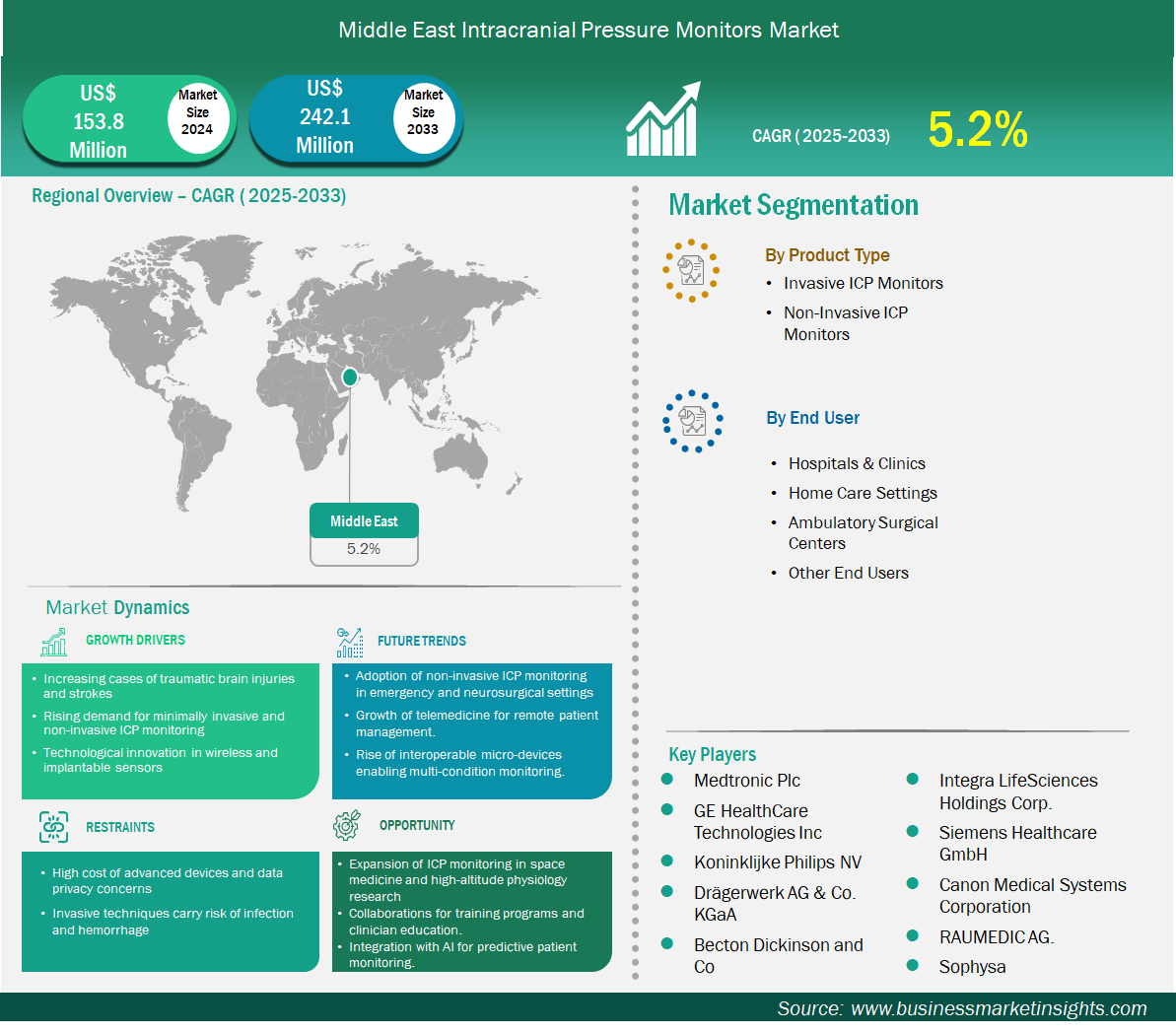
The Middle East intracranial pressure monitors market size is expected to reach US$ 242.1 million by 2033 from US$ 153.8 million in 2024. The market is estimated to record a CAGR of 5.2% from 2025 to 2033.
Executive Summary and Middle East Intracranial Pressure Monitors Market Analysis:
The intracranial pressure monitors market in the Middle East is experiencing significant growth driven by increasing cases of traumatic brain injuries and strokes, rising demand for minimally invasive and non-invasive ICP monitoring, and technological innovation in wireless and implantable sensors. The Middle East intracranial pressure monitors market exhibits a combination of highly developed medical capabilities and access to neurocritical care technologies that are not evenly distributed across the region. In general, invasive ICP monitors hold a majority of the product field, echoing their established use in the management of traumatic brain injuries and neurological emergencies in specialized hospitals. The market is influenced by substantial investments in the public sector for the development of healthcare facilities, notably in Saudi Arabia, the UAE, and Qatar, where national health policies emphasize the importance of specialized diagnostics and the establishment of the trauma response system. Purchases are usually done through a central agency, with ministries of health and big hospital networks being the main drivers of demand on the grounds of clinical efficiency and system compatibility. Multinational MedTech companies are still very competitive and have a good position in the market as they supply the region with devices that are CE- and FDA-approved and comply with local standards. Nonetheless, there still exist disparities in the Middle Eastern region as a whole where low-income countries are trapped in issues such as affordability, training, and device maintenance etc. The market is also shaped by academic partnerships and clinical research initiatives that provide support for evidence-based adoption.
Middle East Intracranial Pressure Monitors Market Segmentation Analysis:
Key segments that contributed to the derivation of the intracranial pressure monitors market analysis are product and end user.
- By product, the intracranial pressure monitors market is segmented into invasive ICP monitors, non-invasive ICP monitors. The invasive ICP monitors segment dominated the market in 2024. Invasive ICP monitors are the largest segment by product in the Middle East due to their clinical reliability and routine use in managing neurotrauma within advanced hospital settings.
- By end user, the market is segmented into hospitals and clinics, home-care Settings, ambulatory surgical centers, and other end users. The hospitals and clinics segment held the largest market share in 2024. Hospitals and clinics are the largest segment by end user in the Middle East due to centralized healthcare systems and significant investment in specialized neurosurgical and trauma care facilities.
Middle East Intracranial Pressure Monitors Market Outlook
The Middle Eastern ICP monitors market forecast is progressively influenced by healthcare digitization, regional innovation, and new models of care delivery. Hospital infrastructures in the smart age and digital health platforms are the major investments of governments in the whole region; thus, there is a demand for ICP monitoring systems that remotely support diagnostics, predictive analytics, and EMR integration. The significant role of AI-enhanced neuro diagnostics has led to a surge of interest in telemetric and non-invasive ICP technologies, mainly for post-operative and outpatient monitoring. Moreover, the focus of the region on medical tourism and international accreditation is the reason for the increased adoption of advanced monitoring technologies to meet global standards. The speed of innovation is being facilitated by the strategic collaborations between healthcare providers and technology firms, with pilot programs around cloud-based monitoring and cross-border data sharing. Besides, the market will also be able to take advantage of the regional harmonization of regulatory frameworks, which aims at easing device approvals and facilitating a quicker market entry. As healthcare systems are moving towards value-based care and outcome-driven protocols, ICP monitoring aids in a very significant way to elevate neurological outcomes and decrease the ICU load throughout the Middle East.
Middle East Intracranial Pressure Monitors Market Country Insights
Based on country, the Middle East intracranial pressure monitors market is segmented into the United Arab Emirates, Saudi Arabia, Bahrain, Oman, Kuwait, Qatar, and Turkiye. Saudi Arabia held the largest share in 2024.
On a country-level, the situation in the Middle East has different patterns of adoption and different strategic priorities in the ICP monitors segment. Saudi Arabia is leading the region in terms of clinical volume and infrastructure. The large-scale investments in trauma centers and academic hospitals have been the main factors in increasing the demand for invasive ICP monitors. The UAE is focusing on innovation and international collaboration. Private hospital networks are the ones that are adopting AI-powered and telemetric solutions to facilitate premium neurological care. Qatar is transforming its health system vision into reality by investing in specialized care, which is creating opportunities for vendors that are aligned with global best practices. Regulations differ from place to place, with some countries having fast-track approvals for critical care devices, whereas others need extensive clinical validation. These country-specific revelations demand the necessity of having local market strategies whereby success depends on engaging clinicians, aligning with infrastructure, and being responsive to national health priorities.
Middle East Intracranial Pressure Monitors Market Company Profiles
Medtronic Plc, GE HealthCare Technologies Inc, Koninklijke Philips NV, Becton Dickinson and Co, Integra LifeSciences Holdings Corp, Dragerwerk AG & Co KGaA, Siemens Healthcare GmbH, Canon Medical Systems Corporation, RAUMEDIC AG, Sophysa, are among the key players operating in the market. These players adopt strategies such as expansion, product innovation, and mergers and acquisitions to stay competitive in the market and offer innovative products to their consumers.
Middle East Intracranial Pressure Monitors Market Research Methodology:
The following methodology has been followed for the collection and analysis of data presented in this report:
-
Secondary Research
The research process begins with comprehensive secondary research, utilizing both internal and external sources to gather qualitative and quantitative data for each market. Commonly referenced secondary research sources include, but are not limited to:
- Company websites, annual reports, financial statements, broker analyses, and investor presentations
- Industry trade journals and other relevant publications
- Government documents, statistical databases, and market reports
- News articles, press releases, and webcasts specific to companies operating in the market
Note: All financial data included in the Company Profiles section has been standardized to US$. For companies reporting in other currencies, figures have been converted to US$ using the relevant exchange rates for the corresponding year.
-
Primary Research
Business Market Insights conducts a significant number of primary interviews each year with industry stakeholders and experts to validate and analyze the data and gain valuable insights. These research interviews are designed to:
- Refine findings from secondary research
- Enhance the expertise and market understanding of the analysis team
- Gain insights into market size, trends, growth patterns, competitive dynamics, and future prospects
Primary research is conducted via email interactions and telephone interviews with industry experts across various markets, categories, segments, and sub-segments in different regions. Participants typically include:
- Industry stakeholders: Vice Presidents, business development managers, market intelligence managers, and national sales managers
- External experts: Valuation specialists, research analysts, and key opinion leaders with industry-specific expertise
Key Sources Referred:
- World Health Organization (WHO)
- Organisation for Economic Co-operation and Development (OECD)
- The World Bank Group
- Worldometer
- The Lancet
- BMC Medical Education
- Eurostat
Middle East Intracranial Pressure Monitors Market Strategic Insights
Middle East Intracranial Pressure MonitorsMarket Report Highlights
| Report Attribute | Details |
| Market size in 2024 | US$ 153.8 Million |
| Market Size by 2033 | US$ 242.1 Million |
| CAGR (2025 - 2033) | 5.2% |
| Historical Data | 2022-2023 |
| Forecast period | 2025-2033 |
| Segments Covered |
By Product
|
|
Regions and Countries Covered
|
|
| Middle East | United Arab Emirates, Saudi Arabia, Bahrain, Oman, Kuwait, Qatar, Turkiye |
| Market leaders and key company profiles |
|
Middle East Intracranial Pressure Monitors Market Country and Regional Insights