Market Summary
Executive Summary and Market Analysis
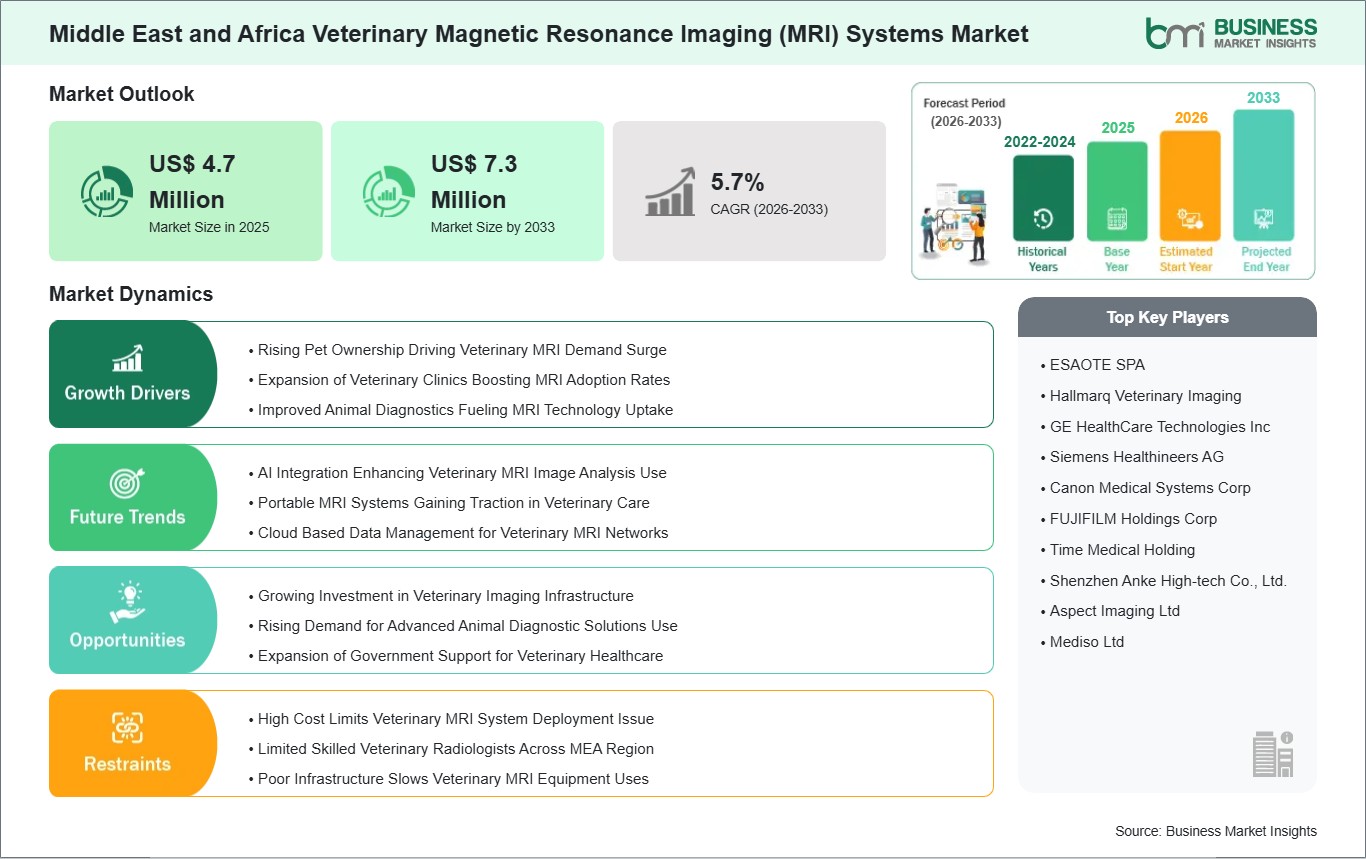
The Middle East and Africa (MEA) Veterinary Magnetic Resonance Imaging (MRI) Systems Market operates through an adoption process that develops but becomes more organized into two different systems. The region experiences growth because people develop a better understanding of companion animal health and demand veterinary services for livestock and veterinary facilities in Gulf Cooperation Council countries and selected African nations progress through modernization. The market expansion gets driven forward because more people own pets, and urban residents spend money on premium veterinary services. The transition shows clear progress throughout major cities in the UAE, Saudi Arabia and South Africa because veterinary specialty centers and referral hospitals now use advanced imaging systems, which include MRI technology for neurology, orthopedics and oncology purposes. The Gulf nations use government-supported diversification projects, which develop their healthcare systems that include veterinary services to create better conditions for acquiring advanced diagnostic equipment. The increasing rate of complicated animal health problems, which include neurological disorders and musculoskeletal injuries, drives the need for high-resolution imaging systems that enable precise diagnosis. The rise of veterinary teaching hospitals and research institutions that use MRI systems for their clinical training and advanced diagnostic work has strengthened this trend. The market encounters significant limitations that prevent its technology from reaching full market penetration. The high costs required to acquire and run MRI systems create a significant problem that affects veterinary clinics that operate in Africa's small and mid-sized facilities throughout their lower-income regions. The installed systems experience underutilization because veterinary facilities cannot operate their systems effectively due to insufficiently trained veterinary radiologists and imaging specialists. The MEA Veterinary MRI Systems Market operates between its first adoption phase and its current market growth phase, which mainly develops in urban areas with high-income populations. The region's rapid veterinary healthcare modernization progress and specialty diagnostic services expansion face challenges from its existing infrastructure problems and workforce skill deficiencies, which create a positive yet uncertain future for development.
Segment Analysis
Middle East and Africa Veterinary Magnetic Resonance Imaging (MRI) Systems Market Segmentation
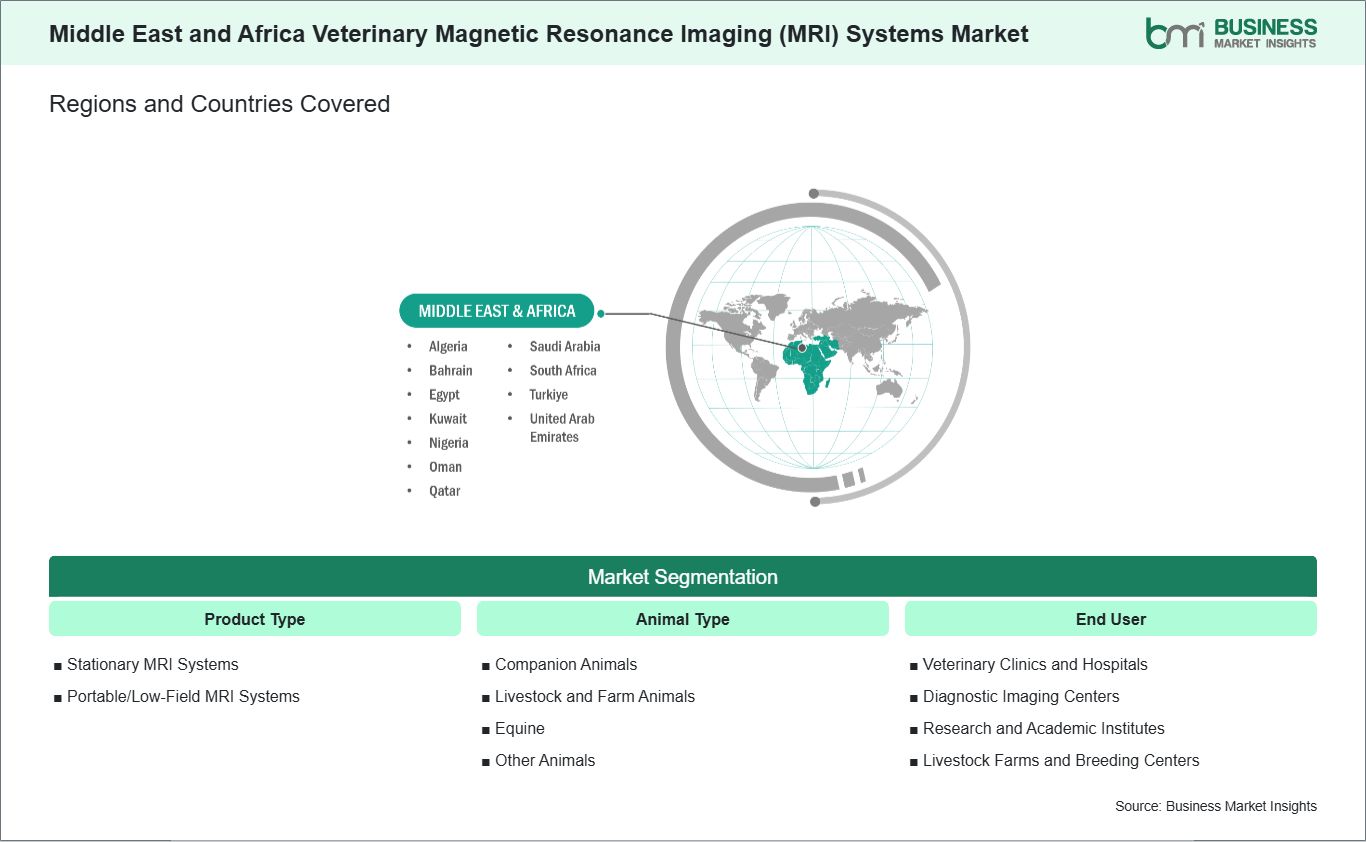
Key segments that contributed to the derivation of the Middle East and Africa veterinary magnetic resonance imaging (MRI) systems market analysis are product type, animal type, and end user.
- By product type, the veterinary magnetic resonance imaging (MRI) systems market is segmented into stationary MRI systems, portable/low-field MRI systems. The stationary MRI systems segment dominated the market in 2025.
- Based on animal type, the veterinary magnetic resonance imaging (MRI) systems market is categorized into companion animals, livestock and farm animals, equine, others. The companion animals segment dominated the market in 2025.
- In terms of end user, the veterinary magnetic resonance imaging (MRI) systems market is categorized into veterinary clinics and hospitals, diagnostic imaging centers, research and academic institutes, livestock farms and breeding centers. The veterinary clinics and hospitals segment dominated the market in 2025.
Market Forces
Middle East and Africa Veterinary Magnetic Resonance Imaging (MRI) Systems Market Drivers and Opportunities
Rising Pet Ownership Driving Veterinary MRI Demand Surge
The Middle East and Africa veterinary MRI systems market is experiencing consistent growth because more people are adopting pets, and veterinary facilities are becoming better equipped. The UAE and Saudi Arabia are developing modern animal care centers, which South Africa uses to enhance its diagnostic systems at urban veterinary hospitals and referral clinics.
The rising occurrence of chronic conditions in pets, which include orthopedic and neurological disorders, creates a growing need for high-resolution MRI diagnostic services throughout the region. Egyptian and Israeli veterinary teaching hospitals implement MRI systems for their research and clinical training programs to enhance diagnostic precision and achieve better results for difficult medical cases.
African markets experience significant growth challenges because high equipment expenses and a short supply of qualified veterinary radiologists create major obstacles. Partnerships between global MRI manufacturers and regional veterinary networks enable better access to medical imaging services through mobile imaging units and joint diagnostic facilities, which government healthcare programs fund in Kenya and Nigeria.
Growing Investment in Veterinary Imaging Infrastructure
Investments in veterinary imaging infrastructure across the Middle East and Africa are accelerating as governments and private players modernize animal healthcare systems. The UAE and Qatar are establishing advanced veterinary referral hospitals equipped with MRI technology, while South Africa’s private veterinary groups are expanding diagnostic imaging networks in major cities.
Pooled funding initiatives and international collaborations are further supporting MRI adoption in veterinary education and clinical practice. Countries like Saudi Arabia are integrating veterinary imaging into academic programs, while Kenya and Morocco are improving access through donor-backed animal health projects and regional diagnostic partnerships.
However, high capital expenditure and maintenance costs continue to limit widespread MRI deployment in smaller veterinary clinics across Africa. Despite this, long-term growth prospects remain strong as increasing pet insurance penetration and rising awareness of advanced animal diagnostics encourage investments in scalable and mobile MRI solutions across the region particularly in rural and underserved veterinary care markets.
Size and Share Analysis
Middle East and Africa Veterinary Magnetic Resonance Imaging (MRI) Systems Market Size and Share Analysis
The Middle East and Africa veterinary magnetic resonance imaging (MRI) systems market is experiencing steady growth, with market size and share analysis reflecting evolving treatment preferences and competitive dynamics among key players. The report evaluates important subsegments categorized within product type, animal type, and end user, highlighting their respective contributions to market performance.
By product type, the stationary MRI systems subsegment dominated the market in 2025, driven by higher image quality, greater throughput, and widespread adoption in hospitals for comprehensive diagnostic imaging.
Based on animal type, the companion animals subsegment dominated the market in 2025, driven by increasing pet ownership and rising demand for advanced diagnostic imaging in routine veterinary care.
In terms of end user, the veterinary clinics and hospitals subsegment dominated the market in 2025, driven by the widespread adoption of x-ray systems for comprehensive diagnostic and treatment services.
Report Coverage
Middle East and Africa Veterinary Magnetic Resonance Imaging (MRI) Systems Market Report Coverage and Deliverables
The "Middle East and Africa Veterinary Magnetic Resonance Imaging (MRI) Systems Market Size and Forecast (2022–2033)" report provides a detailed analysis of the market covering below areas:
- Market size and forecast at regional and country levels for all market segments covered under the scope
- Market trends, as well as drivers, restraints, and opportunities
- Market analysis covering key trends, regional framework, major players, regulations, and recent developments
- Market concentration, heat map analysis, prominent players, and recent developments for the Market
- Detailed company profiles, including SWOT analysis
Geographic Insights
Middle East and Africa Veterinary Magnetic Resonance Imaging (MRI) Systems Market Geographic Insights
The geographical scope of the Middle East and Africa Veterinary Magnetic Resonance Imaging (MRI) Systems Market report is divided into Turkiye, the UAE, Saudi Arabia, Bahrain, Oman, Egypt, South Africa and Africa, Algeria, Nigeria, Kuwait, and Qatar. Turkiye held the largest share in 2025.
The Middle East and Africa (MEA) veterinary MRI systems market consists of highly centralized markets, which show uneven development across all veterinary diagnostic areas because of different healthcare resource levels and veterinary practice capabilities in different nations. Turkiye operates as the primary market for the region because its veterinary healthcare system shows more development than other countries which exist in the region. The hybrid geographic position of Turkiye between Europe and the Middle East enables veterinary facilities to obtain advanced MRI systems through technology transfer development. The UAE and Saudi Arabia represent the next most significant contributors to the market expansion, which occurs because of increasing pet ownership and consumers who spend heavily on animal care. The government supports the modernization of veterinary services in urban areas such as Dubai, Abu Dhabi, Riyadh and Jeddah. These cities have seen premium veterinary hospitals adopt MRI technology for use in neurology, orthopedics and oncology procedures. The Gulf region includes Qatar, Kuwait, Oman and Bahrain as a smaller area that shows consistent growth through its veterinary sector. This area centers its adoption practices within various high-end clinics and government-supported veterinary institutions. The area exhibits strong purchasing power but contains only a small number of patients. The Egyptian market serves as a major North African market because it contains many animals, and its veterinary educational programs continue to develop, but only university hospitals and specialized referral centers use MRI technology because of high costs and inconsistent development in private hospitals. South Africa leads all other sub-Saharan African countries in developing its veterinary imaging market because it has a strong private veterinary sector, which supports both equine and companion animal care, and its veterinary facilities possess better access to imported imaging technology than other African countries, which still use basic MRI systems. Nigeria and Algeria display developing potential, which results from growing needs for livestock health management and increasing availability of private veterinary services, but their development halts because of existing infrastructure problems and high costs. MRI systems in the MEA region only reach high-value referral centers because of expensive equipment and particular operational needs, and because the technology comes from foreign sources. Gulf countries will see steady growth in veterinary services because of rising pet humanization and growing awareness about advanced diagnostic services, while Turkiye will remain the main market hub, which establishes the standard for veterinary MRI use in the region.
Industry Activity
Recent Developments
The Middle East and Africa Veterinary Magnetic Resonance Imaging (MRI) Systems Market is evaluated by gathering qualitative and quantitative data post primary and secondary research, which includes important corporate publications, association data, and databases. A few of the key developments in the Middle East and Africa veterinary magnetic resonance imaging (MRI) systems market are:
- In April 2025, Esaote S.p.A., announced that it hosted the 3rd Edition of MRI & Ultrasound in Veterinary Medicine in Dubai, UAE, where the company showcased its veterinary MRI systems (including Vet-MR platforms) and engaged with regional veterinary hospitals and imaging centers to support adoption and training for MRI-based diagnostics in the Middle East.
- In June 2023, Hallmarq Veterinary Imaging, announced increased manufacturing and deployment capacity driven by rising global demand for its Standing Equine MRI and Small Animal MRI systems, supporting installations across veterinary referral hospitals worldwide through direct sales and partner networks.
Trust & Transparency
Research Methodology
The market analysis combines proprietary research with secondary data from government agencies, company disclosures, regulatory filings, industry databases and expert interviews. Market estimates are validated through data triangulation, cross-market benchmarking and analyst
review.
View Full Research Methodology
Key Sources Referred:
American College of Veterinary Radiology (ACVR)World Small Animal Veterinary Association (WSAVA)British Veterinary Association (BVA)International Veterinary Radiology Association (IVRA)American Veterinary Medical Association (AVMA)European College of Veterinary Diagnostic Imaging (ECVDI)World Organisation for Animal Health (WOAH / OIE)Veterinary Imaging & Radiation Oncology Society (VIROS)