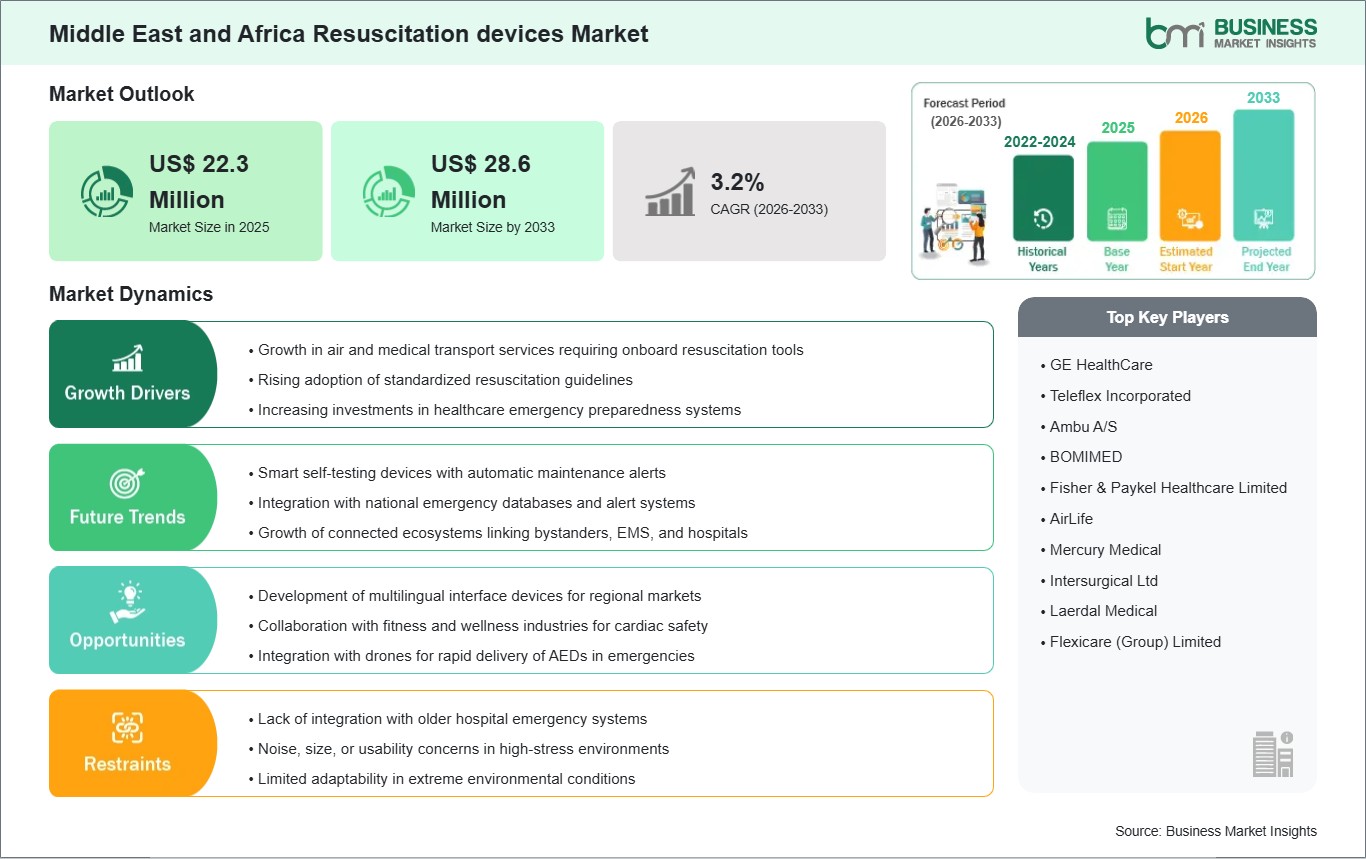
The Middle East and Africa resuscitation devices market size is expected to reach US$ 28.6 million by 2033 from US$ 22.3 million in 2025. The market is estimated to record a CAGR of 3.2 % from 2026 to 2033.
The Middle East and Africa (MEA) resuscitation devices market is experiencing gradual growth, driven by increasing awareness of cardiac emergencies, expanding healthcare infrastructure, and government initiatives to enhance emergency medical services (EMS). Key countries in this region include Turkey, Saudi Arabia, United Arab Emirates, South Africa, and Egypt, with Turkey emerging as the dominant market due to its advanced hospital networks, growing investment in critical care, and proactive adoption of life-saving technologies. The increase in heart conditions, surgeries, and improvement in survival rates of patients have contributed significantly to the market growth in this domain. The hospitals and EMS services in Turkey and other MEA regions are using automated external defibrillators (AED), manual defibrillators, mechanical CPR equipment, and advanced monitors to improve their response time during emergencies. Urban ambulance services are increasingly utilizing mobile resuscitation devices to cut down the duration of rescue operations. Though there are many growth prospects for the market, some challenges are also faced by this market. Some of the issues include uneven distribution of advanced equipment in rural areas, expensive cost of equipment, and professional training requirements for using this equipment. Also, some variations in the regulations across MEA nations may affect the adoption of devices in these regions. Nevertheless, increasing campaigns, hospital developments, and collaboration with international medical device providers will benefit the market in the future.

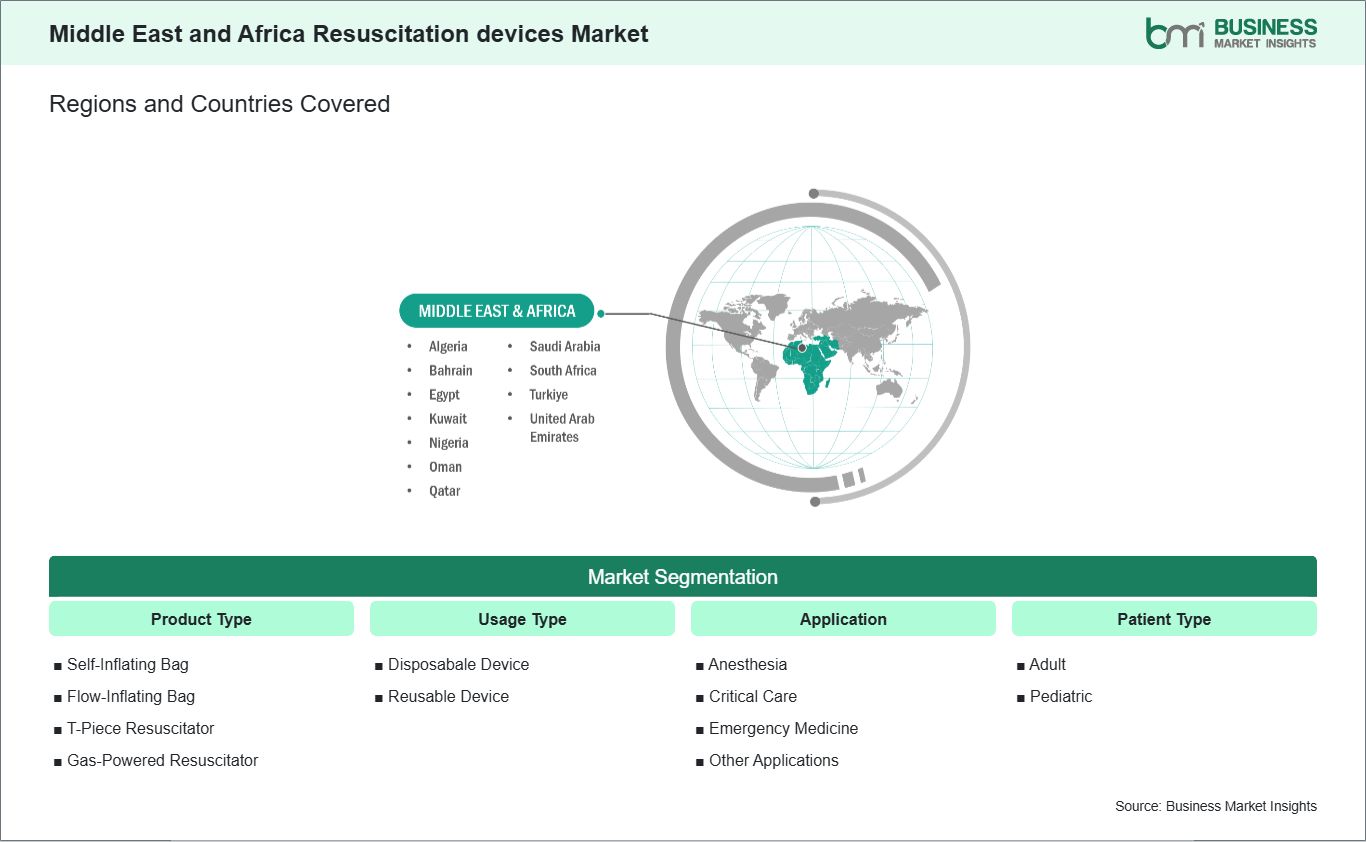
Key segments that contributed to the derivation of the Africa resuscitation devices market analysis are product type, usage type, application, patient type, and end user.
The resuscitation devices market in the Middle East and Africa is now being pushed forward by the rise in air medical transport services, especially in geographical zones that present logistical difficulties and have a poor medical infrastructure. Nations such as the UAE, Saudi Arabia, and South Africa are creating an air ambulance system in order to offer quick critical care to individuals who are situated in rural locations or congested urban centers. Such mobile medical facilities need smaller, dependable resuscitation devices like AEDs, portable respirators, and battery-powered CPR machines.
Emergency services have been investing in ambulances and air ambulances with complete resuscitation facilities within cities like Dubai, Riyadh, and Johannesburg. This requires paramedics and flight nurses to be able to perform advanced cardiac life support on their patients during transport, which in turn requires the use of equipment that is light and multipurpose at once. The need to stabilize the patient before reaching specialized hospitals has brought out the significance of having a device that performs all the essential functions in one go.
Moreover, in developing nations of sub-Saharan Africa where there are no well-developed roads, medical transportation programs help reach those who live far away from hospitals and clinics. In such cases, the portability and durability of resuscitation devices play a vital role as it helps save lives despite the inability of accessing hospitals immediately.
The Middle Eastern and African resuscitation equipment market will gain through the production of multilingual interface resuscitation devices, aimed at accommodating the language variety in the region and allowing international acceptance. For instance, people living in countries within the GCC, Northern Africa, and Sub-Saharan Africa speak languages like Arabic, English, and French among others. Device makers are coming up with voice prompts and instructions as well as manuals written in several languages, allowing access to AED and CPR feedback devices to healthcare workers as well as the general public.
Within multinational cities like Dubai, Abu Dhabi, Casablanca, and Lagos, hospitals, airports, and companies are buying devices that can operate in multiple languages in order to serve their diverse employees and international guests. Such devices increase the effectiveness of emergency responses since they help rescuers act quickly and effectively, avoiding any delays and mistakes. Furthermore, multilingual devices help in the training of health workers in emergency procedures, facilitating simulations in the native tongue of all participants.
Devices that can communicate in multiple languages have also been acquired in the emerging markets of East and West Africa as a part of public health policies in these regions. Their governments have started using multilingual AEDs within schools, transportation terminals, and community centers, thereby promoting greater access and uniformity in emergency responses regardless of the language spoken in that region.

The Middle East and Africa resuscitation devices market is experiencing steady growth, with market size and share analysis reflecting evolving treatment preferences and competitive dynamics among key players. The report evaluates important subsegments categorized within product type, usage type, application, patient type, and end user, highlighting their respective contributions to overall market performance.
By product type, the self-inflating Bag subsegment dominated the market in 2025, as they are easy to use and do not require external gas or power sources, making them ideal for emergencies. They allow precise manual control of ventilation, which is crucial in critical care. Their portability makes them suitable for both hospital wards and transport situations.
Based on usage type, the disposable devices subsegment dominated the market in 2025 due to their ability to prevent cross-contamination and infection. They eliminate the need for complex sterilization processes, saving time and reducing operational costs. In high-volume hospital settings, disposables improve workflow efficiency. This makes them highly preferred in emergency rooms, ICUs, and surgical units.
On the basis of application, the anesthesia subsegment dominated the market in 2025, as resuscitation devices are essential for safe ventilation during induction and recovery. They provide backup support if mechanical ventilators fail. Their precise control helps manage patients with varying lung compliances. Hospitals rely on these devices to prevent hypoxia and ensure patient safety during surgeries.
In terms of patient type, the adult subsegment dominated the market in 2025, as they experience more surgical procedures and critical emergencies than pediatric populations. Their larger lung capacity requires devices designed for adult ventilation. High prevalence of cardiac and respiratory conditions in adults increases usage frequency.
Based on end user, the hospitals subsegment dominated the market in 2025 due to constant emergency and surgical care needs. ICUs, operating rooms, and emergency departments require rapid access to resuscitation devices. High patient volume and stringent safety protocols make hospitals the key market driver. Their centralized procurement and standardized protocols ensure widespread device adoption.
| Report Attribute | Details |
|---|---|
| Market size in 2025 | US$ 22.3 Million |
| Market Size by 2033 | US$ 28.6 Million |
| CAGR (2026 - 2033) | 3.2% |
| Historical Data | 2022-2024 |
| Forecast period | 2026-2033 |
| Segments Covered | By Product Type
|
|
Regions and Countries Covered
| |
| Middle East and Africa | Saudi Arabia, United Arab Emirates, Kuwait, Bahrain, Qatar, Oman, Turkiye, South Africa, Egypt, Nigeria, Algeria |
| Market leaders and key company profiles |
|
The "Middle East and Africa Resuscitation Devices Market Size and Forecast (2022–2033)" report provides a detailed analysis of the market covering below areas:
The geographical scope of the Middle East and Africa Resuscitation devices market report is divided into: Saudi Arabia, the United Arab Emirates, Kuwait, Bahrain, Qatar, Oman, Turkey, South Africa, Egypt, Nigeria, Algeria, and the Rest of MEA. Turkiye held the largest share in 2025.
Turkey is the market leader in MEA resuscitation devices due to the high level of development of the health care sector in the country, along with emergency health services and the adoption of technology. In Istanbul, Ankara, and Izmir, hospitals are adopting more sophisticated defibrillation systems, automated CPR, and portable kits for resuscitation. An important contributor to Turkey’s dominance is that of combining professional education and adoption of technology. Members of the EMS, paramedics, and doctors at hospitals undergo regular simulation training on resuscitation, thus ensuring appropriate use of devices and increasing patients’ chances of survival. Awareness among citizens of Turkey also prompts the purchase and installation of AEDs in airports, learning institutions, and company premises, enhancing emergency care outside hospitals. Turkey has benefited through partnerships between local manufacturers and international producers of medical devices, thus having an adequate flow of high quality and advanced resuscitation devices. With the government investing heavily in upgrading hospitals and expanding the number of emergency units, it continues to be a leader in resuscitation devices in the Middle East and Africa markets.

The Middle East and Africa resuscitation devices market is evaluated by gathering qualitative and quantitative data post primary and secondary research, which includes important corporate publications, association data, and databases. A few of the key developments in the Middle East and Africa resuscitation devices market are:
The Middle East and Africa Resuscitation devices Market is valued at US$ 22.3 Million in 2025, it is projected to reach US$ 28.6 Million by 2033.
As per our report Middle East and Africa Resuscitation devices Market, the market size is valued at US$ 22.3 Million in 2025, projecting it to reach US$ 28.6 Million by 2033. This translates to a CAGR of approximately 3.2% during the forecast period.
The Middle East and Africa Resuscitation devices Market report typically cover these key segments-
The historic period, base year, and forecast period can vary slightly depending on the specific market research report. However, for the Middle East and Africa Resuscitation devices Market report:
The Middle East and Africa Resuscitation devices Market is populated by several key players, each contributing to its growth and innovation. Some of the major players include:
The Middle East and Africa Resuscitation devices Market report is valuable for diverse stakeholders, including:
Essentially, anyone involved in or considering involvement in the Middle East and Africa Resuscitation devices Market value chain can benefit from the information contained in a comprehensive market report.
Please tell us your area of interest
(Market Segments/ Regions and Countries/ Companies)