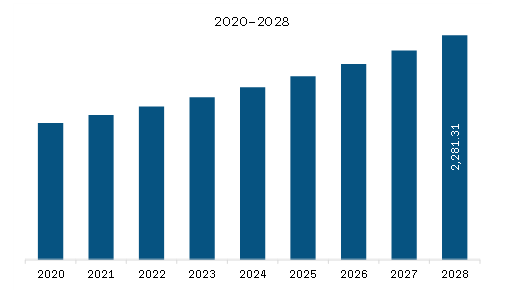
The radar simulator market in the Middle East & Africa is expected to grow from US$ 146.86 million in 2022 to US$ 180.61 million by 2028; it is estimated to grow at a CAGR of 3.5% from 2022 to 2028.
The military & aerospace industry has seen rapid growth over the last decade, and this trend is expected to continue. The increase in investments in modern aircraft fleets by governments, coupled with several other socio-economic factors, has fueled the growth of air traffic control, which ultimately boosted the demand for radar simulators across the region. Air transport plays a critical role in a country’s economic growth. The majority of the governments are emphasizing heavily on the growth of airports in order to catalyze respective aviation sectors. Owing to this, a large number of airports are being constructed or renovated (air traffic control towers, runways, terminals, and others). The development/renovation of air traffic control towers is allowing the radar simulator market players to experience higher demand. The growing modernization of aircraft and radar systems has driven the need for advances in conventional radar simulators. Airline operators and air traffic control officers demand accurate, real-time radar information that helps pilots and operators to make accurate decisions. Radar simulators are being installed in airports and training centers across all the major airports, which is driving their demand. For instance, in February 2019, the Qatar Civil Aviation Authority (QCAA) signed a contract with Micro Nav to design and deliver a 3D air traffic control tower simulator for Hamad International airport. Moreover, radar simulators enhance the efficiency of air traffic control operations and consequently offer greater and more precise testing of radar systems and accurate training of operators. Thus, this rising demand for air traffic control radar simulators from airline and airport authorities is driving the radar simulator market.
Middle East & Africa Radar Simulator Market Revenue and Forecast to 2028 (US$ Million)
Middle East & Africa Radar Simulator Market Segmentation
The Middle East & Africaradar simulator market is segmented based on component, system, application, and country. Based on component, the market has been segmented into hardware and software. The hardware segment would dominate the Middle East & Africa radar simulator market in 2022. In terms of system, the market is divided into system testing and operator training. The operator training segment would dominate the Middle East & Africa radar simulator market in 2022. Based on application, the market has been bifurcated into military and commercial. The commercial segment dominated the Middle East & Africa radar simulator market in 2022. Based on country, The Middle East & Africa radar simulator market is segmented into South Africa, Saudi Arabia, the UAE, and the Rest of Middle East & Africa. The Rest of Middle East & Africa would dominate the market in 2022.
Key players operating in the Middle East & Africa radar simulator market include Adacel Technologies Limited; Collins Aerospace; L3Harris Technologies, Inc.; Micro Nav Limited; and Ultra Electronics Inc.
Middle East and Africa Radar Simulator Market Strategic Insights
Get more information on this report
Middle East and Africa Radar Simulator Market Segmentation Analysis
Middle East and Africa Radar Simulator Market Report Highlights
Middle East and Africa Radar Simulator Report Scope
Report Attribute
Details
Market size in 2022
US$ 146.86 Million
Market Size by 2028
US$ 180.61 Million
CAGR (2022 - 2028)
3.5%
Historical Data
2020-2021
Forecast period
2023-2028
Segments Covered
By Component
Hardware
Software
By System
System Testing
Operator Training
By Application
Military
Commercial
Regions and Countries Covered
Middle East and Africa
South Africa, Saudi Arabia, UAE, Rest of Middle East and Africa
Market leaders and key company profiles
Adacel Technologies Limited
Collins Aerospace
L3Harris Technologies, Inc.
Micro Nav Limited
Ultra Electronics Inc.
Get more information on this report
Middle East and Africa Radar Simulator Market Country and Regional Insights
Get more information on this report
Identical Market Reports with other Region/Countries
The List of Companies - Middle East and Africa Radar Simulator Market
Adacel Technologies LimitedCollins AerospaceL3Harris Technologies, Inc.Micro Nav LimitedUltra Electronics Inc.
Frequently Asked Questions
How big is the Middle East and Africa Radar Simulator Market?
The Middle East and Africa Radar Simulator Market is valued at US$ 146.86 Million in 2022, it is projected to reach US$ 180.61 Million by 2028.
What is the CAGR for Middle East and Africa Radar Simulator Market by (2022 - 2028)?
As per our report Middle East and Africa Radar Simulator Market, the market size is valued at US$ 146.86 Million in 2022, projecting it to reach US$ 180.61 Million by 2028. This translates to a CAGR of approximately 3.5% during the forecast period.
What segments are covered in this report?
The Middle East and Africa Radar Simulator Market report typically cover these key segments-
Component (Hardware, Software)
System (System Testing, Operator Training)
Application (Military, Commercial)
What is the historic period, base year, and forecast period taken for Middle East and Africa Radar Simulator Market?
The historic period, base year, and forecast period can vary slightly depending on the specific market research report. However, for the Middle East and Africa Radar Simulator Market report:
Historic Period : 2020-2021
Base Year : 2022
Forecast Period : 2023-2028
Who are the major players in Middle East and Africa Radar Simulator Market?
The Middle East and Africa Radar Simulator Market is populated by several key players, each contributing to its growth and innovation. Some of the major players include:
Adacel Technologies Limited
Collins Aerospace
L3Harris Technologies, Inc.
Micro Nav Limited
Ultra Electronics Inc.
Who should buy this report?
The Middle East and Africa Radar Simulator Market report is valuable for diverse stakeholders, including:
Investors: Provides insights for investment decisions pertaining to market growth, companies, or industry insights. Helps assess market attractiveness and potential returns.
Industry Players: Offers competitive intelligence, market sizing, and trend analysis to inform strategic planning, product development, and sales strategies.
Suppliers and Manufacturers: Helps understand market demand for components, materials, and services related to concerned industry.
Researchers and Consultants: Provides data and analysis for academic research, consulting projects, and market studies.
Financial Institutions: Helps assess risks and opportunities associated with financing or investing in the concerned market.
Essentially, anyone involved in or considering involvement in the Middle East and Africa Radar Simulator Market value chain can benefit from the information contained in a comprehensive market report.





 Get Free Sample For Middle East and Africa Radar Simulator Market