
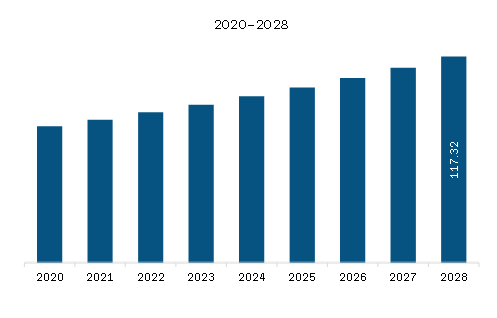
The prebiotic ingredients market in Middle East & Africa is expected to grow from US$ 85.51 million in 2022 to US$ 117.32 million by 2028; it is estimated to grow at a CAGR of 5.4% from 2022 to 2028.
Over the past few years, awareness regarding environmental sustainability has increased significantly. The number of people adopting a vegan lifestyle and a plant-based diet is growing continuously. Consumers’ inclination toward cutting down the food of animal origin, such as meat and dairy products, is attributed to various factors, ranging from environmental sustainability concerns to ethical considerations to personal health objectives. This is likely to generate demand for prebiotic fibers, as they are either already present in plant-based products that are meant to replace animal-based diets or may be easily incorporated into them. Many prebiotic food products are suitable for vegans and people on other diets to eat. According to International Scientific Association for Probiotics and Prebiotics (ISAPP), Inulin and oligofructose are the proven plant-based prebiotics available in the market. Manufacturers are planning to introduce plant-based products by including prebiotic ingredients. Kellogg’s focuses on strengthening its immediate future by promoting its diverse range of plant-based fibers that nourish the human gut. Although various food products are now recognized as having prebiotic properties, several others, such as almonds, artichoke, barley, chia seeds, chicory, dandelion greens, flaxseeds, garlic, and oats, are being explored and used as a functional food. Prebiotics are found in many fruits and vegetables, especially those containing complex carbohydrates, such as fiber and resistant starch. All these factors have significantly contributed to increased sustainability concerns among consumers. Thus, plant-based food is emerging as a significant trend in the prebiotic ingredients market.
Middle East & Africa Prebiotic Ingredients Market Revenue and Forecast to 2028 (US$ Million)
Middle East & Africa Prebiotic Ingredients Market Segmentation
The Middle East & Africa prebiotic ingredients market is segmented by type, form, application, and country. Based on type, the Middle East & Africa prebiotic ingredients market is segmented into inulin, galacto-oligosaccharides (GOS), mannan-oligosaccharides (MOS), and others. Further, the inulin segment dominated the market in 2022. Based on form, the Middle East & Africa prebiotic ingredients market is bifurcated into powder and liquid. Further, the powder segment dominated the market in 2022. Based on application, the Middle East & Africa prebiotic ingredients market is segmented into functional food and beverages, dietary supplements, animal feed, and others. Further, the functional food and beverages segment dominated the market in 2022. Based on country, the Middle East & Africa prebiotic ingredients market is segmented into Saudi Arabia, the UAE, South Africa, and the Rest of Middle East & Africa. Further, the Rest of Middle East & Africa dominated the market in 2022.
A few of the key players dominating the Middle East & Africa prebiotic ingredients market are Cargill, Incorporated; DuPont; Ingredion; Nexira; and SOLACTIS.
Middle East & Africa Prebiotic Ingredients Market Strategic Insights

Middle East & Africa Prebiotic Ingredients Market Report Highlights
| Report Attribute | Details |
| Market size in 2022 | US$ 85.51 Million |
| Market Size by 2028 | US$ 117.32 Million |
| CAGR (2022 - 2028) | 5.4% |
| Historical Data | 2020-2021 |
| Forecast period | 2023-2028 |
| Segments Covered |
By Type
|
|
Regions and Countries Covered
|
|
| Middle East and Africa | South Africa, Saudi Arabia, UAE, Rest of Middle East and Africa |
| Market leaders and key company profiles |
|
Middle East & Africa Prebiotic Ingredients Market Country and Regional Insights



