Analysis by Type (Bidirectional Fabrics, Triaxial Fabrics, Quadraxial Fabrics, and Others) and Application (Construction, Industrial, Military, Consumer Goods, and Others)
No. of Pages:90
Report Code:
BMIRE00028526
Category:
Chemicals and Materials
Middle East & Africa Multiaxial Woven Fabrics Market
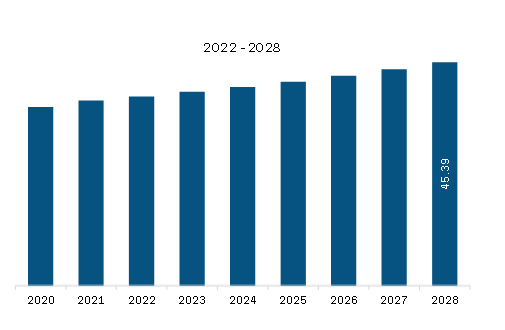
The Middle East & Africa multiaxial woven fabrics market is expected to grow from US$ 38.37 million in 2022 to US$ 45.39 million by 2028. It is estimated to grow at a CAGR of 2.8% from 2022 to 2028.
Strong Growth of Composites Industry Drive Middle East & Africa Multiaxial Woven Fabrics Market
Multiaxial fabrics are used for the reinforcement of composite materials. Rising demand for high-performance materials with properties such as high strength-to-weight ratio, good tensile strength, electrical conductivity, and others drives the growth of the composites industry. Also, there is a growing demand for composites from various end-use industries such as automotive, sporting goods, marine, construction, and wind energy. In the automotive industry, manufacturers prefer lightweight materials for manufacturing automobiles while ensuring safety and performance. Lightweight materials have excellent potential to increase fuel efficiency. Composites can reduce the weight of automotive components, which increases their use in the automotive sector. There is also a high demand for composites to be used as construction materials in high-performance sports gear due to their lightweight, high strength, freedom of design, and easy processing and forming characteristics. Composites are used in sports gear such as skis, baseball bats, golf clubs, tennis rackets, and bicycle frames. Composites are highly used in the marine industry as they are durable and lightweight. Composites weigh less than traditional marine construction materials, which makes them suitable for use in boat construction. Further, composites are used as reinforcing materials in several wind energy applications. High strength and stiffness, lightweight, design flexibility, and other characteristics of composites make them perfect materials for turbines. Also, composites are increasingly used in blade reinforcements, blade laminates, spar caps, blade root joints, and spacers. Rising use of composites in different end-use industries fuels the growth of the composites industry. Hence, the strong growth of the composites industry is bolstering the Middle East & Africa multiaxial woven fabrics market growth.
Middle East & Africa Multiaxial Woven Fabrics Market Overview
The Middle East & Africa has a massive demand for multiaxial woven fabrics in various countries such as the UAE, South Africa, and Saudi Arabia due to the growing requirement from the civil & marine engineering sectors. The demand for new residential projects has increased owing to a surge in migration from rural to urban areas. The increasing populace is also boosting the construction of residential areas. For instance, according to the United Nations report on Urbanization and Migration in Africa, the urban population of the region has been increasing at a high rate (i.e., from ~27% in 1950 to 40% in 2015) and is expected to reach 60% by 2050. Hence, due to the increasing demand for new construction in the region, the need for multiaxial woven fabrics has also grown. In addition, in automotive industry, multiaxial fabrics are used in manufacturing chassis and body parts. Carbon fiber is one of the most used fiber in manufacturing multiaxial fabrics for the automotive industry as they offer stiffness and low-density properties. This leads to a huge demand for multiaxial fabric in the automotive sector. Thus, the growth in demand for multiaxial fabric is attributed to the rising demand for lightweight vehicles to conserve fuel and enhance efficiency. As per the Organization of the Petroleum Exporting Countries (OPEC), the Middle East & Africa are expected to have 90 million vehicles on the road by 2040, up from 59 million in 2018.
Middle East & Africa Multiaxial Woven Fabrics Market Revenue and Forecast to 2028 (US$ Million)
Middle East & Africa Multiaxial Woven Fabrics Market Segmentation
The Middle East & Africa multiaxial woven fabrics market is segmented into type, application, and country.
Based on type, the Middle East & Africa multiaxial woven fabrics market is segmented into bidirectional fabrics, triaxial fabrics, quadraxial fabrics, and others. In 2022, the quadraxial fabrics segment registered a largest share in the Middle East & Africa multiaxial woven fabrics market.
Based on application, the Middle East & Africa multiaxial woven fabrics market is segmented into construction, industrial, military, consumer goods, and others. In 2022, the industrial segment registered a largest share in the Middle East & Africa multiaxial woven fabrics market.
Based on country, the Middle East & Africa multiaxial woven fabrics market is segmented into South Africa, Saudi Arabia, the UAE, and the Rest of Middle East & Africa. In 2022, Saudi Arabia segment registered a largest share in the Middle East & Africa multiaxial woven fabrics market.
3D Weaving SaRL; Albany International Corp; Parabeam BV; SGL Carbon SE; and Sigmatex (UK) Ltd are the leading companies operating in the Middle East & Africa multiaxial woven fabrics market.
Middle East & Africa Multiaxial Woven Fabrics Market Strategic Insights
Get more information on this report
Middle East & Africa Multiaxial Woven Fabrics Market Segmentation Analysis
Middle East & Africa Multiaxial Woven Fabrics Market Report Highlights
Middle East & Africa Multiaxial Woven Fabrics Report Scope
Report Attribute
Details
Market size in 2022
US$ 38.37 Million
Market Size by 2028
US$ 45.39 Million
CAGR (2022 - 2028)
2.8%
Historical Data
2020-2021
Forecast period
2023-2028
Segments Covered
By Type
Bidirectional Fabrics
Triaxial Fabrics
Quadraxial Fabrics
By Application
Construction
Industrial
Military
Consumer Goods
Regions and Countries Covered
Middle East and Africa
South Africa, Saudi Arabia, UAE, Rest of Middle East and Africa
Market leaders and key company profiles
3D Weaving SaRL
Albany International Corp
Parabeam BV
SGL Carbon SE
Sigmatex (UK) Ltd
Get more information on this report
Middle East & Africa Multiaxial Woven Fabrics Market Country and Regional Insights
Get more information on this report
Identical Market Reports with other Region/Countries
The List of Companies - Middle East & Africa Multiaxial Woven Fabrics Market
3D Weaving SaRL Albany International Corp Parabeam BV SGL Carbon SE Sigmatex (UK) Ltd
About Author— Chemicals and Materials Research Team
Suraj Sajeev is a market research and consulting professional with nearly 10 years of experience across Life Sciences, Consumer Goods, Food & Beverages, Materials & Chemicals, and Automotive industries. Throughout his career, he has successfully managed and delivered custom market research and consulting engagements, enabling clients to make informed strategic decisions through actionable market intelligence.
Suraj has extensive expertise in end-to-end project management, including proposal development, market assessment, competitive intelligence, opportunity analysis, market sizing and forecasting, strategic recommendation..
Show More
Frequently Asked Questions
How big is the Middle East & Africa Multiaxial Woven Fabrics Market?
The Middle East & Africa Multiaxial Woven Fabrics Market is valued at US$ 38.37 Million in 2022, it is projected to reach US$ 45.39 Million by 2028.
What is the CAGR for Middle East & Africa Multiaxial Woven Fabrics Market by (2022 - 2028)?
As per our report Middle East & Africa Multiaxial Woven Fabrics Market, the market size is valued at US$ 38.37 Million in 2022, projecting it to reach US$ 45.39 Million by 2028. This translates to a CAGR of approximately 2.8% during the forecast period.
What segments are covered in this report?
The Middle East & Africa Multiaxial Woven Fabrics Market report typically cover these key segments-
Type (Bidirectional Fabrics, Triaxial Fabrics, Quadraxial Fabrics)
What is the historic period, base year, and forecast period taken for Middle East & Africa Multiaxial Woven Fabrics Market?
The historic period, base year, and forecast period can vary slightly depending on the specific market research report. However, for the Middle East & Africa Multiaxial Woven Fabrics Market report:
Historic Period : 2020-2021
Base Year : 2022
Forecast Period : 2023-2028
Who are the major players in Middle East & Africa Multiaxial Woven Fabrics Market?
The Middle East & Africa Multiaxial Woven Fabrics Market is populated by several key players, each contributing to its growth and innovation. Some of the major players include:
3D Weaving SaRL
Albany International Corp
Parabeam BV
SGL Carbon SE
Sigmatex (UK) Ltd
Who should buy this report?
The Middle East & Africa Multiaxial Woven Fabrics Market report is valuable for diverse stakeholders, including:
Investors: Provides insights for investment decisions pertaining to market growth, companies, or industry insights. Helps assess market attractiveness and potential returns.
Industry Players: Offers competitive intelligence, market sizing, and trend analysis to inform strategic planning, product development, and sales strategies.
Suppliers and Manufacturers: Helps understand market demand for components, materials, and services related to concerned industry.
Researchers and Consultants: Provides data and analysis for academic research, consulting projects, and market studies.
Financial Institutions: Helps assess risks and opportunities associated with financing or investing in the concerned market.
Essentially, anyone involved in or considering involvement in the Middle East & Africa Multiaxial Woven Fabrics Market value chain can benefit from the information contained in a comprehensive market report.







 Get Free Sample For Middle East & Africa Multiaxial Woven Fabrics Market