
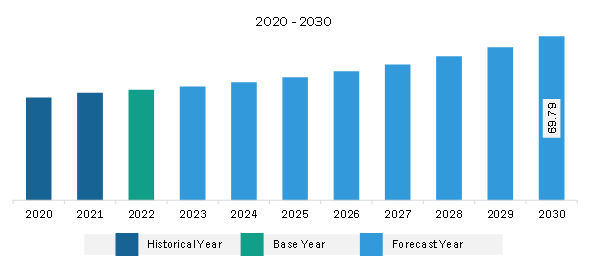
The Middle East & Africa mosquito traps market is expected to grow from US$ 46.98 million in 2022 to US$ 69.79 million by 2030. It is estimated to grow at a CAGR of 5.1% from 2022 to 2030.
Rising Preference for Environment-Friendly Mosquito Control Method Drive Middle East & Africa Mosquito Traps Market
According to the World Health Organization, over 700 thousand deaths were recorded worldwide as of March 2020 due to diseases such as malaria, dengue, schistosomiasis, human African trypanosomiasis, leishmaniasis, Chagas disease, yellow fever, Japanese encephalitis, and onchocerciasis, generally spread by mosquitoes. The prevalence of mosquito-borne diseases differs as per geographic location due to climate change, public health interventions, and vector control efforts. The rising awareness regarding health concerns associated with mosquito infestation has positively influenced the use of mosquito control methods. A few mosquito control methods include the use of larvicides, insect repellents, mosquito repellents, and mosquito traps. However, insecticides contaminate the environment, including soil and water bodies. Mosquito traps eliminate the risk of chemical runoff and reduce ecosystem pollution. Mosquito traps are a nontoxic and chemical-free solution to capture mosquitoes. Further, mosquito traps can be designed to attract and capture specific mosquito species. Thus, a rising preference for eco-friendly mosquito control methods, specifically mosquito traps, positively influences the market growth.
Middle East & Africa Mosquito Traps Market Overview
The Middle East & Africa mosquito traps market is segmented into South Africa, Saudi Arabia, the UAE, and the Rest of Middle East & Africa. In the Middle East & Africa, the rising number of mosquito-borne diseases and growing awareness campaigns regarding mosquito-borne diseases are driving the demand for mosquito traps. The WHO African Region carries a disproportionately high share of the global malaria burden. Africa was home to 95% of malaria cases and 96% of malaria deaths in 2021. Further, in 2020, the King Salman Humanitarian Aid and Relief Center (KSRelief) launched a campaign to spread awareness regarding dengue fever and the importance of insecticide spraying in Aden governorate, Yemen, with the support of the World Health Organization (WHO). The 18-month campaign included indoor and outdoor spraying, vector surveillance, community awareness activities, environmental management of all mosquito breeding sources suctioning, and providing direct protection to 1.7 million people. Thus, such awareness campaigns related to mosquito-borne diseases positively influence the Middle East & Africa mosquito traps market growth.
Middle East & Africa Mosquito Traps Market Revenue and Forecast to 2030 (US$ Million)
Middle East & Africa Mosquito Traps Market Segmentation
The Middle East & Africa mosquito traps market is segmented into product type, category, distribution channel, and country.
Based on product type, the Middle East & Africa mosquito traps market is segmented into electric shock mosquito killer, photocatalytic mosquito killer, and sticky trap mosquito killer. In 2022, the electric shock mosquito killer segment registered the largest share in the Middle East & Africa mosquito traps market.
Based on category, the Middle East & Africa mosquito traps market is bifurcated into outdoor and indoor. In 2022, the indoor segment registered a larger share in the Middle East & Africa mosquito traps market.
Based on distribution channel, the Middle East & Africa mosquito traps market is bifurcated into direct sales and retail sales. In 2022, the direct sales segment registered a larger share in the Middle East & Africa mosquito traps market. The direct sales segment is further segmented into direct offline sales and direct online sales. The retail sales segment is further segmented into supermarkets & hypermarkets, specialty stores, online retail, and others.
Based on country, the Middle East & Africa mosquito traps market is segmented into South Africa, Saudi Arabia, the UAE, and the Rest of Middle East & Africa. In 2022, the Rest of Middle East & Africa segment registered the largest share in the Middle East & Africa mosquito traps market.
Inzecto Corp, Biogents AG, Vuhlari Resource Management Pty Ltd, and Ecowize are some of the leading companies operating in the Middle East & Africa mosquito traps market.
Middle East & Africa Mosquito Traps Market Strategic Insights

Middle East & Africa Mosquito TrapsMarket Report Highlights
| Report Attribute | Details |
| Market size in 2022 | US$ 46.98 Million |
| Market Size by 2030 | US$ 69.79 Million |
| CAGR (2022 - 2030) | 5.1% |
| Historical Data | 2020-2021 |
| Forecast period | 2023-2030 |
| Segments Covered |
By Product Type
|
|
Regions and Countries Covered
|
|
| Middle East and Africa | South Africa, Saudi Arabia, UAE, Rest of Middle East and Africa |
| Market leaders and key company profiles |
|
Middle East & Africa Mosquito Traps Market Country and Regional Insights
